
EPISODE · Feb 1, 2026 · 1H 12M
412 Cirrus SR22T N17DT Stall Crash: Flaps Retracted on Low-Power Approach + GA News
from Aviation News Talk – Pilot Stories, Safety Tips & General Aviation News · host Max Trescott interview Rob Mark
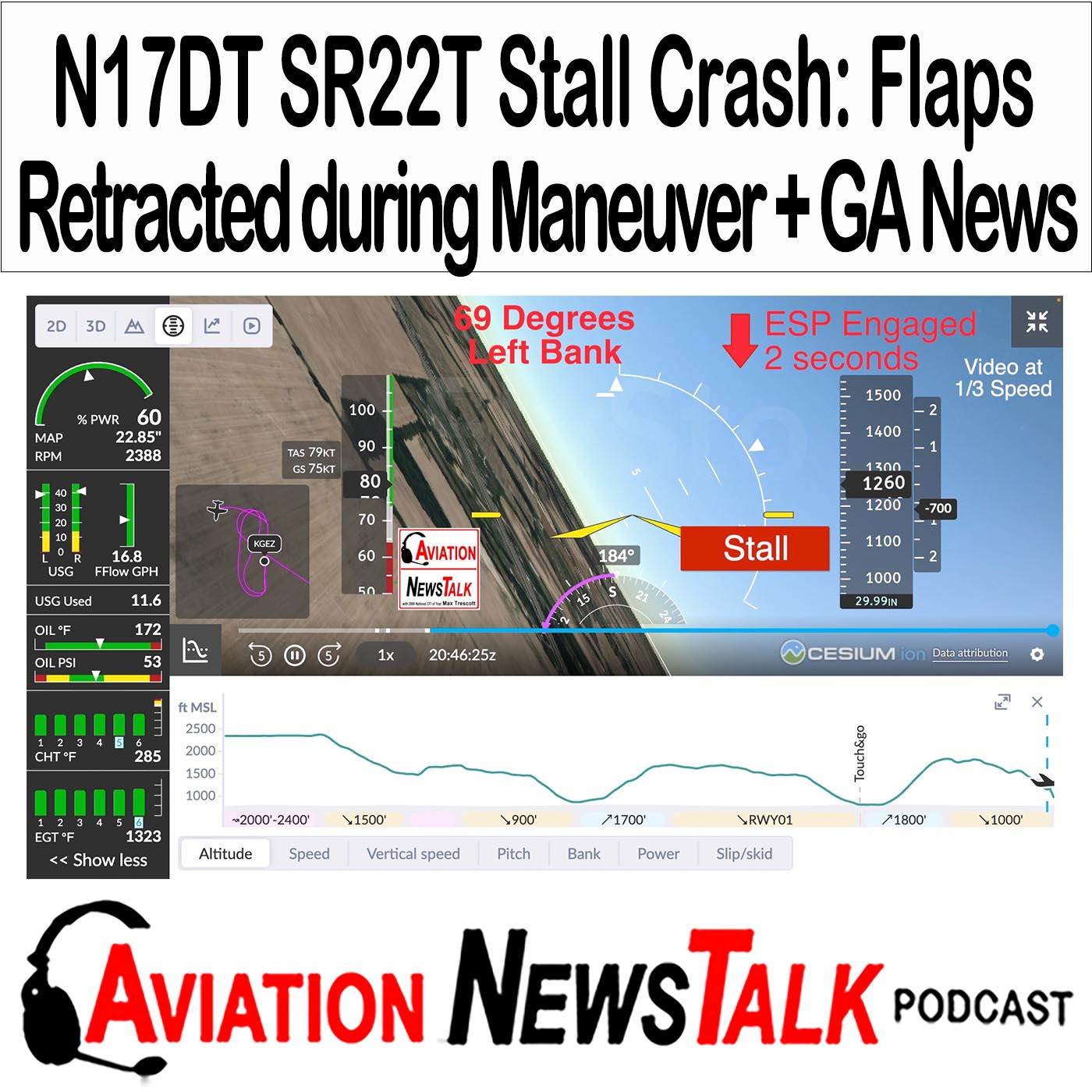
Max talks with Rob Mark about the fatal crash of Cirrus SR22T N17DT near Shelbyville, Indiana, and why this accident is so instructive for any pilot who flies approaches at low altitude with high workload. The NTSB's probable cause centers on inadequate airspeed and an aerodynamic stall, but the real value is in the flight data that shows how the airplane got there: low power held for an extended period, repeated stall warnings, multiple ESP interventions, and flaps that ultimately remained retracted until impact. This episode matters because it's rare to have this level of detail. The NTSB recovered onboard data that captures dozens of parameters multiple times per second—far more than you usually get from ADS-B alone. Max describes how the NTSB published extensive graphs and also released a spreadsheet of recorded parameters. The spreadsheet didn't include position data, so Max combined it with ADS-B track points and interpolated the missing locations to create a second-by-second reconstruction. The result is a cockpit-style view that shows airspeed, pitch attitude, power, flap position, stall warning activations, and ESP engagement together—so you can see the chain of events, not just the endpoint. The key factual finding: the engine was operating normally. The "partial engine failure" theories that circulated right after the crash don't hold up against the final report and recorded parameters. Instead, power was pulled back to a very low setting—about 15%, roughly 10–11 inches of manifold pressure—and held there. That's close to a landing-power setting, which means airspeed and energy must be managed carefully to avoid drifting toward stall, especially if configuration changes. The second key finding is configuration. The flap record shows the flaps briefly at about 50% and then transitioning to 0%. Later, the data shows the flaps again toggling, but ultimately the airplane ends up with flaps retracted and stays that way until the crash. That detail is not cosmetic—stall speed is strongly affected by flap setting. In a low-power approach, retracting flaps increases stall speed and requires a different pitch picture and energy plan. If the airplane is flown as if it has more lift available than it actually does, airspeed can silently bleed away. As the airplane slowed, the recorded data shows repeated stall warning activations in the final minute, and ESP (Envelope Stability Protection) engaging multiple times. ESP is designed to help discourage pilots from exceeding the envelope by nudging pitch and roll back toward safer values, but it can't create airspeed or altitude. It's a guardrail, not an autopilot that can save a low-altitude slow-speed situation once the margin is gone. In the reconstruction, stall warnings and ESP engagement cluster around the periods when the airplane is slow, pitched up, and operating near the edge of the envelope. Witness observations align with a low-altitude stall sequence. A driver on a nearby interstate described the airplane as very low, appearing to "hang," then making a sharp turn. The witness observed a wing drop and rapid rocking from one wing vertical to the other before the aircraft disappeared behind trees and a fireball was seen seconds later. The NTSB's recorded data similarly shows the airplane slowing near stall speed followed by a loss of control consistent with a stall at low altitude. The practical lessons are direct and transferable to any airplane, not just a Cirrus. First, treat any stall warning on approach as a command—not a suggestion. You don't troubleshoot while the airplane is approaching the critical angle of attack. Your first move is to reduce angle of attack (unload) and regain airspeed. Second, make configuration errors harder to commit and easier to catch. Flap position is not a "set it and forget it" item when workload is high. Use callouts, verify indications, and confirm the pitch picture matches the configuration you think you have. Third, recognize that "low-power" plus "slow" plus "turning" is the classic trap. Bank increases stall speed, and when you're low, you don't have the altitude budget to recover from a stall break and wing drop. Finally, this episode reinforces a mindset: the accident wasn't one bad second; it was a sequence of small choices and small drifts that added up to zero margin. The data shows multiple warning opportunities—stall horn and ESP events—before the final loss of control. The goal for listeners is not to judge the pilots. It's to build habits that make this chain harder to start, easier to detect, and easy to abandon early. When the airplane is telling you it's running out of margin, believe it—then reset the approach while you still have altitude to spare. If you're getting value from this show, please support the show via PayPal, Venmo, Zelle or Patreon. Support the Show by buying a Lightspeed ANR Headsets Max has been using only Lightspeed headsets for nearly 25 years! I love their tradeup program that let's you trade in an older Lightspeed headset for a newer model. Start with one of the links below, and Lightspeed will pay a referral fee to support Aviation News Talk. Lightspeed Delta Zulu Headset $1299NEW – Lightspeed Zulu 4 Headset $1099 Lightspeed Zulu 3 Headset $949Lightspeed Sierra Headset $749 My Review on the Lightspeed Delta Zulu Send us your feedback or comments via email If you have a question you'd like answered on the show, let listeners hear you ask the question, by recording your listener question using your phone. News Stories NTSB: Greg Biffle Crash Followed Instrument Failure Reagan National Midair Collision Probable Cause AOPA Air Safety Institute suggests icing as factor in Challenger crash Burbank Airport at risk of a midair collision, according to NTSB Pomona Man Arrested in Connection with Aircraft Thefts Mentioned on the ShowBuy Max Trescott's G3000 Book Call 800-247-6553 Video of the Week: Max's FLYING Magazine article: Pattern Problems Free Index to the first 282 episodes of Aviation New Talk So You Want To Learn to Fly or Buy a Cirrus seminars Online Version of the Seminar Coming Soon – Register for Notification Check out our recommended ADS-B receivers, and order one for yourself. Yes, we'll make a couple of dollars if you do. Get the Free Aviation News Talk app for iOS or Android. Check out Max's Online Courses: G1000 VFR, G1000 IFR, and Flying WAAS & GPS Approaches. Find them all at: https://www.pilotlearning.com/ Social Media Like Aviation News Talk podcast on Facebook Follow Max on Instagram Follow Max on Twitter Listen to all Aviation News Talk podcasts on YouTube or YouTube Premium "Go Around" song used by permission of Ken Dravis; you can buy his music at kendravis.com If you purchase a product through a link on our site, we may receive compensation.
Embed this episode
NOW PLAYING
412 Cirrus SR22T N17DT Stall Crash: Flaps Retracted on Low-Power Approach + GA News
No transcript for this episode yet
Similar Episodes
No similar episodes found.
Similar Podcasts
No similar podcasts found.