
A podcast by CIPRA. In podcast by L'Chippur. Podcast by L'Chippur. Podcast by L'Chippur.
Podcast by L'Chippur. They are CIPRA podcasts. Three-prim podcast. Interviews, background talks and voices from all Alpine countries.
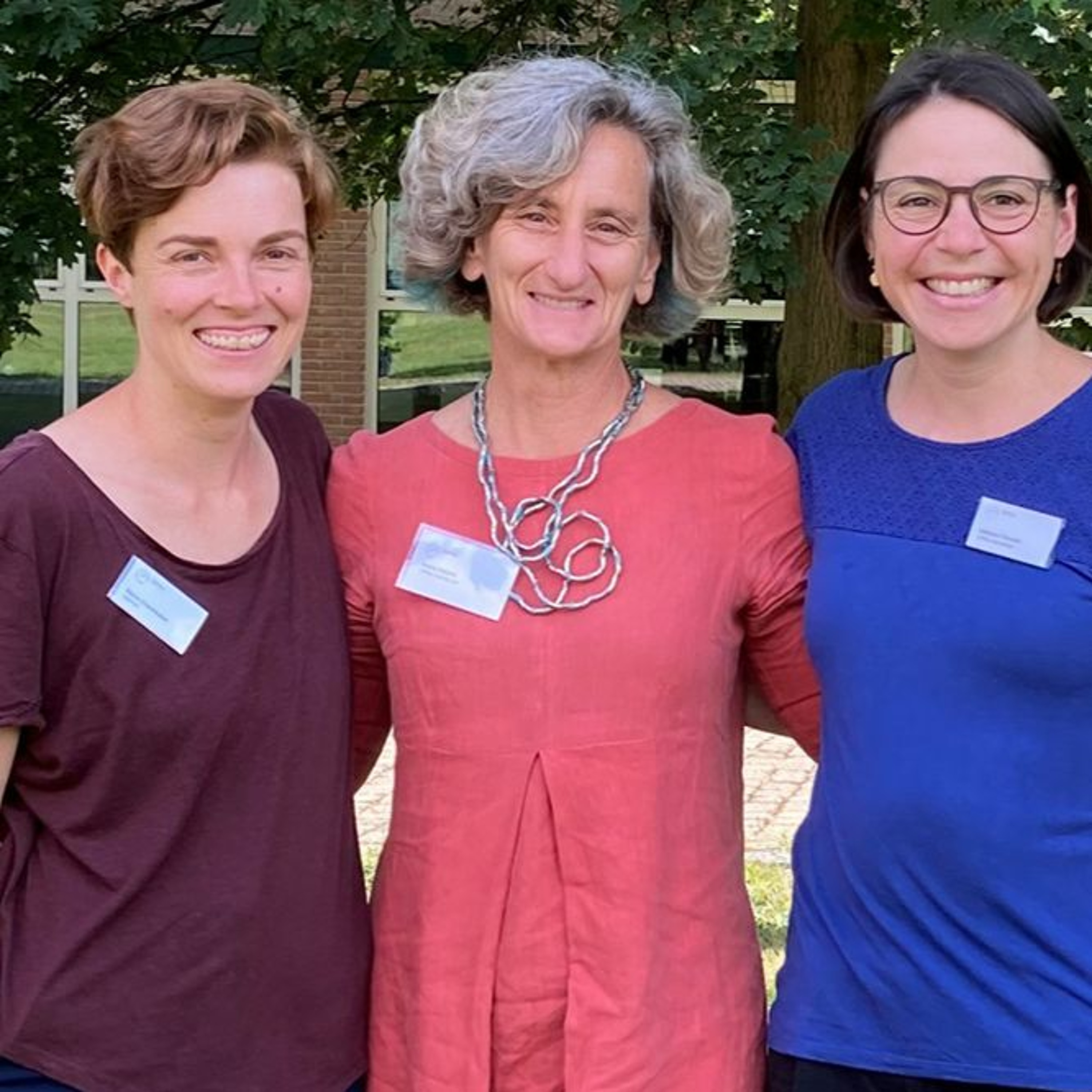
Listen to this and more in the podcast of the International Commission for the Protection of the Alps, www.cipra.org.org. Pull it slash podcast. Welcome to the current episode of our CIPRA podcast. My name is Michel Gams and my guests today are Yaka Eason Bama and Serena Arduino.
They are new co-presidents of CIPRA International and succeed Katrina Contardin who has been in office for almost seven years. Bonjourno, Serena, hello Biacca. Bonjourno, me chai. Hello, me chai.
In the next half hour we are going to talk about your background, how it came to the first co-presidency of two women at the helm of CIPRA International and about your vision for the Alpine region. So, I would like to start right off with Serena. You are living in Milan, if I'm right, in Italy. And you studied environmental studies or sciences at the University of Milan and also environmental planning at the University of British Columbia in Canada.
Yes. I also participate in the Alpine Convention's thematic working groups. Where does your strong interest for the Alps come from? First of all, I did my university thesis on Shambua behavior in the Alps.
So, it was the Alpine Shambua. And I studied how they behave in their environment. And that is when my first practical experience with the Alpine ecosystems began. Then I moved to Canada and I started working on very large ecosystems, including the Rockies.
The Rocky Mountains, you mean? The Rocky Mountains, yes. And when I came back to Italy, I wanted to do something very similar to what I had been doing in Canada, but for the Alps. So, I started contacting my contacts, my friends asking them who was looking at the Alps from a Pan and Pine perspective.
And someone introduced CIPRA to me and Alpark and WWF, which at that time was working on eco-region conservation. And they had identified 200 eco-regions in the world that deserved particular attention. And the Alps were one of them. So at that point, everything happened very quickly.
Because I contacted WWF Italy, I said that I would have loved to do something for the Alps at a wide scale. And they said that WWF Austria, I think, or Switzerland had just contacted all the WWF organizations of the Alpine countries, asking them to coordinate an initiative for the Alps. So I happened to be the person with the right interest in the right spot at the right time. So I was hired by WWF Italy to follow the Alpine eco-region.
And at the time Andreas Weissen was president of CIPRA International. And he was also working for WWF Switzerland. So everything happened together that I happened to work for the Alps and for WWF and for CIPRA at the same time. Thank you, Serena, for this introduction.
Very interesting from Chamois to WWF and now you're with CIPRA, which we are really happy about Bianca. You are living in Bolzano, Boston, Italy. And you are a design researcher and co-founder of the Cultural Association, Brave New Alps. I'm sure our listeners would like to know what exactly does a design researcher do?
That's a question I get asked quite a lot. A design researcher in my idea of what she does is to actually create situations that then create knowledge. So in my case, I'm doing research on commons and on community economies. So really on economies that are governed collectively, that are democratic, but also that have the well-being of the environment and of people as a kind of central aim.
And then I try to create situations where these economies can be lived and experienced and then I theorized on them. So basically it's about getting really involved in the action and in practice. Rather than being a researcher that does observation from outside, I'm really part of the people creating commons, like for instance a community academy at the local train station in Boraito. Maybe we can dive into this later also.
What I would also like to know from you Bianca, when did you first get into touch with Tia and its topics? Well, I grew up in the Alps. So I grew up in a small village in South Cairo. And when I was a kid, I was a snowboarder.
So basically I spent my life traveling around the Alps and around the mountains and areas in the world. And then in about 2005, when I was 25, I got really suspicious about all the artificial snow making and started to dig into who is actually doing critical work on this. Because whenever I voiced my concerns about what is going on there, I wasn't finding good answers. I was thinking about the way I came across Zebra as one of the voices in the Alps really being vocal about how we could live differently here.
And what I really liked was that it was not about giving up certain ways of living in the Alps and still having a contemporary life, but it was really about imagining ways that are about regenerative ways of living about sustainability. So I really was inspired by this. And then actually, about 2006, I left the Alps. I went to the UK and stayed there for about 10 years to study and to work because I was very interested in seeing how my kind of thinking that was generated by the Alps by being in a real space, how we could share in a metropolitan context and I wanted to learn English.
And then I just don't for the mountains so much that I came back 10 years after. And I knew that when I came back, I wanted to do something with Zebra because I really saw it as the organization that is working across the whole alpine arch. And really what I love is it's innovative. It has a really kind of interesting vibe to it that it's contemporary.
I think it's inviting. So I met my young young alpine convention and asked her if she could introduce me. And she made a connection with Baba Nogruz, who was the co-director of Zebra International. And then conversation started and that's how a couple of years later, I'm here with Zebra now as co-president.
Yeah, which is really great. And for the first time, actually, since its foundation in 1952, there are now two women at the helm of Zebra International. How did this idea evolve actually, Zebra? You would have to ask this question to the small committee who selected the president.
But what I know is that when Katarina decided to resign, a procedure was put in place to find successor that could be at her level and who had several talents. I was asked by already being a member of the board whether I was interested in the position. I took quite some time to respond because I felt this was a position with a lot of responsibility. But then I said yes, if at the time of the elections I am the right person or the best candidate I would love and I would be honored to be the president of Zebra with the help of the board members.
Later on, I heard that the procedure was intense. Several candidates were explored and two stood out as the best one who together would have done an optimal work and these two candidates were Bianca and I. We had different talents that were complimentary and Zebra had already experienced the co-founder of the co-management, having two co-directors and it had worked well. So Zebra was ready to experiment with co-presidency.
Knowing who the other candidate was, Bianca, knowing how nicely it would be to work in close contact with other people to share that huge responsibility of the presidency, I said yes without hesitating. I like this proposal. So this is how the story came to me. Bianca, what was the first thought that came to your mind when you were asked if you would like to take over the co-presidency together with Serena?
Actually, first I thought this is kind of crazy. And I was quite surprised, I would say, about the offer because somehow I always felt that Zebra was very much focused on the environmental aspects and I'm not an environmental scientist. So of course, I cannot guide on those issues. But then to me also, it made a lot of sense to do the work together with Serena, who has a different set of experience and expertise to me or as my focus is really on participatory governance and facilitation techniques and also on creating, let's say, really putting those best practices out there in creating the facts on the ground.
And so I think it's actually like having gotten to see Pabatra. I also thought this could be a very good match between Serena and me and the kind of skills we bring in. So yeah, I'm really excited to see how this will play out in the next three years and what we can actually do together. Bianca really took a leap of faith because she was new to the board and I think she was very courageous and admired her a lot for this.
Because I had already been on the board for five years and I knew what the work of the president would be like. So I was more prepared. So I honor Bianca for having taken that leap and jumped into it. And now I see that when we discuss items, we have two different points of view coming also from a more experienced vision of what the board is like and a fresher vision of what the board could be coming from Bianca, who is fresher in this way.
So I confirmed that the combination of the two persons with different experiences and point of view is a strength. Yeah, it's really interesting to see these two points of views coming together. And what I would also like to know is from Bianca in the newspaper interview, you talked about eco-social initiatives in the Alps and about your 40-year project Brave New Alps. I would just like to know which eco-social initiatives do you mean, for example, and what is Brave New Alps all about just to have a bit more background on you.
For Brave New Alps, is the cultural association that I founded and which actually started out as an informal collaboration between people who wanted to think that life in the Alps can be different and to mobilize culture to show that it can be different. So it's very much about using art and design to create real situations of life that is different, that is sustainable, that are the separation between nature and humans and to really see humans as nature and to see what happens if we structure life like this, if we think regional developments from this kind of position where we are not humans kind of abstracted from nature but we are part of the ecosystem and we have our role. And so with Brave New Alps, the name comes actually from the book of Aldus Hacksu, the Red Sea World, which I was very inspired by when I was in my twenties, of like this kind of this token future and I thought somehow it already felt like we were in some sort of this token future with the kind of developments we were seeing, especially in our mobility about masterism and so on. And now actually I think Brave New Alps stands much more for a utopian approach of saying the courageous Alps, who would be the Alpine inhabitants who are courageous today and who can actually reach to the kind of future we would want to see.
And who can, I would say like Serena said, who can make that leap of faith in our every day today and to say actually it's possible to live differently and we just do it. And so that's what I want to do with my association, to kind of support those kind of practices and especially younger and older people who want to try something different, who want to be part of creating that kind of a utopian visionary way of living in the Alps. Very interesting and Serena at the annual conference this year, you said that you want to make the way in which the Alps contribute to global priorities more visible. Which priorities do you mean?
There are some very important processes going on right now at the global level and at the European level. And these processes are going to shape the world and our continent for the next decades. One of these processes is the UN Decade on ecosystem restoration, because ecosystems are at the basis of everything. Most are degraded and don't function at their full potential.
So it is very important for us, the people, for nature, for all processes that are important to humans and to existence of this planet that the ecosystems are healthy and functioned properly. So this enormous effort by the United Nations to put a big emphasis on ecosystem restoration is a priority that CIPRA has implicitly shared for the past years, but we need to make this more explicit and encourage others to take this direction, because ecosystems are also at the community scale and communities that have the courage and the attention to undertake ecosystem restoration will be better off. So this is the first priority process that I think we should be plugged in. And the second one is the European processes.
There are many, but one is the European biodiversity strategy to 2030, which some friends from World Life International define it as the Book of Wonders. For the first time, we have a political strategy which is really brave and bold and commits member countries to do spectacular things for nature. It is very ambitious. And I'm going back to my panel pine vision.
This strategy commits European countries to do certain things on their land. And I want to believe that when these countries make decisions for their alpine portion, they do so in a coordinated way. And they do so also coordinating with the alpine countries that are not part of the EU, namely Switzerland and Liechtenstein, because I cannot believe that countries that share the alts decide about what is going on in the alts without talking to each other and seeing what makes sense across borders. And of course, I'm thinking of rivers, but it's not just rivers.
It's about transnational landscapes and mountain ranges and border towns that talk to each other. So just to name two, these are two processes where I think we make, we need to make it please it and visible what is already happening. And also we need to be a driving force behind ensuring that stakeholders stop to each other. And this is also the story of SIPRA, making sure that people get together to protect the alts and finally getting to the alpine convention.
I think that if we ensure that countries coordinate to contribute to these processes, we are also implementing the alpine convention. This was the first part of our interview with the new co-presidents of SIPRA International, Serena Arwino and Bianca Eltzenbama. We talked about their way to Tika, their professional background, and their topics of interest. In the next podcast episode, you will hear the second part of this interview.
There we talk about SIPRA's role on society and politics, how to reshape the economy in the alps together and about Bianca's and Serena's vision for the alps in the year 2030. My name is Michel Gams. Thank you for listening.