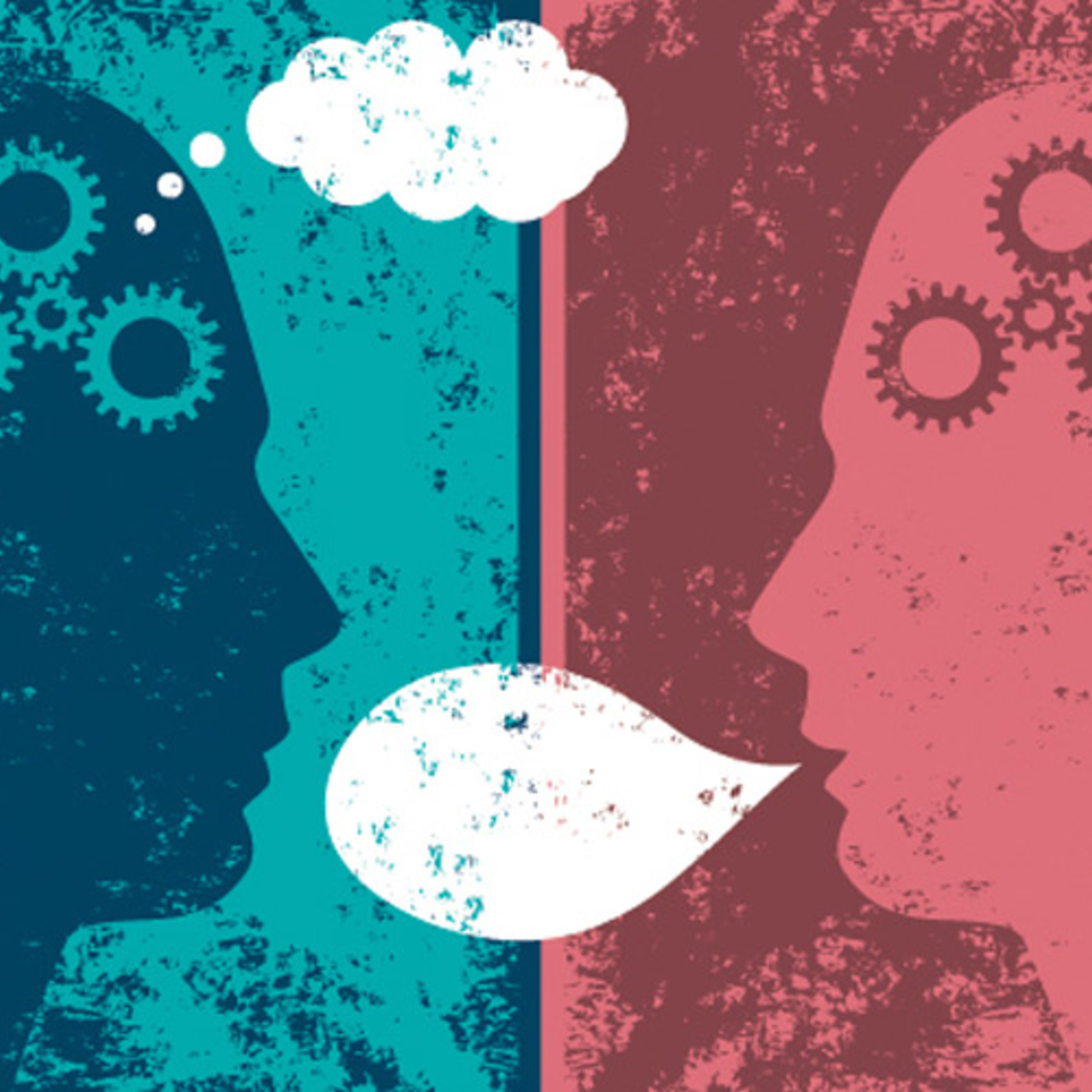
#42 (C&R, Chap 12+13) - Language and the Body-Mind Problem episode artwork

EPISODE · Jul 21, 2022 · 50 MIN

#42 (C&R, Chap 12+13) - Language and the Body-Mind Problem

from Increments · host Ben Chugg and Vaden Masrani

Ben and Vaden sit down to discuss what is possibly Popper's most confusing essay ever: Language and the Body-Mind Problem: A restatement of Interactionism. Determinism, causality, language, bodies, minds, and Ferris Buhler. What's not to like! Except for the terrible writing, spanning the entire essay. And before we get to that, we revolutionize the peer-review system in less than 10 minutes. We discuss Problems with the current peer-review system and how to improve it The Mind-Body Problem How chaos theory relates to determinism The four functions of language Why you don't argue with thermometers Whether Popper thinks we can build AGI Why causality occurs at the level of ideas, not just of atoms References Link to the essay, which you should most definitely read for yourself. Ben's call to abolish peer-review Discrete Analysis Math Journal Pachinko Karl Buhler's theory of language Quotes This, I think, solves the so-called problem of 'other minds'. If we talk to other people, and especially if we argue with them, then we assume (sometimes mistakenly) that they also argue: that they speak intentionally about things, seriously wishing to solve a problem, and not merely behaving as if they were doing so. It has often been seen that language is a social affair and that solipsism, and doubts about the existence of other minds, become selfcontradictory if formulated in a language. We can put this now more clearly. In arguing with other people (a thing which we have learnt from other people), for example about other minds, we cannot but attribute to them intentions, and this means, mental states. We do not argue with a thermometer. - C&R, Chap 13 Once we understand the causal behaviour of the machine, we realize that its behaviour is purely expressive or symptomatic. For amusement we may continue to ask the machine questions, but we shall not seriously argue with it-- unless we believe that it transmits the arguments, both from a person and back to a person. - C&R, Chap 13 If the behaviour of such a machine becomes very much like that of a man, then we may mistakenly believe that the machine describes and argues; just as a man"who does not know the working of a phonograph or radio may mistakenly think that it describes and argues. Yet an analysis of its mechanism teaches us that nothing of this kind happens. The radio does not argue, although it expresses and signals. - C&R, Chap 13 It is true that the presence of Mike in my environment may be one of the physical 'causes' of my saying, 'Here is Mike'. But if I say, 'Should this be your argument, then it is contradictory', because I have grasped or realized that it is so, then there was no physical 'cause' analogous to Mike; I do not need to hear or see your words in order to realize that a certain theory (it does not matter whose) is contradictory. The analogy is not to Mike, but rather to my realization that Mike is here. - C&R, Chap 13 The fear of obscurantism (or of being judged an obscurantist) has prevented most anti-obscurantists from saying such things as these. But this fear has produced, in the end, only obscurantism of another kind. - C&R, Chap 13 When's the last time you argued with your thermometer? Tell us over at [email protected] Image Credit: http://humanities.exeter.ac.uk/modernlanguages/research/groups/linguistics/

Ben and Vaden sit down to discuss what is possibly Popper's most confusing essay ever: Language and the Body-Mind Problem: A restatement of Interactionism. Determinism, causality, language, bodies, minds, and Ferris Buhler. What's not to like! Except for the terrible writing, spanning the entire essay. And before we get to that, we revolutionize the peer-review system in less than 10 minutes. We discuss Problems with the current peer-review system and how to improve it The Mind-Body Problem How chaos theory relates to determinism The four functions of language Why you don't argue with thermometers Whether Popper thinks we can build AGI Why causality occurs at the level of ideas, not just of atoms References Link to the essay, which you should most definitely read for yourself. Ben's call to abolish peer-review Discrete Analysis Math Journal Pachinko Karl Buhler's theory of language Quotes This, I think, solves the so-called problem of 'other minds'. If we talk to other people, and especially if we argue with them, then we assume (sometimes mistakenly) that they also argue: that they speak intentionally about things, seriously wishing to solve a problem, and not merely behaving as if they were doing so. It has often been seen that language is a social affair and that solipsism, and doubts about the existence of other minds, become selfcontradictory if formulated in a language. We can put this now more clearly. In arguing with other people (a thing which we have learnt from other people), for example about other minds, we cannot but attribute to them intentions, and this means, mental states. We do not argue with a thermometer. - C&R, Chap 13 Once we understand the causal behaviour of the machine, we realize that its behaviour is purely expressive or symptomatic. For amusement we may continue to ask the machine questions, but we shall not seriously argue with it-- unless we believe that it transmits the arguments, both from a person and back to a person. - C&R, Chap 13 If the behaviour of such a machine becomes very much like that of a man, then we may mistakenly believe that the machine describes and argues; just as a man"who does not know the working of a phonograph or radio may mistakenly think that it describes and argues. Yet an analysis of its mechanism teaches us that nothing of this kind happens. The radio does not argue, although it expresses and signals. - C&R, Chap 13 It is true that the presence of Mike in my environment may be one of the physical 'causes' of my saying, 'Here is Mike'. But if I say, 'Should this be your argument, then it is contradictory', because I have grasped or realized that it is so, then there was no physical 'cause' analogous to Mike; I do not need to hear or see your words in order to realize that a certain theory (it does not matter whose) is contradictory. The analogy is not to Mike, but rather to my realization that Mike is here. - C&R, Chap 13 The fear of obscurantism (or of being judged an obscurantist) has prevented most anti-obscurantists from saying such things as these. But this fear has produced, in the end, only obscurantism of another kind. - C&R, Chap 13 When's the last time you argued with your thermometer? Tell us over at [email protected] Image Credit: http://humanities.exeter.ac.uk/modernlanguages/research/groups/linguistics/Support Increments

NOW PLAYING

#42 (C&R, Chap 12+13) - Language and the Body-Mind Problem

0:00 50:39

No transcript for this episode yet

We transcribe on demand. Request one and we'll notify you when it's ready — usually under 10 minutes.

Bible Read Me Charles Van Deursen Most people may have never read the Holy Bible from cover to cover for several good reasons. A couple of hinderances might be that the texts reflect an ancient culture and that much of it is not in chronological order. Here you will enjoy listening to a summary of daily portions of Scripture grouped in one week increments, chosen in the order that they occurred in history. By this time next year you will have gained a better understanding of the big picture of the Bible narrative as well as intriguing details that will help you to connect the events of ancient days with the life that you are now living. Just as wise King Solomon wrote, "There is nothing new under the sun," but many times it can be difficult to find the time to dig out and apply these nuggets of golden truth to your daily life.Charles Van Deursen presents the Scripture summaries in a literal, grammatical-historical context while using the language in the way that Christian Women’s Weight Loss | Faith, Food, Fitness Ondrea Lynn - Certified Personal Trainer and Nutrition Coach for Christian Women Are you tired of fighting the scale 24/7? Are you sick of fad diets that only get you temporary results? Do you wish you had an easy plan to follow so you don’t have to stress out about how to lose weight? Are you looking for a simple foundational weight loss framework that can fit into your busy day so it becomes a lifestyle? Do you wish you could workout in 15-minute increments instead of hours at the gym? Do you wish you have an exercise plan that gets you results while working out at home? Are you looking for ways to naturally speed up your metabolism? Do you want your pizza and spinach too? Are you ready to break free from binge eating, over eating, and sugar addiction? Are you ready to be free from past trauma and hurts that drive you to sabotage? Do you desire a stronger relationship with Jesus, even on your weight loss journey but unsure how that looks? Hey, I’m Ondrea Lynn and I’m so excited that you are here with me on Christian Women Weight Loss! I remember what Increments with Alishah Novin Alishah Novin Increments is a show for technologists about leveraging the in-between moments. Those moments you come up for air, and take a beat.They say music is about the space between the notes, and just like music - growth happens in those moments between projects. Increments won't always give you answers, but will create the space for you to find them Siblinghood of Recovery Angie Reno When I found out my son was deep in the throes of Substance Use Disorder (SUD), chaos became the norm. As each step became more challenging, the information on SUDs, treatment, healing, and basically everything that comes with an SUD Family crisis, became overwhelming. Inundated with so much information, I felt like I had crossed space and time and landed in a new world. I actually had: I had entered the world of Recovery. My goal through this Podcast is to condense what I learned into small increments, and provide anyone willing to listen a message of hope. The world of Recovery is filled with parents, children, and family members who walk together. We share what we learn, listen with heart, and provide a community of support. We are a Siblinghood of Recovery.

Frequently Asked Questions

How long is this episode of Increments?

This episode is 50 minutes long.

When was this Increments episode published?

This episode was published on July 21, 2022.

What is this episode about?

Ben and Vaden sit down to discuss what is possibly Popper's most confusing essay ever: Language and the Body-Mind Problem: A restatement of Interactionism. Determinism, causality, language, bodies, minds, and Ferris Buhler. What's not to like!...

Can I download this Increments episode?

Yes, you can download this episode by clicking the download button on the episode player, or subscribe to the podcast in your preferred podcast app for automatic downloads.
URL copied to clipboard!