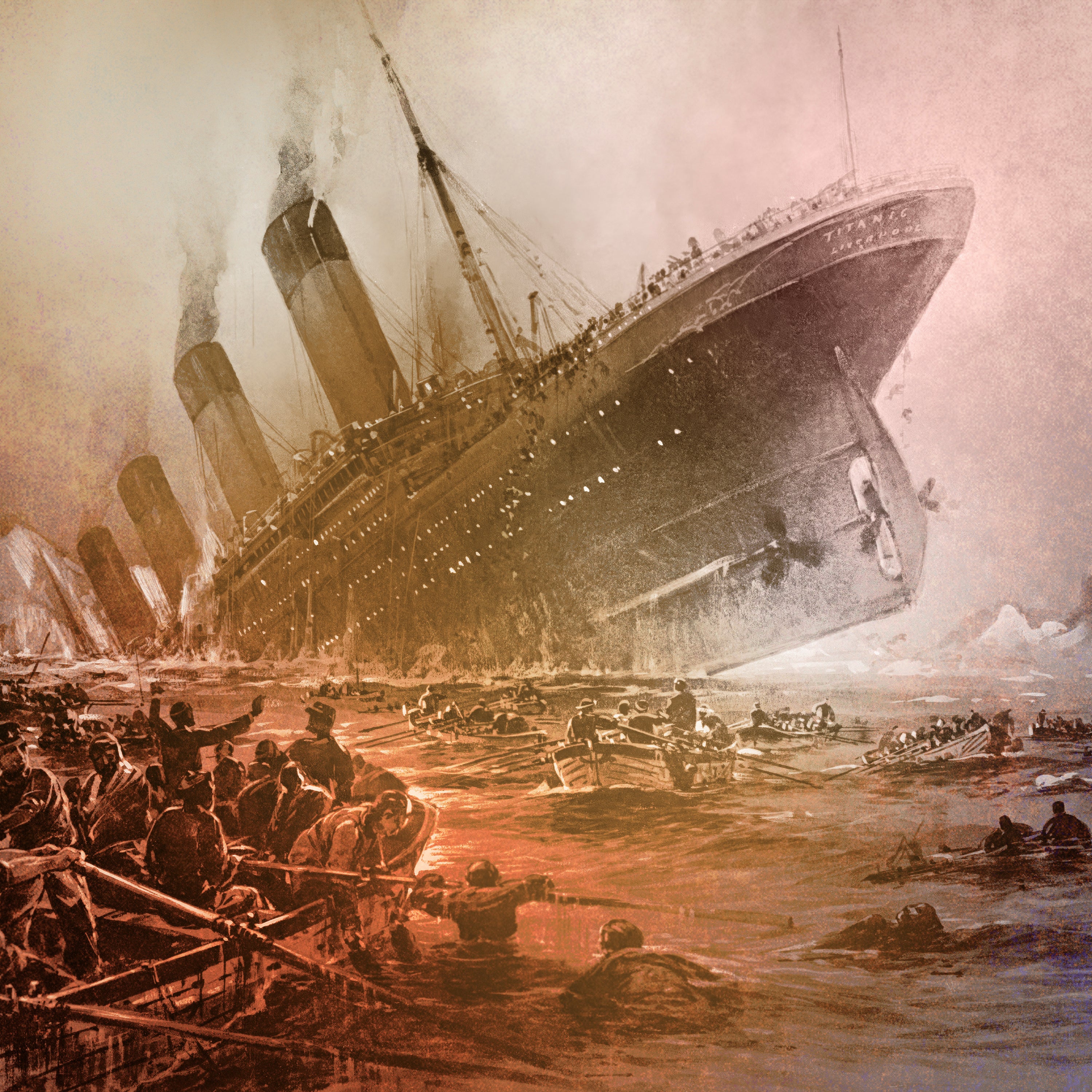
My dear mum and dad, it don't seem possible we're out on the briny writing to you. Well dears, so far we're having a delightful trip. The weather is beautiful and the ship magnificent. We can't describe the tables, it's like a floating town.
I can tell you we do swank, we shall miss it on the trains, we go third on them. You would not imagine you were on a ship. There's hardly any motion, she's so large, we've not felt sick. We expect to get to Queenstown today, so I thought I'd drop this with the males.
We had a fine send off from Southampton. Lots of love, don't worry about us. Ever you're loving children. Harvey, Lot and Madge.
So that's almost a letter from a chuck called Harvey Collier, to his parents from the Titanic. And Harvey was a grocer from a basic bishop's token, Hampshire. And he was also a big bell-ringer in the local church. And he and his family were emigrating to Idaho.
When they left, because Harvey was big in the local church, there was a great send off for them, they sort of sat them down in the churchyard and people went up to the tower and rang the bells for them. It was very moving. Harvey loved it. His wife Charlotte was sitting there and she was a bit ambivalent about going to America.
So she was a little bit tearful or something. They had all their savings with them, which he had in banknotes and the lining of his jacket. And I don't think it's giving anything away to say that the fate of the Collier family is very poignant. And those are the human details, aren't they, that make the story of the Titanic just so incredibly resonant?
It is. And the idea of writing back to your loved one, saying, don't worry about us. Everything's great. It's all going to be fine.
And of course, the reason that we're doing this episode, the reason that the Titanic has the kind of the mythic resonance that it does is the contrast between the confidence and the horror that we know is coming. So before we get to the horror, we're going to look at some of the details of the people who were traveling. And everyone will know that there are lots of millionaires on it, but they will also know, particularly if they've seen Titanic, the film, that there are lots of people in steerage. And in the last episode, I quoted Francis Wilson making the comment that basically the Titanic is a ship that only seems to be a luxury hotel, but actually it's there to carry poor immigrants.
So in these next two episodes, we're going to look at the range of people who are traveling on the Titanic. And as anyone who has seen the James Cameron film will know, there are, of course, millionaires. And then there are people down in steerage. And we're going to look at both groups of people.
And Dominic, we're also going to look at the people who are traveling in second class, who don't make it into the film and who slightly tend to be written out, because we do enjoy the kind of down to now the idea of upstairs and downstairs, don't we? And the fact that actually there are lots of people kind of in the middle is often written out of the story. It is because I think people want to turn it into a parable, they're in a morality tale about inequality in hubris. Yeah.
And so you have, you know, John Jacob Astor and then you have some very poor guy play by Leonardo DiCaprio or something. Absolutely. But actually we miss in that the complexity of all these people who were there, many of them, were, as you say, in the middle, make the story much more complicated. Right.
So having said that, should we kick off with the millionaires? Yeah, why not? You know, we're very much a class-based book. We are.
So let's go in with the millionaires first. So in the last episode, we talked about how the Titanic was a product of the Gilded Age, the capitalism of the Gilded Age of the competition between different companies, British, German, for control of the Atlantic trade we talked about. It's Belfast, didn't we? And we had the Titanic going through all its tests and then being brought to Southampton, and then, of course, staying out of Southampton, Harbour.
And you were very rude over a member of Captain Smith when you, yes, I was, you're accused of incompetence. I think very harshly. Not incompetence, but perhaps not being as fully on the ball as once he was. Puts.
I mean, what's the moment? I think the evidence is... Stop, anyone can have a mistake. Anyone can have a mistake in a transatlantic crossing.
Come on. He has four mistakes in the space for me. Yeah, but anyway, let's not get on with that. He did a lot of very successful voyages.
I think it's our judgement, they... On his last year. On one, yeah. So actually most of the passengers that morning start off in London, and they come from Waterloo.
Now we talked last time about how Southampton had been built up as this great rival to Liverpool. It's been built up by the Liverpool and Southwestern railway among other companies. So at about 7.30, there is a train that will leave Waterloo. It's the boat train that will head to Southampton.
And there are hundreds of people on this train. And actually there are paparazzi at Waterloo, aren't there? Yeah, so that's brilliant. It's in the camera fiends, they call.
Yes. I love that phrase. So there are camera fiends there because, as you say, there are so many millionaires. So the train goes off.
Waterloo is being redeveloped, so it's kind of very chaotic and messy and sootty and all that sort of stuff. They head down to Southampton, and at Southampton, 427 passengers in first and second class get on and 495 in third class. And then they pick up more passengers, actually a lot more first class passengers at Sherborg. Because they're straight to Sherborg.
And here, clearly they're picking up Americans, for example, who have been travelling in the continent, who have been in Paris, and so on and so forth. And we talked, didn't we, how? They have to go out and cut little boats to take them out. Yes, I can say it's so huge you can't actually get into Sherborg.
And so they finally pull out of Sherborg at 8 o'clock that evening, and they are heading for Queenstown, now, Cove in Ireland. So of those first class passengers, there are 337 of them. I think the interesting thing is that there are always different estimates for the numbers. It needs to be a slightly different figure.
Because we never entirely sure who turned up and who didn't, which will come to in a second. But it's definite that it's not filtered capacity, is it? By some estimates, under 50%. Now, that is really interesting.
And there's a couple of things that that one is that one is that the competition for the transatlantic crossing is so fierce, there's actually massive overcapacity. So there are more births than there are potential first class passengers. But the other thing, Richard Havenbore-Hines has a really good section on this, I think. He says, you know, it was a great trait of Edwardian millionaires.
It was seen as a sort of badge of their quality, that they would change their plans and cancel things and put everybody out at the last minute. That was a sign of your status. People were always canceling things in a way that now, I think, well, maybe tech billionaires cancel things. I don't know.
I feel bad about cancelling. I mean, I wouldn't book a transatlantic crossing and then just not turn up. I mean, that's the expression of your middle class. Bullshark, I've tightness.
It is. Yes, it is, Tom. Whereas if you're with a high spending, guilty-age billionaire, there's nothing you'd enjoy more than letting people down. No.
I need to be less polite to waiters and things like that. So several millionaires could have been on this maiden voyage of Titanic. So there's Milton Hershey. The chocolate.
Chocolate millionaire. Chocolate guy. Yeah. To be honest, I mean, he deserved to go down.
That's terrible chocolate and rehearsals. Yes. Terrible chocolate. There's Henry Clay Frick, as in the Frick, the Art Gallery.
George found to build another very kind of guilty-age American millionaire name. He doesn't go. But of course, the famous person who doesn't go is the guy who's behind the whole shebang, who is a pay-point Morgan. Yeah.
And so he takes over Frick's booking. But then he cancels because he is keen to oversee the movement of his art collection from Paris to America. All of that is what he says, because this is the focus for some hot conspiracy theories. Are you up to speed with them?
I know they exist. I consider them demented. So I haven't really gone into them as much as I should. So the conspiracy theory is that we talked about how Morgan is basically behind the setting up of the American Central Bank, isn't he?
That he comes to the rescue. Yeah. Well, he's America's banker. Yeah.
And the conspiracy theory is that John Jacobaster, Benjamin Guggenheim, and Isador Strauss, all of whom are, you know, absolute top league millionaires are against this. And so Morgan has arranged for them to go on the Titanic so that they can be removed, taken out of the equation. Yeah. Which I agree doesn't seem an entirely, it seems around about an expensive way.
Very out of getting rid of them. And unreliable way. What if they get into the lifeboats? Exactly.
But I just mentioned that. I just put that out there because we don't want people listening to think that we're not acknowledging the conspiracy theories because you particularly have quite a degree for your skepticism towards JFK conspiracy theories. That's true. I'm actually just part of the conspiracy.
I'm going to admit that now. OK. So Astor is by Father Richard Snyzny. He is Colonel Jack.
He's called John Jacob Astor the fourth. The Astors are the sort of paradigmatic, dominant family, dynasty of Gilded Age, New York. He owns a lot of New York, among other things. It's not just a hotelier.
He's a slum-lum-lord. But the hotels are interesting, aren't they? Because they kind of provide the model for the luxury and first class that the Titanic embodies. Absolutely they do.
So the most famous one, of course, is the Waldorf Astoria, you know, it has Astor in the name. And the Waldorf Astoria was seen as having set standards in hotels. So it's the Waldorf Astoria really then invents the idea of you going to a sort of downtown city center hotel. And there being a tea room, a bar, a lounge, the sort of gentleman's club, atmosphere.
Yeah. So in other words, it's not just a place you sleep. It's a place where all life is there. A range of entertainment, so on tap.
Exactly. Exactly. But also the fact that he is this notorious slum-lum-lord while enjoying all this luxury in the luxury hotels and things. I think that that is also something that gets superimposed in the public imagination on the Titanic.
Yeah, I think so. So the idea of them sipping cocktails and champagne and things in first class, while down in steerage, it's all rats and build water. I mean, we will come to that. Yes.
And see whether that is accurate or not. Yeah. And he looks, as American millionaires of that era did, they tried to be kind of more English than the English. So he sort of, you know, he wears an overcoat with a velvet collar.
That's actually been Nigel Farrah. He wears a bowler hat and he has an umbrella and he's got a nice mustache and all that sort of thing. He looks like the father in Mary Poppins. Yes, he does.
Yes, he does. But interestingly, he has a child bride, doesn't he? He does. Madeline Force, as was?
Yes. Madeline Force, which is slightly more sort of 1970s rock star behaviour. So she was 18. And this was very controversial because she's decades, his junior.
They had a big reception at Fifth Avenue, where he was going to introduce that to all his friends and all the other society people. And lots of people didn't turn up. So lots of people would ignore them when they went to the Opera and things. They have gone off to France and Egypt.
She is pregnant, four months pregnant. And they are now coming back to New York and they have this big retinue. They have a valet. She has a maid.
She has a nursemaid. And they have a dog called Kitty. I know you're very keen on the dogs. Yes.
So in Airdell, one of 12 confirmed dogs, Dominic, who were on the Titanic. Confirmed dogs. Yes, so they might be another dog, so we don't know. Right.
You've kind of got smuggled aboard. So there were several Airdelles. There was a King Charles Daniel. There was a fox terrier.
There was a bulldog. And there was a great Dane. Who takes a great Dane on the ship? Well, so the great Dane does not get into the lifeboat.
Right. And nor am I a fader's kitty. So kitty drowns. Right.
But there are three that do get onto the boats in due course. There are two pomeranians. One of those is called Lady and she gets smuggled on wrapped in a blanket. And then there's a picnies called Sunyat Sen.
Wow. He also makes it on. So Sunyat Sen is the Chinese leader. Yeah.
So people who listen to our top dogs episode, there was Lutee the picnies. So clearly picnies are given not entirely politically correct names. This is very much a Victorian and Edwardian thing. So Sunyat Sen gets away as well.
And there's also the ship's cat, Jenny, who sadly doesn't make it. Jay doesn't make it. No. Oh, sad.
So there are animals as well as millionaires and so on. But back to the humans for a second. Yes. Back to the human story.
Yes. So other millionaires, as I've told you mentioned to him already, Ben Guggenheim. So the Guggenheim family, again, in Park Gallery, name, the Guggenheim Gallery and so on. The Guggenheims have made their money out in Colorado in the silver mines in Leadville.
They are notorious kind of strike breakers, very hard-nosed sort of business tycoons. Ben Guggenheim, I think, is generally thought the sort of most attractive of them. He's actually left the family business. He lives on Fifth Avenue.
He sees himself as so many people did. He's a bit like a character in a Henry James novel or something. They all are, aren't they? Yeah, they go off to Europe and they hang around in Venice and Paris.
And he's got a lover, hasn't he? He has married a bride who is only eight years old. It's all that kind of thing. It is.
Very much. It was actually an Anderson or somebody there, joining us. Yeah. We will not be receiving that.
So Ben Guggenheim has a mistress in Paris with Leontine Obard, who is a singer. She's traveling with him. Again, he's got a big entourage. She's got a maid.
He's got a valet. They have a chauffeur called Rene. Rene Perno. He's got the ultimate French name.
So he's down in second class, isn't he? Yes. So they're all there. And again, probably because he's with his mistress, they probably keep themselves themselves and don't mix.
We don't know, but they're senses that they would not have mixed that closely with the other millionaires because they would have been horrified at the thought of him with his French mistress. Then there's the Whitteners. So we mentioned that, didn't we, in the first episode? So the grandfather of it all, the patriarchal figure, Peter Widner, he joined with Morgan in setting up American steel and all kinds of things like that.
Yeah. And his son and his grandson are on the Titanic. Yes. So George and Eleanor, his son and Dortonnall.
And they've gone to Paris to buy the star of the Truso for their daughters wedding. And they've taken their son with them, their son is Harry. He's a very attractive person, I think, Harry. He is because he's a great bibliophile.
Yes. So he's in his mid-twenties and D. And he, since he first went to Harvard, he has become an addict of first traditions. So he's got loads of Dickens, first edition, Ben Johnson.
Yeah. And he's got a Shakespeare first folio. Yes. Very impressive.
And with him on the ship, he's carrying a 50-98 edition of Francis Bacon's Essays, which he bought for 260 pounds. Yeah. His mother's pearls were assured 150,000 pounds. So that gives you some sense.
You're going to be adding multiple norts to that to me. They have modern equivalent. Yeah. But people who've seen Titanic the film will remember that Rose, the character played by Kate Winslet in her cabin.
She has the Demosseldavignor by Picasso. Oh, yes. I think she has a Degas. I think she has a Monet, all of which obviously didn't sink.
But in the film, do sink. And people always kind of laugh about that. But it does reflect the fact that, of course, all these treasures, you know, from other pieces of European art that are now in American art galleries, most of them were transported on ships like Titanic. There were.
Yeah. Had they get there? Exactly. Exactly.
And that these are precisely the people who are transporting them. Yeah. This is what they do. This is compared to the Henry James characters.
This is absolutely that world that they will have, you know, folios of bacon stuffed into their pockets. Yeah. Because I think there's a library, Harvard isn't the way the memorial library, which was set up after his death by his family. So yes, I mean, obviously they didn't take that one.
So they have any because it still exists. But yeah, there are masterpieces of art. I guess it's down there on the ocean bed. There must be.
There must be. So there's finance. There is railroads. There are railroads represented.
There are two family parties that are related to railroads. They are the Thayer family. They're the owners of the Pennsylvania Railroad, which is the biggest in terms of traffic and revenue in the United States, the Hayes family. So they are the grand drunk railway of Canada.
And Dominic, are there any gay couples? Yes, there is a gay couple. And this is the world of politics. And they're an extraordinary pair.
So there's a guy called Francis. I would call him Francis Millet. But I guess Americans would call him Millet. They'd call Francis Millet.
He's a painter. He's a very impressive man. He served with Union troops in the Civil War. He'd been a war correspondent in Russia when the Russians fought the Ottomans in the 1870s.
He was brilliant at sort of sketching those beautiful sketches of public buildings in Boston. And he's the head of the American Academy in Rome. This guy, Francis Millet. And he lives with a man in Washington, a much younger man, Archie Bart.
Archie Bart, exactly, who is the military advisor to President Taft, slimmer of the year. Slimmer of the year, right? And the household is full of Filipino boys, which kind of gives a, you know, might have some listeners raising their eyebrows. Archie Bart is also a sort of quite a jolly and an impressive kind of person.
He had served in the Spanish-American War. And he made himself indispensable to Theodore Roosevelt and then to his successor, William Howard Taft. And there's a lovely description in Richard Devon behind his book, Titanic Lives. He says, why Taft liked Archie Bart around him?
And he says, but misplayed shots to revive the gold from that president when he was disheartened. Sat up late playing bridge with him, laughed at his dull legal jokes, mitigated his boredom, at the horrible meals which the obese president liked. And these meals, royal chicken, hominy, and melon for breakfast. Fish chowder, mustard pickles, baked beans, and brown bread for lunch.
And then he would modify the president when people shouted, hello, Fatia. He sounds a wonderful man, doesn't he? Yeah, he sounds great fun. Yeah.
And didn't you cause he drowns? I mean, spoiler alert. And Taft is devastated, really devastated. Taft is absolutely devastated.
Yeah. So there's this couple. It's pretty clear they work up, I think. Yeah.
For instance, Malay and Archie Bart. So that's kind of interesting. And then, Don, are there any kind of major underwear entrepreneurs? There are, there are, yes.
So obviously British aristocracy is there in alliance time with big underwear. Yes. Well, it's actually, it's big and lingerie, isn't it? It's big and lingerie.
Yeah, it's not just underwear. It's sexy and lingerie. So there's a guy called with a spender there, a Socosmo duff Gordon. So Socosmo duff Gordon is like a sort of Englishman from a parody.
He plays bridge and he fences, he's lost an eye in a shooting accident. He fets for England. Yeah. And of course, former rest is history associates, also fenced at the eyes level, didn't he?
But he didn't marry a lingerie pioneer, like Socosmo did. But actually, I mean, Dominic, there is a kind of link between Oswald Mosley and lingerie because he provides a model for Sir Roger Xbeau in the PG Woodhouse novels. And his terrible secret is that he runs Ullily, doesn't he? Which is a lingerie company.
So maybe there was a kind of knowing a riff on Socosmo duff Gordon, who knows? Yeah, I hadn't thought of that. I hadn't thought of that, Tom. Because Socosmo had married to someone called Lucy Wallace, who was the world's greatest entrepreneur of sort of Lacey underwear.
Yeah, so she was a distressed gentle woman. She was posh, but she lost all her money. And so she goes into business and makes a tremendous success of it. Yeah.
Yeah. And people sort of look down on her, I suppose, because she was in trade. But she gets sponsored by Duchesses, so Duchesses start buying her courses and things. Then it becomes very socially exclusive.
And she had everything connects in this world of millionaires, because she had gone to New York, and she had stayed at the Waldorf Astoria, while she had been opening her shop in New York. So she is one of these great pioneers who has shops both in London and New York. This isn't like Victoria's Secret or something. This is stuff that has been bought, as you say, by Duchesses and whatnot.
Rick would be in Pella, I believe. Right. Rick would be in Pella is exactly the comparison, Tom. Very good.
Cosetti Air to the Lake Queen. Yeah, very good. So Cosetti Air would appeal to our next first-class passenger, who I would say is the greatest newspaperman who's ever existed, Tom. Yeah, I would not disagree.
He is W.T. Sted. And he is the great populist newspaper editor of the Lake Victorian period. He's the person who really invents populist newspapers, I would say.
So W.T. Sted, listeners of very long standing, will remember that he is the man behind the sending of General Gordon, the ultimate friend of the rest of his history, to cartoon. Do you remember that, Tom? I do, yeah.
Back in the 1880s. Yeah. It was W.T. said he then kicks up a huge fuss about Dreadnaughts and all that stuff.
Yeah, the Germans going to overtake Britain. His most famous thing, of course, is when he bought a prostitute, a young girl, didn't he? Yeah, to demonstrate how easy it was. Yes.
What's it, the maiden tribute to the modern Babylon or something? Exactly. Exactly. He was prosecuted.
And he became a huge hero to the British working classes because he was seen as having sort of lifted the lid on the seething underbelly tom of the white slave trade, as it was called. And he's a complete mountobankers and tea. He's a sensationalist, very entertaining, brilliantly entertaining. And I imagine would have been tremendously entertaining company on the ship.
I imagine so, yeah. Can I tell you an interesting fact about his? I mean, he does die on the ship. Yeah.
He's committed spiritualist as well. So he's into all that kind of stuff. And his house in London is in Smith Square, just down from the house of parliament. And his daughter Estelle lived within there before he drowned.
And before he left, one evening, she's in her bedroom, when a man walks in to her room, takes off his hat, sits down at the desk, and starts writing poetry. Oh my god. It's unusual. She goes over and says, what are you doing?
He doesn't say anything, but she can see that it's poetry. He just completely ignores her. Yeah. And then he vanishes.
And then the same thing happens tonight after, and the night after, and the night after that. So she mentions it to her father and her father draws the obvious inclusion that this guy is clearly a ghost. And he has a bit of kit called a spirit indicator, which is. Is that real?
Does that work? So it's a device for communicating with the dead. Right. And so Estelle uses it.
And it turns out that this guy who's been coming in is a poet, and he's called Gordon Knight. And he had specialized in rollicking songs of the sea. And now that they've made contact, he and Estelle get on really, really well. You know, they have absolutely brilliant time.
And when, when said dies on the Titanic, it's very touching, because Gordon Knight, this minor poet, is able to make contact with her father in the afterworld and pass on messages. So they can say in touch. Oh, that's nice, isn't it? Yeah.
That's a lovely detail. Yeah. So I mean, obviously there's a lot of tragedy in the story. But it's nice to know that that ghosts.
Great behavior from ghosts. Yeah. Which may be to do with the fact that he's a minor poet. Do you think so?
If he'd been a more successful poet, he'd be head of other things on his mind. I think by and large, if you meet the ghost of a minor poet, he's probably going to be all right. Yeah. Kind of a decent, quiet, retiring kind of person.
Yeah. Not seduced by worldly success, because they haven't had much success in their life. No. They're only a minor poet.
No. Although possibly the whole walking into a girls bedroom. Yeah. I mean, it's a bit odd.
You'd be gutted if the person who communicated to you from the afterlife was T.S. Eliot or somebody, wouldn't you? I mean, a sort of chilly or steer difficult person. I think, personally, I quite like to.
You'd like it. Yeah. I think so. OK.
Yeah. Well, I'm out of that bombshell time. I think we should take a very quick break. And then we'll come back and we'll continue talking about that's class messages, probably not so much about ghosts and poets.
And we'll also move on to the second class messages. Hey, this is Michael and Hannah from Go Hangers to the rest of science. This episode is brought to you by Chancellor of Science UK. We often think of beating cancer as treatment.
But imagine stopping it before it begins. After years of work, cancer research UK scientists are launching a clinical trial of lungvax, the first vaccine designed to prevent lung cancer. It builds on trace erects, the world's largest cancer evolution study, which tracks lung cancer cells over many years, to uncover the disease's earliest warning signs. Lungvax is designed to train the immune system to spot these signs early on, destroying 40 cells before cancer develops.
So it's not treatment, but preventative, with the potential to stop lung cancer before it starts. The first stage of the trial starts this year, focusing on people at higher risk. It shows what long-term research makes possible. For more information about cancer research UK, their research breakthroughs and how you can support them, visit cancer research UK.org forward slash the rest is science.
Welcome back to the rest of history. We are talking about the passengers on the Titanic. So one of the things that strikes me about so many of these first class passengers is that it's often seen as you've got first class on one side, all millionaires, kind of Boston Brahmins and Gilded Age American plutocrats. And on the other side, you have all the immigrants.
But actually, a huge proportion of these millionaires are themselves, the sons of all daughters or whatever of immigrants. Aren't they? I was looking at the list of names that Richard Davenport Heinz gives in his book, Henry Stengel, John Baumann, Jakob Bernbaum, William Greenfield, Samuel Goldenberg, Adolf Salveldt, Art Brahm Lincoln Salomon, Martin Rothschild, George Riesenshein. An awful lot of these people in first class are actually first second, third generations who are Jewish German Americans.
Aren't they? It's really remarkable how many of such people there are. That is the melting pot of Gilded Age American, right? Yeah.
Well, that's a lovely profound insight there. And I was left to you completely. I wasn't expecting that. You were just...
It's your period, Dominic. Well, Richard Dunbarine says, first class was only steerage twice removed. Very good. Which is true.
Well, because we talked about this in collection with Andrew Conneke. Yeah, we did. He was, of course, not on the Titanic. But it's going out and then going backwards and forwards.
Logan Roy, type figure. Very Logan Roy. So what's it like being a first class passenger? The guy we talked about before Frank Millet.
He wrote about this. He said, of Titanic. She has everything but taxi cab and theatres, tubble-dotes, restaurant like art, gymnasium, Turkish bar, squash court, palm garden, smoking rooms for ladies and gents. And that's just some of the public rooms.
They had writing machines in the gym. Wow, a writing machine. This should bring those back. I'd love that.
No, not that I go to the gym, but I'd like the thought of other people doing it. Apparently, very good for the thighs. Yeah, sure, that's true. So they have dining saloons, they have lounges, they have cafes.
There are quarters for the first class dogs. Yes. Sun Yat Sen and Lady. Yeah.
They have the first swimming pool on a ship. And they have an operating theatre in the sick bay. And the private rooms are very, very fancy. So, Millet again, as for the rooms, they're larger than the ordinary hotel room, much more luxurious with wooden bedsteads, dressing tables, hot and cold water, electric vans, electric heater, the suites with their dumbass hangings and mahogany oak furniture are really very sumptuous.
And they're done in a great sort of medley of architectural styles. Some of them are kind of Regency Queen Anne, some of them kind of Louis-Canes, Louis-Ces, Tudor, Georgian. You know, you choose what kind of style you like. But having said that, Dominic, there is a kind of integrity to the design because the white star logo is everywhere, isn't it?
Yeah. So all the crockery, all the plates and everything, they're all stamped with the white star logo. All the cutlery, everything. It's the comparison that you made before with the Warhol for Storia.
Yeah. It's exactly the right comparison, I think. I mean, for these guys, it's not an immigrant ship. It's a floating hotel.
They go to the gym, they go to the steam bath, they play poker all the time. I mean, the food, they obviously spend an enormous amount of time in this big jacka bean dining room. And the list of food is kind of mind-boggling. Yeah, that's amazing, isn't it?
Oysters, salmon, lamb, roast duck, beef. Yeah. And this, of course, is, you know, maybe there'll be people who've done cruises and things to sell. This is, you know, that's nothing on the cruise.
We had much better than that. But this is, you know, more than 100 years ago, when refrigeration techniques and all these kinds of things are in their infancy. And it's a tremendous enterprise to get all this stuff ready to have a huge armies of cooks and chefs and whatnot. But I think that two other people who are travelling first of us, Isne and Andrews, who are responsible for the design, for the conception of the Titanic, for the attention to detail, looking around and seeing how everything is perfect.
I mean, that's why they're going there. Isne went previously, you know, he went on the Olympic and he was checking to make sure, you know, things that could be improved. And these improvements are now manifested on the Titanic. Yeah, they've got the right fish knives or whatever, the things that we're missing, potato peelers.
Everything is just so, just so. Yes, exactly. And obviously that is something that they are incredibly proud of and that people are responding to. So whether it's the millionaires or whether it's, you know, the guy that we began with, writing back and saying, it's amazing.
Everybody is saying, this is incredible. Yeah, and instantly the millionaire says, incredible. So Colonel Archibald Gracie IV, he says, it's like a summer palace on the seashore, surrounded with every comfort. There's nothing to indicate that we're on the storm in Atlantic Ocean.
Lady Duff Gordon, so lingerie, luxury. I was entranced with a beauty of the liner. Fancy strawberries in April and in mid-ocean. Why you would think you were at the ritz?
You know, again, the comparison with the hotel. Yeah. So that's first class. Now, the one thing that people probably will be thinking if they see in the film is, this is all hermetically sealed off from the rest of the ship, because there are barriers.
And they're actually locked barriers, aren't the metal barriers, between first class and second class. But the reason for that is not the snobbery of white star. It is demanded by US immigration authorities, isn't it? It is.
US immigration demands that there must be barriers on the ship because they are terrified of contagious diseases. Right. They want to limit the spread of disease. And so people have had to be checked before they bought the ship and all that kind of thing.
So that's an important point because I think that's often seen as this is the snobbery of the millionaires or the snobbery of the company. But that's not right at all. It's the bureaucratic demands of the immigration service. Yeah.
So second class, it's a smaller group than first or third. And as you said, Tom, they are totally missing, aren't they, from the film? And I actually think from most popular accounts of the Titanic disaster, don't you? Yeah.
Because as you said, the power of the Titanic is that it serves almost everybody as a metaphor. And so certainly for left-wing critiques of British American Atlantic society, the idea of haves and have-nots doesn't really have a place for people who are in the middle. Yeah. It's blue to crafts or porpers.
But that's not the case with this. Yeah. And of course, the nature of industrial society, the beginning of the 20th century, is there are tens of millions of people who don't fit into those categories. And these are the people in second class.
So they are clergymen, teachers, people who own shops, clerks, there are some chauffeurs, there are some workmen who are kind of splashing out. You know, it's exactly as you expect. Well, I'm servants, so chauffeurs and ballots as well. Yes.
I'm going second class. Also, just as we said that the first class is modeled on the luxury hotels are growing up. There are establishments now that are catering for the middle classes. And that's effectively the vibe that is being replicated on the Titanic.
So lions, what is it? Lions, corner houses and things. Two shops. Yeah.
It's a respectable boarding house kind of atmosphere, isn't it, don't you think? Yes. So films about the Second World War, the nippies and civil servants will meet their wives when they're having domestic problems. Yeah.
And they'll kind of hide behind menus and things like that. That's the kind of mood that you're getting in the second class. Yeah. It was the sort of a hotel that would feature in an Agatha Christie novel.
Exactly. You know, not super swanky. And the characters, so as you said, clergymen and doctors and so on. Yeah, absolutely.
Yeah. Interestingly, the single biggest group in the second class stacks is Cornishmen. So there are several dozen Cornish miners who are going out to the Michigan copper belt. And they are very introverted to the Cornish miners.
They don't really mix with other people. There was a hotel in Southampton that caters specifically for Cornish for wages. And there's one in New York, isn't there? There is indeed in Brooklyn, run by John and Sid Blake, the star hotel, if anybody's thinking of checking in, anybody from, I don't know, Mully or whatever.
They give traveling to New York. But second class has really fun characters, I think. So there's a couple of people who run off with their mistresses. There's a man, a confectioner called Henry Morley from Worcester.
He has run off with a 19 year old girl called Kate Phillips. So kind of middle-aged men running off with teenage girls. This is quite a theme, isn't it? Totally.
And there's another one, a Lancashire Carras and potato salesman called Harry Formthorp. He's running off with Lizzie Wilkinson. She's not a teenager, she's 29. She's 11 years as junior.
But what would the clergymen be making this? Well, he'd very disbreative of this man, Michelle Navratil. Oh, yes. This is the guy who's kidnapped his children from his wife.
He's kidnapped his children. So he was from Slovakia, originally what became Slovakia. He had married an Italian woman and they lived in Nice. They had a very acrimonious divorce.
He accused her of having run off with somebody else. He collects his boys and then runs off with them. He leaves a note to his wife that says, you will never see the children again, but never fear about them. They will be in good hands.
He buys second-class Titanic tickets. And the boys and this bloke is, by the way, carrying a revolver. They get on the ship. So he's there with his boys.
Do you know what, Tom? This is a big spoiler. He lives. And do you know what happens to him?
No, I don't. He became a French philosophy professor later life. Did he? Yeah.
And he lived until the 1960s or 70s or something. Goodness. I mean, who would have guessed? French philosophers do have kind of exciting personal lives.
They do. Yeah, they definitely do. Foucault. And he was the guy who's wrangled his wife.
Out is everything. Oh, really? I didn't know he was wrangled his wife. Yes.
Anyway, could I just mention two travelers from outside Europe? Do. So one of them is the only black man traveling on the Titanic. And he is from Haiti.
And he's a guy called Joseph LaRoche. He's a very brilliant engineer. And he's gone to Paris age 15 to study engineering. He's lived there.
He's married a French woman. They have two daughters who are aged three and two. But he suffers from discrimination in France. And he's fed up with this.
And he's had an offer from his uncle, who is president of Haiti, to go back and he can have a job as a mass teacher. Well, they given out by the president mass teaching jobs. Yes. So he's going back and they were going to go later in the year.
But because his wife is pregnant and they want to get to Haiti before she is due to give birth to the baby, they decide that they'll go early. Second class on the Titanic. And that's what they're doing. So they're on second class.
And another guy from outside Europe is a Japanese, the only Japanese person who is. He's called Massabumi Hosono. And he's civil servant who's been in Russia. He said he studied Russian in Tokyo.
He's then gone to Russia to study the railway system there. And he is traveling back to Japan across Atlantic over America. And then he'll go to Japan from the Pacific coast. So both of these men will feature in the due course when we look at what happens.
Yeah. When the Titanic hits the iceberg. Right. I just wanted to flag them up.
I mean, there's so many interesting characters in the second class. There's a guy who's a rubber merchant from Liverpool called Joseph Finney. And he has a teenage companion with him slightly, dubiously. Richard Dunbar describes him as a handsome bachelor with his gaining mede.
Oh, right. More of a later men traveling with teenagers. Exactly. Exactly.
He's traveling with a 16 year old apprentice Cooper called Alfred Gaskell. Right. Then there's a this should appeal to you Tom. A menonite missionary with a splendid name of Clema Funk.
You wouldn't believe that if you read it in the novel. No. So Clema Funk, she's from Pennsylvania. Oh, it's a woman.
Yeah. Yeah. It's a not obvious. I thought I'd imagine Clema Funk.
Yeah. The massive moustache. Right. Clema Funk could be the sheriff of some.
I don't know. Yeah. Hard boy old hard drinker. But no, a menonite missionary.
I'm not hard drinking. Menonite missionary who taught girls in one room school out in India in Madhya Pradesh. And she is traveling home to see her father who is ill. And she's come all the way from rural India.
She has to go to Bombay. Then she went from Bombay all the way to London, I guess. And then she has got on the Titanic. Oh.
She's been on Guaita Journey. Yeah, she has. So another possibly same-sex couple who claims to be mother and daughter but clearly aren't. They are called Lucy Temple and Iminiita Shelley.
Lucy Temple is from the Gugrass country of Kentucky. And Richard Oompa has this very funny about them. And he says, An older woman from the milieu of stables and racetracks traveling with a younger woman from the drabist of convict settlements should arouse mistrust. One imagines Lucy Parrish with a rasping voice.
And skin like dirty leather. Iminiita Shelley with a sharp pixie face and lashing tongue. Does he actually have any evidence for this or is it? No, no.
And then he says, there were surely paltry scams lurking in their history. It seems a bit harsh. Sarge, can you kind of make sense though? It's funny.