Hello, and welcome to Classical Stuff You Should Know, a podcast on the classical world, the ancient world, classical education, put on by three guys who like that stuff. And that's our intro for today. That's a great intro. Thanks.
All of our intros might be the most intro of them all. That's very succinct. You got to the point. We like to talk about literature.
We like to talk sometimes about theology, but we love to talk about the classical world, education, how we learn things, how human beings grow and develop and become good men and women. And today, AJ is, I think, talking about some kind of dog? Yeah. Yeah, a wolf.
Oh, a wolf. Okay. So he's talking, oh. It's predominantly found in bodies of water.
The bay wolf? The bay wolf. The bay of wolves. That's terrifying.
I'm sorry, audience. That's a bit of fun. Okay. Yeah, I'm talking about bay wolf today.
And it's a book that I teach my ninth graders, so I've read through it a few times. And there's still gaps in my knowledge, right? The Viking world is sort of a deep thing to study if you want to jump in there. I still intend to read about all the North and Salt mythology and all that stuff.
But I do know a little bit about bay wolf, and so I'm going to be walking us through the basics of the book. It might have been intimidating to you in school. It wasn't for me. It shouldn't be.
The translations have come out recently to make it really easy. It's a great story. It's really simple. So first, I want to paint sort of a picture of where you would have heard this tale, right?
Is that a glass of mead you were drinking? It's the only way to talk about bay wolf. Yeah, I know. No, because mead is gross.
You don't like fermented honey water? No, it's gross. It's way too sweet for me. Maybe I just had sweet mead.
Sweet mead. Sweet mead broth. So honey was bitter. I've never had mead before.
That's not my favorite. Okay. You were probably a noble or a wealthy person, and you would be invited to a castle or a wealthy nobleman's home. You would wear your finest clothing.
You would be with the finest, smartest people. They would all be educated. You would be away from the cares and worries of the world. And sort of sing it.
Sing? Wait, really? Yeah. Most of the old epics were sung.
You had the whole thing? Yeah. The whole thing. He would sit down.
He would have food and drink right at his right-hand side in case he got hungry or thirsty. Because it was a long thing. But he was someone that had worked hard. He put together this tale.
And then he would sing it to you as a noble person. Do we have any records of what kind of music would have been played? Or do we sort of even have people hypothesized what that music would have sounded like? Death Metal, probably.
So scream. Love is just true. Love is just true. Your hair is everywhere.
So you would be sitting and hearing this tale. And now we kind of see parties generally as sometimes maybe a chore. And partying is a chore? Not that kind of party, but like fancy parties.
You have to put on a tux. You've got to put on a black tie. You have to go to this thing. You get to put on it.
And that was the exact attitude of ancient man, right? This was you put on your good clothes to have the best time, right? It wasn't that the clothes were kind of stodgy and you had to do it. It was such a bummer.
You did it because it was nice. And you put on your finery. Everyone else put on their finery. And it was a great time.
So you'd sit and you'd hear this tale. And Beowulf, the action, I think, happened sometime in 500. I've also seen it said that the action happened somewhere between 700 to 1,000. I'm pretty sure the action is somewhere in the 500s, right?
That's when the tale occurs. And what country are we talking about? So Beowulf was a modern what? Like where would he be?
Sweden and Denmark. Okay, so like Scandinavia. Yeah, they were the Danes, which is primarily where all this happens. So Beowulf was a Dane.
Beowulf was a Yeet. Yeet. Yep. Yeah, if you read the tale, it looks like Geet.
G-E-A-T. So he was a Yeet and he goes and visits the Danes, but we're not in the tale yet. So we date this tale because a few of the guys in the story are actually real fellas, right? I think Finn is a guy that's mentioned here and he was a real guy.
And then Half Dane we think was a real person and he probably lived. We also think I think Hrothgar was probably a real guy. And you don't know who those people are yet, but because we know that these people probably existed, we can kind of date the tale. But Beowulf was not a real person.
It's doubtful. But, you know, we don't know. Was Half Dane super short? Yeah.
Half Dane. That was a good amendment back then. That was a full Dane. So he, man, you throw me off my hat here.
Yeah, so it was composed somewhere between 600 and 1,000. We have one manuscript. Even the dating of the manuscript is a little bit, you know, fought about. It's like 900 to 1,100 around there.
But we only have a single copy compared with many other books from antiquity. Aristotle, Plato, sometimes we have more than one copy of those. We have like three to ten. The scriptures, we have like 5,000 different copies, but it's different pieces of the book all over the place.
At Beowulf, we have one. And I think it's in the British Museum. Cool. Yeah.
And so we don't know some of the pieces of the tale because there's a complex tension between paganism and Christianity through the tale. We're not sure if there were some things added by the copyist, who was probably a monk, to the original tale. So he got his pagan story and he fixed things and he fixed this and it's like, but deep down he knew he loved Christ. But that's the thing.
I don't think it is. I think the person who wrote the tale was writing in a time when they were recently Christianized and so recent they still had sympathy for the pagan ancestors of the past, right? He would say they were pagans, yeah, but that was their way, right? They didn't know they had some trouble.
And so there's this weird tension where sometimes you'll hear Beowulf speak Christian words and then sometimes he'll do very pagan things or have pagan attitudes. So there's this weird tension to the whole tale. Okay. The basics of the story.
Here we go. So the scene opens and it talks about the great, great ancestor of the Danes, Shield Sheafing or Shield Sheffing. And he lives and he gives birth to some kids. I think it's Beow and then Halfdane and then Hrothgar.
Shield Sheafing? Yeah. The man sounds like a verb because he's sheafing a shield. Well, they don't think Sheafing was a real guy.
Halfdane was probably a real guy. A wee little lad. And then Beowulf. And Beowulf is not even part of this.
So Beowulf's not the same as Beowulf? Yeah, Beowulf's a different guy. And so one of the translations I have is actually by J.R.R. Tolkien.
He was a huge Beowulf fan. That would become even more evident how his Hobbit tale and Beowulf is connected later in the podcast. But he thinks that it could have been a mistake. It could have been a different guy.
There's a lot of different thought about who Beowulf exactly was. Probably it was just a different guy. So they're shield-cheafing, gives birth to Beowulf, gives birth to Halfdane. Halfdane has some kids.
Heerogar, Hrothgar, Halga, and a daughter, who's unnamed. Yeah. And they bury him. And if you're imagining where they put you on a boat and then shoot and light the boat on fire, well, they didn't light it on fire.
They just piled up all his gold. And because he was an orphan coming from an unknown land, they sent him back out to sea. And nobody knows who gathered that horde of gold. So somebody got really lucky and was like, hey, a boat is full of gold.
And also a dead guy, which is a bummer. Or just some model of the ocean. I can't help but wonder if it was really hard to get it. I've got to wait for just the right windy day.
Otherwise, it just ends up like two miles on shore. And there's one guy just sort of following the whole way. And one farmer comes into town and he buys all the beer. Yeah.
And so it turns out, Hrothgar eventually gets kingship. And Hrothgar is a good king. It says he wrecks mead benches. And what that means is that he does.
But that's a weird thing. So I kind of have to now introduce you to the culture of the time. So it was hard, dark, and difficult. They're in Norway, in Sweden.
And it is snowy. Norway, Sweden, Denmark, so Scandinavia. It's dark, it's snowy, it's horrible, it's really hard to raise crops. It's good for raising kids and not much else.
Ruddy sons. We northerners are that way. Because there are not enough resources to go around, if you don't have something, the easiest way to get it is to go take it from somebody else. And then at the center of the culture is the hall.
This is where the king lives. Often the guys will sleep here. There's business that goes on here at night. They will be feasted.
They will come in communion. And the Kamitatus, or group of warriors, the retinue of the lord, their job is to protect the lord and fight for him. The lord's job is to, in return, protect them politically, give them land, food, money, protection, that sort of thing. And so there's sort of a relationship here.
We in America have a hard time thinking of a lord as anything except terrible. But that wasn't the case back then. They often loved their lords. Their lords were the bulwark, the anchor of the society.
And they're the ones who would decide when to go to war. And they would be leading the charges. And then they would give out. If they were a good lord, they would give out generously at the end.
And in Beowulf, if you read it, it says he was a ring-giver or gave rings. They're not the rings that you're thinking of. They were these big, giant gold hoops that you could put around your neck or around your bicep. They were big chunks of gold, often twisted.
They looked really awesome and manly. So it wasn't like he was giving you a little pinky ring. It was like these big hoops of gold to go around. That's what he got for fighting the war?
Yeah, for fighting. He would dole out land and rings and try to be scammed with men's lives and not give those away too easily. And so you'd all gather in this hall. You'd be feasted.
The green warriors would learn from the older warriors. They would do business. And that's kind of what happened. And they would drink a lot.
And so if Hrothgar was a wrecker of mead benches, what that means is that he denied. It didn't mean that he could hold his liquor. It meant that as a king, he denied the drinking benches to other men. He would wreck their bench, meaning he killed them.
If I deny you the drinking bench, I have a good one. Oh, I just thought you meant that you took my bench away. So he turned out to be a great king. And what that meant is that he was strong.
And then other nations that he defeated had to pay tribute to that king. So he brought in a lot of money. And then he set his eyes to hall building, building a good central hall for his community. And he thought it was going to be the greatest hall in all the world.
And it was beautiful. And he gave it the name whose utterance was Law, Hayroth. H-E-R-H-E-O-R-O-T. H-E-A-R-O-T?
I should know this. I think it's A. H-E-O. Yeah, Hayroth.
Hayroth. H-E-O. H-E-O? I had it right for the first time.
Also, H-E-R-O-T. It's a meat hall. Not a dame. These guys are dames.
The guy I'm talking about is not... H-Rothgar's a dame? H-Rothgar's a dame. H-E-R-O-T.
Yeah. A shielding. A spear dame. So he builds this hall.
And it's really great. And it's great for a little while. And then some demon named Grendel comes out of the dark. I remember this part.
Yeah. So he is a descendant of Cain. Cain? Yeah.
Like Cain Abel? Yeah. They cursed his descendants. And so he makes all these nasty, murky shapes.
Are we all descendants of Cain? Yeah. No. I don't know.
That's a totally different thing. Anyway, it says he's a descendant of Cain. And he is... Have you guys ever seen the Beowulf?
I refuse to watch it. I'm actually Julie Beowulf. Sorry. Yeah.
She plays Grendel's mom. Yeah. She does. In 3D.
It's a live action. It's 3D. Oh, yeah. But it also starts that...
The guy who plays Beowulf is... I don't know. Is it really bad? Oh, it's really bad.
Does that make it like... Like if he kills the dragon by tearing his heart out, and the heart is hand-sized. That doesn't mean for a dragon. And it's like it is upper throat.
I don't know how it got it. That's where the heart goes. It actually beats real fast. No, not at all.
Yes, movie's bad. So there are actually a number of different Beowulf films. One of them is in space, in the future. One of them involves a small bearded child.
There's also the live action one. And none of them are even close to accurate. And the problem is, they also generally show Beowulf as a sympathetic character. Sorry, Grendel as a sympathetic character.
He has his dad killed early. He wasn't brought up well. Or in the Angelina Jolie one, he's a demon who has ear problems. And he hears that.
And they're noisy. Oh, I guess I've said that. And he gets upset. So what's his rationale in Beowulf?
He hates their community. He hears that they are having a good time. And there's a minstrel in there singing about the creation of the world. And he is excluded.
And he hates that they are together in the light and in the dark. And so he attacks. And on his first attack, he kills 30 men. Wow.
Like, just kills them. We find out later that he has a dragon skin bag that he stuffs some of the bodies into and then hauls off. Is he a man? Is he a demon?
He's a demon. We don't ever get many details about what he looks like. We get a few. We get that his claw has big, huge talons and spines.
That he's enormous. Really big. Like, it takes four guys that carry his head. And that his eyes burn with delight.
So he has left vague, I think, on purpose. To be kind of this ethereal monster shape. And not invite to the party. Obviously not.
And you have to kind of approach a whale wolf not like you're going to get a straightforward tale. Like, it's going to have an intro and then a middle and then a climax and then a conclusion. That's not really the way it works. It's like three different episodes in a hero's life.
And you have to kind of see it like a dreamscape. Everything's a little funny. People do things they shouldn't be able to do. There's danger kind of lurking at every turn.
Everything's a little misty. Like, that's kind of how you have to see it. So he comes in. He kills 30 men.
And he keeps on killing people. And it says that the guys sleeping in the meat hall move further into the hall. And they're not sleeping out in the main room anymore. They're like way back in the storerooms in the closets trying to pass out.
And this goes on for 12 years. Wait, he comes every night and kills people? Whenever there are people to be killed. So basically the hall ends up being abandoned.
They're dying by the guy? Yeah. Yes. They are Danes.
They're Viking warriors. That's like first instinct. Yeah. That's the 12 years of them losing this.
Repeatedly again and again and again getting smoked by this big monster. And so, and then meanwhile, over in Gateland is a guy named Beowulf. Now Beowulf hears about the Danes' problem. And what makes this more remarkable, and this isn't explicitly highlighted in the American enemy right now.
Do we have like a straight up nemesis? Canada. All right. So we'll say Canada.
We'll say Canada is allied with France. It's in French. So we hate Canada, but I hear someone's having problems in France. And so I go help France.
So he was doing something magnanimous, helping an ally of his enemy. All right. So he goes and he hears and he takes 14 of his buddies, making 15 in all. And they go and he says, he lands on the shore.
He talks to the coast guard. The coast guard takes him to the coast guard. It takes him like 12 years to show up on the scene. Well, I mean, you would assume as if they're eventually going to take care of it.
But then the rumors spread. I mean, they don't have internet. It takes a while for rumors to spread. So rumors spread.
And he shows up on the scene and goes and talks. And you'd be thinking that the tale is all like he bursts through the door and he's already drunk. And that's not the case. It is more honorable than you'd think.
He comes. He's in front of a coast guard. The coast guard says, it's my job to watch the land. Who are you people?
You better tell me. And he says, here's my purpose. These are my men. Here's why we've come.
Can I please go talk to Hrothgar? They leave their weapons. They approach a messenger first. And then they go and approach the king.
There's all these necessary kind of honor things. And we find out that Hrothgar and Mayowulf actually kind of know each other. Mayowulf's dad is named Edgtheo. Which is a cool name.
Yeah. So Edgtheo turned out he killed a guy that was. I'm going to kill Hrothgar? No.
So Hrothgar isn't even in the scene yet. So Edgtheo was fighting with this guy. And he killed, I think it was a wolfing. And so he kills a wolfing.
And because the Yayas are afraid of war, like a backfire, they kick Edgtheo out. They say, you have to go because we don't want war with the wolfing people. So he goes to Hrothgar and says, hey, could you help me out? And Hrothgar pays what's called a blood price.
I don't know if we talked about the blood price before. I think maybe a little. But the way it works is, if I say kill, I don't know, neither do you have kids. You have a dog, though.
I have a dog. All right. So if I kill your dog, because I stink and hate that dog. Because I have the best.
So I hate your dog and I kill your dog. You are kind of almost by law required to kill yourself. And then if I die, well, then someone from my family has to kill you. And then you've got to kill yourself.
It just spirals into these feuds that last forever. And so what I can do is say, hey, look, I'm sorry. I killed the dog. And we can go to the Lord.
And the Lord will set an appropriate blood price. And say, you have to pay, I don't know, what would be appropriate. An infinite amount of money for a perfect dog. I don't even.
I don't know, like three grand. Okay. So I pay you three grand. I say, I'm sorry about your dog.
I say, I can't hate that dog. The guy who's listening to this podcast is going to think three grand is way too little. Yeah. And then the feuds, you know, hopefully ended.
But usually it didn't work in practice. Usually the blood price was refused. or you'd pick the money and still kill me or I'd refuse to pay it or I was too poor to pay it or any number of things would end in a few. That's like two gold neck rings.
Oh, wow, gold neck rings. Okay, I did that then. So Ejtheo shows up on Hrothgar's door and Hrothgar pays the blood price for this wolfing that was killed letting Ejtheo go home. So they have kind of a rapport already.
So they stay and they hang out and Hrothgar's a great king. Yeah, he's a great king. And so they feast the night before. So Beowulf has said, I will face this horrible monster of yours.
Let's see if I can find some quotes here. Does Beowulf come in with any prior reputation? No, actually the Yates didn't think much of him at all. They thought that he wasn't worth much.
We find out that way later in the book. They're like, yeah, I didn't really think he was worth much of anything. Hail to be Hrothgar. This is what he says when he meets the king.
I am Helax kinsman and vassal on many a renown deed I ventured in my youth. And remember, this is a translation that's a little more difficult. There's another one called that's by Seamus Haney. It looks like Seamus Haney and it's far easier to understand and approach.
So if you're looking to get into this, you don't have to jump straight to the Tolkien translation. And I'm just ringing over your shoulder but is it also in prose or is it in poetry? It's in prose. Because it's Haney one's poetry, isn't it?
It's still in prose. To me, on my native soil, the matter of Grendel became known and revealed. Drowers upon the sea reported that this hall, ferris of houses, stands empty and to all men useless as soon as the light of evening is hid beneath heaven's pale. Thereupon the worthiest of my people and wise men counseled me to come to thee, King Hrothgar, for they had learned the power of my body's strength.
They had themselves observed it when I returned from the toils of my foes earning their enmity where five I bound making desolate the race of monsters and when I slew amid the waves by night the water demons enduring bitter need avenging the afflictions of the wind-loving yeads destroying those hostile things woe they had asked for. And now I shall with Grendel with that fierce slayer hold debate alone with the ogre. Now therefore will I ask of thee prince of the glorious dayings defender of the shieldings this one boon that thou deny not me O protector of warriors fair lord of peoples since I have come from so far away that only I may and may my proud company of men this meltless company make Hayrat clean. I have learned too that this fierce slayer in his savagery to weapons gives no heed.
I too then will disdain so let me heal act my least lord to bear either sword or wide shield yellow boss to battle nay with my gripe I shall seize upon the foe and engage in mortal contrast with hate against hate there to the judgment of the lord shall he resign himself whom death doth take. So he's going to rassle so he says not only am I going to fight this thing that has been slaying all of you for 12 years I'm going to do it without a sword or shield. But I had chain mail which was a big advancement in weaponry back then it meant it was relatively light it didn't have gaps it could stop slashing weapons it was way better than the leather and metal stuff they had prior to that but that's still not much against a demon and they can kill 30 guys in one go so then they feast and they feast and then there's a fella named Unferth that stands up and says hey weren't you the guy who went on a swimming contest with a dude named Breka and if I remember right you lost isn't that true? And Beowulf says well you had your facts a little bit wrong I did have a swimming contest with Breka me and him swam for five nights in the winter in the waves with chain mail and swords and then we got separated by the wind and then I got attacked by sea monsters killed nine of them and then ended up on the coast of Finland which I've looked it up and it can be either as little as 200 miles away or 5,000 depending on where you are so he ended up swimming for forever and he's like so you know I came out with a stronger swimmer now I can't remember any contest you've been in Unferth that bears repeating and then he goes way further remember they're all a little bit drunk by now and he's like also you killed your own family so you're going straight to hell and he like really ramps it up oh dang did you actually do that?
400 has a guy killed his family? it doesn't really say he just says yeah you're a bad swimmer and you killed your family and I'm pretty sure you're going to hell and then he stands up and gives a formal boast and says here's what I'm going to do I'm sorry did you say a formal boast? yeah so it's it's a thing where you kind of stand up and you say has there ever been a boxer and they find out you know what he's been treated really hard I might lose this one yeah I've been treated hard too but you know who knows like never has that happened all right so he the night comes it's like Mr. G and Rocky III yeah so they're all sleeping all of Bale Wolf's men think they're certainly going to die they are absolutely sure this is it so they lay down everyone's really nervous I don't think anyone's really getting any sleep and then Grendel of course shows up busts the door open and then as soon as he sees someone he just starts eating him like he eats a whole dude before anything else happens hand, foot, the whole stuff and it's kind of graphic and then Bale Wolf waits and he pretends to be sleeping and then when Grendel reaches for him Bale Wolf gets in an arm lock and then they wrestle their brains out for a while and they knock over a bunch of chairs and all of Bale Wolf's men stand up and try to hit him with their swords and just kind of don't succeed at it turns out later that the reason they couldn't and it was a good thing that Bale Wolf didn't try to use a sword is because Grendel had a spell that took away the harm of every sword he could never be hurt by weapons so he was actually kind of lucky that he swore them off and then he wrestles and then Grendel wants to run away and eventually you see a wound appear on Grendel's shoulder because he's got an arm lock and then he goes further and you see the sinews explode and then the bones do and then Grendel kind of says Grendel runs off and it goes a little further and it gives you the punchline saying well it's because Bale Wolf was holding his entire arm he tore his arm clean off and it was enough to kill Grendel Grendel runs off and then from the bleeding that's a wound you don't get off so they like fall to blood and find his little Grendel layer no without medical attention you're in pretty big trouble with his top arm yeah Grendel dies now for sure we know Grendel's dead for sure Grendel is dead are we for Bale Wolf too?
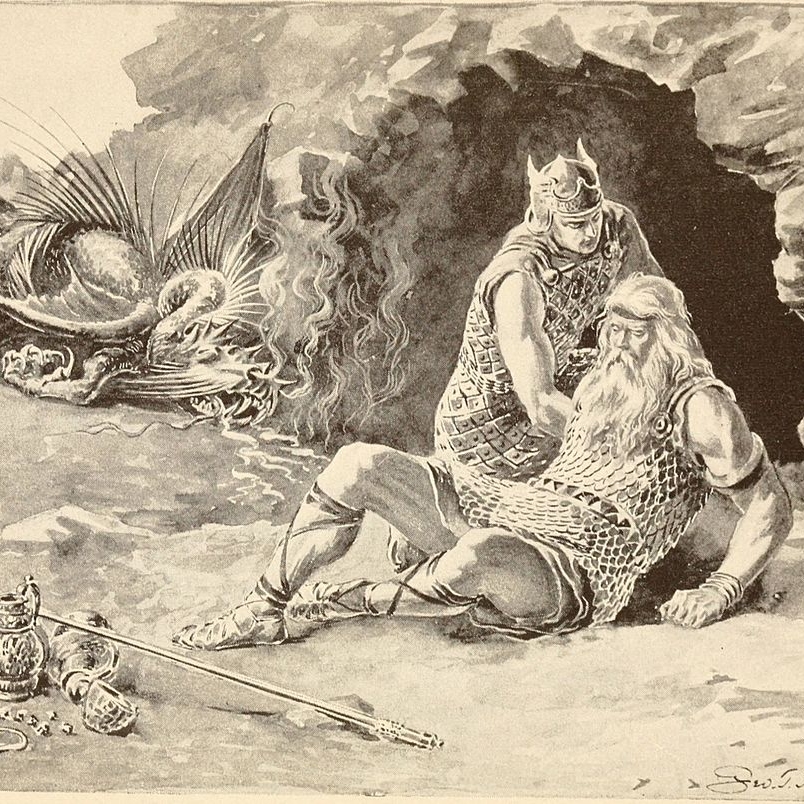
it's not like Grendel's roof you'll see later we're sure Grendel's dead so they are happy right everything's awesome and they get on their horses the next morning and they're hanging that arm over the bar did you have you read this book? no they literally hang it over the bar oh that's awesome yeah they display it over the door that's my instinct yeah you got some Viking I got some northern blood for sure so they get up the next morning and the world is rosy and wonderful and bright and they get on their chestnut steeds and they race around and there's a minstrel that's making up Bale Wolf's song as they ride and they're like you're so great Bale Wolf and he just rides and the minstrel's like oh great Bale Wolf and so they go off and is this how the second amendment was born? the right to bear arms sorry keep on okay and Hrothgar Hrothgar makes good on his offers of spoils should Grendel be killed and gives him just loads of treasure all kinds of good stuff and they make fair the death of Bale Wolf's man in gold oh the guy that got eaten was Bale too yeah unfortunately yeah it's kind of sad so he's gone but they get gold for it and he gives him a bunch of horses and some other things and it's great and they have a good time and they all go to sleep and that's not the end of the story nope we also I'm trying to decide well there's this kind of in between like there's an interlude where a minstrel sings a song and it's about some politics stuff that happens and I don't know I don't want to go too far into it but the basics is that there's a war between two clans and they eventually decide on a truce but it's too far into winter to let one side sail home so they have to stay in the hall and it's not good and eventually they're looking at the swords that would kill some of their friends and they go back on the truce and kill each other and sail home and it kind of sets sort of a feeling of doom yeah like right after something great happened why does Mitchell sing that song come on man sing the happy song yeah so it turns out to be kind of this terrible song and so then they all go to sleep after the song and Grendel's mother comes and seeks revenge and takes him so they're like oh no and he was one of Frothgar's favorite counselors and so he's like oh no my best friend so they have to go and they ride after her and they have a chat and Beowulf with Grendel's mom no no sorry Frothgar and Beowulf chat before going in and we get one of the most famous quotes in the book and it's Beowulf to Frothgar and he says why sir do not grieve it is always better to avenge dear ones than to indulge in mourning for every one of us get them back rather than be sad for every one of us living in this world means waiting for our end let whoever can win glory before death when a warrior is gone that will be his best about God through the whole thing God's in control and all this stuff so it's this weird melding of a Christian belief in God and also depending on the glory of the warrior pagan world so he decides to jump in and go after this whole thing and he's not going in without a sword this time well Unfrith actually lends him one called fronting and he says here you go it's a hard edge it's never failed me it's going to be awesome because the steel sometimes wasn't that great and biting swords and it would snap in fact you usually took two swords and went to battle and presumably Grendel's mom doesn't have the same spell that Grendel did so presumably so they go to Hermir and her mirror the water burns mirror yeah it's like a little pond so she's got this pond and the water kind of burns it super unnatural and then they see all these weird slithering like dragon shapes and salamanders and it's not clear what they are it's like little lizards and water beings and they're like whoa that thing's weird and then Grendel's like here I go and then he jumps in and full of lizards and he jumps and he swims and he swims for the better part of the day so he holds his breath and this isn't the only time he's done something crazy in the water swimming in the winter in Scandinavia is the first sign that they're doing unreal things so he swims until he hits the bottom and he sees the mom and she's not happy he's there and they fight and they fight and her hunting is just not getting the job done it's not biting and eventually she grabs him and takes him to her little cave so that he can stand on some solid ground and the water isn't working against him so they fight some more and the sword just won't bite and so he looks around and then he sees another sword an ancient blade forged by giants and so he's like yes so he grabs that thing and then hacks her head off and then he looks around holding the sword high and finds Grendel's body and then cuts the head off of that so Grendel's mom's blood actually melts the blade of the sword it's like weird crazy acid blood so he swims back with two prizes so Grendel's mom looks like Grendel also or did they ever talk about it's never clear it just calls her a turn hag she's a lady and it's weird that's kind of sad because she was seeking revenge for her only son she was doing what he says we should be doing yeah and we can get to that later but she is a little bit more sympathetic than Grendel at least she's following almost the law of the land getting revenge so he grabs the hilt of the sword that's full of jewels and he grabs the head of Grendel and he heads back up and by this time he's been down there like nine hours it says it's the ninth hour of the day it's late and Hrothgar and all of those guys have already left because all of the elders are like he's dead because when he killed the mom some of that blood made its way into the water and they saw it kind of upturn and there was blood in it and so they're like well he's dead for sure let's go home so they all go home and all the Beowulf's warriors stay kind of hanging on the thing hoping to see their lord and then he I always imagine this being a little bit like you ever see Terminator 2 where his thumb comes out of the water like that I always imagine he's like raising out of the water and they see Grendel's head first and they're like oh and then they see his arm and they're like oh it's such a cinematic moment that's never been taken advantage of in any of the films even the one in space even the one in space oh especially the one in space and so he's got this giant head it takes four warriors to carry the thing it's huge and he's got this sword they go back and more partying more partying more gifts but Hrothgar doesn't just stop there what he gives the Beowulf is actually a long talk about how to be a good king which is weird Beowulf is not a king so let me read you a piece of this if I can find it yeah here we go okay this one's a little bit lengthier wondrous it is to tell how the mighty god doth apportion in his purpose deep unto the race of men wisdom lands and noble estate of all things he is lord at while is the heart's thought of men of famous house he suffereth in delight to walk granteth him in his realm earthly joy ruling over men within his walled town maketh the religions of the earth as his to sway a kingdom vast so that the end thereof in his unwisdom he cannot himself conceive he dwells in plenty no wit to age or sickness thwart him nor doth a black care grieve his soul nor strike in any place bring murderous hatred forth nay all the world goeth to his desire he knows nothing of worse fate until within him a measure of arrogance doth grow and spread now sleeps the watchman guardian of the soul two sounds that sleep in troubles wrapped the slayer is very nigh who in malice shooteth arrows from his bow then beneath his guard he is smitten to the heart with bitter shaft the strange and crooked biddings of the accursed spirit he cannot himself defend too little now him seems what long he hath enjoyed his grim heart fills with greed in no wise doth he deal gold-plated rings to earn him praise and the doom that cometh he forgets and heeds not because God the Lord of Glory hath before granted him a portion of honor high thereafter in the final end it cometh to pass that his fleshly garb being mortal faileth falls in death ordained another succeeds all who unwrecking scattereth his precious things the old hoarded treasures of that man his wrath he fears not defend thee from that deadly malice dear Beowulf best of knights and choose for thyself the better part counsels of everlasting worth countenance no pride O champion in thy renown now for a little while thy valor is in flower but soon shall it be that sickness or the sword rob thee of thy might or fires embrace or waters wave or bite of blade or flight of spear or dreadful age or the flashing of thine eyes shall fail and fade very soon till come that thee proud knight shall death lay low even so that I for half a hundred years beneath heaven rule the ring proud Danes and with my battle fenced them round from many a neighbor over this earth below with swords and spears so that I counted no man beneath the compass of the sky my likely foe lo a change of this fortune in my very home befell me grief after gladness when Grendel ancient enemy became the invader of my house and I for that trespass unceasingly endured a deep sorrow in my heart for this be the creator thanks to the everlasting lord that I have lived in my life that long strife over to gaze on this head died with cruel gore he's looking at Grendel's brains go now to thy seat use the gladness of the feast war's honor with thee between us shall many a host of treasures pass when more shall come so he says look it's going great right now you're feeling really good you're at the height of your powers everything's awesome it doesn't stay that way you might rule it all but if you let that pride overtake you it'll make you a bad king and then even if you mass all this treasure the kid after you is going to scatter all over the place so why would you work that hard it's an incredible example of a good king being wise in his praise he could have praised Beowulf and in that moment made it terror like made it hyrant but he didn't he said you're feeling good things could go bad be smart and now enjoy the feast does Beowulf take the advice or is he like a bro he's like whatever whatever the stupid I'm the best that's the thing Beowulf isn't a king he's a warrior and so he ends up going home and things are great for Hrothgar right Grendel dead lady dead everything's great he goes home and gives some rewards to his lord Helac his queen gives her some horses and stuff and everything's good and then after Helac dies in a battle Beowulf eventually you know avenges himself then the nobody has faith in Helac's kid right so they're like hey Beowulf you should be in charge and he's like I don't really want to it's not my place right I'm not the prince and they're like yeah but he's kind of a wuss he's like look I'll stay with him and support him and train him it's like okay so the kingdom passes to Heyardrid and then Heyardrid he was a kid yeah the one kid but he doesn't live that long just like they thought and then Beowulf eventually takes over and he does avenge Heyardrid he gets him back he's a guy named Dayraven the Frank such a cool name Dayraven? Dayraven the Frank the French guy yeah I thought he was like a very honest person the Frank I killed the king I liked him and so he takes the kingdom and he rules it for 50 years and so this right here marks a big break in the novel, right?
It doesn't really, it's usually not highlighted, it just goes to the next paragraph, but now we have seen the warrior on the rise, and we are moving towards the warrior in old age. So 50 years pass, and he rules the gays, and he rules them well. He took the advice. He's a great king.
And then, it turns out, that there's a dragon. And what do dragons usually do? They put treasure, and they sit on it. They sit on gold.
And so we find out that there's a treasure horde of gold from an old race that died out. It's really sad. Like, the guy that put all the gold in there, he goes, well, I'm the only one in my country left. I guess I'll just wander the world until I die.
And then he leaves, and the dragon takes over, and he's been sitting on it for 300 years. Then there's a slave, and he's been kicked out by his master, and he doesn't know what to do, and so he stumbles upon this horde of gold, steals a cup, and then returns to his master. Do we know why dragons like horde gold? Is it just like their nature?
Why do cats jump in boxes? Maybe it's a comfort thing. Maybe they're so big, they get on good rocks. You can actually sort of spread out of the gold, and it jitters away.
It scratches the scales a little bit. It just seems like, I don't know, they're not going to use it. They're literally just going to sit on it. It's trying to give a modern analogy.
It's like companies that have money offshore. Why do they have it offshore? Maybe they know something we don't like. They know the end of the world is coming, and the thing we need the most is gold.
Because it'll be in the transistors of our warheads or something. They're just smarter than we are, and we have no idea. Anyway, there's a dragon here. And he is angry that he's missing a cup, and so he goes and he burns a bunch of houses.
I'm dead serious. He gets super mad. He's like, I can't believe this. And then he goes and burns a bunch of houses, and one of them is Beowulf's house.
And Beowulf, in the Seamus Haynes translation, it says he was confused with anger. Everything always goes Beowulf's way, and so this is the first time he's like, what is happening? My house burned down? How does this even happen?
And so he has to fight this dragon. And then he gets 12 other dudes to go with him to go find out what's going on with this dragon. And that's the funny thing. Does that sound like a book to you?
There's a thief, a king, and 12 other guys, and a dragon. I mean, this is the Hobbit. And I actually brought that up to Tolkien himself. They said, this sounds a lot like Beowulf.
And he actually wrote one of the similar criticisms of Beowulf, called The Monsters and the Critics. And in it, he has said, yes, I have studied that book so thoroughly. He translated it. He was speaking to it.
He's like, there's no way it wasn't in my head. Yeah, he's allowed to. At that point, you're allowed to. But he didn't specifically think about it and steal it.
But it was just one of those things that was so deeply ingrained in the person of Tolkien that, you know, thinking of dragons, thinking of kings, everything kind of came out that way. So Tolkien did this translation before he wrote The Hobbit? I don't know when he did which. But either way, he was very familiar with the book.
Right, right. Okay. So he takes these dudes. They find out where the barrow is.
And Beowulf knows that he's going to be facing a dragon. And so he has this special shield made of iron. Because their shield is vertically wood. It's light.
It's sturdy. It's light of metal. But not so good when you're about against a dragon. Yeah.
Do Beowulf dragons have fire-breathing faces like the dragons we know? They do, but they're probably smaller. You're thinking probably like Pete's dragon, like big fat bellies and lots of spines. You know, the movies make him look scarier.
This one was probably about 50 feet long, but think more like Sky Serpent with big wings than dragon you're thinking of. Because it lands in a portion, at one point it chomps on his shoulder, but it doesn't like tear his whole shoulder off, right? So it's big, but it's more snakey than anything else. So like those dragons you see, like the size of dragons you see in the old renaissance paintings of St.
George, when he's killing the dragon, it's not like this giant Tolkien dragon. Yeah, probably. I'm Googling this as you say those things. I'm sorry.
St. George and the dragon. I know the story, but I don't know the renaissance paintings. Okay, anyway, he goes and he sits down and he says, if I knew a way to fight this dragon without weapons, I would do it.
That's too small, though. Yeah, that's too small. And so he says, if I could do this without weapons, I would do it, but I don't know how to face fire without weapons. So I have to take a shield and I have to take a sword.
And keep in mind, it's been 50 years. How old is he supposed to be at this point? He's an older dude. 70s, 80s, maybe?
Like if he was early 30s or early 20s. It doesn't really say, but you have to put him as old. So he sits down and it is not a joyful moment. He's not like, let's go to the fray.
He kind of talks about this sad thing and doom and horrible history. Wait, why don't you just say, I'm building a house 50 miles downstream. I'm just letting the dragon in. It's out of his system.
He burned down my house. I'm just not going to worry about it. I'm just going to keep Beowulf in. Graham, you're a mountain climber.
It's a Zephyrus. Is it really? I mean, it's not. I was wondering if he was like, he needed to avenge.
This dragon did something against him, so he now needs to go and take a life. I mean, it's a threat to the people. It's a dragon. And it's a monster.
He kills monsters. But he's old. Don't retire at some point. So we can open an inn.
The wisdom is questionable. Should he have let people in the woods as a king? Maybe. But at this point, he's old anyway.
So if you're going to go, might as well be facing a dragon. Might as well be facing a dragon. And he took a pick troop. And so he takes all these guys.
He goes down there. And he goes, rah! And yells. And the dragon comes out.
And the dragon lands. So he actually has a moment. But all the people that he picked take off. Of course they do.
They all bail to the woods. And so Beowulf is left standing there and facing this dragon alone. And he can't get his sword to bite. He's using his incestional blade named Nagling.
And Nagling, when he brought it down on the dragon's head, it snapped. It breaks. And it says the reason it breaks is because Beowulf is so strong, he breaks swords. He'd never get them to work just because he's too big.
So the sword never does what it's supposed to. And so he's fighting there. He's in danger. And then we have kind of a meanwhile in the trees.
And one warrior named Wiglof. Or you should actually pronounce We-lof. But Wiglof sounds better. And it's also a great name for a dog, by the way.
And you'll see why in a second. So Wiglof is a green warrior. He has never been in battle. He has, you know, this is his first anything ever.
And he turns and he says, you guys are a disgrace. When he gave you weapons. When he gave you swords and shields and gold and land. He was throwing it away.
Because in the time when he needs you, you are not there. What a shame it would be to go back home wearing the weapons that he gave me rather than use them. Wow. That's terrible.
You should be ashamed. Good job, We-lof. And then he turns and he runs and he joins Beowulf. Oh, wow.
Stands next to him and says, go on, Beowulf. You got this, buddy. It's awesome. And that's why it's a great dog name.
Because it's like man's best friend. He's there in the thick of it. Who's a good boy? He's a good boy.
And there's this moment where they are using the same shield, right? To shield them both from the flames. And I like to choose microcosms if I can of the book and the main themes of the book. And it's right here.
It's men in community shielded against all the forces of the outside world that want to do them harm. It's a great moment. And also, again, really cinematic. I don't know why they don't ever use this stuff.
Is the dragon in the really bad Beowulf movie you're talking about? Yeah. Is it just Beowulf versus the dragon? Well, it depends.
There's one where the dragon, I think, is just like more dudes. Oh. There's no real dragon. And the 3D one, there is a big dragon.
And he's fighting on his throne? I'll give you a rundown on that movie in a second. So he's fighting with Wiglof. Back to the story.
He's fighting with Wiglof, and Wiglof stabs the dragon in the stomach, and so the fire gets to be less. So they actually have a shot. And then Beowulf turns and takes out a knife and stabs it in the flank. But earlier, when he was fighting alone, the dragon had clamped him on the shoulder, and the dragon was poisonous.
Oh. So the dragon dies from the wound in the hip, and Beowulf is like laying there dying from this poison. And he sits down. He doesn't freak out.
He sits down, and he stares at the rocks around the cave. Can I fight up? Oh, man. Bad news.
And he pretty much says, Wiglof, good job. Can you get the gold? I really want to see it. I want to know that I'm leaving my people well off when I die.
So Wiglof goes, yeah. And then he runs off into the thing, and he can kind of see it. They explain it because there's this gold banner, and the light reflects off it. So he gets a bunch of the gold he brings out, and he's like, look, it's great.
And then Beowulf's like, awesome. Thank you. You're great. I wish I could have given my weapons to my own son, but I'd give them to you.
He kind of passes the mantle to Wiglof. And then a messenger carries the, you know, Beowulf is dead. He carries it up to all the people waiting for the outcome. And he pretty much has this really long speech.
It's one of the longest in the books. It's basically like, we're all going to die because the Swedes, who hate us, are going to hear that Beowulf is dead. And they're also going to hear that our warriors ran from the battle for the dragon. And so judging by the quality of men that we have, like, we are doomed.
And then they mourn Beowulf, they put him in a barrow, and they bury a bunch of gold with him. And that's the end. So the end of the story is Beowulf's dead, and everyone's scared that the Swedes are going to take him over. Oh, man.
Is there, like, another part to this? No, but that's what's interesting. So the book is written in something called a literative verse. And this is something Tolkien points out.
So a literative verse means the syllables don't matter, but every line has four stressed syllables. It doesn't matter how many there are, like, total syllables, but there are four of them stressed. So, like, I went down to the store to find a cake. I went down to the store to find a cake.
Or winter went wild in the waves. Winter went wild in the waves. So there should be four stresses, one way or the other. And stresses number one and three should alliterate.
So if it's a W noise, it's got to be another W noise. Two sometimes does, and four never does. And this reflects the story in that the first and third battles Beowulf has are with big monsters that threaten his community. Grendel, the dragon, that attack from nowhere.
The second is sort of similar, right? And it's linked with the first one. There, by the way, also is usually a gap between the first two stresses and the second two. But there is a fourth battle, is there?
The Swedes would be implied. So one, Grendel, second stresses the mom, and then there's that big gap of 50 years, just like there would be in the line. And then battle three, and then the implied fourth battle that never alliterates with the other stressed syllables. So the structure of the tale reflects the meter in which it was written.
I tend to think that that's more of an accident than intentional, but it's there. So a quick rundown of the movie. Yeah, sure. Important stuff.
Yeah. Beowulf goes to kill Grendel's mom, and she's Angelina Jolie, made of gold. It's weird and not appropriate. And they spend some time in the cave, and she's not dead at the end of that time.
And then he leaves, and the dragon is his son. That doesn't, what? From Grendel's mom? Yeah.
So Beowulf and Grendel's mom get together, and they produce the dragon, strangely. So it's an actual dragon, sorry. It's an actual dragon. But later, I think, when he's dying in the water, the dragon stands up and is like, it's weird.
It's super weird. And it's not good. And they mess up the tale, and the dragon heart's small. It's just not the greatest thing ever.
Right, so lessons to take from this. I think at the end of novels, we always really want there to be some big moral story. And we have to remember in what place this was set. This would have been entertaining at a party.
It would have been an example of kingship to follow. It would have been something to inspire us to goodness, to honor, to battle, to all of these things. Looking at this good man who worked his whole life. But there's also questions of, you know, what does glory leave us with?