#436 The Road Hole: Golf’s Purest Examination episode artwork

EPISODE · Dec 13, 2025 · 10 MIN

#436 The Road Hole: Golf’s Purest Examination

from Golf 247.eu: The Global Platform for Innovative Technologies and Teaching Concepts. · host Golf247.eu

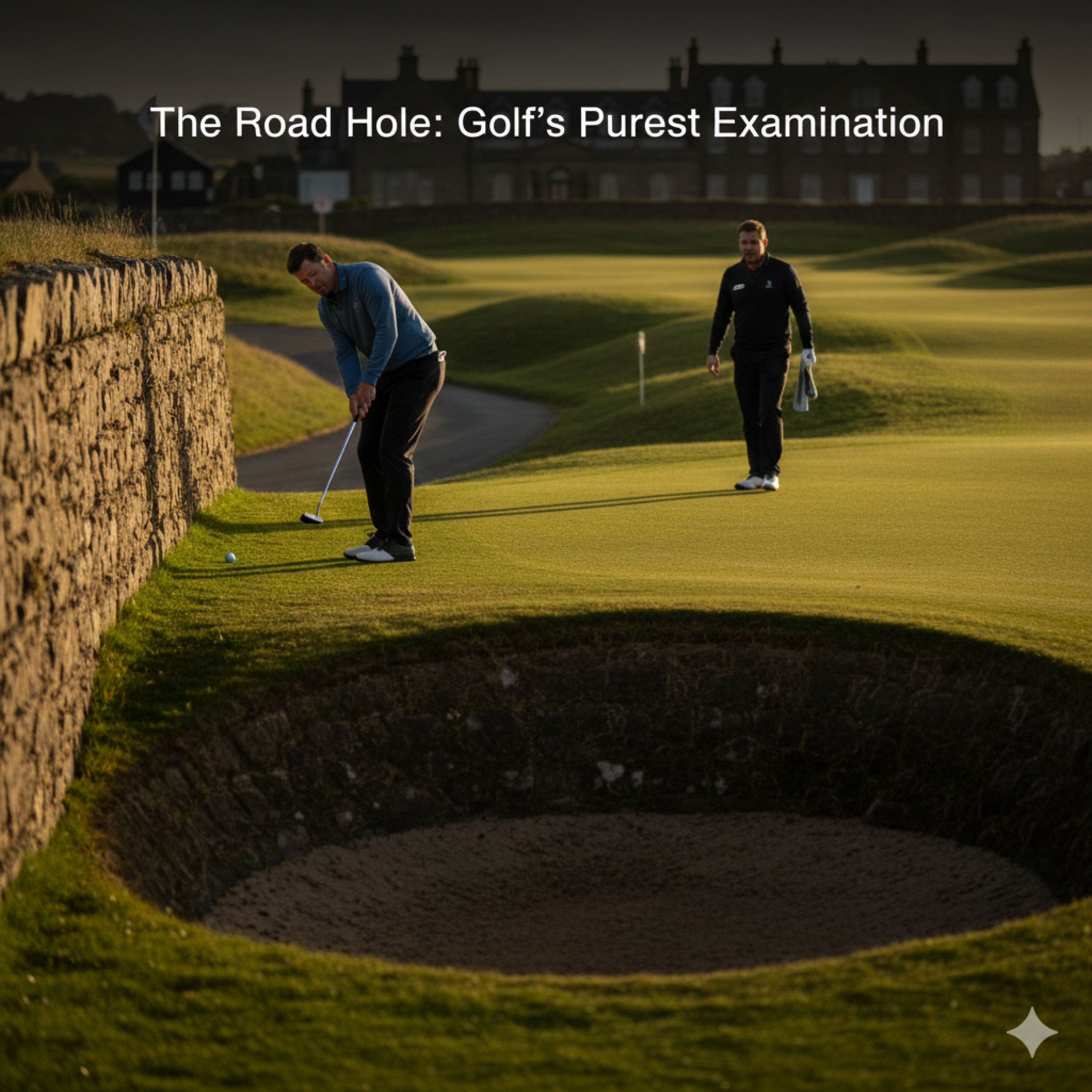
This analysis, presented by Henrik Jentsch, explores why the 17th hole on the Old Course at St Andrews stands as one of golf’s most demanding tests. The hole begins with a blind tee shot played over buildings toward a fairway bordered by out-of-bounds. The approach targets a small, two-tiered green set diagonally beside a road, defended by one of the game’s most feared hazards: the Road Hole bunker. This pot bunker is physically narrow but strategically enormous, as surrounding contours funnel shots into it from many yards away.The road itself has never been marked out of bounds, meaning balls finishing on pavement or against the wall must be played as they lie. This rule, unchanged for generations, reinforces the hole’s unforgiving nature. Although the routing has remained almost identical for more than a century, a major change in the 1960s transformed the hole from a short par-5 into a long, punishing par-4. Later tee extensions pushed the length to nearly 500 yards—and even longer when the pin sits on the elevated rear plateau.The green complex is the smallest on the course. It consists of a front section sloping sharply toward the road and a raised back plateau where all realistic pin positions are located. Its narrow shape, combined with its diagonal orientation, demands exceptional accuracy. Shots landing directly on the back plateau almost always release through the green and down onto the road or wall. For this reason, the ideal strategy is to land the second shot short of the putting surface and let it release upward, controlling momentum naturally.Historic changes did not alter the hole’s character but intensified its difficulty. Early versions required players to hit over sheds and rail lines; modern structures still preserve the blind tee shot and the tension that defines the hole. The road-and-wall boundary, unchanged since the earliest maps, continues to punish even slightly mis-struck approaches.The complexity of the green’s topography is central to the challenge. The transition slope between tiers curves toward the Road Hole bunker, guiding approach shots, chips, and even putts directly into danger. The green’s narrowness, severe tilt, and hard boundary create a strategic puzzle in which precision outweighs power.The bunker’s influence is magnified by its surroundings: ground contours feed balls inward, making it a far larger target than its size suggests. Combined with the ever-present risk of the road and wall, the result is a uniquely demanding approach in which both aerial shots and ground shots carry significant risk.The Road Hole endures as an uncompromising examination of skill because every element—blind tee shot, angled fairway, diagonal green, severe bunker, hard boundary—works together seamlessly. Many architects have attempted to imitate it, yet none have succeeded, because its brilliance lies in the exact blend of angles, slopes, and consequences that cannot be replicated.www.Golf247.eu

This analysis, presented by Henrik Jentsch, explores why the 17th hole on the Old Course at St Andrews stands as one of golf’s most demanding tests. The hole begins with a blind tee shot played over buildings toward a fairway bordered by out-of-bounds. The approach targets a small, two-tiered green set diagonally beside a road, defended by one of the game’s most feared hazards: the Road Hole bunker. This pot bunker is physically narrow but strategically enormous, as surrounding contours funnel shots into it from many yards away.The road itself has never been marked out of bounds, meaning balls finishing on pavement or against the wall must be played as they lie. This rule, unchanged for generations, reinforces the hole’s unforgiving nature. Although the routing has remained almost identical for more than a century, a major change in the 1960s transformed the hole from a short par-5 into a long, punishing par-4. Later tee extensions pushed the length to nearly 500 yards—and even longer when the pin sits on the elevated rear plateau.The green complex is the smallest on the course. It consists of a front section sloping sharply toward the road and a raised back plateau where all realistic pin positions are located. Its narrow shape, combined with its diagonal orientation, demands exceptional accuracy. Shots landing directly on the back plateau almost always release through the green and down onto the road or wall. For this reason, the ideal strategy is to land the second shot short of the putting surface and let it release upward, controlling momentum naturally.Historic changes did not alter the hole’s character but intensified its difficulty. Early versions required players to hit over sheds and rail lines; modern structures still preserve the blind tee shot and the tension that defines the hole. The road-and-wall boundary, unchanged since the earliest maps, continues to punish even slightly mis-struck approaches.The complexity of the green’s topography is central to the challenge. The transition slope between tiers curves toward the Road Hole bunker, guiding approach shots, chips, and even putts directly into danger. The green’s narrowness, severe tilt, and hard boundary create a strategic puzzle in which precision outweighs power.The bunker’s influence is magnified by its surroundings: ground contours feed balls inward, making it a far larger target than its size suggests. Combined with the ever-present risk of the road and wall, the result is a uniquely demanding approach in which both aerial shots and ground shots carry significant risk.The Road Hole endures as an uncompromising examination of skill because every element—blind tee shot, angled fairway, diagonal green, severe bunker, hard boundary—works together seamlessly. Many architects have attempted to imitate it, yet none have succeeded, because its brilliance lies in the exact blend of angles, slopes, and consequences that cannot be replicated.www.Golf247.eu

NOW PLAYING

#436 The Road Hole: Golf’s Purest Examination

0:00 10:52

No transcript for this episode yet

We transcribe on demand. Request one and we'll notify you when it's ready — usually under 10 minutes.

Frequently Asked Questions

How long is this episode of Golf 247.eu: The Global Platform for Innovative Technologies and Teaching Concepts.?

This episode is 10 minutes long.

When was this Golf 247.eu: The Global Platform for Innovative Technologies and Teaching Concepts. episode published?

This episode was published on December 13, 2025.

What is this episode about?

This analysis, presented by Henrik Jentsch, explores why the 17th hole on the Old Course at St Andrews stands as one of golf’s most demanding tests. The hole begins with a blind tee shot played over buildings toward a fairway bordered by...

Can I download this Golf 247.eu: The Global Platform for Innovative Technologies and Teaching Concepts. episode?

Yes, you can download this episode by clicking the download button on the episode player, or subscribe to the podcast in your preferred podcast app for automatic downloads.
URL copied to clipboard!