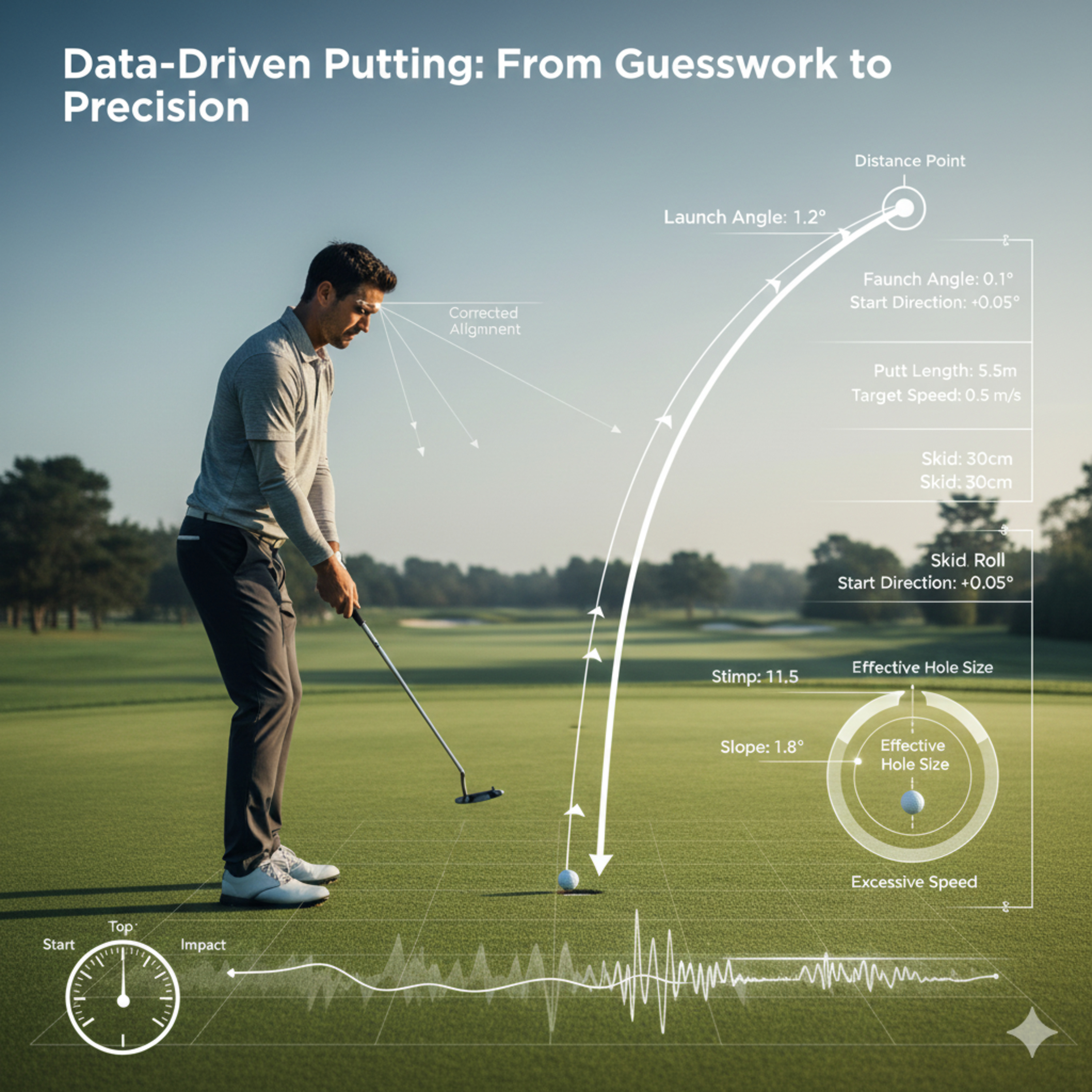
#449 Data-Driven Putting: From Guesswork to Precision episode artwork

EPISODE · Dec 26, 2025 · 14 MIN

#449 Data-Driven Putting: From Guesswork to Precision

from Golf 247.eu: The Global Platform for Innovative Technologies and Teaching Concepts. · host Golf247.eu

Elite putting performance is built on a data-driven framework that combines advanced diagnostics with disciplined execution. Technologies such as high-speed video analysis and ball-roll measurement systems reveal stroke mechanics and ball behavior that the human eye cannot detect. Successful putting goes beyond technical accuracy; it requires stable rhythm, reliable visual alignment, and the ability to perform under pressure. When physical mechanics, spatial perception, and mental control are trained together, players move from overthinking their stroke to executing with clear intent.Modern diagnostics break the putting stroke into measurable components. Impact data reveals face angle at strike, start direction, and spin rate, while launch and roll metrics identify launch angle and skid distance before true roll begins. Even small deviations—such as a consistently open face by just over one degree—can explain repeated misses on longer putts. This objective feedback exposes issues related to excessive or insufficient loft, inconsistent launch, or prolonged skidding, allowing precise corrections instead of guesswork.Putting physics is based on the motion of a rolling ball on an inclined plane. Physics-based models calculate the ideal line using four inputs: green speed (Stimp), slope percentage, putt length, and target speed. From these, three key outputs are generated: the ideal aim line, the distance point (where the ball should stop if it misses), and the total effective putt length. Ball speed is critical, as it directly affects forgiveness at the hole. At an optimal entry speed of roughly three rotations per second, the effective hole size is maximized. Faster speeds reduce forgiveness dramatically, making speed control a decisive scoring factor.Data also corrects visual distortion. Many golfers believe they are aligned correctly when head or eye position creates a false perception. Objective measurements replace feel-based assumptions with reality, ensuring that setup, aim, and stroke match the intended physics model. Trying to putt without this feedback is comparable to navigating in fog without instruments—intuition alone cannot guarantee accuracy.Execution is stabilized through rhythm training, most effectively with a three-beat metronome cadence: start, top of backswing, and impact. This structure regulates energy flow, prevents deceleration or rushed follow-throughs, and promotes even energy buildup with instinctive release. Rhythm is defined as motion without hesitation. By operating within a short, consistent timing window, the golfer minimizes conscious interference and allows athletic intent to guide the stroke.Consistent scoring emerges from the combination of scientific diagnostics, physics-based targeting, and a disciplined routine. When modern data tools are integrated with structured rhythm training, putting becomes a precise, repeatable skill rather than a matter of feel or chance.📺 The Explainerwww.Golg247.eu

Elite putting performance is built on a data-driven framework that combines advanced diagnostics with disciplined execution. Technologies such as high-speed video analysis and ball-roll measurement systems reveal stroke mechanics and ball behavior that the human eye cannot detect. Successful putting goes beyond technical accuracy; it requires stable rhythm, reliable visual alignment, and the ability to perform under pressure. When physical mechanics, spatial perception, and mental control are trained together, players move from overthinking their stroke to executing with clear intent.Modern diagnostics break the putting stroke into measurable components. Impact data reveals face angle at strike, start direction, and spin rate, while launch and roll metrics identify launch angle and skid distance before true roll begins. Even small deviations—such as a consistently open face by just over one degree—can explain repeated misses on longer putts. This objective feedback exposes issues related to excessive or insufficient loft, inconsistent launch, or prolonged skidding, allowing precise corrections instead of guesswork.Putting physics is based on the motion of a rolling ball on an inclined plane. Physics-based models calculate the ideal line using four inputs: green speed (Stimp), slope percentage, putt length, and target speed. From these, three key outputs are generated: the ideal aim line, the distance point (where the ball should stop if it misses), and the total effective putt length. Ball speed is critical, as it directly affects forgiveness at the hole. At an optimal entry speed of roughly three rotations per second, the effective hole size is maximized. Faster speeds reduce forgiveness dramatically, making speed control a decisive scoring factor.Data also corrects visual distortion. Many golfers believe they are aligned correctly when head or eye position creates a false perception. Objective measurements replace feel-based assumptions with reality, ensuring that setup, aim, and stroke match the intended physics model. Trying to putt without this feedback is comparable to navigating in fog without instruments—intuition alone cannot guarantee accuracy.Execution is stabilized through rhythm training, most effectively with a three-beat metronome cadence: start, top of backswing, and impact. This structure regulates energy flow, prevents deceleration or rushed follow-throughs, and promotes even energy buildup with instinctive release. Rhythm is defined as motion without hesitation. By operating within a short, consistent timing window, the golfer minimizes conscious interference and allows athletic intent to guide the stroke.Consistent scoring emerges from the combination of scientific diagnostics, physics-based targeting, and a disciplined routine. When modern data tools are integrated with structured rhythm training, putting becomes a precise, repeatable skill rather than a matter of feel or chance.📺 The Explainerwww.Golg247.eu

NOW PLAYING

#449 Data-Driven Putting: From Guesswork to Precision

0:00 14:20

No transcript for this episode yet

We transcribe on demand. Request one and we'll notify you when it's ready — usually under 10 minutes.

Frequently Asked Questions

How long is this episode of Golf 247.eu: The Global Platform for Innovative Technologies and Teaching Concepts.?

This episode is 14 minutes long.

When was this Golf 247.eu: The Global Platform for Innovative Technologies and Teaching Concepts. episode published?

This episode was published on December 26, 2025.

What is this episode about?

Elite putting performance is built on a data-driven framework that combines advanced diagnostics with disciplined execution. Technologies such as high-speed video analysis and ball-roll measurement systems reveal stroke mechanics and ball behavior...

Can I download this Golf 247.eu: The Global Platform for Innovative Technologies and Teaching Concepts. episode?

Yes, you can download this episode by clicking the download button on the episode player, or subscribe to the podcast in your preferred podcast app for automatic downloads.
URL copied to clipboard!