
A podcast by Cipra. In podcast, de la Cipra. The Articpa Podcast. The Articpa Podcast.
We bring podcast. Interviews, background talks and voices from all Alpine countries. Listen to this and more in the podcast of the International Commission for the Protection of the Alps, www.cipra.org.org. Hello and welcome to a new episode of the Cipra Podcast.
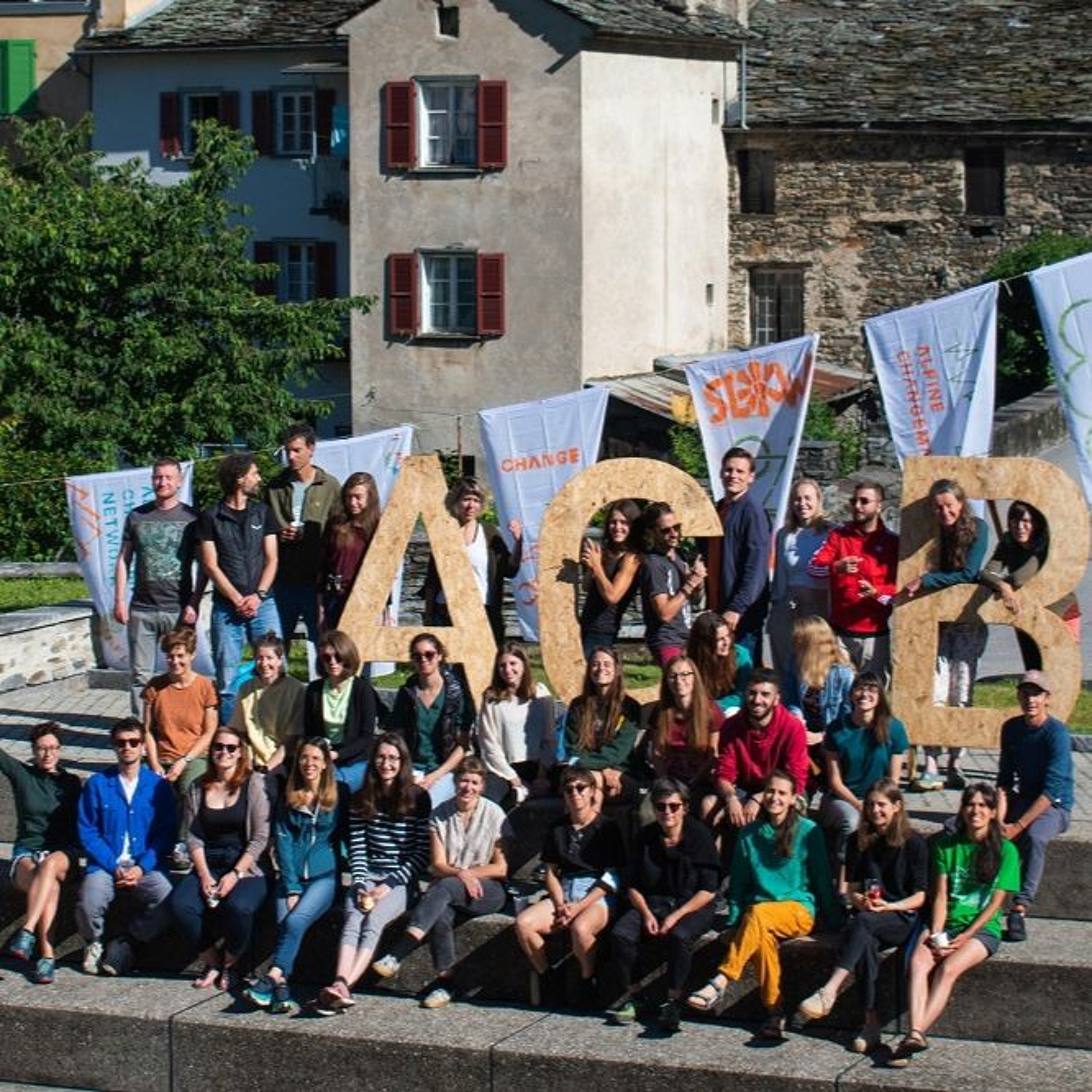
My name is Veronica Ribenik and today you will hear from young Alpine change makers. They will share their creative ideas and innovative projects for better future in the Alps. These light-minded people met in July at the first Alpine change maker base camp in the Swiss Valley of Albus Cabo. Surrounded by mountains and nature, the participants had the opportunity to develop their ideas into projects.
In numerous workshops, international coaches offered them new tools to further concretize their plans. Whether it's an art pavilion on the topic of masterism, view walks in abandoned barns, or integrating marginalized groups better. The young change makers also learned from each other's ideas and experiences. Let's hear from them now.
They send a short message to tell us more about their plans, their ideas and their projects. Hi, my name is Sonia. I am living in the Alpine region of BERN in Switzerland and I am working on the project with the title Holy Cow. With a background as a dietitian, I have a particular interest in the topic of meat and I wonder what places should have in future dietary patterns.
Because if I am looking at the international scientific literature, the answer would have to be we should eat as little meat as possible and if so, then poultry meat most likely. At the same time, it is clear that we cannot simply transfer such global dietary recommendations to Switzerland with its many grasslands and agricultural land in mountain areas. With my questions, I am pursuing in my project. They revolve around how farmers experience their beef business in the Alpine region.
For example, I would like to learn how they want to be perceived as producers, what is important to them in sustainable cattle use in the Alpine region, how they see their role in strengthening sustainable development and cattle farming, why they like to produce meat, what is important to them and what the reasons are for this, and how the use of cattle farming production in the Alpine region shapes local identity and appreciation of the products and what they would like to see from city dwellers in terms of consumption of their meat. As a first step, I will run some interviews with farmers in the Alpine region and where I also will ask them if they think that, for example, a festival in honor of the sacred cow could increase the visibility of Alpine farming. So I will offer them to organize such a festival and to improve the appreciation of beef and strengthen the relationship between customers and producers and I will try to find out what they think about this idea. At such a festival, in addition to the sale of beef products, of course, there is activities that could be offered that would enable mutual exchange between customers and producers.
Hi, this is Anna. I study agricultural sciences at the Bern University of Applied Sciences. For the Alpine Change Maker Base Camp, I was very interested in the way people produce food and live in the Alpine space, so I therefore choose to look at agricultural barns. They are usually not used anymore for agricultural purposes, so I see a lot of them just collapsing.
That's why I want to investigate on ideas and how we could use them again, for example, for soft tourism and one idea could be to build beefwalks so the barn's appearance will not change from the outside, but inside the barn will be an opportunity for people to sleep there and stay overnight. And this could also be a big chance for farmers or rural communities to rent them out to people from the city, for example. So there are a lot of activities that could actually follow with this to connect urban people with rural society. Hello, my name is Nico Lassa.
I come from Viterbo, which is a city in the center of Italy. I studied industrial design in Rome, and now I'm living in Bolsono, where I'm currently attending a master in agricultural design and enjoying the mountains. I'm also passionate as Nigerad, so the project I'm developing with the Alpine Change Maker Base Camp, and Torka is related to making a ecological and sociological change into the footworld world. The name I gave to the project is Digital Shoe Making, Need for New Traditions.
Since the plan is to design and to make real, a blueprint of local shoe production by entangling shoe makers with fablabs and designers. What such a thing you would ask. I'm sure multi-disciplinarity and collaborations would help innovate footworld know how setting new standards for consumers and producers. The main target of this project is to try redifying the profession of shoe makers by merging together the ancient Nua'u of handcrafts with the current technologies of digital fabrication.
So shoes would be tailored to one's feet and suit 3D scanning tools, with a 3D printed sole and a person made by shoe makers with materials available locally. That's all could then be entirely recycled and reused, and the upper, either recycled or disposed in nature. Workers and nature are already exploited by companies, so I wish I could design a more ethical and sustainable way of producing shoes within a secular life cycle while trying to save an update to make a profession for fiducienarius. Imatching a skiing area with no more traffic jam, cleaner air, and no more loss of biodiversity because of the expansion of parking lots.
Hi, I'm Angela and I'm currently working in Living in Munich, but I'm born and raised in a touristic town in Tereau in Austria. And that was my vision when I applied for the L-Pancin-Cha-based camp. Having an engineering background in energy system planning, I already had the perfect solution in thought. Visitors arriving by train can utilize a free electric shuttle bus from the last mile.
But by solar energy from photovoltaic models installed in the skiing area. But the discussion and input session, but also the exchange with other participants at the L-Pancin-Cha-based camp opened my eyes that probably the right solution might not be found within a certain technology or a certain alternative to private cars. Probably one need to deeper analyze the needs of not only the locals, but also the visitors coming to our area. Probably there should be more offers to drive by public transport, but probably you will need to have incentives to stay overnight or to stay even longer to reduce traffic.
So the required steps will be to talk and to understand the concrete needs that people have that drive to our place. And then probably the beginning is to talk with those just living in my current neighborhood in Munich. Hi, my name is Sichtevani Schoitz. I'm living in Rosenheim, Germany, where I just finished my studies in field of interior architecture.
My change maker idea for a better and more sustainable dealing with the Alps is an architectural pavilion that is called the Alpine Space Pavilion. It is mainly constructed with a stack timber and invites people to discover the meaning of its architectural design, to walk through the informative exhibition inside and to use it as a place for public discussion. The main goal of the Alpine Space Pavilion is therefore to raise the publicity's awareness on the versatility and complexity of the beautiful Alpine region in the context of our man-made problems. I am Khera Jakobow, and then come from Kowatsen, a small town in which alive and it is before that protected.
Otherwise, all the beauty of this planet mountains will be lost. And consequently, the importance of the magnificent customs and cultures of the place. My project talks about integration, not only that referring to the Neagrams, but also to drug addicts, social outcasts referring from signrooms of disorder. The goal of my project is to integrate them into the mountain, the mountain community, through the work supported by the locals and the restoration of the reality that has been lost.
The other possible activities can be carried out through local authorities for the restoration of the paths and the announcement of the rules and typical features of the mountains, the properties and the first support through homes to live in, to live in, will be provided by family homes made available by NGOs and local people. Hello, I am Anna, I am Italian and I am a geographer. I participated in Alpine change maker Basecamp with a project about the future of the middle mountain territories, the mountain at low or medium altitude. These areas have precious geographic forms such as paths, terraces, villages and traditional culture.
We are now threatened by demographic abandonment and ideological risk, especially in some contexts in Italy. And these areas sometimes, they are not even considered through mountain areas on the contrary of the mountain at high altitude. Well, the idea is to recreate a new imaginary, a new story, a new presence on this area, starting from a local resource. For example, a path, so low trophies could be a solution.
So these beautiful territories are waiting to be discovered and especially to be lived by us and I hope that our generation can do that and can take advantage of it. Hello everyone, my name is Jim McNale and I am currently a researcher in tourism at the University of Crento here in Italy. The Voorai project would really open up a type of tourist accommodation in the mountains and one that also acts as a social enterprise and a resource for the local community. In the name of our project is Lake Below Zero and it refers to our vision of creating a regenerative and circular future.
It is based on the concept of zero waste, reducing the amount of waste in our supply streams and daily operations, zero kilometer, the idea of sourcing all your products and materials locally or locally as possible. And that's the zero negative impact because we are looking to take the idea of sustainable tourism a step further and not only reduce the impact that tourism has had but also have positive influence on local communities and surrounding landscapes. We look to confront these themes based on the pillars of community, education, culture and nature by proposing also a type of community space for events, interactions and local workshops. The idea is also to implement several circle business models in our approach, ranging from equal design to waste as a resource from the build of our place but also in daily operations and as well as repairing and using recycled materials and as one of the main things providing a learning environment for guests and locals alike.
Hi, we are Elizabeth and Sophia from Padua and our idea is to organize a school exchange between classes coming from mountain valleys and metropolitan cities. Considering the strong relationship that alpine regions have with nearby lowlands, we wanted to encourage new dynamics of interaction between the gender connected contexts. Thus, workshop or other educational activities will be a dedicated space for the students to create new relationships and get to know the different living environments. The discovery of the two territories will encourage the comprehensive knowledge of mountain and city environments both in terms of seasonal periodicity and the mental complexity.
On one hand, the partition of the year in high and low season can be tackled by proposing activities all along their year. On the other hand, the proposed activities can deal with various topics of local sustainable development. Moreover, for a deeper contact with the local communities, the proposal can involve local actors and students' families. Hello, my name is Shambh Lehindra Khenjuk and I come from Poland.
Currently I'm an active student at the University of Liechtenstein. The main project idea is based on the upcycling architecture. Together with my group, we want to focus on the region in Pascale Valley because that region is extremely respective to new solutions and at thinking about the future. During the workshop, we made a site visit in several different villages in the region like San Carlo, Pascale, Brouzio, La Presse and Campacolónio.
After a pre-minal study and many discussions with the residents there, we choose the village of Campacolónio as a starting point for our future project. It is the last village on the road leading to the Swiss Italian border due to global reasons. It is nowadays practically abandoned place with current 20 inhabitants, with many empty, ghost houses visible from the street site. With our project, we want to have to recapitulate this place.
We want to choose one specific building in the village and renovate to create a new function for it to bring new people. Moreover, we believe that this is a very good opportunity to start the process of village renewal and create a new chapter together with the local people. You just heard about some of the projects and ideas of our young Alpine change makers. Do you feel inspired by the change maker spirit?
Do you want to be part of this community as well? Then keep your eyes and ears open because we will publish the next call for projects in spring 2022. In the meantime, you can visit our website vvv.lpunchangemaker.org to find out more about the Alpine change maker base camp or as we call it the ACB. You can also follow us on social media with the hashtag lpunchangemaker.
And if you are also working towards a more sustainable future in the Alps, keep us posted on your change maker ideas on social media. The ACB was the first pilot project of the transdisciplinary Alpine change maker network. That's an association of organizations from the fields of education, regional development and the environment. The network is accompanied by a reflection group that evaluates the conception and implementation of the base camps.
After the base camp, a mentoring program supports the participants for a year in the implementation of their projects. The Alpine change maker network was initiated by T-pr International and Jens Padura from the Beacur-Kultubiro. My name is Veronica Ribenik. Thank you for listening.
Till next time.