#451 Golf Putting Mechanics episode artwork

EPISODE · Dec 28, 2025 · 15 MIN

#451 Golf Putting Mechanics

from Golf 247.eu: The Global Platform for Innovative Technologies and Teaching Concepts. · host Golf247.eu

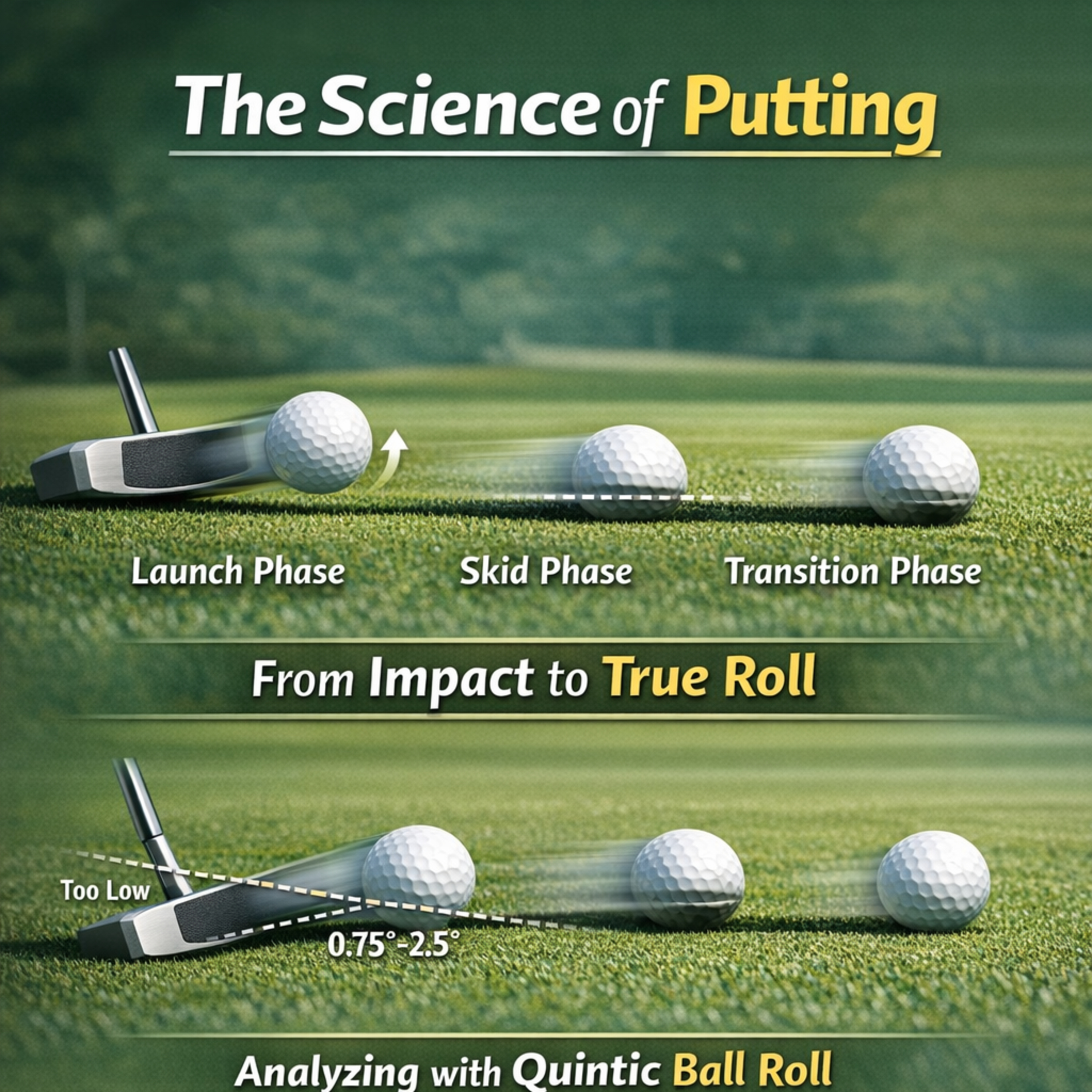
This podcast explores the technical mechanics of putting, focusing on how a golf ball transitions from impact to true roll. After being struck, the ball moves through four key phases:Launch Phase: The ball lifts slightly off the green.Skid Phase: The ball slides without full rotation.Transition Phase: Sliding slows, rotation takes over.True Roll: The ball rolls end-over-end without slipping.The goal in elite putting is to minimize the skid phase and reach true roll as early as possible—ideally within 10–15 cm of impact. Once true roll begins, the ball behaves predictably, improving distance control and start line accuracy.Launch Angle: The Critical VariableThe launch angle determines how cleanly the ball leaves the putter and escapes the “nest” (its slight depression in the grass).Too low (< 0.75°): The ball drags on the surface, causing grabs or bounces.Too high (> 2.5°): The ball goes airborne, landing inconsistently.Ideal range: 0.75°–2.5°Staying within this range ensures smooth launch, shorter skid, and early true roll.Measuring with QUINTIC Ball RollThe QUINTIC Ball Roll System uses high-speed cameras to capture every detail of the ball and putter during the stroke. It tracks:Launch Angle: The vertical departure angle from the putter.Flight Angle: The actual trajectory after impact.Skid Distance: How far the ball glides before rolling.Time to True Roll: Duration to reach end-over-end rotation.Key Insight: Launch vs. Flight AngleBy comparing Launch Angle and Flight Angle, coaches can diagnose if the ball is launching cleanly or interacting too long with the surface.A small difference = Clean launch.A large difference = Grass interference and poor rollout.Real ExampleA player had a launch angle of 0.5°, but the flight angle differed by over 1.5°. The ball snagged on the surface and skidded inconsistently. After adjusting the player’s shaft lean and putter loft, the launch was improved to 1.5°, matching the flight angle—and the ball rolled smoothly with better control.🎯 SummaryClean launch = consistent roll.Launch angle between 0.75°–2.5° = optimal.QUINTIC helps players and coaches fine-tune stroke and equipment for predictable putting results.📺 The Explainerwww.Golf247.eu

This podcast explores the technical mechanics of putting, focusing on how a golf ball transitions from impact to true roll. After being struck, the ball moves through four key phases:Launch Phase: The ball lifts slightly off the green.Skid Phase: The ball slides without full rotation.Transition Phase: Sliding slows, rotation takes over.True Roll: The ball rolls end-over-end without slipping.The goal in elite putting is to minimize the skid phase and reach true roll as early as possible—ideally within 10–15 cm of impact. Once true roll begins, the ball behaves predictably, improving distance control and start line accuracy.Launch Angle: The Critical VariableThe launch angle determines how cleanly the ball leaves the putter and escapes the “nest” (its slight depression in the grass).Too low (< 0.75°): The ball drags on the surface, causing grabs or bounces.Too high (> 2.5°): The ball goes airborne, landing inconsistently.Ideal range: 0.75°–2.5°Staying within this range ensures smooth launch, shorter skid, and early true roll.Measuring with QUINTIC Ball RollThe QUINTIC Ball Roll System uses high-speed cameras to capture every detail of the ball and putter during the stroke. It tracks:Launch Angle: The vertical departure angle from the putter.Flight Angle: The actual trajectory after impact.Skid Distance: How far the ball glides before rolling.Time to True Roll: Duration to reach end-over-end rotation.Key Insight: Launch vs. Flight AngleBy comparing Launch Angle and Flight Angle, coaches can diagnose if the ball is launching cleanly or interacting too long with the surface.A small difference = Clean launch.A large difference = Grass interference and poor rollout.Real ExampleA player had a launch angle of 0.5°, but the flight angle differed by over 1.5°. The ball snagged on the surface and skidded inconsistently. After adjusting the player’s shaft lean and putter loft, the launch was improved to 1.5°, matching the flight angle—and the ball rolled smoothly with better control.🎯 SummaryClean launch = consistent roll.Launch angle between 0.75°–2.5° = optimal.QUINTIC helps players and coaches fine-tune stroke and equipment for predictable putting results.📺 The Explainerwww.Golf247.eu

NOW PLAYING

#451 Golf Putting Mechanics

0:00 15:11

No transcript for this episode yet

We transcribe on demand. Request one and we'll notify you when it's ready — usually under 10 minutes.

Frequently Asked Questions

How long is this episode of Golf 247.eu: The Global Platform for Innovative Technologies and Teaching Concepts.?

This episode is 15 minutes long.

When was this Golf 247.eu: The Global Platform for Innovative Technologies and Teaching Concepts. episode published?

This episode was published on December 28, 2025.

What is this episode about?

This podcast explores the technical mechanics of putting, focusing on how a golf ball transitions from impact to true roll. After being struck, the ball moves through four key phases:Launch Phase: The ball lifts slightly off the green.Skid Phase:...

Can I download this Golf 247.eu: The Global Platform for Innovative Technologies and Teaching Concepts. episode?

Yes, you can download this episode by clicking the download button on the episode player, or subscribe to the podcast in your preferred podcast app for automatic downloads.
URL copied to clipboard!