Hello and welcome to Classical Stuff You Should Know, a podcast about the classical world, literature, and the things that have to do with that. Delivered to you by three guys who love classical education and the classical world. My name is Brian Balanson. I am here with Arthur Jan Hanenberg and Thomas Magby.
And we are here today to talk to you about history. But I just need to confess something before this podcast happens. Listeners, you don't know this, but these two other podcasters have three times offered me the crown to be king of the podcast. And thrice I have denied it.
And I just want you to know that I'm a man of the people. And I podcast for the people. And I don't want to be emperor of the podcast. But if I have to be, I will.
I appreciate that. I just want to put that out there. And I have no fear about the future. And you are my friends.
And I know you've got my back. I'm afraid that if you're putting on this character, there's an elements that you might not necessarily want. I don't want a sexy scandal. All right.
Today, Graham is hinting at it pretty heavy-handed over there. I'm talking about Julius Caesar. And not just Julius Caesar. I'm talking about Julius Caesar and the historian Plutarch and Shakespeare.
I'm doing the whole, I'm doing everybody. It's going to be the whole thing. I'm way over-prepared for this. And it's going to take way longer than I think.
I hope not. I'm going to try to keep it brisk and keep it moving. And you'll see the point when I hit the end of this. So I have to do this first.
Romulus and Remus are stuffed by the sheeple, which is also really cool. Probably didn't happen, but still really cool. All right. So I'm, imagine if you go, a ninth grade English teacher who has recently been teaching Julius Caesar, which is a play by Shakespeare.
I have the image in my mind. Okay. Now, imagine this teacher begins to read some other classical works, namely one history book by a fellow called Plutarch, right? Plutarch wrote a book called The Lives, right?
Or Lives. And it's Plutarch's Lives. It is a fantastic book. I think I've referenced it before in the podcast.
It just talks about the kings of Rome as they are opposed to the kings of Greece. And he'll give you a king of Rome and a king of Greece. And then he'll compare the two and say which one was better or more virtuous. It does not pretend at all at objectivity, right?
I mean, historically, he tries to be objective, but he makes value judgments based on these characters, which I honestly kind of appreciate, right? History books, unless they are just lists of dates and facts, even then are still probably a little biased, right? So I appreciate that he takes one size. And it's incredibly interesting, especially the stuff about like Hurgis, the founder of Sparta, who solved class problems by outlawing gold coins.
It's awesome. Socialism. I mean, you can still have lots of iron ones. Just good luck hauling those around with your donkeys.
So he, I mean, it's a great book. Near the beginning, you might struggle a little bit through, you know, Romulus and Remus because for even Plutarch, that was so far back that the information is really hard to come by. But when you get closer to Plutarch, when Plutarch actually lived, the information gets a lot more credible and that sort of thing. He's a great historian.
It's really interesting. So I, as my great teacher, read this and came to find that it had some bearing on Shakespeare, which I'll kind of reveal later. And all of this concerns a fellow named Julius Caesar. You've probably heard of Julius Caesar.
So I'm going to start telling you about Julius Caesar's life. Part of it is going to be supplemented. The Plutarch is going to be supplemented with a little, you know, some side sources, Wikipedia, for just like basic dates and stuff that Plutarch doesn't necessarily focus on. And then I will give you some stuff directly from Plutarch and then I'll guide you to my conclusion.
So that's the lay of the land. That's where we're going. Cool. So Julius Caesar was born to a patrician family.
They're kind of rich, but they're not that influential in the empire. Their family's called the Gens Julia, which ultimately claims descendants from Aeneas and therefore from Venus or Aphrodite. That was one of the Romans' big claims was that since Aeneas came from Aphrodite and since Aeneas eventually founded Rome, then Rome could claim godhood, essentially. At least the citizens of Rome could or anybody directly descended.
And he was one of these people. The name Caesar comes from an ancestor who was one of these three options, either born by a Caesarean section. It's either that, because of the Latin, the word Caesar to cut. It's also possible that the name comes from having a thick head of hair or from having gray eyes or from one of his ancestors killing an elephant.
So it's one of those four things. Either Caesarean section where he had nice hair or gray eyes. Caesar himself favored the elephant version of this probably because he issued even a coin with the elephant on it. I think he was fond of that one.
He thought a lot of him and himself and his family. Wait, just when you're saying that, so Rome, does that mean that Rome have this close association with Aphrodite? I remember reading this when I was a little kid and I don't know if it was just the author was just saying this for fun or if this actually had credence, but does that have anything to do with Roma or being amor backwards? Does it have anything to do with the word love and the word for Rome?
No? I doubt it. Maybe if someone found out the city and was like, let's make it love backwards. It may have just been some fun kid's book about Rome and I remember reading that Rome has a secret word and it was amor.
But that may have just been a little kid's book. Anyway. So I'm going to keep on giving you some bare facts and I'm going to give you an overview of Caesar's life. Bare facts.
Bare facts. And then I'm going to go back and sort of fill in this picture a little bit. So at 16 years old, his dad dies, making him the head of the family. And this also coincided, this is in 85 BC, with a civil war between two guys, Marius and Sulla, who were fighting for control of the empire.
Now Marius happened to be his uncle. Gioff also happened to be on the losing side of this. And Sulla won. And so because Sulla was in charge, he stripped Julius Caesar of his priesthood.
He was going to be a priest of Jupiter. And I think there's actually some political intrigue going on in the background here. I think Sulla himself was up for it and kind of said, no, let's give it to Julius. And then eventually it got around that he was probably going to kill Julius.
And so Julius sort of took off and did not want to be there anymore, which makes a lot of sense. But it's kind of good because a priest of Jupiter is forbidden from touching a horse, sleeping three nights outside of his own bed, or one night outside of Rome, or even looking on an army. So if young Julius had stayed a priest of Jupiter, he would have lived a completely different life. I've almost done all of those things.
Except sleeping in Rome. Not that's worse. And so he leaves to avoid Sulla and his murderous ways. And he actually tries to stay out of the limelight pretty aggressively here.
And eventually joins the army. And he wins a civic crown for his part in one of the sieges. He goes on a mission to Bithynia to get help from a king there. And he actually stays way too long down there to get help from this king.
And rumors start to circulate about maybe a relationship going on there. It's doubtful. But those rumors would kind of plague him for quite a long time. On the way back, he was kidnapped by pirates.
Which I will tell you about later, at more length. Well, fun fact about Sulla, he had a really bad skin condition. Super itchy and his face was all like pop marked from it. So he heads back to some military action in Asia.
He is elected for, after Sulla kind of gets out of there, he's elected for a chaos store in 69 BC. He delivers a funeral oration for his aunt, Julia. His wife, Cornelia, also died that year. And so he gives these funeral orations for them.
And doing funeral orations for older women was a thing, right? Everybody did it. And his was so touching. And then he gave one for a younger woman, his wife, which was not a thing people typically did.
And it was so human that it won a lot of acclaim from all the people. They're like, wow, he's what a nice guy, right? Saying these nice things about his wife. And he felt like that was a really good time to sort of make some political moves.
And so he sort of brought out some of the images of Marius that had been pulled down before. Remember, Marius was defeated, his uncle was defeated by Sulla, his opponent. And so he brings these out and was like, great, he's bringing back some of our heritage and all these people that have been so oppressed for so long. And so he garnered support from some of those people that supported Marius, but hadn't been able to say anything for a really long time.
He serves his chaos for shit in Spain. While he's there, he encounters the statue of Alexander the Great. And he's very dissatisfied. And he even cries a little bit.
And basically he... He's dissatisfied with the statue? No, he's dissatisfied that he hasn't done as much with his life as Alexander the Great had done at his same age. Alexander had had most of the world at his feet at this point in Julius Caesar's life.
And he's like, man, I haven't done anything worthy of note yet. I feel that way when I've been watching the recent World Cup. And some guy scores like four goals. He's like, look at that, 19-year-olds go.
I'm like, oh, man. On return, he married Pompeia, a granddaughter of Sulla, and sort of helps... Oh, I got your granddaughter. He later divorced her.
I'll give you some more details on that scandal. Remember, I mentioned a sexy scandal. Oh, that's coming. In 65 BC, he was elected the serial aedile.
He saved some lavish games, winning him support. In 63, he got Ponce de Pex Maximus after running against two other powerful senators. There was lots of muscling. Basically, it's just a story of a slow gain of political power.
He keeps on being elected to things. He keeps on doing well. And he consistently gains the favor of the people by spending money, putting on games. And he's pretty free with his money.
Some people are like, dude, you are paying dearly for support. And he was actually... That support ended up meaning more than the money ever did. He was acclaimed imperator in 60 and 45 BC.
Only your troops could do this, if they really liked you. It was necessary for having a triumph, which was one of the greatest honors in Rome. A triumphal entry. We talk about that in the scripture, right?
So it's kind of the same thing where a conqueror would come leading all of the spoils of war into Rome and he would get this laurel wreath, and they would usually build an arch for him to walk under. That's why we see a lot of those arches built in Rome even today. He had a big military career. He ended up redistributing some lands of the poor, using arms of Nibi.
He eventually started a thing called the... I'm wondering how much I want to give you on my first pass here. He sounds like a decent dude. I'm sure he's doing it for a political game, but he's doing good stuff, right?
Yeah. I mean, he was. He also kind of went into debt and tried to avoid some of that debt. That's a bummer.
But so is everybody else in the United States. So at this point, he has... Hard hate and commentary. So at this point, he has started something called the First Triumvirate.
And it's power... Like we have this power in the podcast. A power of three men. Can I be the rich one?
Sure. Crassus. Yeah. Pompey.
Yeah, you're Pompey. I'll be Caesar. I'll be Pompey. When you die, someone pours molten gold in your head.
In my head? Yeah. I don't think that was Pompey. I think you're thinking of somebody else.
I don't think that was Pompey. I'm pretty sure it's Pompey. I just don't like molten gold in my head. No, Pompey died in battle.
In the guy's head. Different Pompey. Pompey, Pompey, anyway. The Pompey Julius Caesar fought, died in Egypt, being killed by an assassin.
Yeah, then he's literally his head full of gold. Really? I think so. I love Pompey.
Yeah. Then he went and had the Gaelic Wars. I'll tell you more about those wars later. Proved himself a great warrior.
Came back, and during those wars, the triumvirate failed, and Crassus kicked it. I stink. And so Caesar's out of town, fighting wars. Crassus kicked it.
If you're Pompey, and the two other legs of your power are gone, what do you want to do? Yeah. You're Pompey. You have been ruling Rome with two other fellows.
One is now dead, and the other one's out of town. It's only two new dudes, right? So I can keep power. Oh, you think I'm going to die next when I get out of town?
Why not? You just take power. You're the only one in Rome. I need three.
I'm a terrible dictator. I am a terrible dictator. You have all the power now, dude. Take over, man.
Yeah, for sure. Burgeoning political career. Goes out for the wars. Eventually, it comes to civil war.
He takes full control, and then is assassinated. How old is he when he dies? He is, I think, 60-something? 68?
67? Okay. Let's talk about how Plutarch addresses all of this. Plutarch gives some more colorful details, and he doesn't necessarily focus so much on dates and facts and the offices that he got, but more some of the way that those things came about.
So you remember the whole Sulla thing that happened, and the reason he left is because he had heard that Sulla had said he saw many Amarius in Caesar. Amarius was the guy he had just bested. So he's like, that guy looks dangerous, and I am. And so he heard that Sulla thought these things of him and took off.
And he eventually, as he was changing houses, got caught by the men of Sulla. And the only way he could get out of it was by offering a huge bribe. And so he did. And he got off, and he wasn't killed.
And this is when he sort of did his military campaigning, and then went to Bithynia, and on his way back, he was captured by pirates. Let me tell you a little bit more about that pirate instance. This is from Plutarch. So I'm going to read.
Yeah, this is verbatim from Plutarch. When these men at first demanded of him 20 talents for his ransom, and a talent, by the way, was an exorbitant amount of money. We're talking, I think, I tried to look it up. The best evening I could, you know, the best weight measurement I could get was, it's like a weight measurement of gold or silver, and it's equivalent to about 16 years of salary.
One talent? Yeah, one talent. So 20 of those, which is just a gob of money. So they asked him 20 talents for his ransom.
He laughed at them for not understanding the value of their prisoner, and voluntarily engaged to give them 50. He presently dispatched those about him to several places to raise the money. So at last he was left among a set of the most bloodthirsty people in the world, the Cilicians, only with one friend and two attendants. Yet he made so little of them, that when he had a mind to sleep, he would send to them and order them to make no noise.
For 38 days, with all the freedom in the world, he amused himself with joining in their exercises and games, as if they had not been his keepers, but his guards. He wrote verses and speeches and made them his auditors. And those who did not admire them, he called to their faces illiterate and barbarous, and would often, in raillery, threaten to hang them. They were greatly taken with this, and attributed his free talking to a kind of simplicity and boyish playfulness.
He's funny, he's talking about it. So he'd write poems, and they'd be like, that poem sucked, and they'd be like, I'm going to hang you. And they're like, I'm going to hang you. As soon as his ransom was come from Meletus, he paid it and was discharged, and proceeded at once to man some ships at the port of Meletus, and went in pursuit of pirates, who he surprised with their ships still stationed at the island, and took most of them.
Their money, he made his prize. So he paid them, got them, and took all their money back. And they hadn't left, because I don't think they understood the guy that they were dealing with. Their money, he made his prize, and the men he secured in prison at Pergamos.
And he made application to Junius, who was then governor of Asia, to whose office it belonged to Praetor, to determine their punishment. You're like poems now? Yeah. Junius, having his eye upon the money, for the sum was considerable, said he would think at his leisure what to do with the prisoners, upon which Caesar took his leave of him, and went off to Pergamos, where he ordered the pirates to be brought forth and crucified, the punishment he had often threatened them with while he was in their hands.
And they little drenched he wasn't earnest. And he actually, from his mercy, he had their throats cut in the middle of it. So he's captured by pirates. He writes poems and plays their games.
He has a great month. He calls them idiots, illiterate, and barbarous. He's friends to hang them. And then they let him go.
And he does exactly what he promised to do. So that's kind of the guy we're dealing with. And then after that, he goes and is schooled in rhetoric. So kids, if you're listening at home, he doesn't sound such a great guy anymore.
We'll see how you feel at the end of this. So he goes to be schooled in rhetoric at one of the same schools that Cicero was in. And while he could have attained a high position as a rhetorician, he was a great speaker, he decided more to turn his attentions to military and statesmanship rather than being a speaker of men, right? So he goes home.
He starts being a lawyer. And I'm going to gloss over some of this. Here's a little passage about this time from Plutarch. In his pleadings at Rome, his eloquence soon obtained him great credit and favor.
And he won no less upon the affections of the people by affability of his manners and address, in which he showed a tact and consideration beyond what would have been expected at his age. And the open house he kept, the entertainments he gave, and the general splendor of his manner of life contributed little by little to create and increase his political influence. His enemies slighted the growth of it at first, presuming it would soon fail when his money was gone, whilst in the meantime it was growing up and flourishing among the common people. When his power at last was established, and not to be overthrown, and now openly tended to the altering of the whole constitution, they were aware too late that there is no beginning so mean, which continued application will not make it considerable, and that despising a danger at first will make it at last irresistible.
Cicero was the first who had any suspicions of his designs upon the government, and as a good pilot is apprehensive of a storm when the sea is most smiling, saw the designing temper of the man through his disguise of good humor and affability, and said that in general, in all he didn't undertook, he detected the ambition for absolute power. And then this is quoting Cicero. But when I see his hair so carefully arranged, and observe him adjusting it with one finger, I cannot imagine it should enter into such a man's thoughts to subvert the Roman's tale. So Cicero's like, he's not a man, but he's not a man.
So Cicero's like, he's not a man. seems really ambitious, but man, he's such a dandy that I can't think that he actually wants it. So then he has the episode where he praises his dead wife and his aunt, Julia, when they die. That's after he does rhetoric school, or whatever it's called.
Yes, after he does rhetoric school and stuff. He was pretty free with his cash again, and eventually designed to make Marius' fans his fans, so he gets a whole bunch of support. And then he has a weird scandal involving his wife, Pompeia. This is his second wife, remember, the first one died.
Sulla's granddaughter. Sulla's granddaughter. And I think by this time, Sulla's kicked it, so he's pretty open with his overtures towards Howard now. So there's this festival called the Bonadilla, or Good Goddess.
Men aren't even allowed to know the name of this goddess, so it is a only for the ladies. When they celebrate this, everything male has to leave the house. Everything. We're talking dogs, chickens, any male is expelled from the house, and then they have they bring in all the ladies, and they have these secret events.
Now there was a guy, Clodius, or Claudius, and I can't help but wonder if this is where being a clown comes from, but he dresses as a woman, sneaks into these games, which is not okay at all, getting into, you know, if you offend the gods, you're in big trouble. This is a huge breach of religion in general, and decency at the very least. So he dresses up as a woman, and he's kind of sneaking around, and I think he had an inside servant that let him in, and then eventually someone comes up and is like, hey, let's do the things we're supposed to do in the thing, and he's like, he has no idea. Yes, lady!
I'm a lady! And she's like, wait, who are you? And she looks face, and she's like, oh, man! And then everyone freaks out, and they try to hide everything that's secret, and it comes out that what Claudius was intended to do was seduce Caesar's wife.
That's why he was there. Why at the party? Anyway, whatever. And so there's this big scandal, and eventually Caesar, even though it's not known whether she had anything to do with it, or she had a relationship with this guy, it could have been that it was all his idea.
I was like, she hot, I'm going. But it could have been that she had something going on with it, and so he quietly divorces her, and everyone's like, why? She didn't do anything wrong. He says, well, my wife has to be above reproach.
She has to be above question. And so he divorced her. I was like, the part where he said he killed Claudius, but... He actually gets Claudius involved in government.
Wait, really? So he wanted to divorce Claudius, but he just hired Claudius to do this. It's very possible. I also want to know, what happens at the party?
What do they do? I don't know. We're just hanging out by them? We're not supposed to know.
It's cool. We have this guy stuff and this girl stuff. Cariopee? Yeah, wine and cariopee.
Really fun. Awesome. I'm going to have any Roman cariopee right now. I got nothing.
Lots of lutes. Yep. Okay, so he goes to be a caster in Spain and ends up getting a lot of debt. To get out of debt, he has to call on this felony in Crassus.
And I told you about Crassus. He's one of the first triumvirate. Do you know how I made all my money? I would burn your house down, and then I would buy the land, and then rebuild it.
I own the fire department. So actually, what would happen would be, somehow your house would catch fire, and he'd be like, oh, my house is burning in Crassus, and your fire department, can you put it out? And he'd be like, yeah, I can put your house out, but how about you sell it to me? How about you sell this property?
And he'd be like, yeah, yeah, yeah, I'll sell it to you for $10,000. Actually, your house is burning down. The price is now $8,000. Okay, okay, okay, okay.
Then he'd sell it for $8,000, and then I'd buy this property, and then I'd put the fire out, and I'd build it, and then I'm re-itch. It's messed up. It's true. He's a bad man.
I think that's what Michael Bloomberg did, too. I don't think he'd burn. He didn't burn places down. Oh, okay.
No, that's probably true. Anyway, this established the relationship between me and you, between Julius and Crassus. And then you, Crassus, and you, Pompey, you hate each other. You are not fans.
You've been at odds forever. And I realize that if I can make you two friendly, we three have enough firepower to pretty much run this place. Pompey, you were pretty cool. I mean, if Caesar wasn't around, you would have been the top boy in Rome.
You've got all the talents. You've got, like, you're a first-line center on a good hockey team. Julius Caesar is generational talent. But if I run this Triumvirate thing now, I'm dictator.
Not yet. So this is right at the beginning, and we're elected consul. We're the first three-man consul. Usually that's a duo, and then eventually they elect a new duo.
So we pretty much run everything. And we do it partially through shows of power. I, Caesar, would propose this thing that the senators didn't like, and the senators would cross me, and I would say, all right, you guys are crossing me. I'm going to have to go run up other people.
And I'd run outside and be like, do you guys agree? And I'd be like, yeah! Meanwhile, I'm giving them buckets of money. And you would be running out your military.
So the Senate would be really terrified. We clearly have enough money, power, and influence to make all of this happen. We run the place. We run the story.
I like the story. This is good. And the way that I kind of healed the rift is by having, I think it was, Pompey marry one of my kids. It's kind of like the prequels of Star Wars.
Like, you're Jar Jar and the Emperor. Oh, I'm sorry. And he's like the Galactic Senate. There's Jar Jar who, like, Jar Jar doesn't, like, Misa submit this affidavit.
Are you saying that Jar Jar is part of the Triumvirate? It is, yeah. Jar Jar's a dark lord. In the family.
He's just some random dope. No, like, they make him a senator. But you said there's also a theory that Jar Jar is like a sif the entire time that he's the one orchestrating everything. There's also a theory in Karate Kid that the main protagonist, what's his name, Johnny?
Sure. Yeah. Daniel-san. Oh, Daniel.
So Daniel is a mentally addled, anti-social kid that routinely assaults people who don't deserve it and stalks women. And he goes through all of these scenes to show how he's done. If you just watch the movie, not from his perspective, if you watch it from, like, Cobra Kai's perspective, you'll be like, Daniel-san is a problem. We gotta get this together.
We gotta beat him up in the parking lot. Yeah. Okay. So he goes off to the wars.
And this is kind of a shift in his life between his previous political stuff and he's moving into his military campaigns. So he leaves. And you guys are both still alive. You're kind of running Rome.
Good. You're in charge. I like this. And he takes off.
And let me just read you some stuff about him as a general and as a man. This is coming from Plutarch. He was so much master of the goodwill and hardy service of his soldiers that those who were in other expeditions were but ordinary men displayed a courage past defeating or withstanding when they went upon any danger where Caesar's quarry was concerned. Such a one was Asilius, who in the sea fight before Marseille had his right hand struck off with a sword yet did not quit his buckler out of his left but struck the enemies in the face with it until he drove them off and made himself master of the vessel.
So he loses his sword hand and just beats him up with his shield until he takes his ship back. Such another was Cassius Saeva who in a battle near Deer... It's a place, Deerhackium had one of his eyes shot out with an arrow his shoulder pierced with a javelin and his thigh with another and having received 130 darts upon his target called to the enemy as though he would surrender himself but when two of them came up to him he caught off the shoulder of one with a sword and by a blow over the face forced the other to retire and so with assistance of his friends who now came up made his escape. Again in Britain when some of the foremost officers had accidentally got into a morass full of water and there were assaulted by the enemy a common soldier while Caesar stood and looked on threw himself in the midst of them and after many signal demonstrations of his valor rescued the officers and beat off the barbarians.
He himself in the end took to the water and with much difficulty partly by swimming partly by wading past it but in the passage lost his shield. Caesar and his officers saw it and admired and went to meet him with joy and exclamation but the soldier much dejected and in tears threw himself down at Caesar's feet and begged his pardon for having let go of his buckler. So they're inspired by Caesar's presence and here's why. Added to this also in the discussing Caesar there was no danger to which he did not willingly expose himself no labor from which he pleaded an exemption his contempt of danger was not so much wondered at by his soldiers because they knew how much he coveted honor but his enduring so much hardship which he did to all appearance beyond his natural strength very much astonished them for he was a spare man he had a soft and white skin was distempered in the head and subject to an epilepsy which it is said first ceased in the Cordoba but he did not make the weakness of its constitution a pretext for his ease but rather used war as the best physic against his indispositions whilst by indefatigable journeys coarse diet frequent lodging in the field and continual laborious exercise he struggled with his diseases and fortified his body against all attacks he slept generally in his chariots or litters employing even his rest in pursuit of action so it's not like he commands them to go do stuff he was in the front lines he fought routinely there was even an instance where they were visiting this poor guy's house and he, Caesar, the leader of the armies could have taken charge but there was a sick guy in the team so he let the sick guy sleep inside and everybody else slept outside including him he was a sickly guy but in order to combat that sickliness he just sort of worked it he worked hard alright there's two more stories I want to tell you one is at the table so when he was at the table of Valerius Leo who entertained him at a supper in Milan a dish of asparagus was put before him on which his host instead of oil and poured sweet ointment so I think it's kind of like perfume instead of olive oil but it buys a mistake?
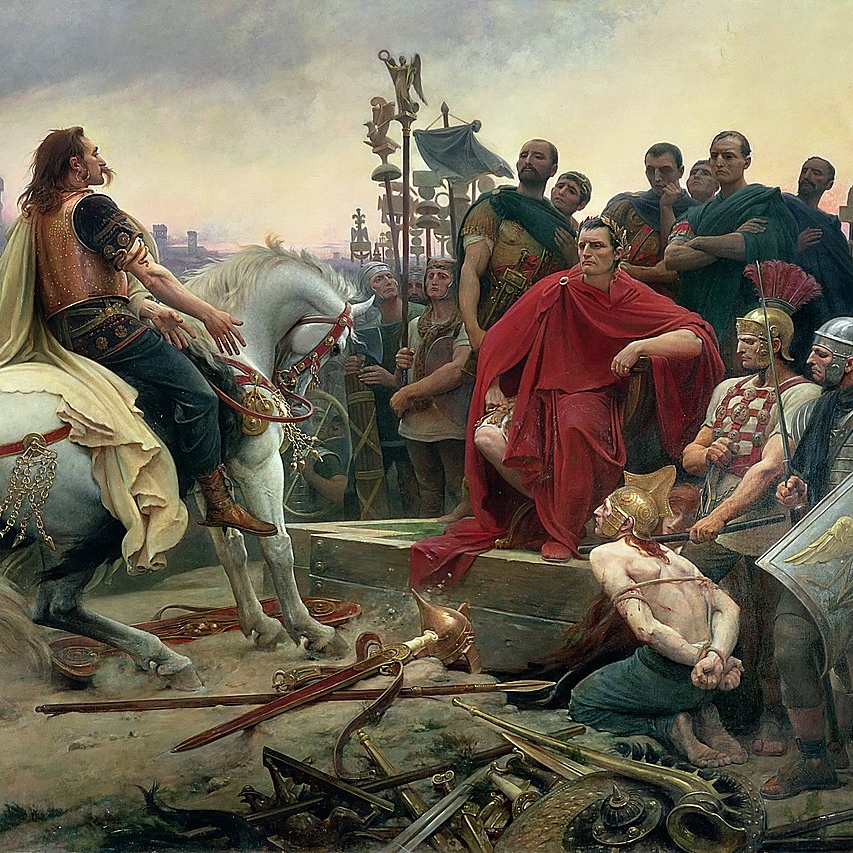
yeah this was not that's not good Caesar partook of it without any disgust and reprimanded his friends for finding fault with it to quote for it was enough, said he not to eat what you did not like but he who reflects on another man's want of breeding shows he wants it as much himself eat that perfume instead so good alright and then there's so we're getting on the big drama here and as a last moment I'll tell you about an instance where he pursued a rival king to a town and he besieged the town and built some walls somehow word got out to the rest of this guy's army that he was besieged in a small town and so they're marching up behind Caesar was this the French king? De Gaulle? I think so yeah I can read it to you let's see where is it Gallic fashion oh Vergentrix is his name it's this Gallic barbarian king and so they build the walls around Vergentrix his army finds out and they're coming to kill Caesar so Caesar builds another set of walls around him so he has bad guys on the inside and bad guys on the outside and the guys on the inside sort of find out what's going on and so start attacking and the guys on the outside are attacking and somehow Caesar with some horsemen breaks out of his wall goes and routes the army outside of his wall and he does it so fast so speedily does he destroy this army that the men that are fighting on the inside of Caesar's walls don't know what has happened until they see their own army bringing in like bloody armor and bucklers and horses and stuff that they've looted and then in Vergentrix he sees this he sees like Gallic fashion swords and armor and stuff being brought in he knows that his army has been destroyed and he just he walks out of the city sits down on the ground and takes off all his armor and just sits there until Caesar comes up it is awesome so Caesar is no slouch when it comes to war and he was the main trophy in his triumph yeah and Plutarch notes that of the 3 million men that Caesar fought while in the Gallic Wars which by the way took him all the way to Britain that they thought was a myth at that point and by the way was so poor that he pretty much just hurt people more than he did himself any favors because they didn't have anything worth stealing in Britain at the time apparently he went looking around and was like this place kind of sucks they're fighting me but even then they're not fighting with that much spirit because they're like take my sticks I don't know man it's not that cool like whatever and so he he fought 3 million men he killed a million and took 1 million captive and then the other million he left to be allies of Rome so then he heads back but this time remember Crassus has died and so my money won't save me and his dealings with Pompey are on the fritz I think because his daughter had died and so Pompey was wifeless and so there's nothing tying us together and so you think you're going to take the city so you do you make over to take the city and as I come to the Rubicon I'm not allowed to pass into Rome with an army I'm not allowed to lead my army across this river and so I am and I haw and Caesar wondered what kind of damage he was going to do to everyone to mankind what sort of horrors it would bring if he brought his army into Rome and he thought about it for a really long time he asked the council of his friends and eventually he was just like you know what rock and roll and he said a famous line let the die be cast or the dice cast it's one of the two basically I've rolled the dice here we go folks and after he made that decision to cross the Rubicon with his army he didn't take it slow he started taking cities that night before the next morning he had taken a city and so what happened as he took cities is he would take the city and he'd be really nice he'd be like look just support me you guys chill and chill and he'd be like yes we're chill we are chill we're chill indeed and he'd be like great except people would hear he was coming as they started running to a town further away and this kept happening and so there's this flood of people running from town to town away from his advancing armies so he conquers each each one along the way because there are fewer people one of my favorite stories is that as he was coming up on a town the mayor of the town thought he was going to die for certain and so he had his physician come and give him what he thought was poison to kill himself the physician didn't want to be responsible for his death and so he gave him sleeping pills and so and then the messenger comes in and he's like hey man it's okay I hear that Caesar's really nice to anybody that he conquers and the guy's like oh why did I take the poison and at that point the doctor's like dude I got your back it was just sleeping pills and he's like nice see you in a couple hours see you in a couple hours and so he passes out for a while and then loses to Caesar and eventually he actually supports Pompey anyway but by the time Caesar has reached Rome Rome is so full of these fleeing peoples that the city is in total chaos everyone's raised to Caesar is packed to the gills there's no room for anything that city was not made to hold that many people and so Pompey is not in control of things anymore obviously and so eventually bails Caesar takes the city he takes money out of the treasury to pay his armies and there's a guy that actually tried to stop him and he's like don't do this wrong he's like dude get out of my way and the guy's like Caesar you know this is wrong he's like I have been nice to you but I don't have to be and the guy's like message take it and he leaves and Caesar gets the money and then he pursues Pompey and they have this grand civil war when does the Cato thing happen? Cato kills himself because he doesn't want Caesar to be around I'm not sure it might be right around here but I don't know about that one that may be when Caesar's considering being the king so this big civil war ensues and I can't give you many details suffice it to say that Pompey ends up fleeing to Egypt where he is assassinated by the king of Egypt by one of his assassins to garner favor with Julius Caesar who comes down and he sends him his hand full of gold so this says that it was Crassus and the seemingly wealthy Roman general's roommate would have died this way aw dang it so it was me it was me all along your roommate would have died that way in any case Caesar cried and he saw Pompey's head remember they were friends and he's so sad that he had the assassin killed and then you know how the king of Egypt was trying to garner support he actually supported Cleopatra that he's rival in their civil war and so he sets up Cleopatra on the Egyptian throne makes a nice ally and then heads back to Rome oh yeah makes a nice ally don't they oh yeah they hang out doesn't they have a little child yeah he actually has a kid with her and he continues that affair through their entire pretty much entire life and no one really saw his genius it was like a thing that he did and it was okay and so he returns to Rome and this is where we're bumping up against Shakespeare so he comes back to Rome and he has a triumphal entry for his defeat of Pompey now as a Roman citizen Pompey's another Roman citizen and especially after he goes out and defeats Pompey's kids then he comes back it's a bummer how would you feel about that it's almost like say you know say Trump had led a civil war against Marco Rubio killed Marco Rubio and then murdered his kids would you be super stoked about the parade no he would be sad you would think this was like a blemish on the republic right and so the people really love Caesar and so a lot of them are claiming him but a lot of the senators and the people who love Pompey and were on Pompey's side feel real conflicted about this and this is where Shakespeare's play opens it opens on that day the day of the entry and also I think it coincides with Lupercal so it's a big parade Caesar comes in and some of the senators are like pulling scarves and garlands off of Caesar's statues to like knock him down a few pegs like this will make him fly right and they pull some things off and they're actually arrested for that and Caesar is pretty much in charge now at this time he was elected dictator for life he's pretty much in charge of everything but there's still a Senate isn't there yeah it just doesn't do anything he passes some laws that reduce their power consistently and this is why the conspiracy and that's when Cato kills himself this is why the conspiracy comes about because they can see that he kind of intends to reduce the power of the Senate and the people until he does no more their power is threatened he keeps on garnishing more and more and more power and setting up people that support him in places of power and the thing is though he's kind of doing a good job he redistributes some of the public land to the poor and to his armies he revises some of the laws he resets the calendar we actually still use the calendar right July is named for Julius so he pretty much set up the calendar we still use today he was going to make one of the cities into a port he was a really good statesman the people liked him for reasons because he did a lot of good things for them but the conspiracy comes about and the conspiracy is centered around two fellas Brutus and Cassius now Brutus and Cassius for anyone who's read Dante you know that they end up in Satan's mouth because they betrayed the lord brutus is a great man like bar none he's a great guy and julius caesar when he was fighting with pompey because brutus had supported pompey actually a couple of times i heard that he was in danger and was really scared for him and then got news that he was okay and he brought brutus in and he said look i know you've been supporting pompey support me i'll make you in charge of town let's be friends just like i said he was nice to anybody he conquered he was incredibly generous to brutus and he actually had kind of a thing for brutus's mom so he was wondering brutus might be his kid oh okay well wow yeah is that in the blue card yeah okay so he has a thing for brutus's mom it was kind of out in the open and thought it might be his kid so he has some pretty solid feelings for brutus cassius on the other hand was a bit of a dirtbag and on a couple of different occasions caesar would say things like yeah i don't like that guy he's too skinny he thinks too much right like i don't know anybody i should be afraid of more than that cassius over there and so cassius finds out that as julius caesar is getting power brutus is kind of feeling weird about it and so presses that convinces him to join the conspiracy and together they killed julius caesar on the eyes of march so march 15th and casca the guy who made the first blow came up and stood behind caesar as they were all sort of kneeling around him stabbed him in the back of the neck caesar grabbed his hand looked at casca in the face and said casca you villain what do you think you're doing and casca was like help like he's like oh no and so everyone starts stabbing and there were so many blades flooring around that many of the conspirators actually cut each other because it was just accidental right and so he died that day and then eventually it dissolved into civil war so why do i bring this up what can i say so um you're probably going into this but when shakespeare tells it i feel like it's a more complicated story and don't take clearly takes a side in saying that brudus and cassius did a bad thing but the history you set up makes it sound much more reasonable that brudus would take part in this that the murder would occur you think that's reasonable or not yeah um yeah knowing that he is gathering as much power as he is he is taking away from the senate that he has killed a roman citizen is celebrating the death of a roman citizen like just because so julius ceter's always been a political dude and so he's doing things to get more power so in the same way him redistributing land is to get more power and to get more favor i mean the people he has he has the power the people who are benefiting are not going to oppose him it has to be someone like brudus in the senate has to be someone who is a check on that power and yeah it just makes me much more sympathetic to um brudus well shakespeare paints a picture that is gray right he it doesn't spend much time with julius ceter it makes him seem at worst a little bit foolhardy which he was he balked at danger he didn't think he could ever touch him he was very prideful and even the day i think like near nearby when they're gonna kill him somebody was talking they're like what is the best kind of death and he in the other room goes i'm not expecting one like he yelled it through the walls and it's i like that play because it's not a clear cut and dry who are the good guys and who are the bad guys right and part of that is because it's horrible after reading plutarch i found that shakespeare had not invented most of that play he pulled sometimes verbatim from plutarch and even before the the death of caesar there are omens right that happen in the in the capital right there's a line walking around there are noises there's blood drizzling from the sky there are owls at noon sort of screeching in the middle of the theater that's not okay like that's weird that's a bad omen for them there's it's a bad omen for everybody yeah there's like blood dripping from your walls i mean you don't want you to get that check out yeah and there's a guy walking around with his hand that looks like he was on fire and they put it out and he's fine and then there's a bunch of glasses that's just cool yeah and the thing is these happen like these are recorded by plutarch as historical events so the reason i think this this kind of dovetails nicely with grams is that as an english teacher teaching julius caesar prior to reading plutarch i could easily have made the mistake of trying to look for too much symbolism in those omens or too much symbolism in some of the things that some of the characters said or did when really he was just kind of lifting wholesale from plutarch and putting it nicely i'm not i'm not saying shakespeare did a great job of the play it's just very clear he was drawn from a single source about what happened and i'm gonna give you some comparisons here but like the omens he lifted directly uh the fact that brutus after he killed caesar before the final battle in which he died talked to julius caesar's ghost happened right he and brutus actually had a lot of trouble with it because he did not believe in ghosts so the next day he's like cassius we gotta chat i saw something weird last night and i really need to know how to think about it uh the the fact that cassius died on his on the dagger that stabbed caesar was true it's not symbolic it's just something that happened and fortuitous cool the fact that he died on his birthday cassius that like the final battle for his freedom happened on his birthday and that's when he died actually happened that portia brutus's wife when he was thinking of joining the conspiracy against caesar that he she had to see if she could handle a secret like that cut herself in the thigh gave herself a big gash and then covered it to see if she could deal with it you know in a steadfast way that happened his wife was so awesome that she just to see if she could handle a secret when i can do this and she pulled back her skirt to show this giant like gash that she had made and he was like holy cow you're hardcore you're an intense woman that she died later out of fear for him and from being like kind of diseased and she was captured after he left the town she actually shoved coals in her mouth and that's how she died burning hot coals she swallowed hot coals to kill herself that that happened like all of these things are lifted directly from plutarch and so that's just another sort of facet of the symbolism question someone coming to this book having never read plutarch or not really knowing the story could easily think that these things were intended to be symbolic the ghost talking to brutus cassius dying on the same blade of caesar dying on his birthday all the omens all of these things but they're not they're sorry we got some drilling happening outside the apartment right now so if you're hearing all this random drilling that's that's the thing that's happening uh so i don't know i i read this and i was impressed and it doesn't make me love the story any less it just makes me leery sometimes of jumping to conclusions before i know source material for something especially if it's historical so roman and juliet was lifted from an old myth but the myth doesn't give as many details as roman and juliet does roman and juliet goes far further and they're not historical characters right whereas julius caesar is do you guys want some examples of like side-to-side comparison here yeah i um i think so i hear that shakespeare's looking from plutarch but the thing i'm thinking is that plutarch is attempting history but that's not to say that everything is perfectly historical yeah for sure i don't know plutarch usually tries to note when things aren't yeah so just to say that like there are things that could be symbolic and plutarch that are brought into shakespeare shakespeare could use them symbolically or they could have been symbolic and plutarch so it's the same like they're both being used symbolically plutarch was it's history he's not intending anything to be symbolic it was symbolic it was because people had seized on those and and kept them as history and he recorded it is that your point i just think i think it's a little more complicated than that because he is he is recording history he's making value judgments this is what he started with but he's making judgments throughout history and so um to say it's a story about history and not all of them necessarily actually happened they're recording plutarchs of meetings between people who couldn't have actually met because they lived hundreds of years apart from each other um in the same way with these events of julius caesar um but plutarch while plutarch isn't fully reliable as a historical source it has it has some gaffes it is not intended to be a story about history he intends to record things as he thought they were historical at the time definitely not gaffes so it is a more thing that's legendary sense of history it's a more um yeah it's not just wikipedia here's a list of things that happened um yeah the thing is wikipedia is also drawing from plutarch like he is one of the historians that we draw from and there are some other things that fix that but wikipedia select plutarch even about the three million men that he fought while he was in the gallic wars it wasn't exactly three million no but this is i mean we couldn't have recorded exactly how many people died there was no keeping census up there the only way we could get that information is legend from him his men and what they brought legend is the right word for it so even three million if it's coming from plutarch arguing about your life that exactly three million people were impacted by wars no but my point is that this is about as historical as we can be you can't really get closer yeah right so he got as close as he possibly could he did not i don't think plutarch intended symbols there may have been symbols because they were part of the legend but the legend is as close as we're gonna get in some of these instances in any case uh let's see i want to find so here are it's about the omens that happened before julius caesar died and i forgot to finish the story so julius caesar was assassinated cassius and brutus flee because the people really turn on him and after this rousing speech by anthony anthony gives a funeral oration that kind of turns all public opinion against bruce and cassius it's pretty awesome and the shakespearean version is the only version we have we know that the speech happened that there really was a speech given mark anthony that changed everybody's minds and after that they rioted and that bruce and cassius had to flee rome we don't know what it was actually said so the best version we have of that is shakespeare they ride out they eventually go to battle against anthony and the upcoming emperor octavian and they lose and that's it so and octavian is shakespeare's nephew yeah sorry shakespeare's nephew caesar's nephew okay so here's a little bit from the omen so we include tar first for touching the fires in the elements and also the solitary birds to be seen at noonday sitting in the great marketplace men were seen going up and down in fire and furthermore that there was a slave of the soldiers that did cast a marvelous burning flame out of his hand insomuch as that they they that saw it thought he had been burnt but when the fire was out it was found he had no hurt caesar's self also doing sacrifice unto the gods found that one of the beasts which was sacrificed had no heart and that was a strange thing in nature how a beast could live without hearts history thomas okay and so looking at the actual play so casket says but never till tonight never till now that i go through a tempest-dropping fire and yesterday the bird of night did sit even at noonday upon the marketplace hooting shrieking i'll be an owl and then again a hundred ghastly women transformed in their fear who swore they saw men all in fire walk up and down the streets here's another one a common slave you know from all by sight held of his left hand which did flame and burn like twenty torches joined and yet his hand not sensible fire remained unscourced just like some common themes going on in these omens well yeah fire and looking like you're on fire but my point is he's drawing pretty directly um if you're interested both caesar's life and bruise's life are really interesting reads and julius is a great play but they are i think they're even more powerful when you read them in tandem and you sort of see the original story as it was in plutarch as shakespeare would have read it and then read his version of julius caesar and the events there cool yeah do we have a rubicon does our republic have some rubicon something that if it was crossed it's like a sacred i think borders if somebody crossed our borders within the republic itself i guess maybe if like someone like like you know rome has this legend that you do not bring an army across the rubicon i'm just wondering like we don't really do we yeah do countries do that anymore or do like nations have these sort of arbitrary things that you just don't do or else you don't bring soldiers into the senate floor i guess that's true yeah wouldn't you be nervous of any gathering of like a big gathering of soldiers like that like yeah i don't think there's an exact location for it like across the tomic yeah i guess so so i've sort of hustled through the story there is so much more that i can tell you there's so much more in plutarch so many more anecdotes i can tell you way more about british and cassius and way more about the play and anthony's speech in general is a great example of rhetoric but i'm curious about cedars's hair now his hair yeah that's one of the reasons for his name and also not necessarily his name no that his family he can't possibly take over rome that man is obsessed with keeping his hair perfect so i want to know about that because on all the busts of him he has this like perfectly co-opped co-opped hair it's like these little loops although it seems his hairline is receding so maybe that's why he was so conscious of it awesome well gentlemen did we get any classical things wrong sure i mean i doubt it but you got some comments uh no i don't it's not pulled up all right so we did have someone as we were talking about beowulf and middle english versus old english we're a little confused on it so old english is anything pre-1066 like beowulf middle english is between 1066 and 1485 so sir godwin and the green knight would be that so chaucer early modern english is 1485 to 1660 shakespeare and then modern english is us right anything close to 1660 modern cool all right awesome well this has been classical stuff you should know um if you want to tell us whether or not you think assassinating caesar was a good idea or a bad idea you can email us at classical stuff at veritasacademy.net i think the more interesting question because you know hindsight's 2020 and it devolved into civil war i think the more interesting question is would you have done it would you have assassinated caesar we should talk like um if you want to make any mean girls references you can also tweet at us at at classical stuff at twitter um that's us to tweet our way and i will try to tweet back at you um because that's just the fun of the internet um if you you can find us at classical stuff.net or at any place that you can find podcasts uh we thank you for listening to us and do we have any commonplace book readings i do not all right cool well then then then we will sign off and catch you next time this is julius crassus and poppy try over it um one big happy family our friendships will never we're all excited we already agree all right uh let's catch you next time bye