#461 Mastering the Mental Game: Nervous System Control in Golf  episode artwork

EPISODE · Jan 7, 2026 · 12 MIN

#461 Mastering the Mental Game: Nervous System Control in Golf

from Golf 247.eu: The Global Platform for Innovative Technologies and Teaching Concepts. · host Golf247.eu

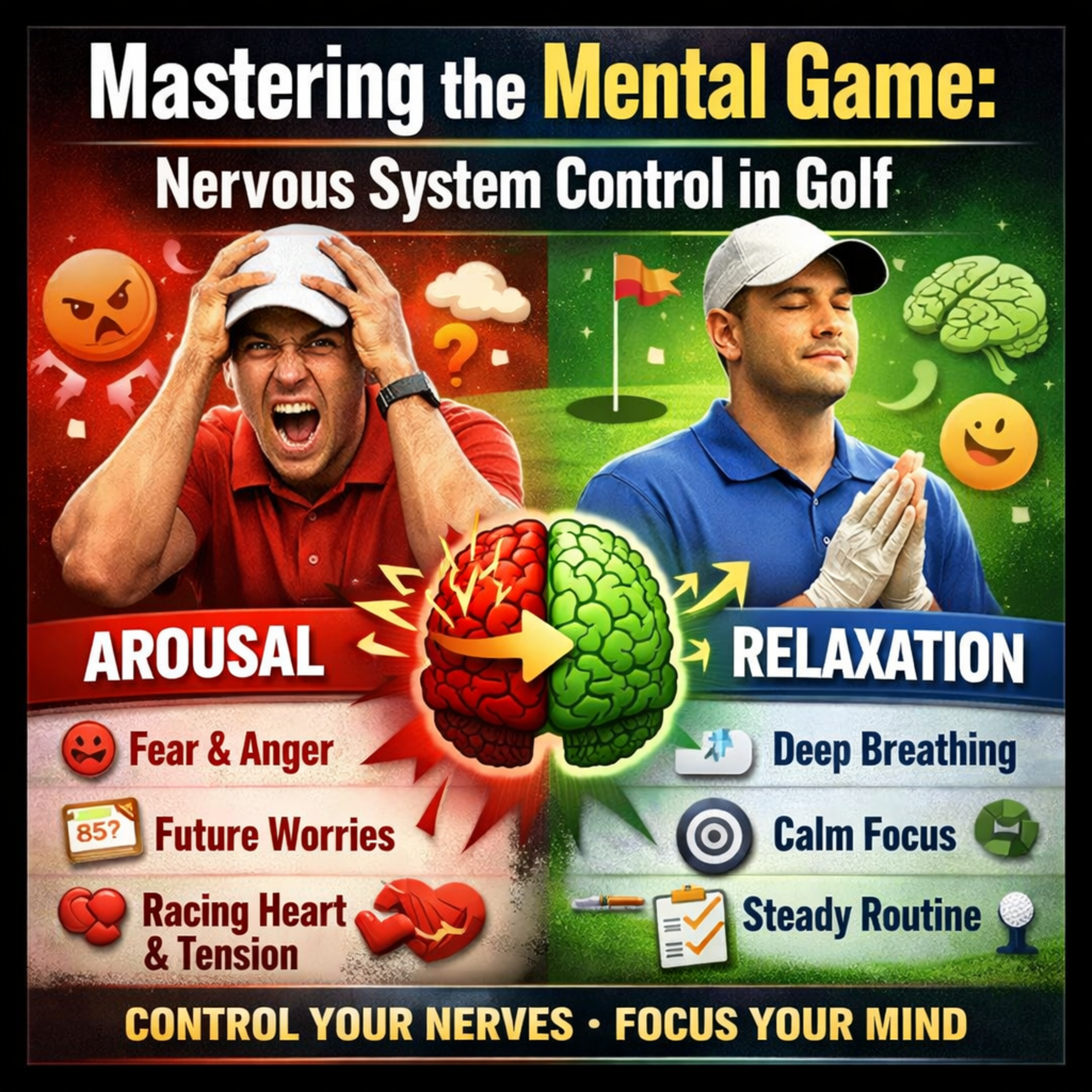
This Podcast describes how controlling the nervous system is central to consistent performance in precision sports like golf. High arousal—caused by fear, anger, excitement, or future-focused thinking—disrupts coordination, tempo, and concentration. The key to peak performance lies in balancing the two branches of the autonomic nervous system: the sympathetic (arousal) and the parasympathetic (relaxation).The sympathetic system acts as the body’s accelerator. When activated, it increases heart rate, blood pressure, muscle tension, and breathing speed. Mentally, it leads to sensory overload: the brain processes too much information at once, making it difficult to focus on a single task. In golf, this results in rushed swings, loss of fine motor control, blurred vision, and racing thoughts. Common triggers include worrying about scores, reacting to mistakes, fear of judgment, and even positive excitement after good shots.The parasympathetic system is the counterbalance. It slows the body down, relaxes muscles, restores normal breathing, and quiets the mind. This state enables selective attention—blocking out distractions like hazards or leaderboards—and supports a calm, “one-shot-at-a-time” focus. Most players perform best in this controlled, relaxed state, although a small group of naturally under-aroused athletes may need mild stimulation.Breathing is the main switch between these systems. Fast, shallow breathing activates arousal, while deep diaphragmatic breathing—especially with an exhale twice as long as the inhale—interrupts the stress chain and restores calm. Because physiological reactions form a chain, changing breathing alone can stabilize the entire system.The Podcast identifies four primary causes of arousal:Future thinking (scores, results, outcomes)Anger from blocked goals or mistakesFear of failure or judgmentExcitement, which creates the same physiological response as fearAll four press the “gas pedal” of the nervous system, increasing speed but reducing control.To manage arousal, nine practical strategies are outlined: deep breathing, slowing physical movement, mindfulness, visualization, consistent routines, stretching, upright posture, biofeedback awareness, and confidence built through preparation. Together, these habits replace “hit and hope” reactions with calm, intentional execution. Peak performance emerges not from intensity, but from composure under pressure.📺 The Explainerwww.Golf247.eu

This Podcast describes how controlling the nervous system is central to consistent performance in precision sports like golf. High arousal—caused by fear, anger, excitement, or future-focused thinking—disrupts coordination, tempo, and concentration. The key to peak performance lies in balancing the two branches of the autonomic nervous system: the sympathetic (arousal) and the parasympathetic (relaxation).The sympathetic system acts as the body’s accelerator. When activated, it increases heart rate, blood pressure, muscle tension, and breathing speed. Mentally, it leads to sensory overload: the brain processes too much information at once, making it difficult to focus on a single task. In golf, this results in rushed swings, loss of fine motor control, blurred vision, and racing thoughts. Common triggers include worrying about scores, reacting to mistakes, fear of judgment, and even positive excitement after good shots.The parasympathetic system is the counterbalance. It slows the body down, relaxes muscles, restores normal breathing, and quiets the mind. This state enables selective attention—blocking out distractions like hazards or leaderboards—and supports a calm, “one-shot-at-a-time” focus. Most players perform best in this controlled, relaxed state, although a small group of naturally under-aroused athletes may need mild stimulation.Breathing is the main switch between these systems. Fast, shallow breathing activates arousal, while deep diaphragmatic breathing—especially with an exhale twice as long as the inhale—interrupts the stress chain and restores calm. Because physiological reactions form a chain, changing breathing alone can stabilize the entire system.The Podcast identifies four primary causes of arousal:Future thinking (scores, results, outcomes)Anger from blocked goals or mistakesFear of failure or judgmentExcitement, which creates the same physiological response as fearAll four press the “gas pedal” of the nervous system, increasing speed but reducing control.To manage arousal, nine practical strategies are outlined: deep breathing, slowing physical movement, mindfulness, visualization, consistent routines, stretching, upright posture, biofeedback awareness, and confidence built through preparation. Together, these habits replace “hit and hope” reactions with calm, intentional execution. Peak performance emerges not from intensity, but from composure under pressure.📺 The Explainerwww.Golf247.eu

NOW PLAYING

#461 Mastering the Mental Game: Nervous System Control in Golf

0:00 12:51

No transcript for this episode yet

We transcribe on demand. Request one and we'll notify you when it's ready — usually under 10 minutes.

Frequently Asked Questions

How long is this episode of Golf 247.eu: The Global Platform for Innovative Technologies and Teaching Concepts.?

This episode is 12 minutes long.

When was this Golf 247.eu: The Global Platform for Innovative Technologies and Teaching Concepts. episode published?

This episode was published on January 7, 2026.

What is this episode about?

This Podcast describes how controlling the nervous system is central to consistent performance in precision sports like golf. High arousal—caused by fear, anger, excitement, or future-focused thinking—disrupts coordination, tempo, and concentration....

Can I download this Golf 247.eu: The Global Platform for Innovative Technologies and Teaching Concepts. episode?

Yes, you can download this episode by clicking the download button on the episode player, or subscribe to the podcast in your preferred podcast app for automatic downloads.
URL copied to clipboard!