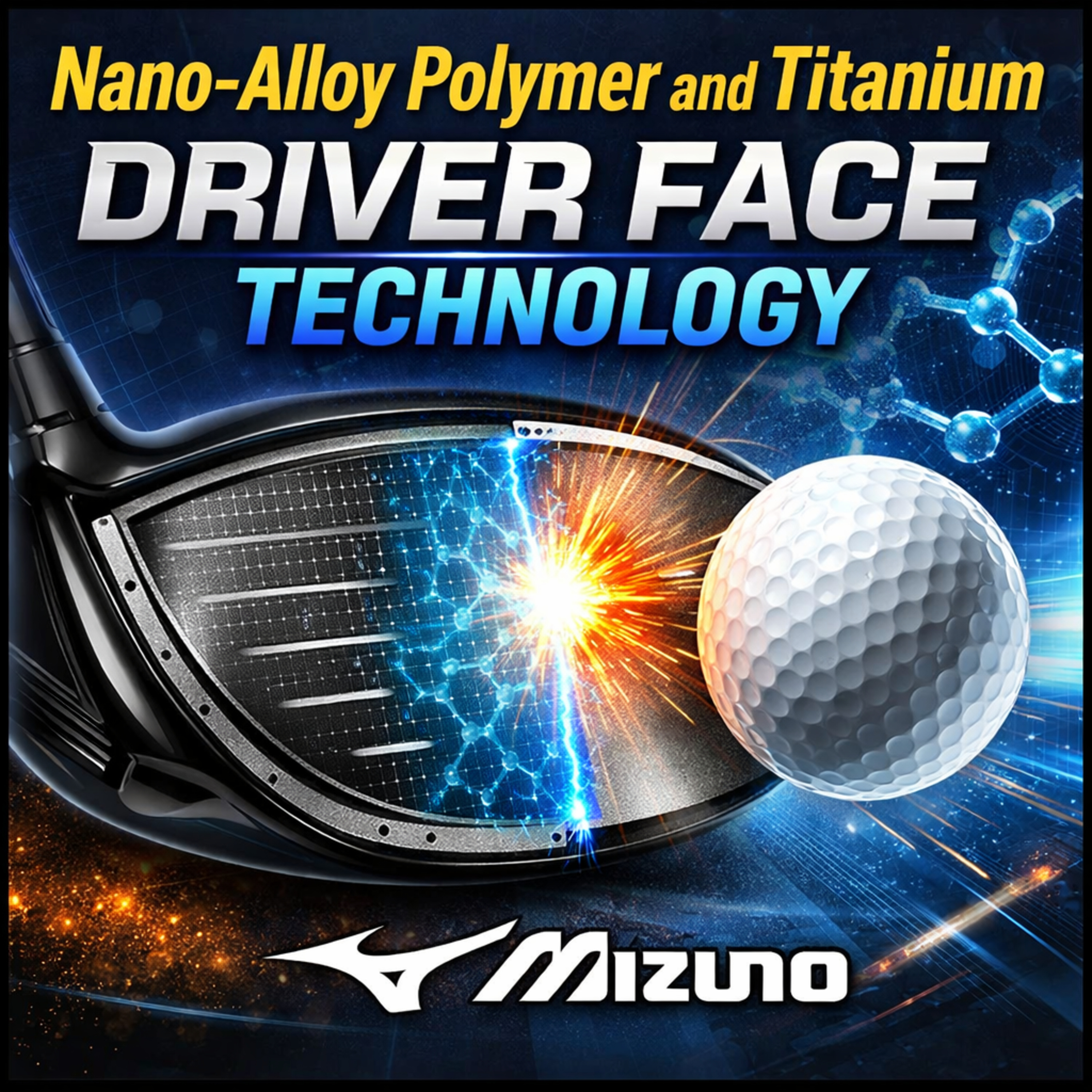
#469 Nano-Alloy Polymer and Titanium Driver Face Technology by Mizuno episode artwork

EPISODE · Jan 15, 2026 · 9 MIN

#469 Nano-Alloy Polymer and Titanium Driver Face Technology by Mizuno

from Golf 247.eu: The Global Platform for Innovative Technologies and Teaching Concepts. · host Golf247.eu

For the 2026 product cycle, Mizuno introduced a significant material innovation in driver design by combining a forged titanium face with a nano-scale polymer alloy layer. This multi-material construction represents a shift from traditional single-material faces toward a more adaptive, energy-efficient impact structure.The nano-alloy polymer layer is not a cosmetic coating. It is molecularly bonded to the titanium and functions as a dynamic reinforcement. This allows the face to exhibit adaptive elasticity, meaning it responds differently depending on the level of impact force. Under low stress, the face remains stable and firm. During high-speed driver impact, elasticity increases locally around the contact zone.This behavior improves energy transfer by reducing energy loss caused by excessive golf ball compression. In conventional impacts, a significant portion of energy is absorbed by the ball itself. Mizuno’s nano-alloy structure allows the face to absorb and release deformation more efficiently, returning more energy as ball speed.The added structural strength provided by the polymer layer enables Mizuno engineers to reduce the thickness of critical areas of the titanium face by approximately 10–11% without compromising durability. A thinner face increases the effective high-rebound area, resulting in:More consistent ball speed across the faceImproved performance on heel and toe strikesGreater forgiveness on off-center impactsAs a result, launch conditions become more stable and speed retention improves across a wider strike pattern.From an engineering perspective, Mizuno’s nano-alloy technology transforms the driver face from a rigid barrier into an adaptive energy interface. Rather than forcing the golf ball to absorb most of the impact stress, the face actively manages deformation to preserve energy.Overall, this technology represents a material-science-driven approach to driver performance, focusing on consistency, forgiveness, and efficient energy transfer while remaining fully compliant with equipment regulations.📺 The Explainerwww.Golf247.eu

For the 2026 product cycle, Mizuno introduced a significant material innovation in driver design by combining a forged titanium face with a nano-scale polymer alloy layer. This multi-material construction represents a shift from traditional single-material faces toward a more adaptive, energy-efficient impact structure.The nano-alloy polymer layer is not a cosmetic coating. It is molecularly bonded to the titanium and functions as a dynamic reinforcement. This allows the face to exhibit adaptive elasticity, meaning it responds differently depending on the level of impact force. Under low stress, the face remains stable and firm. During high-speed driver impact, elasticity increases locally around the contact zone.This behavior improves energy transfer by reducing energy loss caused by excessive golf ball compression. In conventional impacts, a significant portion of energy is absorbed by the ball itself. Mizuno’s nano-alloy structure allows the face to absorb and release deformation more efficiently, returning more energy as ball speed.The added structural strength provided by the polymer layer enables Mizuno engineers to reduce the thickness of critical areas of the titanium face by approximately 10–11% without compromising durability. A thinner face increases the effective high-rebound area, resulting in:More consistent ball speed across the faceImproved performance on heel and toe strikesGreater forgiveness on off-center impactsAs a result, launch conditions become more stable and speed retention improves across a wider strike pattern.From an engineering perspective, Mizuno’s nano-alloy technology transforms the driver face from a rigid barrier into an adaptive energy interface. Rather than forcing the golf ball to absorb most of the impact stress, the face actively manages deformation to preserve energy.Overall, this technology represents a material-science-driven approach to driver performance, focusing on consistency, forgiveness, and efficient energy transfer while remaining fully compliant with equipment regulations.📺 The Explainerwww.Golf247.eu

NOW PLAYING

#469 Nano-Alloy Polymer and Titanium Driver Face Technology by Mizuno

0:00 9:38

No transcript for this episode yet

We transcribe on demand. Request one and we'll notify you when it's ready — usually under 10 minutes.

Frequently Asked Questions

How long is this episode of Golf 247.eu: The Global Platform for Innovative Technologies and Teaching Concepts.?

This episode is 9 minutes long.

When was this Golf 247.eu: The Global Platform for Innovative Technologies and Teaching Concepts. episode published?

This episode was published on January 15, 2026.

What is this episode about?

For the 2026 product cycle, Mizuno introduced a significant material innovation in driver design by combining a forged titanium face with a nano-scale polymer alloy layer. This multi-material construction represents a shift from traditional...

Can I download this Golf 247.eu: The Global Platform for Innovative Technologies and Teaching Concepts. episode?

Yes, you can download this episode by clicking the download button on the episode player, or subscribe to the podcast in your preferred podcast app for automatic downloads.
URL copied to clipboard!