
EPISODE · Dec 5, 2022 · 36 MIN
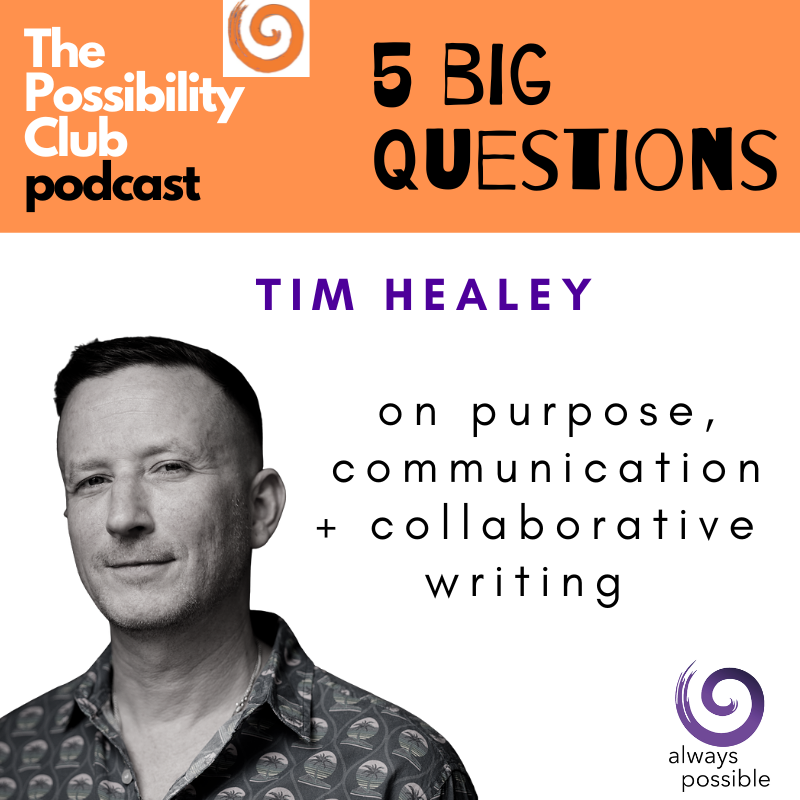
5 Big Questions: TIM HEALEY
from The Possibility Club
Can a purpose-led business also be commercial? How do you use the Pqualizer? And what is the 'mullet economy'? In this week's 5 Big Questions interview we talk to writer, broadcaster and musician TIM HEALEY. Known for: Founder - Shoot 4 The Moon Co-author - Better Business On Purpose Founder / Former Owner - Kooks DJ & Music Producer - Bennun & Healey Former Director - Surfer Rosa Records The Big 5 Questions: How do you measure the impact of what you do? How should people/businesses be preparing for the future? How do we build the workforce we need for that future? How do you use creativity to solve problems? How do you collaborate? Key quotes: "My flat became our headquarters for the best part of a year, as we met as often as we could, typically on Wednesday mornings, and discussed all manner of topics. After doing that for about nine months, we were like, well okay, what are we going to do next?" "We did have different writing styles, that was a learning as part of the process, and we did recruit an editor to help us pull it together. Essentially we just carved up the content, and said right, it's going three ways, that's yours, that's yours and that's yours. And off we went" "Strickler called it the 'mullet economy', business up front and a party in the back. That's why people are getting paid no more than twenty years ago but the shareholders are taking out more and more. It's why the film industry has become a series of prequels and sequels and reboots. It's also why every city in the world has shopping malls with homogenous brands in every single one." "The Pqualizer is a way of visualising how you — or anyone in your business — feels about how your business is doing, across seven key areas: purpose, positioning, products, people, planet, profit and platforms." "We've gone through an unusual period of business where we've become obsessed with technology, technology platforms, unicorn businesses, mega investment in concepts that perhaps aren't even turning a profit, and we're really starting to see that now. I'm feeling a really big tidal change." "I've worked with a number of founders who've been hugely successful in technology and in my experience they're scared of the word 'strategy'. Even using the word in some meetings gets people's backs up. I've been told by colleagues to use words like 'goals' because just the word 'strategy' seems to stress people who don't like applying it." "Setting really clear objectives, in terms of strategy, informs everything else you do. And of course, these objectives should be smart." "The world isn't in a completely downward negative spiral, there are fantastic things going on all around us and we can build on them. Which is one of the major reasons why we think businesses should be more ethical. I think you'd be forgiven as a business owner to go, oh it's just too late, what's the point? Whereas we're saying no, it's never too late, we have all the possibility of making the world a better place, and every tiny bit helps." "I have a threshold for poor behaviour at work, and I don't mean people that I'm directing not delivering, I mean typically people above, that disgrace themselves. I just can't work with them, which sounds terrible, but that is something that I've kept I guess from my world of being hugely independent, doing music." Useful links: Shoot 4 The Moon Tim Healey, Nikki Gattenby, Neil Witten — Better Business On Purpose (from The Hive) (from Amazon) Tim Healey — 'Why I decided to write a book' Nikki Gattenby — Superengaged Patagonia Clothing Yancey Strickler — This Could Be Our Future (Amazon link) Tony's Chocolonely social impact report The Pqualizer — free downloads page Bill Hicks 'got ourselves a reader' bit (via YouTube) Mark Ritson's mini MBA in Marketing 'strategos' (from the Greek, via Wikipedia) Politics UK Weekly episode with Ed Miliband and Just Stop Oil (via The Guardian) The Knepp Estate in East Sussex Broughton Hall Estate in Yorkshire John Higgs — The Future Starts Here (Amazon link) This episode was recorded in November 2022 Interviewer: Richard Freeman for always possible Editor: CJ Thorpe-Tracey for Lo Fi Arts
Embed this episode
NOW PLAYING
5 Big Questions: TIM HEALEY
No transcript for this episode yet
Similar Episodes
No similar episodes found.
Similar Podcasts
No similar podcasts found.