
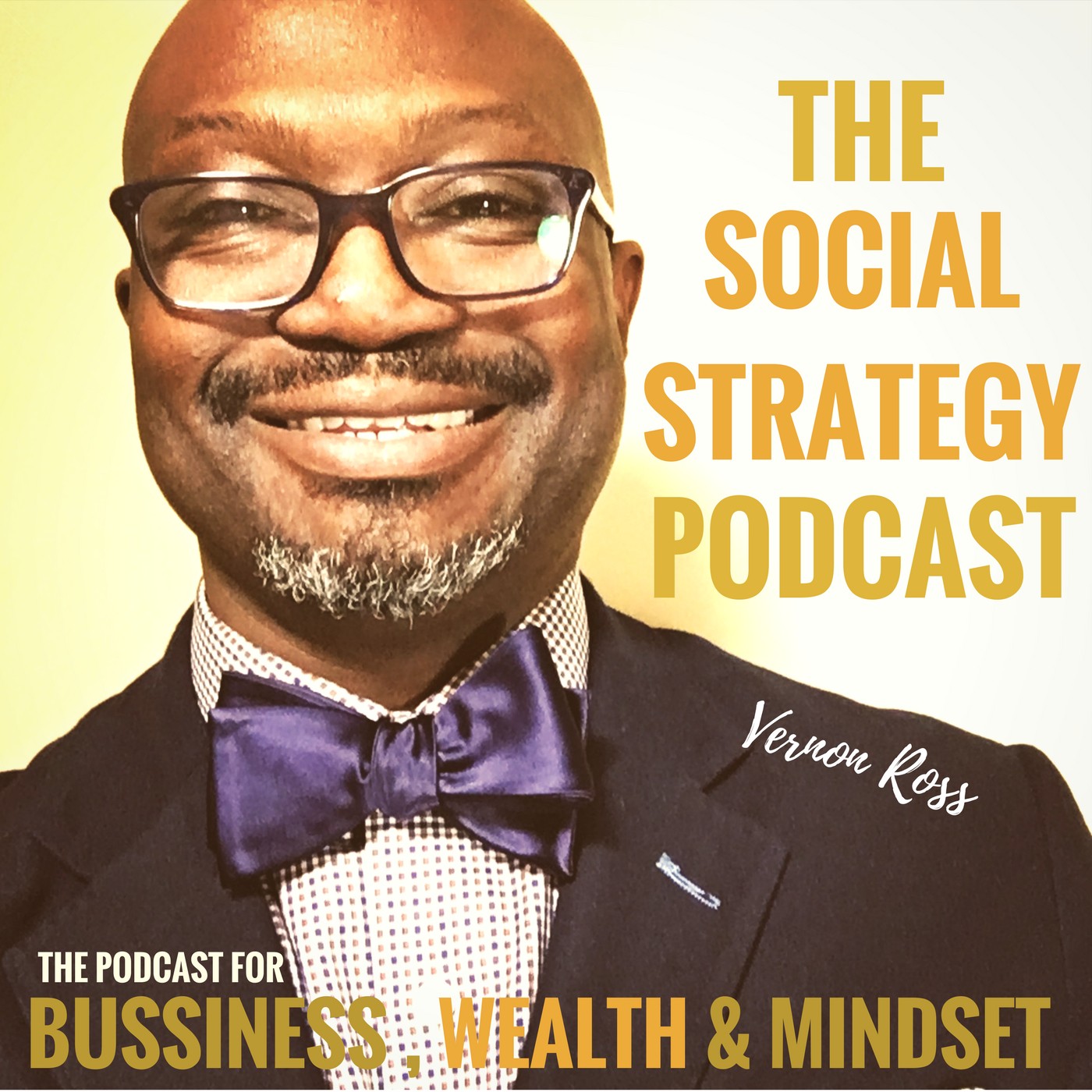
Welcome to the Social Strategy Podcast, where it's all about making the most of your business with smart tips on what's working now in social media, online business, and good old-fashioned network. And now your host was also known as Ross Keyard on Twitter, Vernon Ross. Hey, what's up guys? This is Vernon Ross and welcome to the Social Strategy Podcast.
We're going to be the best in online business social media in your fashion networking. And today we're going solo. So I wanted to talk to you guys today about something I get a lot of questions about all the time and something I cover in my business. And it is actually LinkedIn strategies and effective LinkedIn strategies.
One of the questions that I get a lot is what do I need to have in my LinkedIn profile? How do I make my LinkedIn profile stand out and pop? So I wanted to cover that. I created a document a while back that were five top strategies for job seekers to use on LinkedIn.
So today we're going to do this, but this is going to be an actual enhanced podcast because I'm going to have some video along with it. So you guys can go out and take a look at the show notes. It'll be right out there, Vernon Ross dot com slash episode 27 and actually just slash 27. And you guys are going to see this presentation and I'll have it all linked up in the show notes and I'll actually have the video embedded right there in the show notes.
So you can go and look at the video, check it out and just, you know, see everything that you want to see there, but you're going to get all the information here, but it'd be much easier for you to refer to the show notes. There's going to be a massive amount of stuff in the show notes anyway. So enjoy that. I'll get right to it and I'll see you guys on the back end.
All right. So welcome back guys. This is folks, everyone, however you like to be referred to. I've a one of my listeners said to me, Hey, why do you always say guys?
What, you know, you're not including women and you know what that could be possible. And for that, I apologize if I've offended you. I doubt that I have, but it's just a colloquialism that I have a habit of saying, which is, Hey, guys, what's up? So everyone, what's up?
This is Vernon Ross and let's get started on this five top strategies for job seekers, must use on LinkedIn. So I'm just going to go, you know, right into it, upload your picture. And if you're watching this, and you can see there are a couple pictures of me, you know, I'm looking a little perplexed perplexed and I'm actually smiling than one. So the reason that it's so important to upload your picture to LinkedIn, a lot of people don't think that it is, but having a picture and a decent picture, it doesn't have to be a super professional headshot in my opinion.
It all depends on, you know, the impression you're trying to leave and who your target market is. If your target market is surfers, then maybe you being in a suit is not the right thing for you to wear. Maybe you should be in a t-shirt, you know, with a surfboard on it and some flip flops and maybe a full body shot at you at the beach or, you know, you with popular surf gear or, you know, the same thing goes for maybe ski gear. I don't know why I'm focused so much on action sports, but I'll just go with it.
Stuff like that. You know, so if you're a skateboarder, maybe you want to be holding a skateboard in one hand and you're helmeting another or something like that. But if you're going for a professional position, you may want to have on a certain tie or just a nice business shirt and a blazer and have, you know, a professional headshot. But a professional headshot could be literally someone holding your phone and taking a picture of you, not quite a selfie and using that picture, but uploading your picture is important because it goes into the overall strategy of communicating who you are on LinkedIn to someone that is looking at a static page and a static image.
So make sure that your picture actually reflects your personality. So no fake smiles, no, you know, cheese for the camera. Actually something that's authentic, something with you smiling, something with you enjoying yourself that shows your actual personality. You would be surprised at the amount of trust it instills and impression that it makes when you're trying to communicate or talk to someone or reach out to make a connection on LinkedIn.
It's vitally important to upload your picture. The next part of this is complete your profile. I know you know this, but most people don't do it. You want to complete your profile to 100%.
And so what that means, there's several areas within LinkedIn that you need to complete. Of course, your job information and stuff like that, but you want to put down organizations that you're involved with, charities that you contribute to. If you're a LinkedIn pro member, you want to actually write a couple of blog posts in your industry with opinions about other things that people have written or your own opinions. If you guys checked out my link, my LinkedIn profile, if you go out to vernaros.com slash linked, you'll go right over to my profile.
You'll see that I have several things that I do in my profile. I blog on LinkedIn with content that I don't put anywhere else. And that's simply for the sake of putting my message out there in multiple places to have the advantage of reaching you wherever you are. So my audience is spread out all over the place.
I have people that look at me on YouTube. I have people that look at me on LinkedIn. I have a entirely different Twitter following. You never know exactly where your audience is going to be.
So it's part of that be everywhere strategy that James Webb more talks about. He's a YouTube guy, big YouTube guy. If you guys want to check them out, I'll link to him in the show notes. But you want to have a complete profile, a complete picture of who you are.
If you want someone to do business with you, if you want someone to hire you, and particularly since this is for job seekers, if you're looking for a job, the more complete profile that you give of yourself, the more people are apt to take interest in you. But you have to be interesting. If there's nothing about you other than, oh, here's a little resume and some stuff I did on my job, but you don't talk about anything else or you don't have anything else in your profile other than the bare minimums and your profile says 60% complete and you think that it's good enough. It's not a 60% in school is failing.
So you want to make sure that you get as close to 100% as possible so that you have the best representation of yourself on LinkedIn because it is the impression that people are going to get from you when they go and they visit your LinkedIn profile. Make a list, companies you plan in contact and get inspired. Think about who you want to work for. What do you want to do?
What's your dream job? And then make a list of those companies. I mean, it's just something that you should do if at all possible. And I say if at all possible and it is possible, make a list.
I mean, you know, if you want to work at IBM, make a list of put IBM on your list. I mean, it's really not that difficult, but you do. You should make a list of the companies that you plan on contacting. And when I say get inspired, I mean, I really think about, you know, where do I want to work?
What do I want to do? What do I want to live if the place is not in the place that you want? So the picture in the background that you see and for those of you listening to the podcast, you can't see this, but it's a blurred out image of Sydney, Australia and it's like the Sydney Opera House. It's a crazy expensive city to live in.
But if that's where you want to work, make a list of the companies that have their home offices and sit and the things about those companies that make them attractive to you to want to work at, you know, why do you want to work there? Think about it. I mean, really, really go deeply into it. You have to plan when you want to succeed.
You cannot get into these companies and get people to talk to you if you don't know anything about the company. So when I say make a list of the companies that you plan to contact, I'm not just talking about, okay, just write a list and then you're good and then contact those companies and you'll get in. It doesn't work that way. So you make your list and when you make your list of companies of contact, you also look at the positions that are listed for that company and the positions that you may be interested in.
When you're looking at that position and LinkedIn, you have the ability, if the person makes it open to see who it is that actually posted the position. So when you see the person that posted the position, then you can reach out to that person either directly or through what I'm going to cover in the next slide. And I'll tell you about the whole strategy and how this whole thing comes together at the end of the, you know, going through these slides. So the next one, the next thing you should do is join groups and participate.
Conversations count. You have to bring this all together. You've got to be really, really solid foundation. And the example that I was just talking about when you list a company, say for instance, there's a company that's located in Sydney, Australia, you make a list of that company, you put that company down on that list and you go through and you look at the people that are in that company or that belong to that company.
The next thing you should do is say for instance, there is a senior recruiter or a better yet a hiring manager has listed a position that you're interested in in this fictitious company that exists in Sydney, Australia. You've made your list of the company, you've done your homework on the company. You know, you know what the company does. You've looked at some recent news articles on the company.
You've looked at some blog posts and some Twitter stuff that they have on their company about their company, about the widget that they make and just information about the company. They have a lot of things that you want to be involved. Then you take a look at that person's profile and you examine what groups they're in and how those groups relate to what it is that you want to do. And you join those groups and you participate in conversations.
Do it for about three, maybe four days before you actually reach out to contact this person. And the reason that you want to do that is you don't want to join a group to make it look like you've only joined that group to contact that one person. You should have an interest in a relatable reason for being in the group. So if it's a group for a college alma mater that you did not go to that college, don't join that group just to talk to that person.
But for me, there's a really large marketing and PR group that I belong to. I also belong to a link working St. Louis and I run a really large group called Connected STL. There are reasons that I'm in those groups.
I do PR stuff. So I should be in a public relations group. So if there's someone, for instance, that works at one of the local PR companies and I really want to get to know who they are, contact them about the possibility of talking to them about a future position that I might be interested in. If I'm going that route, then I'm going to want to participate in the group.
Look for conversations from that person like a conversation here or there. And then after you like that conversation, maybe start a conversation, make a comment. You have to be active. People are only going to get to know you from the conversations that you have.
And going through these five steps, if you just go through them on the surface, they're very easy to do. But if you really, really dig in and I mean really commit to going beyond just five superficial steps of doing things, joining groups is great. But you want to join groups, participate and actually put good information in. Joining a group and every other day you add a news feed article and you don't make any comments, you don't follow up on it and you're just putting links to articles to seem interesting is not good enough.
You need to start conversations and jump into conversations with people in the group, in the company that you're interested in working in and sitting, it all connects to each other. You want to make sure that you're spending the time and doing the legwork to get to know these people. It's all networking, but it's in the way that you do it. I mean, we all want something when we network with other people.
And anyone that tells you anything else is just lying. I mean, that's just my opinion. But you know, if I connect to someone on LinkedIn, there's some reason I'm connected to them. Of course, I may have something to contribute that's going to help them out.
I mean, you know, I'm not joining or trying to connect to them for purely selfish reasons. But to be honest, if you're prospecting for new business, when you're in business, your product, you should believe in what you're doing so much that you're doing a disservice by not trying to connect to someone that you know you can help. And the same thing when you're looking for a job and you're a job seeker and you're wanting to work at a company, you should feel like that company needs you to work there and that you're doing them a disservice and they're doing themselves disservice by not talking to you to find out whether or not you can provide value for that company and you have to be convinced that you can provide value to that company or you have no business applying there. So when you start thinking about your job prospects and this list of companies that you've made, that's why I said get inspired because if you don't believe that you're the absolute best employee that you can contribute to this environment and that this is where you want to be because of the culture, because of what they do, because of what they stand for and the quality of the products that they make, you don't have any business being there.
If you're not passionate about delivering quality and delivering whatever it is that you do and whatever it is that you can do to your customers, to your employer or what have you, then you may want to look at does this company belong on my list going back to the list? It's not just as simple as making the list, making the list, make that list of things that companies you want to work at for a really good reason. There's nothing wrong with going the job route, not everybody wants to own their own business and do all that stuff. So if you're seeking a job, make sure that you're seeking something that's just not a job.
You can go get a job anywhere. And you can tell people that and I tell people that all the time, it's like, yeah, I'm going to job anywhere. If I'm going to work somewhere, I want to work somewhere where I'm inspired. What inspires you?
And I ask people that question when I talk to them about jobs. So what inspires you about working at XYZ Company in Sydney? Why would I want to work there other than paycheck and benefits? You can get a paycheck and benefits just about anywhere.
So next slide. Make new connections. Wishing out on a daily basis grows your network. When you're doing this list of companies that you want to work at after you've completed your profile and uploaded your picture to instill trust in people and you've joined groups and started conversations, now it's time to reach out to those people.
And this whole process, this five step process actually takes me and it has taken people that I've advised to use this to find a new job. It takes about two weeks and a lot of people are like, what? I've been laid off and now you want me to take two weeks, two weeks to go through this stupid process. I'm like, yes, take the two weeks.
Most people are unemployed for 12 months here nowadays. Taking two weeks is not going to kill you and you should be able to take the time that it takes to make these quality connections that are going to pay off. And I've not had anybody that have actually coached through this process that has not found a job within 60 to 90 days of starting this process. Because I mean, it's not magic and you may not be qualified, you may not make the connection, you may not gel well, you may not interview well, there's some things that I mean, I just don't have any control over, but I can teach you how to get in front of the person.
I can tell you how to make the connection. I can't help you once you get there. But, you know, there are other reasons for that. I can touch a little bit on interviewing skills and actually quite a bit on interviewing skills because I'll interview him and is telling stories about yourself and you just have to become good at that and telling stories.
But you want to make new connections and making new connections is my God, not sending out the blanket, oh, connect on LinkedIn and the canned message that LinkedIn puts there. If you're doing that, you're doing it wrong. Put a personal messaging. Sometimes you have to make a direct request because you just can't afford the time.
And I give that levity, even though I just know I went into the whole two-week thing, sometimes you have to move a little quicker than I want you to move in these five steps. But when you don't, reach out and make new connections. So going back to the job that you want from the company that you made a list of that's located in Sydney, Australia, that has the company culture and you've connected to the person in the group and contributed to some conversations and now they've seen your face and you're familiar, which is the whole reason that you do this. Now it's time to reach out and make a new connection.
So if I were sending out a connection request to someone, what I normally do is say, hey, so-and-so, whatever their name is, we'll say Amy. Hi, Amy. We're in the same group and I contributed to a couple of the conversations that you posted. Or hey, I noticed we were in the same group and I have interest in XYZ.
We'll love to talk to you about the company culture. What inspires you about working at such and such and such. Let's connect. I didn't say, hey, I'm looking for a job.
Can I send you my resume? Here's a link to my dot about page or my dot me page. Check me out. Come look at me.
I made it about Amy. It's like, hey, Amy, I noticed we're in the same group. We have the same interest. I have some questions about your company.
What inspires you? How often do you think she gets asked that at work? I'm probably guessing that she doesn't. So if you're the person that shows interest in her and it's not fake interest, you want it.
You have to want to know what it is and you got to have a follow-up question when she responds back. And if she doesn't respond back, that's OK. You email her after they accept the request and say, hey, thank you so much for connecting. That's usually my title.
Thanks again for connecting. If they didn't answer the question, exit again. Hey, I really was interested in what inspires you about working there. I'm in the market and I'm looking for a new place to call home.
I'm considering working at so-and-so. But I would love to know more. I noticed that you were the one that posted a job. But before I applied online or before I sent a resume, I really would like to know more about what inspires people that work there.
And since you're hiring people for the position, I bet you could give me a unique and interesting perspective on the company. Would you be interested in jumping on a quick Skype call or phone call and leave your phone number? If you're open to that grade, if not, I totally understand. And then leave the ball in their core.
Give them an out. You don't want to pressure them. It's going to be the first time they've ever received an invitation like that in a response to an acceptance of an invitation. I can almost guarantee you.
95% of the people out there do not communicate like this on LinkedIn. I'm pretty sure that's autistic. I haven't done any quantitative analysis to find that output. I'm pretty sure it's high.
Most people don't take that much time and connecting to other people on LinkedIn. And then once you make that connection and if you have the conversation, you should know what you want to say in that conversation. This can be all BS. This can be, oh, okay, I'm going to say these things to make them feel like I care and then I'm not going to have anything to say once I get them on the phone.
You've got to have good questions. Make a list of questions that you want to ask and not ones that you want to have to read, but questions that you want to know. It's like, so what's it like working there? Where do you go for lunch?
I mean, something as simple as where do you go for lunch? Do you guys go to lunch together or do you have to, or are you a loner all the time? Tell me about Sydney. What's your favorite thing to do there?
Do you live in Sydney or do you live on the outskirts? Do you live outside the city? How expensive is a housing? What kind of stuff do you do on the weekend for fun?
What kind of stuff does your company do for fun? Do you guys have picnics? Do you have outings together? What do you guys do?
Do you have a softball team, a baseball team? You know, do you guys do kickball? I mean, what about the place inspires you to do your job? When you approach making new connections like that, when you want to know information, the best way to do it is actually invest in the relationship that you're building with the person.
And yes, you are investing in a relationship that you build with a person. That's why it doesn't make a difference on how many people you're connected to on LinkedIn. Yes, I have a large LinkedIn network, but almost every person that I'm connected to, at least over the past two years. I have a personal message to say, hey, thanks for connecting.
Let me know if there's anything I can help you with if they've just reached out to me. But people that I've actually reached out to, they get a thank you, a manual thank you. Hey, thanks for connecting. I know it is blah, blah, blah.
It takes a lot of time. I don't have nearly as many LinkedIn connections as some people. I've got over a, you know, well over a thousand. Thanks approaching to, but I know people with 25, 30,000 LinkedIn connections and they've not had a conversation with 10 people in their network.
I try to make at least one outbound LinkedIn message to someone within my network once a week. I used to try to do it every day, but it just became overwhelming. But I do at least once a week, talk to someone within my network just to see how they're doing. I can know what's going on in their life.
Maybe there's something that I can help them with and not something from, you know, a necessary, a money standpoint or a business standpoint, but maybe there's just something I can help with. Maybe I can refer them to something. It's building relationships so that when I do actually need something, if I'm, you know, looking for a job, if I want some freelance work or if someone else that I know, like my wife, when she went through this whole layoff thing that I talked about in episode one, helping her with this process. I talked about this process in episode one, but I didn't really dedicate it to that.
I mean, this is what that is. You're building relationships so that when you have a need, you can say, Hey, guys, guess what happened? This happened. So I need, I need employment.
And this is what I'm looking for working. What direction can you guys point me or Hey, I'm on the market. Who's who's up? Let's talk about what we can do for each other.
How can I help you? This is what I'm bringing. What do you guys need? Making new connections is all about making new connections, making new connections, joining groups, creating conversations in those groups, being inspired when you make your list of companies, completing your profile for God's sake.
Make sure it's as close to 100% as you can possibly get and upload a picture and not your high school yearbook picture. If you don't have a picture, somebody that you know has a smart phone, have them take a picture and text it to you. If you don't do text, have them email it to you and upload the thing to LinkedIn, it creates so much more trust. Now, a lot of people think that, oh, well, people are going to judge me.
People are going to judge me because of my photo. Yeah, absolutely are. And those are the people that you don't want to deal with anyway. If they're not going to talk to you, hire you, do business with you based on your picture.
Trust me, you don't want to do business with them. Work with them anyway. And that's a few in front of between. And it's a very, very, very minute minority of people that behave in that way.
So I wouldn't worry about it. Don't worry about it. Get your picture out there. Get it uploaded.
Complete your profile. I love to see one of the strategies that you can use or you want to just go into more in-depth conversation about this, connecting me on Skype, all my LinkedIn stuff and all my contact information is right there in the show notes. I'm going to link to that again, love that you guys are listening to the podcast. It is growing in popularity.
And this week I'm so, super excited that I am going to be speaking at podcast movement and beautiful, hot, steamy, sweltering Dallas, Texas. I actually do like Texas, going to be there on the 16th and the 17th of Saturday and Sunday looking really forward to this. Friday, Saturday, Sunday, am flying out Friday. So Friday, Saturday, Sunday going to be there.
I'll be back in town Sunday actually. So it's a short two day conference, but it is going to be powerful. We've got some amazing people on the lineups. Check it out.
I'm also going to be speaking at FinCon, the Financial Bloggers Conference, coming up, FinCon Expo 14, or actually FinCon Expo.com. This is of course 2014, and I'm loving the fact that I'm going to be on a panel there. That is exciting. It'll be my second year at FinCon.
The first year I was at the Financial Bloggers Conference, I was actually covering it as a media part. This year I actually got invited to speak on a panel. So that is awesome. And it's about podcasting and getting awesome guests for your podcast and creating an amazing show with amazing people that you can learn from, which is you guys know one of the reasons I do a podcast with guests.
I could do a podcast and trust me, I can just run my mouth for a long time and talk about random stuff. Of course, it's going to help you with social media business and online business and networking, but I can learn so much more from people that have done it that are smarter than me and you guys benefit. So, and it's free. Podcasts are free.
I mean, it's great. I love it. I'm smiling the entire time I'm behind the mic and you could probably tell I love this. So go out to iTunes guys, vernonross.com slash iTunes, subscribe and rate the podcast.
Let me know what you think because when you let me know what you think and you go out and you subscribe and you download all the episodes and you go back and you listen and you give me a five star rating on iTunes, more people get to see the show. They get to see the listing. It keeps me up there in the what's hot section in iTunes and it's great because it gives me more exposure and it gives me the ability to reach out to bigger guests that want to be on the show. Let me know who you guys want to know about.
I would love to get some audience feedback on who you want to have on the show, whether it's a huge name or whether it's somebody that you know that's just amazing. I've had some amazing people on the show that are not like huge, you know, big names, not celebrities, but have a very interesting story and a lot of value to give to you guys. So make sure that you let me know. You can reach me very easily.
Vernon at Vernon Ross dot com VR, you know, in at VR, you know, in our OSS dot com email me. Let me know. Hey, I want to see someone so on the show. If you want Seth, go down here email me.
Let me know. I'll get him on the show. I'll get Gary V. I'll get Gary V.
I talk to Gary all the time over Twitter, you know, every now and then and I watch his stuff and Gary's awesome and I would love to have him on the show. If you guys want him on the show, let me know who you want on the show. Remember email me at Vernon Ross dot com. I will get whoever you like on this show celebrity or not.
I've got a pretty far reach and as long as I have to do with social media, using it to do whatever online business and go fashion networking. Hey, I'm all open to getting them on the show or if you want to be on the show, if you're amazing yourself, I'll tell people that you're amazing. You don't have to get on the show. I would love to have you on.
Anyway, guys, I'm going to go ahead and get out of here, wrap it up. And I do appreciate you tuning into this podcast slash web video thing that I'm doing. Let me know what you think. I love to know.
I want to know what you think about these steps and if you use them, let me know. There's also a PDF document that I'm going to link up in the show notes that you guys can download so you can follow these steps and just use it as a checklist. I've actually created a checklist that you can use for this and I have so much fun with the feedback that I get from people when they actually go through the steps and I can coach people through how to really, really get into doing this. All right, guys, this is it.
I'm going to sign out and I will see you guys in the next episode.