
EPISODE · Apr 6, 2026 · 2 MIN
500 Broken Treaties and No War Was Fought: The Garrison Dam and the Theft of Fort Berthold
from Education is Elevation · host The Conscious Lee
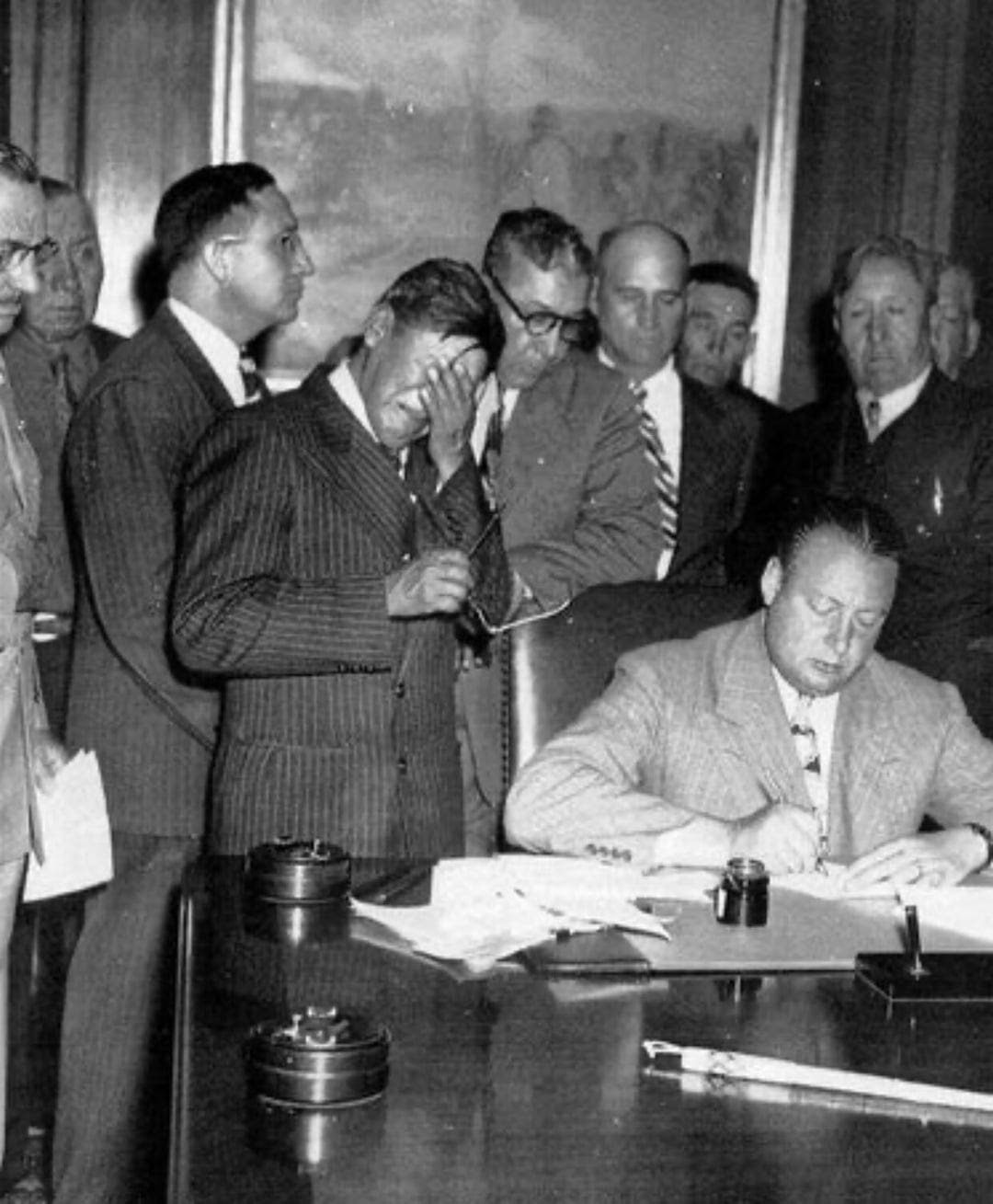
Education Is Elevation is a reader-supported publication. To receive new posts and support my work, consider becoming a free or paid subscriber.Native Americans are presented to us as a conquered people, but we never talk about how the United States federal government has broken over 500 treaties — and no war was fought. Let that sit with you. No declaration of war. No battlefield. Just paper, pens, and power. The weapon wasn’t a rifle. It was a contract. And the violence wasn’t in a single moment — it was stretched across centuries, administered through bureaucracy, and dressed up as progress.1948 was one hell of a year in history, wasn’t it? That’s when one of the most devastating photographs in American history was taken — and most of y’all have never seen it. It’s the story of George Gillette, the chairman of the Three Affiliated Tribes of the Fort Berthold Reservation in North Dakota. In that photo, Gillette is covering his face, weeping, while Secretary of the Interior Julius Krug signs a contract — not an agreement, a contract — that would forcibly transfer over 155,000 acres of the most fertile, productive tribal land to the United States federal government for the construction of the Garrison Dam. A damn dam.And I need y’all to understand why that image hits different when you know the full story. Because it’s not just a man crying. It’s a man being forced to watch the legal destruction of his people’s homeland in real time, knowing he had no power to stop it. That’s the part they leave out of the history books. That’s the part that makes this Research over MeSearch.The Land Before the TheftBefore we unpack the theft, let’s talk about what was taken. The Fort Laramie Treaty of 1851 recognized nearly 12 million acres belonging to the Mandan, Hidatsa, and Arikara Nations — territory spanning across what we now call North Dakota, South Dakota, Montana, Nebraska, and Wyoming. Twelve million acres. By the time the federal government formally created the Fort Berthold Reservation in 1870, that territory had already been slashed dramatically. But what remained was still rich. Still alive. Still theirs.The Three Affiliated Tribes — the Mandan, Hidatsa, and Arikara — had survived smallpox epidemics in the 18th and 19th centuries that nearly wiped them out entirely. These epidemics, brought by European settlers, devastated their population so severely that the three nations consolidated for survival, eventually settling together at Fort Berthold along the Missouri River. And they rebuilt. They recovered. They created a self-sustaining economy based on agriculture, ranching, and the abundant resources of the Missouri River bottomlands. They had farms. They had cattle. They had a hospital. They had tribal headquarters. They had a way of life.And then the Army Corps of Engineers showed up.The Pick-Sloan Plan: Infrastructure as Colonial WeaponHere’s where you have to understand the machinery behind the theft. In 1944, Congress authorized the Pick-Sloan Missouri Basin Program — a massive infrastructure project designed to control the Missouri River through a series of dams. The plan was the brainchild of Colonel Lewis A. Pick of the Army Corps of Engineers and William Glenn Sloan of the Bureau of Reclamation. The stated goals were flood control, navigation, irrigation, and hydroelectric power.But here’s what the history books don’t emphasize enough — the Missouri River States Committee that selected the dam sites had zero Native American members. None. The locations were chosen based on topography, minimal impact to major cities and towns, and cost-to-benefit ratios. And because there were no Indigenous voices at the table, the impact to reservations simply wasn’t a “large consideration.” That’s not my language — that’s the historical record.The Garrison Dam was one of five massive main-stem dams built along the upper Missouri River. And here’s the kicker — the original Sloan plan actually assessed the situation and recommended leaving tribal holdings alone. But when the plans merged into Pick-Sloan, that recommendation was ignored. White support of Native opposition to the dam declined radically once Congress accepted the combined plan. As somebody that knows a lot about history in this country, urban development and government projects have always been about how can we preserve white institutions and comfort and efficiency at the expense of people of color. Every. Single. Time.Historian Vine Deloria Jr. — one of the most important Native American scholars in history — called the Pick-Sloan Program “the single most destructive act ever perpetrated on any tribe by the United States.” Read that again. The single most destructive act. Not the Trail of Tears. Not the Indian Removal Act. This. And most Americans have never heard of it.They Started Building Before They Even AskedThis is the part that should make your blood boil. The Army Corps of Engineers began construction on the Garrison Dam in 1946 — two years before the tribes even signed the contract. Two years. When the Corps arrived at Fort Berthold to start construction, the Three Affiliated Tribes had no idea they were coming. Nobody told them. Nobody consulted them. The Bureau of Indian Affairs made no objections while the project was debated in Congress, and none of the tribes were consulted during the legislative process.And you from the hood or you know how it works in terms of urban development. Hey, we don’t give you the option to sell it under value or it’s eminent domain — you don’t get a damn thing. You don’t get nothing at all. That’s the reason why George Gillette is crying in that photograph, because he didn’t have a real option. He had to sell over the land to get something because it was better than nothing. But the entire time, it was coercion and not consent.The tribes knew that if they failed to agree to the outlined terms, they would receive even less compensation in the future — or nothing at all. The construction was already happening. The dam was already being built. This wasn’t a negotiation. This was a mugging with paperwork.On May 20, 1948, George Gillette, fighting back tears, watched Secretary Krug sign the contract. In his own words, Gillette said: “The truth is, as everyone knows, our Treaty of Fort Laramie and our constitution are being torn to shreds by this contract.” He said, “We will sign this contract with a heavy heart. With a few scratches of the pen, we will sell the best part of our reservation. Right now the future doesn’t look too good to us.”He was right.Education Is Elevation is a reader-supported publication. To receive new posts and support my work, consider becoming a free or paid subscriber.What Was LostThe flooding of Fort Berthold was catastrophic. The Garrison Dam created Lake Sakakawea — the second-largest man-made lake in the United States — and it drowned the heart of the reservation. Let me give you the receipts on what was destroyed:156,000 acres of the most fertile farmland on the reservation — gone. Tribal headquarters — gone. The hospital — gone. Approximately 90% of the tribal population was forced to relocate to higher ground — barren, dry, wind-swept land with poor soil and no timber for protection from North Dakota winters. 325 families displaced. 80% of tribal members forced to move. An entire self-sustaining economy, decimated overnight.And here’s what makes this even more sinister — the compensation the tribes received was well below market value and significantly less than what non-Indian landowners received for comparable land. The initial offer was $5.1 million. It was eventually increased to $12.6 million, but that was still $9 million less than what the tribes calculated as fair compensation. And the final settlement legislation denied them the right to use the reservoir shoreline for grazing, hunting, fishing, or any other purposes. It also rejected their requests for irrigation development and royalty rights on subsurface minerals. They took the land, flooded it, and then told the original owners they couldn’t even use the shoreline of the lake that destroyed their home.The dam now generates over $40 million worth of hydroelectric power every single year. The tribes saw almost none of it. It took until 1992 — forty-four years later — for Congress to finally provide additional compensation of $142 million to the Three Affiliated Tribes. Forty-four years of poverty, displacement, and health devastation before the government acknowledged what it had done.The Health Crisis Nobody Talks AboutBefore the Garrison Dam was built, there wasn’t a single known case of diabetes on the Fort Berthold Reservation. Obesity was almost unheard of. Let that sink in. These were people who farmed, ranched, hunted, and lived off the land their ancestors had cultivated for a millennium.After the dam? The loss of agricultural land decimated their food sources. Natural foods were replaced with processed government commodities. Drinking water now came from wells with high-alkaline content. The construction project triggered long-term unemployment, intense poverty, and a decades-long descent into obesity, hypertension, diabetes, alcoholism, and drug abuse. Today, the population suffers diabetes at more than double the national average. This is what happens when you destroy a people’s ability to feed themselves and then hand them commodity cheese and call it assistance.This is how coloniality works. We’re going to force you on a reservation and take the majority of your land. And then when you own that reservation because white folks are losing their houses, we’re going to make you lose your land and your house to make sure they don’t lose theirs and build a dam because we can’t have this Missouri River threatening the descendants of settler colonizers while you, the colonized subjects, lose everything. Give me that.This Wasn’t Just Fort BertholdAnd here’s what blows my mind — the Garrison Dam wasn’t an isolated incident. Under the Pick-Sloan Plan, the Army Corps of Engineers built five main-stem dams that destroyed more than 550 square miles of tribal land across North Dakota and South Dakota. The projects devastated multiple reservations — Standing Rock, Cheyenne River, Crow Creek, Lower Brule, and Yankton. The Oahe Dam alone flooded over 200,000 acres on the Standing Rock and Cheyenne River Reservations. In total, more than 900 Native American families were displaced. Over 1.6 million acres of fertile bottomland were flooded — and a massive percentage of that was Indigenous land.The Pick-Sloan Plan reduced the total land base of five Sioux reservations by 6% and forced one-third of their population to relocate. And here’s the pattern — the best land on every reservation was flooded, and residents were moved to barren, dry uplands. Every time. The fertile land was taken, the people were pushed to the margins, and the benefits — the cheap power, the flood protection, the recreation lakes — flowed downstream to non-Native communities.That ain’t development. That’s dispossession with an engineering degree.Stop Thinking Deeply About Shallow S**tPeople want to act like treaty violations and land theft are ancient history. Something that happened “back then.” But the Garrison Dam was completed in 1953. My parents were alive. Your grandparents were alive. This ain’t ancient — this is modern American policy. And the health consequences, the poverty, the displacement? Those are happening right now. Today. Unemployment on Fort Berthold remains around 42%. Communities that were once connected by the river are now separated by a lake they never asked for, with a single bridge connecting them.And this is what I need y’all to understand about the difference between how we’re taught history and how history actually operates. It’s presented to you as if these people consensually agreed. Look what they signed. Look what they agreed to. But they signed under force. Under coercion. Under the threat of getting nothing if they didn’t take something. That’s not consent. That’s extortion.The Garrison Dam is a case study in how the United States federal government uses infrastructure as a weapon of colonial dispossession. Highways through Black neighborhoods. Dams on Native reservations. Urban renewal that’s really urban removal. The machinery changes, but the logic doesn’t — sacrifice communities of color to preserve white comfort, white property, and white profit.And until we teach this in every classroom, until we name it for what it is, we’re not doing education. We’re doing propaganda.EXPLICIT TO BECOME PAID SUBSCRIBERThis article took hours of research, cross-referencing primary sources, legal records, and historical archives to produce. And I did it without a single corporate sponsor telling me what I can and can’t say.I’m fighting to fill a critical void left by the retreat of public education media. I document and teach the histories, legal frameworks, and cultural knowledge that are being systematically erased or distorted. With no corporate backing or wealthy sponsors, this work depends entirely on readers like you. As a Black educator and researcher, my work depends entirely on a community of readers, not corporate sponsors. If everyone reading this became a paid subscriber, we could build a full-time digital sanctuary: a new, independent source of PBS-depth reporting and curriculum, centered on Black expertise. But right now, less than 1% of my followers are paid subscribers.If this article taught you something your school never did — if it made you think differently about the photograph of George Gillette, about dam construction, about what “eminent domain” really means for colonized people — then I’m asking you to put your money where your education is. A paid subscription isn’t charity. It’s an investment in the kind of independent, fearless, receipts-based education that no corporation will fund and no government wants you to have.Education Is Elevation is a reader-supported publication. To receive new posts and support my work, consider becoming a free or paid subscriber.BIBLIOGRAPHY & RELATED READINGS* Parker, Angela K. Damming the Reservation: Tribal Sovereignty and Activism at Fort Berthold. University of Nebraska Press, 2023.* Lawson, Michael L. Dammed Indians: The Pick-Sloan Plan and the Missouri River Sioux, 1944–1980. University of Oklahoma Press, 1994.* Deloria, Vine Jr. Custer Died for Your Sins: An Indian Manifesto. University of Oklahoma Press, 1969.* Wilkinson, Charles. Blood Struggle: The Rise of Modern Indian Nations. W.W. Norton & Company, 2005.* Dunbar-Ortiz, Roxanne. An Indigenous Peoples’ History of the United States. Beacon Press, 2014.* “For the Taking: The Garrison Dam and the Tribal Taking Area.” Cultural Survival Quarterly, February 2010.* “Dam Floods Hospital, One-Quarter of Reservation.” National Library of Medicine, Native Voices Timeline, 1948 Entry. https://www.nlm.nih.gov/nativevoices/timeline/489.html* Ferrell, John R. Big Dam Era: A Legislative and Institutional History of the Pick-Sloan Missouri Basin Program. U.S. Army Corps of Engineers, Omaha District, 1993.* VanDevelder, Paul. Coyote Warrior: One Man, Three Tribes, and the Trial That Forged a Nation. Little, Brown and Company, 2004. This is a public episode. If you'd like to discuss this with other subscribers or get access to bonus episodes, visit theconsciouslee.substack.com/subscribe
Embed this episode
Ready to play
500 Broken Treaties and No War Was Fought: The Garrison Dam and the Theft of Fort Berthold
No transcript for this episode yet
Similar Episodes
No similar episodes found.
Similar Podcasts
No similar podcasts found.