
EPISODE · Feb 22, 2026 · 15 MIN
#507 The Biomechanical Reinvention of Anthony Kim
from Golf 247.eu: The Global Platform for Innovative Technologies and Teaching Concepts. · host Golf247.eu
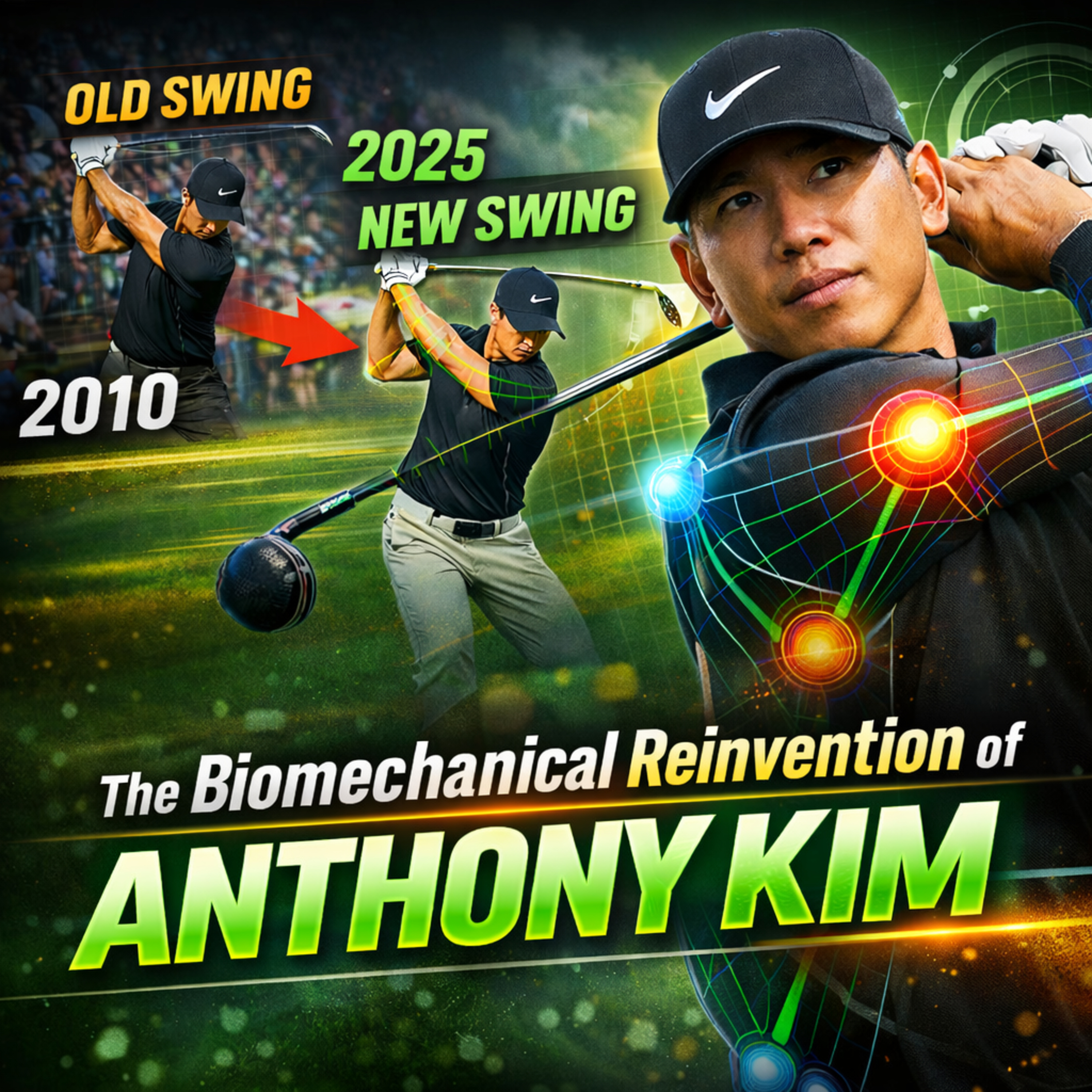
This report analyzes Anthony Kim’s 2026 victory following a sixteen-year absence and compares his 2010 championship swing with his 2025 model using 3D biomechanics. The data shows a clear evolution: from an explosive, high-variability, lateral-dependent action to a compact, rotation-dominant and centered motion. The shift reflects a move from raw amplitude to mechanical efficiency, face control, and long-term sustainability.1. Address – A Centered FoundationIn 2010, Kim set up with pronounced reverse tilt. By 2025, he adopted a more stacked geometry.Sway Gap: –3.6" → –2.2"Reduced lateral tilt positioned his chest more vertically over the pelvis, improving balance and low-point control from the start.2. Top of Backswing – Compact Over ExtremeHis 2010 swing exceeded modern Tour averages in rotational range. The 2025 version is shorter and more controlled.Chest Turn: –98° → –93°Pelvis Turn: –42° → –39°By reducing amplitude, Kim maintained functional tension instead of overstretching, allowing cleaner sequencing and fewer timing dependencies.3. Transition – Rotational EfficiencyThe biggest change occurred in the downswing. In 2010 he relied on lateral slide and “hang back.” In 2025 the body rotates earlier with less sway.Chest (arm parallel): 10° more open than 2010Sway Gap: –3.6" → –1.9"This reduced reliance on late hand manipulation and improved face stability.4. Impact – Stability and ControlThe 2025 motion favors rotation over lateral “bump.”Chest Turn: 27° → 32°Sway Gap: –6.7" → –4.6"A more open, centered impact enhances compression, keeps the lead arm connected, and reduces lumbar shear forces.Strategic TransformationFrom Launcher to Optimizer:2010 relied on large range and lateral slide (elastic-dominant).2025 generates speed through tighter sequencing and rotational efficiencyInjury Prevention:Reduced side bend and sway lower the “crunch factor,” promoting longevity.Comparison to Modern Tour AveragesKim’s 2025 metrics align more closely with Tour norms than his 2010 swing. His –93° chest turn remains slightly above average (–87°), preserving coil potential. At impact, his –4.6" sway gap is more centered than the Tour mean (–6.0"), suggesting superior stack and lower spinal stress. He is slightly less open at impact than average, indicating a balanced blend of rotation and timing.Contrast with the Modern “Launcher” ModelCompared to Rory McIlroy’s high-amplitude, high-launch style, Kim’s 2025 swing is more compact and stacked.McIlroy maximizes turn and backward torso lean to optimize launch and distance.Kim prioritizes centered geometry, compression consistency, and reduced mechanical volatility.Why It Worked at AdelaideHis final-round 63 reflected a motion built for pressure:Less timing dependencyImproved face controlBetter low-point stabilityLower mechanical volatilityKim’s reinvention demonstrates that performance longevity at elite level is not built on preserving explosive youth mechanics, but on refining geometry, sequencing, and centered rotational efficiency.📺 The Explainerwww.Golf247.eu
Embed this episode
NOW PLAYING
#507 The Biomechanical Reinvention of Anthony Kim
No transcript for this episode yet
Similar Episodes
No similar episodes found.
Similar Podcasts
No similar podcasts found.