Yes, I'm hoping for one heckler just Let's get this thing started. Yeah, I think I'm ready. All right. Kind of down Hamburg.
We are already recording. Oh great Great interesting. Yeah, hi and welcome to classical stuff You should know a podcast on the classical world classical education run by three guys who work at a classical school veritas academy in sunny sunny Austin, Texas very very sunny. And this guys this is our 52nd podcast.
This is our one-year anniversary podcast It's a year, and I got you both something. Oh, you can have my old yeti if you want I want you to also change my photo on website, which I'm not too happy about. Yeah, what's the photo now? It's just you'll have to look at it on your own time They're right now and as an added treat for you listeners out there and listener land.
We are here today with a live studio audience Indeed, well, we could literally just tell them not to make any noise And then prompted them to fear for us today as we've made reference to the last podcast We are talking about Boethius a man a scholar Philosopher and also a public servant of his time and AJ you're gonna be taking the helm on this one What do we need to know? All right, so I figured out what's just a little bit about Boethius the man himself and the first most important thing You have to know about him is his name, which is amisius manly is all severinas boethius Oh, sure middle name manly is yeah, it's what the coolest names ever heard He was born in 480. He was a member of an aristocratic family But his dad died when he was young so he was actually raised by a different aristocratic family rose to prominence in Rome kind of after you know As Rome is in decline and he was kind of a philosophy nerd right? He studied all the time he grew up reading books mainly under the tutelage of the the guy that he was raised by and as a side note He eventually married that guy's daughter.
So he loved this family works. Yep. It happened sometimes Yes, yeah, and and so he he grew up loving philosophy learning about philosophy wanting to translate his life mission was to translate Plato and Aristotle into You know digestible forms for everyone and that was kind of what he went after and he only entered public life because Plato's ideal of a State run by philosophers He felt the duty as a philosopher to become participant in the state And so he served under a guy named Theodoric the Ostrogoth, which is another one of the coolest names I've ever heard there's just a bunch of that guy mad I think so this is at the point in Rome where Theodoric is pretty much an Autonomous King he did the adork the adork the adoric the adoric the door is not in there. Yeah, the adoric the ostrich I don't make that joke around the adoric.
Well, he's not here he was an autonomous king in In the east and then he sort of interacted with the emperor in the west But the emperor was sort of a figurehead Theodoric had all the power and so what city we talking like where's he living? Wrong is he in Constantinople? Is he not that noble is I think the emperor is I think he is an Italy somewhere So I'm a little unclear on that But he he served him and just rose through the ranks Successively and at some point something went wrong And he was accused of stopping a messenger from delivering papers that would show the Senate was guilty of treason They want to take out Theodoric the the king and so he stopped that messenger to protect the Senate and then got found out The Senate turned on him even the Senate served him up while he was trying to protect the Senate and he got condemned to death And so he wrote this book the consolation of philosophy while in prison by himself Now these are pretty lame charges, right? Like this is not death worthy.
Yeah, this kind of treasonous, right? Yeah, but worst of all he didn't stand for trial, right? He was condemned in absentia and then just condemned to death, right? He could not really give defense he couldn't stand and speak on his own behalf Nothing nothing like that He was just condemned and he was partially delivered up by some fellows that hated him because he consistently and routinely stopped people From doing the evil they wanted to do like take advantage of the resources of a town You know insight rebellion he was always the guy that stood in the way of the rapacious You know inclinations of senators and stuff and so yeah A lot of enemies because he was a good dude and they all sort of banded together to get him condemned But he was a good guy yeah He was a super good guy and he as he wrote this in prison the depth of his knowledge becomes obvious because of his references to Plato It's Aristotle to other philosophers.
He just does it off the top of his head He doesn't even need the text there with him So surely as a good guy like the cream rose to the top and during his trial He got off and lived a happy life in in old age and seclusion and the back guys don't win Yeah, I mean nearly he almost got it, right? He was brutally tortured and beaten to death so he died Which makes this book all the more compelling right? So here's a quick summary of the book just and then you guys can jump in and bring up the things you want to so he starts in a pretty Bad way. He's just been condemned to death.
He's alone in prison He's feeling like everything's going wrong And so as he mourns the sirens of poetry come and minister to him and then in their wisdom philosophy comes down and So philosophy comes down and she says pretty much like you muses of poetry are not helping anything like you all get out of here You're making it worse So she tosses them out of the room and as she accuses them making it worse They're all like yeah, you right and then they walk off and they know they're not helping anything And then comes like book one is a discussion on the whims of fortune and how like you were in a good place And now you're in a bad place But what did you expect? That's how fortune goes and she gave you everything she has the right to take it away So it's a discussion of fortune and then Book two is I think oh man. I'm mixing these up book one is like an intro to like what's happening So I just went through like why he's in prison is there book two goes into fortune And we can talk about the themes there more if you want to and then book three is what is the nature of goodness? Like what what are men truly seeking book for is essentially the problem of evil Yes, how can good like bad things yet happen if God who is good rules the universe and then the final book is about fate and Yeah, whether chance exists So is this thing that's happening to me something that God is in control of or is this just a chance fluke that I'm suffering?
And so it goes from let's pull you out of the dumps Let's talk about what is really good Let's deal with the evil men that you've been accused by and then let's move to is this God's fault or is this an accent? And so philosophy comes and sort of starts with easy medicine saying like you're still blessed suck it up You dork and then let's talk about what good is what evil is and then how God has meant this world to be and you can rest in the knowledge that Nothing happens by accident God is in charge evil men are pitiable You are still good and the good is we're pursuing which brings him out of his doldrums and then makes him ready for death Which is such a cool message now. We've talked about on the podcast before we talked about that poetry Aspect before where it's not helpful to wallow in sweet sounding. It's like if you're sad sad music's not gonna help you Yeah, break up songs don't help a breakup if not just make it more sad Yeah, although we have had some people email us and tell us that that they that we are just a heart on the poets Yeah, why do we hate poetry was in fact the Question so so both this isn't chapter one So these muses are around him and they're making him they're continuing him feeling worse But y'all how many poems are in this book?
What give me an estimate? Yeah, exactly Well, every so the book is structured where at the end of every chapter in each book. There's a poem so they're philosophy, right? Yeah, so there are five there are five books in Boethius and then each book has somewhere between eight and twelve sections in there So you're looking somewhere of thirty forty poems in this book that condemns poetry at the outset So I like it doesn't make a whole lot of sense So must not be I don't these condemning poetry, but condemning like sentimentality right exactly Yeah, so there's a value to poetry But it's that the poet the muses that meet Boethius in the beginning are not tied to truth They are only the emotion and so they keep him in sadness Well philosophy has to come and give him truth that he can't accept is that fair?
So like there is a value to the poetry that is offered, but it must be the beauty and truth that are tied together. Yes, I think that's fair Okay, so the book is so in the book it's philosophies a person and the muses are people But those are symbols so are we assuming that Boethius is in jail and he's feeling sorry for himself and like singing sad songs to try To make him feel better. I don't know what's like what is the the he doesn't literally talk with philosophy in this book So like isn't it like you're just making a point that it's metaphor. Yeah, so what actually is happening in the jail is he's going insane I don't know.
What do you think I mean? He's making use of the philosophy that he studied all his life Yeah, I mean he's probably having the same reaction any of us Which is I'm in jail This is the worst I hate my life and I want to murder everyone and then he slowly kind of comes out of that and says get it Go hold yourself. Yeah, you know this like you use the philosophy you've learned and like pull yourself out of it Yeah, you use the philosophy. Yeah, okay.
All right. So book book one book two those things kind of go together Yeah, you want so well what makes you why doesn't power money fame where the five was a power money fame and Something else make us I believe those are well on her power fame bodily pleasure. I think in book three Oh, okay. Oh, is that no, it's a book book three.
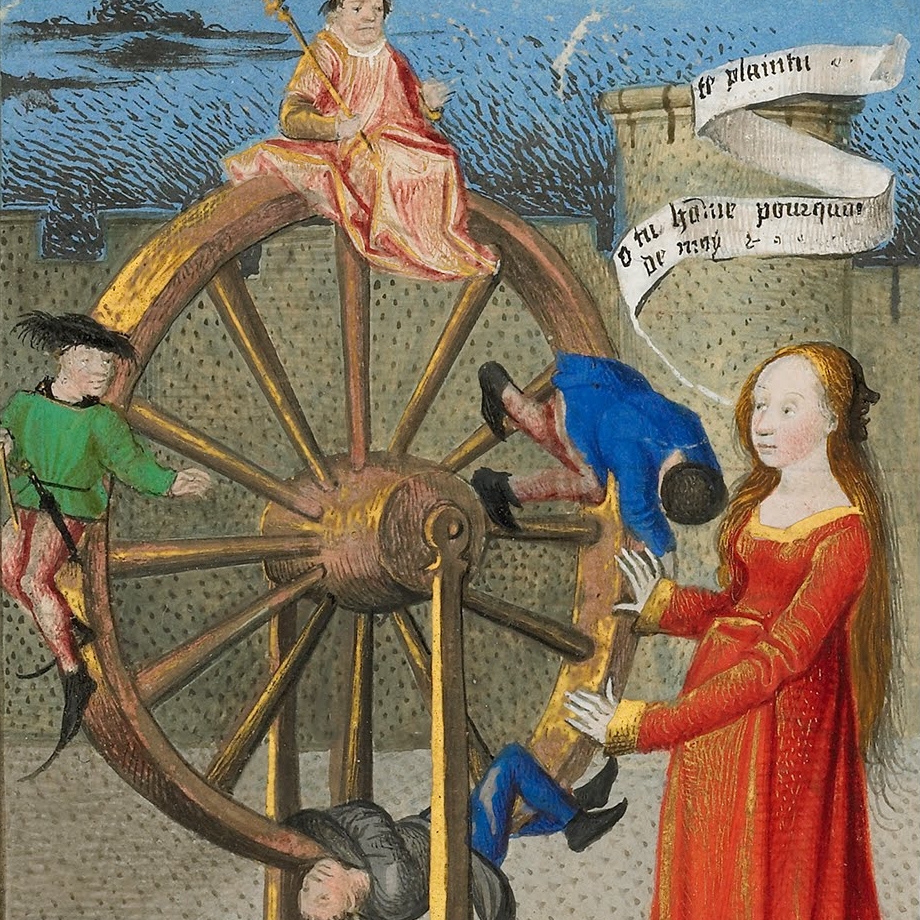
That's book three book two. It is Quietly no actually you should talk more because scream you reference more often than others the concept of the wheel of fortune We are transitioning to a game show podcast. I believe we'll yeah You want to so I think book two goes into this the most you want to kind of start a talk on what he's getting at with Fortune and why that idea might be helpful for us. Yeah, so medieval concept of fortune.
We've talked about this a couple times So just as a recap this idea that Sort of good things in life are needed out at well I was gonna say random a random distribution, but that gets talked about at the end of the book But as far as human beings are concerned as far as we perceive it it seems like good things and bad things get get doled out randomly That fortune is a demiure. It's actually a spiritual being created by God whose job it is It's like stick her arm in the water and stir it around every now and again to keep the water from getting stale So people will rise and families will rise and families will fall Fortunes will be made and fortunes will be lost and these things are meted out through fate or through fortunes Judgment and we as human beings Don't need to or we can't predict any of that and we shouldn't be super happy when we get stuff because oftentimes We got it just because of our good luck our good fortune And we should not be super bummed when we lose our loose things because that's just the way that the wheel turns and our time And the Sun is done now as the book goes on Philosophy proves to Boethius that the turns of fortune have no bearing on the happiness of people because the truly happy are the ones who Well regardless of your Whatever fortune or fate does to you you can be truly happy without fates blessings or without fates curses, which I don't know But this is crazy right like you you agree with that no matter what you don't agree with that I mean I want to but it's one of the things where it's like yeah, I'm super holy. I'm going to agree that regardless of situation I'm gonna be like you know, I mean and so part of whatever Level to this that is not probably useful to talk about talk about like Boethius is the author of this work But he's also a character in this work I don't think those two people are the same like I think Boethius the character is philosophy ultimately He must believe these things to write this book. So like I think he's he had to convince himself that yeah Actually, I can be happy even in jail, but like I don't think The studio audience like like doesn't that sound crazy or is that like you're yeah?
Is that your initial reaction to be like yeah, I'm gonna be really happy and I'm gonna think about philosophy all the time Right, you can't bring them in. Don't don't sorry. They're not here Yeah, the laughter is popular and it works. You know the people so I mean Boethius makes a couple of points here So first he says you are blessed even even in jail right your sons are consoles You have a wife that loves you you have a good family you lived a good life You were incredibly blessed before now you still have blessings you have like all of these accolades at your back So you are blessed he also points out that even men that have incredible fortune are unhappy Yeah, and I think any teachers in this room can attest to we've given everything to the students and they're still gonna find something to complain about Yeah, parents gonna test the same.
I think the suicides of famous people also a test for the same like they have everything They've got fame. They've got fortune They've got accolades and they are still unhappy and so fortune itself cannot bring you happiness So the happiness must come from some other place. So you're blessed first of all second of all fortune can't bring you happiness Third yeah, everybody's gonna complain all the time. So you've got to find your okayness someplace else Hey, do you have the quote in front of you?
You've referenced it and I think it's in your commonplace book about how like regardless of station in life There's still something to be unhappy about I can go another one of this book I think it's really powerful and it just goes through like when you're not married You wish you had a wife and then you get married and you wish I'd kids and you wish I acted better and like no matter Where you are there's always a problem with that? Yeah, I have it here. I think this one. Oh, here you go.
I got it. It's all read. Okay. One two Let's see it is the nature of human affairs to be fraught with anxiety They never prosper perfectly and they never remain constant in one man's case You'll find riches offset by the shame of a humble birth and another's noble birth offset by unwelcome publicity on account of the crippling poverty of his family fortunes Some are blessed with both wealth and noble birth But we're unhappy because they have no wife some are happily married but without children and husband their money for an air of alien blood Some again have been blessed with children only to weep over their misdeeds No one finds it easy to accept a lot of fortune has sent him There's something in the case of each of us that escapes the notice of the man who's not experienced it But causes horror to the man who has so that's not great.
Yes, so the point is is that he would so Even if fortune gave you everything there's still something there can still be dissatisfaction in the heart of the person that has it all So and usually there is this and it also brings fear that you will lose it right and you have the accolades of fortune There is the constant fear of losing everything and he comes and she points that out later again with wealth like wealth brings care And the more wealth the more care. Well, I mean puffed daddy and mace were right when they said money more problems. That's right Problems we see yeah, I mean but we see some of our time Okay, so yeah, so y'all are summarizing So book one is about how things are really bad book two moves into there's this thing called fortune and there's just this Random stuff we get like we don't deserve a lot of the good stuff in our life And we don't deserve a lot of the bad stuff in our life And so he worked up over those things it's probably kind of a dumb philosophy like you think you don't deserve it Just happen to you just kind of roll with it. Yeah, and eventually you're gonna die and if the soul lives on forever Well, you're losing your fortunes then so your happiness has to be based on something else and if fortune leaves you You were gonna leave fortune at death anyway, so it was gonna, you know, you're gonna wear the other yeah And listen to anything else there we want to move into book three Yes, please y'all are talking so but three is about there are all these different ways that people try and pursue well First off there's a thing everyone wants and he says happiness is that thing everyone wants happiness because he's a good Aristotelian.
He has a good. I love this book a lot But there are all these different ways that we try and go after that happiness We've referenced them before you don't want to say anything there the different ways that people go out there right there's wealth There's fame. There's finally pleasure. Let's go through the reasons why that they're not ultimately satisfying You touched on wealth wealth can be lost or when you have lots of wealth you are paranoid that you're going to lose it And you only get the good things that wealth brings by spending the wealth Right wealth is only valuable when you're giving it away And if it's based in like the beauty of your clothing or the stones that you're wearing it is those things that people see I will see Thomas dressed in nice clothes and say those are some really nice clothes and none of that is conferred to Thomas Come on if you see Thomas driving in a nice car.
I don't say Good Second one is fame and fame is ultimately not I'm gonna bring happiness Because everyone's gonna scream at you on Twitter. Is that what he says? It's partially because this world is small compared to the grand sort of things and even if you've got fame here It won't transfer to another nation and eventually you're gonna die and then give it a few years and no one will know You're the most famous console in Rome and you go to Mongolia, they're gonna be like I don't know who you are He does a cool part in here about how we try and give you know Some people get fame but not everyone does but in fact we all share noble origins He doesn't use the term amago day image of God But it'd be cool if he did but like to say that there's an ability just in humanity in and of itself So in the poem for section six thus all men come from noble origin Why then boast of your ancestors if you consider your beginning and God your maker no one is based on unless you desert His birthright and makes himself a slave device. Yeah Okay, so there's fame and then power kings kings ultimately that power is not as satisfying or makes you happy does not make you happy Because you're always looking at your back.
Yeah, and yes the people who conferred power upon you can take it away What's the sort of them damn please? Yeah? Yeah? Yeah, so there's a story I'm sorry them please.
There's this dude. There's a lot of these a lot of these right chicken heads So yeah, so there's this dude who's a king and he wants to explain to a guy what it feels like to be king And so he has a guy sit on the throne and then they hang a sword above his head And it's connected to the ceiling by a piece of horse hair But a tiny tiny thread and so you have to sit there and like knowing the sword is directly above him and that's the pressure It is to be king to know that things can go very badly very quickly The other reason public office and power wasn't good is because it doesn't it doesn't confer virtue to the person who holds the office Like if you're a bad dude the only thing public office is gonna do for you is highlight your bad You're gonna show that you're the worst and so both is like hates So Nero had power he had office, but you still a super bad dude, so yeah, okay And then the fourth one is bodily pleasure Yeah, and body pleasure does not ultimately bring satisfaction because according to both this and I agree is that it leads you down into being an Animal yep, I was gonna also say I think in my opinion people die, but there's that too Yeah, there's an into a bodily pleasure. Yeah, yeah That it can't be the ultimate source of happiness because bodies are if happiness is a divine and eternal thing Which he's gonna talk about in book four then bodily pleasure can't bring that because bodies corrupt and fade and And and sort of the physical the physical vices eventually lead the person into a more degraded place as opposed to a more satisfied place So he's any more in the section like camera. No wealth on her power fame bodily pleasure, and then he moves in and says okay So all these things are insufficient goods, so there's that there's a thing he opens with in book three Which I think is really interesting that he both these argues that Happiness is kind of actually one thing, but we split it up into lots of little things and so Whereas what we want is happiness We instead break that into well kind of be nice to have money and power and fame and all those things and then goes into when you break Into the small parts they don't satisfy in and of themselves, so then he moves into this part of okay So then if these human things are not sufficient, then it must be a divine thing that is sufficient That's what he moves into at the end of book three.
Yeah, he and If he kind of makes the point after this that like we we try to get happiness through all of these side avenues But the only way we can have it happiness is we have all of them at once right if we have power and some pleasure And a little bit of wealth and like things We need if we only have it all if we have all of them at once and the way to get all of them at once And there's some I think some some little goofy arguing here He argues that the goodness is God and God is unity and everything seeks unity because if you're taking apart you die Yeah, you follow me like you guys have bodies and if you take an arm off you're probably gonna die So everything wants unity therefore everything wants God because God's unity So there's it seems like there's some equivocation and some funny argument here But basically the place where he ends I'm trying to speak through this a little bit because I really want to get to book five Oh, really I totally think book five. I think so cool fine So you just want it well I'm just trying to get like his basic definition of happiness is men seek because we naturally seek to stay alive We seek unity unity is God and the divine with that comes everything else that is included So if you see God and participate in the divine you get all of these other things you get power you get wealth you get Everything that can satisfy you and all of those things kind of come as a group package rather than seeking each one individually Yeah, is that a fair summary of what he's saying? I think so and then this is also the point of the book where it sounds most like Plato because it's got philosophy making these statements And then both of you saying why yes, how could it be otherwise? Yeah, then indeed it cannot be argued with like it both is writing the book and then he's like putting the words like yes That's the smartest thing I've ever heard before But yeah, so the ultimate so his conclusion is that happiness is Basically holiness or he I think he calls it a divinity Yeah, I'll treat a few quotes that kind of get to it So men become happy by acquiring divinity Even later says that the essence of God is to be found in the good so then that's what's tying this virtue to happiness The good is the end toward which all things tend so we're all working toward goodness And he wraps up book three with this thing about people go for evil which is a bummer, but God cannot do evil But God can do anything everything therefore evil is nothing kind of his logic in the book Which is one of the examples I think of equifications, right?
It's but there's nothing that an omnipotent power could not do no then God can do evil then conduct can not God Evil no so that evil is nothing right since God can do everything and God can do evil must be nothing because there's nothing God Can't do but if you slightly switch the words he's using right if God can do anything and evil is something then God can do evil Right, so you can easily reconstruct a counter argument there And I see where he's going but I was just one example of kind of his like goofy argumentation But then the next section is where he kind of ends up it's great summary Well, just before you move away from that I mean if that isn't if the the nothingness or the lack of substance of evil is something that listen Are you find interesting a more robust defense of that is found in Augustine's city of God? Yeah, so if you really want to go into that yes I agree that in in Boethys he kind of blows through it right and both his is like well Yes, how could it be argued otherwise, but if you do want a more in-depth defense or more in-depth Work through of that idea of like what actually is the nature of evil? Augustine talks about it a lot in city of God or a guston storage almost. Thank you.
I appreciate it So here's kind of the end of book summary for book three Just now you began with happiness and said it was the highest good And you said it was to be found in God Then you be arguing that God himself was also the supreme good and perfect happiness and added as a kind of bonus that no one could be happy Unless he was also divine You said that the very form of the good was identical with the substance of God and of happiness And you taught us that unity itself was the same as the good because all things had a natural inclination to it Then you argued that God rules the universe by the helm of goodness that all things obey willingly and the evil is nothing All of which you unfolded without the help of any external aid But with one internal proof grafted upon another so that each druid's credibility from that which proceeded and this kind of argument is what laid A little bit I mean I think it came from some dudes before him But it was sustained the notion that everything in the world seeks God like even the spheres move in a as they move So that they can return to the unity and goodness of God, right? Everything seeks unity therefore everything seeks God the telos of everything is moving towards God in some way I don't really know how that works in because if you think about like the telos of a tool like a hammer Which is an example we use the purpose of that tool is to hammer things I don't really know how that fits into that the hammer I mean I guess it's if the person using the hammer is building the house on the house is a good and maybe you follow that chain upwards I think that's also why he has to say that the essence of divinity is goodness like I don't know Yeah, the virtuous use of things therefore is a part of divinity right so I'm gonna move us along We're you know run a little short on time, so I'm gonna kind of blow through book for if that's okay, and I'm like book five Yes, okay, so book for what do you like about the five? Oh, it's so much. I like what we're there in a second You like to grump on the things I love so feel like we were predestined to move to book five Yeah, for sure so before is basically an argument about how evil men are to be pitied They're not winning right if they if they are trying to seek happiness in the wrong things then they lack the power to achieve true happiness They're spinning their wheels getting things that are terrible if they avoid punishment That's awful because it doesn't correct them on to the path of virtue So even if they get away with something that hurts them more Yeah, so essentially evil men are to be pity because of all men they are seeking for happiness in the wrong places They do not have the power to see the good they cannot find the good even if they get away with it They're even to be pretty more never get away with it It's basically the obvious is phrase is that if they get away with the evil that they do the evil that they do Essentially corrodes and breaks them down internally and they become wretched and vile and if they don't get away with what they do They're getting correction and that correction is a good because it's bringing them back to actual true happiness Which is found in virtue.
Yeah, and so he and that he that's the conclusion of the argument He lays out that argument kind of step-by-step in that socratic platonic back and forth style Yeah, I really like that it's really good I find it interesting that he takes an attitude some other folks have taken in that criminals are not to be treated with Hatred or cruelty but to be pitied and then drawn back to the good right seen as someone who is ill rather than someone who is A monster. Yeah, exactly right. They're mistaken more than anything else. All right, so book five He he lays out Providence versus fate.
So how would you guys say what would you say the difference is did you guys grab get this? So if I try reading I was looking at this again last night because I know you want to talk about book five So insulting the way he said let's see if I can put this together Providence and I mean fate is subservient to Providence. So Providence is over fate. Yes Providence deals with the overarching big final story of God's will and fate is the Small interactions that happen on earth that are moving God's will to fruition.
Yeah, there's a way to think about it is if Providence is a blueprints fate is the actual building of the house Yeah, right. That's the easy way to think of it Providence is God's overarching plan set in his mind from eternity past to eternity future and fate is the day-to-day working out of that plan in minuja and It sounded like he would say that there is no room for randomness that random things don't happen Is that fair there is a cause of everything that causes God so in that sense there is no such thing as chance But in the sense of we don't know what's going to happen Yeah, there's chance all over the place. So we call things chance because we don't know the cause is his argument Like if you dig in your yard, and then you're like whoa a box of gold coins What a lucky chance like it's not really chance somebody buried that there for a reason and then you were digging because you wanted to find You know your sewer line or whatever So there were reasons for both of those things It was just a coincidence that those that happened to bring you to a box of gold coins on the day when you needed by present for Your wife because we ran a version and you forgot but I can say that's what that what makes a chance is actual cause that we don't fully understand But aren't there things that we do that actually have no bearing on God's providence? Like if I roll if I sat here for this whole podcast and I roll the dice like the outcome of that those dice rolls are going to be Chance and oh there's a cause for those dice rolls the weight of the dice the way that you threw them right There's no making of the dice like there is a reason there and it's ready to be like random chance I think I think what we're getting into is an argument about the definition of chance which he says that there's Yeah, but but we would say yes chance can have a cause and so I think maybe all of us would agree that chance exists It's just what we call it when cause is coming to into fruition to bring a weird circumstance to bear right or a weird coincidence to bear I think both you so probably agree with you but he's arguing that nothing happens completely by chance They're always causes, but this isn't the interest.
I just don't like the idea is that God wanted my sister to beat me I'm an Opoli. That's all I wanted to try to do was ordain There is a cause for that. Yeah, you can be bad enough and she is good enough Alright, so the interesting part that I wanted to get to is he goes then into a question of free will How can there be human freedom if there is no chance right he talks about chance first and then he says well Then how are we free if God has predestined everything so the first thing we have to understand before we sort of understand his definition is that there is a difference between eternal time and Infinite eternal life so life for God eternity for God is the fruition of all Moments at once. Yeah, we're filled with life and knowledge So while we exist exist in moments in a series So we even even in the eternity of time whatever moment we are living and we have lost the past and we have yet to gain the future So think of what we have as perpetual time not infinite time what God has is infinite time He exists in every moment simultaneously and sees all of those moments and fills them with knowledge and love and life Right, so it turns for God is completely filled with time and life and knowledge He sees everything as it is happening whereas we see it as perpetual time, which isn't nearly as good So that is a more fun way to think about the way that God exists with it and so then he says okay Graham you are sitting there, right?
Yes, yes the fact that I am seeing you makes it logically necessary that that's what you're doing Mm-hmm, right so but do I have any effect on what you're doing am I forcing you to sit there? I mean kind of like no, you're not no you could get up and throw things around as I've watched you because I see it happening It would be logically necessary that you're doing it Yeah, I see you doing it therefore you must be sitting but I convey no necessity Yes, right you're sitting not because I'm watching but I'm watching because you're sitting and so this is where Boethius lands with predestination God confers no necessity on our will but because he sees it in the eternity of time He sees what we are doing for all of our lives, but he doesn't convey necessity upon it Right we still choose freely But we see every choice there and so that is where we get freedom despite his knowledge of everything is the difference in eternal time and perpetual time And that he sees all we do so logically we have to be doing it But he doesn't necessarily force us to do those things does that make sense? All right, does that make some um, I mean yes Let's wait a while like are we there? Yes, I'm this entirely explain Boethius.
Yes, okay, so that's what you guys think because this is kind of his whole conception of predestination this kind of That was a dismissive shake of the head you just gave sure okay I think it's a fine way to think about God's relation to time I think it's problematic in thinking of God just as like he watches everything and sees everything happen and humans do whatever they want Like there is more if you read Aristotle and the ethics you will see that the so Aristotle who is not a Christian logic His way into yeah, there's probably has to be a God the prime mover the first mover And so Aristotle's Aristotle's God that he comes to in book 10 of the ethics is a God who is a part from creation So he sets things in motion He kind of sets all these laws and then things kind of roll from there and it's just kind of the place Boethius gets to The consolation is for sure a Boethius believes in God and is a Christian, but like it's not an explicitly Christian work He's going into so like yeah There's no discussion about what is happening in the person of Christ when God is entering into time right and under fate Yeah, so then I just think you get into problems of like how people are saved like that so in saying that people have people Choice is not an illusion I do in fact choose to raise my right hand right now like that is a thing that did actually happen. I just I For the listeners he didn't I just think you get into problematic territories when you say okay Well, Boethius logic is way into this therefore salvation also works this way Which I think is the more contentious category of we understand what we mean when people say free will audience What do you think of when you hear free well free well versus predestination like is that just me maybe just me? I think of free will as a category of how people are saved before it's I choose salvation therefore I am saved as opposed to God's preordaining Whether someone is saved or not, but it's both so great and that's fine But Boethius is clearly only presenting one side of that argument is that fair is that yeah? That's what I'm saying and that's kind of where I land to like even if even if that is the nature predestination that God sees all but conveys No, no necessity at some point there was providence right and he chose a plan right and then at another point he created So there is divine agency there.
He's not just watching it all happen Yeah, he created a certain world that would have certain outcomes outcomes that he knew and so he is still his choice Yeah, right overall I was thinking into D as I'm very quickly of like God is just apart from his creation as opposed to actively involved I think that's yeah I think that's the danger is it takes away a little bit of the sovereignty of God Yeah, and maybe perhaps a little bit of a divine agency But what I do like about it is that I think that way of thinking about infinite eternal life is a more helpful way of thinking about it Sure, and it does change the way that we talk about this problem right predestination is how we experience destination not how he does Does that make sense there is no pre with God? It's an all with God right for knowledge assumes a before and after for him It is just present present it is knowledge He knows these things and so yeah, there words we use but it's describing how we experience it not how God does And I think that's an important distinction when we're discussing this is probably what is behind the what Christ says in I think it's gospel of Matthew where he says like The Sun does not know the will of the Father will the Father only the Father knows all things That's probably what he's getting at because Jesus is in time at that point I don't I have to I have to go relook that and think that through but that's an interesting interesting thought Do you think that? So really quick this party ends at 40 right yeah, well I was that was moving to wrap it up 45 Okay, we are at 545 now, so we got to do our little outro they let out a little bit early But the last so the last question do you think is this a satisfying work to you like if you for whatever reason megby were thrown in jail Oh, Annenberg if you were unjustly put into prison is this something that you would take comfort from does philosophy console you the I think there are some things here that do the knowledge that bad men are not Succeeding at life like that's that's a good notion and that everything is under God sovereign control is good and that fortune goes Where it will and so you just sort of have to deal with the throws of fortune I think all of those things would be incredibly comforting But I would still want to do like a thousand push-ups to get out my frustrations sure no I mean like there's still there's still some feelings there that I deal with right it not they don't always come under the Dominion of the mind I can't be like yes my philosophy will solve all these complicated feelings that I'm having right I'd still need to throw some food at the wall and do some push-ups and then after get my frustrations out I could have a good think and have a good cry and I'd probably be in a good place well Yeah, I agree with that I think books I would find books one through four most comforting and then book I would throw you into like an existential crisis again I know I'm chill and thinking about But I was fine and there's also this progression of like by book five Boethius no longer is mentioning that things are really bad for him It's almost like he's no longer in prison, which is like a metaphor man like it's mine's not in the prison. So You don't own my mind man.
Yeah, so book five is fine But well, I'm getting it's like if I have the choice between like the Psalms and the consolation of luck I'd rather have the Psalms. That's all I'm trying to say but I think I think so you're saying the Bible is better than this book I was a controversial, but yeah, whatever It was between have a cook and this book I would have a harder time, but you know anyway But yeah, it's great book His point that like he comes to all these things through reason and that there is a consolation through that reason I find very helpful because he didn't have a Bible with him because he was in prison But yeah, and I find the phrase or the fact that one never you never really get away with anything to be very troubling and also very Comforting I find that to be a very comforting thought well This has been classical stuff. You should know with AJ Thomas and Graham Thank you for listening. You can find us at classical stuff net if you have questions or concerns or you have solved the dilemma between Free Will and predestination please email us at classical stuff at veritas academy net we are always intending to respond to emails I think we respond to lots of them.
Yeah, but Graham responded to lots of them. Thank you tweet at us at cool school stuff at Twitter And I will tweet back at you or at least like things that you say that I agree with um, great and besides that go Catherine Turns out she doesn't have ancestors wow at all wow she it was a weird way to know where There was a lot of confusion there You are not a descendant from the Concrete on a center for anybody just appeared. Yeah cool. All right Well, this is also stuff.
You should know and we are signing off. Bye. Bye. Thank you I'm glad I didn't stop the table