
EPISODE · Apr 25, 2026 · 21 MIN
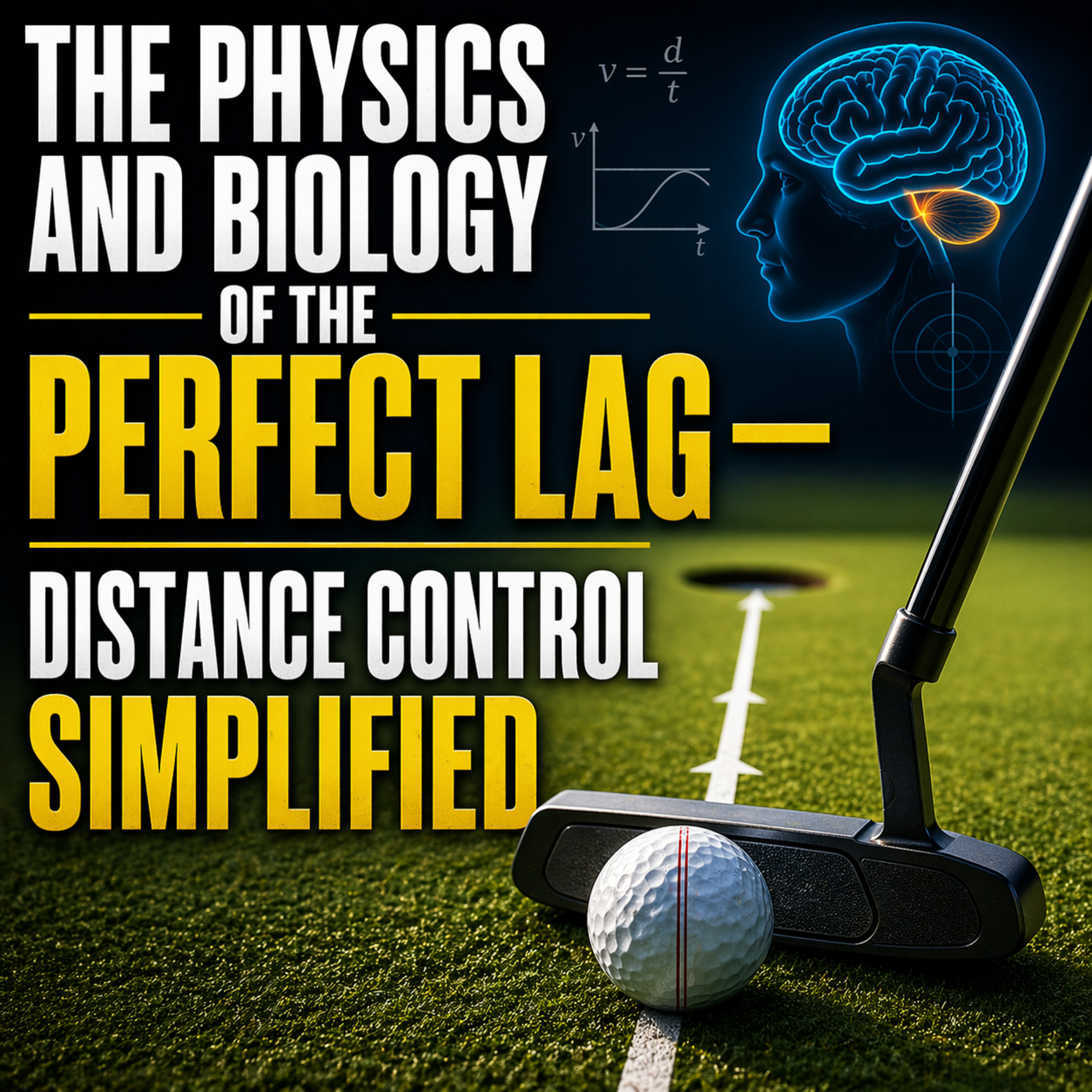
#568 The Physics and Biology of the Perfect Lag — Distance Control Simplified
from Golf 247.eu: The Global Platform for Innovative Technologies and Teaching Concepts. · host Golf247.eu
A journalist recently interviewed Henrik Jentsch about the Puttalyze concept, revealing a clear shift in how putting performance should be understood and trained.Most golfers plateau not because they misread greens, but because they focus on the wrong variable. Line is secondary; speed controls everything. Without correct velocity, even a perfect read fails. Elite putting replaces fragile “feel” with biological calibration—allowing the body’s internal system to regulate energy output.At the core of this approach is a rejection of traditional “feel-based” putting. Feel is inconsistent and unreliable, especially under pressure. Instead, the system focuses on instinctive putting—synchronizing movement with the brain’s natural calibration processes. When the brain processes visual information and releases the correct amount of energy, the stroke becomes automatic rather than mechanical.This shift creates psychological stability. Instead of guessing and manipulating the stroke, players operate from a reliable baseline. The result is a transition from uncertainty to execution.The real scoring gap in putting lies in distance control. Three-putts are rarely caused by poor green reading—they stem from incorrect speed. Professionals understand that speed defines the line, not the other way around.An important concept within this framework is the idea of the brain acting as a safety system. When a putt is left short, it is not necessarily a mistake—it is the brain limiting energy to maintain control. Short is perceived as safe; long is perceived as risky. When players fight this instinct and try to force speed, they fall into what is described as the “Control Trap,” disrupting rhythm and consistency.From a physics perspective, a slower ball is less stable because it is exposed longer to slope and gravity, causing more break. This challenges the traditional idea of “dying the ball into the hole.” Instead, the system targets an optimal capture speed of approximately 3–4 revolutions per second at the hole, balancing maximum effective hole size with roll stability.Distance control often breaks down due to conscious interference. When players stop trusting their natural stroke, the thinking brain overrides instinct, leading to what is described as “Distance Amnesia.” The solution is to accept results—especially short ones—to allow the brain’s calibration system to function and improve.Training within the system is built around three key phases: establishing stability, identifying the natural “zero point,” and gradually extending beyond it. A central principle is eliminating practice swings, as they introduce artificial feel and disrupt true calibration.Execution is simplified into a three-step process:Look: gather visual informationBall: translate that information into energyRelease: execute without conscious controlTraining is intentionally limited to short, focused sessions—typically no more than six minutes—to maintain neurological precision. Beyond that, calibration turns into repetition, and control begins to interfere again.Ultimately, this approach reframes putting entirely. It is not a mechanical skill to be controlled, but a biological response to environmental input. When the system is calibrated correctly, distance control becomes a natural output rather than something forced.Key InsightsPrioritize speed over lineShort putts are a baseline, not a failureUse the Look–Ball–Release sequenceTrain in short, high-quality sessionsEliminate practice strokesDistance control is not something a player creates—it is something the system allows.The ExplainerPuttalyze-Appwww.Golf247.eu
Embed this episode
NOW PLAYING
#568 The Physics and Biology of the Perfect Lag — Distance Control Simplified
No transcript for this episode yet
Similar Episodes
No similar episodes found.
Similar Podcasts
No similar podcasts found.