
A podcast by Sipra. In podcast, they'll actually be a podcast. They are Sipra podcasts. Sipra podcast.
Interviews, background talks, and voices from all Alpine countries. Listen to this and more in the podcast of the International Commission for the Protection of the Alps. www.sipra.org. Forward slash podcast.
Welcome to the second episode of our podcast about commuter mobility in the Slovenian industrial zone, Trata. In the first episode, we took part in a study trip to good practice examples for mobility management in the very west of Austria and in Liechtenstein. In the next half hour, you will hear various voices from Slovenian participants in the study trip. And which conclusions they draw from it.
We start off in Liechtenstein. Teachers, police, public administration. In 2007, the principality of Liechtenstein has integrated a law on mobility management concerning all persons working in public service. With measures such as partial reimbursement for public transport and financial support for sustainable means of transport, for example for buying bicycles.
On the other hand, they have to pay a fee for parking spots. The result between 2008 and 2021, the amount of people commuting by car to work constantly reduced from almost 73% to 54%. 2008, only 8% cycled or worked to work. Nowadays, it is more than 20%.
As many as this come by bus or by carpooling. So let's come back to the situation in the industrial zone of Trata in Slovenia. Every day, thousands of persons commute there, most by car. Würban Iraja works for the Institute for Spatial Policies based in Ljubljana, which consults the community and the companies within the project.
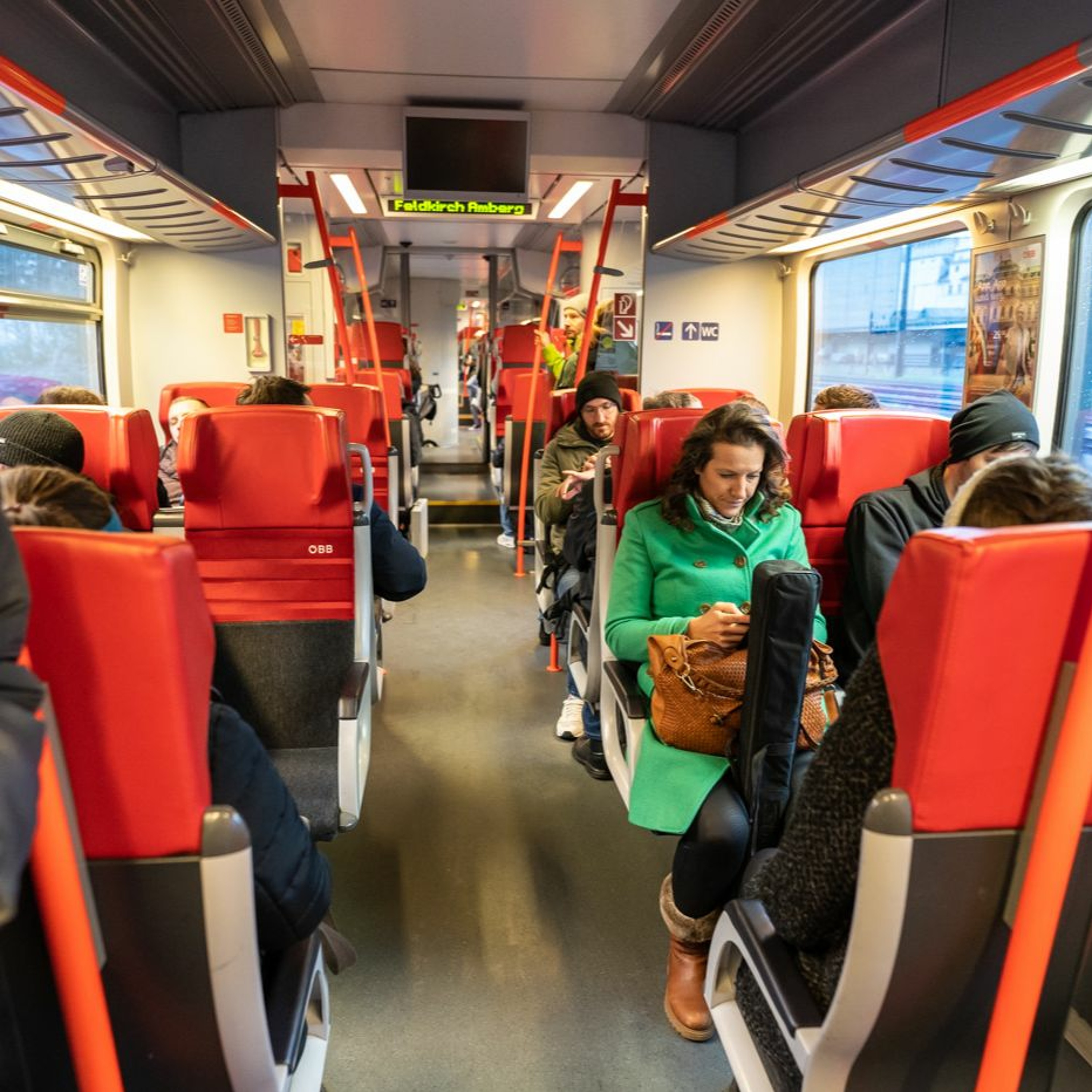
On the bus from Düampen to Büggens, we talk to him about the main challenges of commutability in the Trata region. Well, the biggest challenge is that most of the people commuting to Trata, they use private cars and they drive alone in the car. And the problem is that it takes a lot of space, it creates traffic jams and yes, of course, the air is not the best. About what percentage are we talking here, how many people are going by car?
It depends on the company of course, but we are talking about 80% of all the commute is done by private cars as a driver. The rest, all the 20% is all the other means, so either cycling, walking and so on. Where do we see the biggest possibilities or the biggest potential to change this? I mean, the change could only be possible if commuters see the benefit for them.
So when talking with companies, they see the change of incentives, not directly to payments because that is complicated, but all the incentives are an important part of this. And now they are with free parking, they are incentivized to ride the car and they don't see any advantage on riding a bike or even using a public transportation because, to be honest, the public transportation has its own challenges. So one point would be to improve public transport also there? That is correct and logical way to think, however, it is a very complicated one in Slovenia.
Why? Because the train infrastructure, yes, it is there, but it is not in the best shape and the management of the railways, it is very bureaucratic and very inefficient. So it is almost near to impossible to change something on the railways. So it is really sad now.
And to be honest, nobody really counts on improving of the timetables and so on for the railways. For the buses, it is slightly better because on one hand there is the municipality of Köpilnokka who can have some authority over it. It is slightly better than on railways, but it is still a long way to go. If I listen to you, one of the quickest solutions would be to bring people more on the bicycles.
Exactly, exactly. That is the core of the project. On one hand, to build some of the missing links of the cycling infrastructure and on the other hand, to enable employers to buy company bikes so that employers and employees can use them for daily commute. And so with the project, Tra-ta, the industrial zones for the 21st century, they are going to buy, let's say, a moderate number of e-bikes.
With, on one hand, they would like to really change the model split. On the other hand, they would like to advertise or to showcase what it can be possible and to build a foundation for the next, let's say, wave of either private or company bikes. We are travelling around Eastonstein, around for Alberg. You know the region already, pretty good.
And we already had a look at some companies and municipalities here. What strikes you the most? Are there two or three measures where you said, wow, that is really something that we also could do? Now, in this current second, we are driving through Walford.
And in the morning, we were guests of Mr. Martin, who is a mobility expert from the municipality of Walford. And we have been amazed by how much it is possible to achieve with relatively modest interventions. Shared space streets in front of the kindergarten and the hotel and the connection to the circus streets.
But also we were quite happy to learn about what are the measures in the parking policy, where it makes an impact on the daily commuters, while at the same time enabling all the shopkeepers to have the access to their shops quite efficient. How do you get to work yourself every day? I cycle. I am lucky to be in the job where I am able to cycle every day, so the distance is 4.5 kilometers, so it is easy for me to cycle.
And yes, I do it in every weather, because in sunny weather it is kind of more normal to cycle, but when it rains, I really don't dare to use a car because there is a horrible traffic jam. And I am so much faster on the bike, so I use it throughout all the seasons. This was an interview with Urban Yar here from the Institute for Spatial Policy in Uralian. We drive by bus from Walford to Bragens, where we visit the Ilverke Faucaville.
This is the largest energy provider in the region, with around 1,200 employees. Since 2013, Ilverke is part of the network Vetch of Mobile that we already mentioned in the first podcast episode about this topic. Since 2017, Ilverke Faucaville employs a mobility manager who coordinates activities such as bike breakfasts or bike wash events together with mobility multipliers. Employees working at different locations of the company.
Lucia Podomnick from Slovenia is also dedicated to become mobility manager within her company, Knaof Insolations in the Tatarzon. That is also the reason why she takes part in this study trip to Vaucaville. We talk with her about different working hours as a challenge and about her personal mobility. I come to work by car solo.
For now, I am willing to change that at least twice a week. I am very looking forward to these e-bikes, because the path is nice from our office to my house, so I am looking forward to ride a bike. What do you think is the main challenge for your company to switch to sustainable mobility? The main challenge I believe are working in three shifts.
That is one of the biggest challenges, because the public transport is not very user friendly. For example, for first shift in the morning, our employees have to be at work, let's say half past five in the morning, and connections of public transport at that time are terrible, there are none, practically. And same story in the evening. When the employees finish their work, it's ten, the connections are very bad.
This is the main reason I believe, and the motivation. Of course, the motivation of employees is always a challenge. We visited some companies here in Far Alpehark, Liechtenstein, and what do you take out from these examples? What strikes you most?
What are some points where you say, this would be really nice, that would be also something for us? The first thing that comes on my mind are the eco points. I think that this competition really motivates people. So this is one of the tasks that maybe could work with us.
And then, as I said, there are limitations compared to Austria. For example, the public transport, it's very frequent, which is not with us in Slovenia. So I got some view of limitations and possibilities. So this is valuable to me.
At the end of the study trip to Austria and Liechtenstein, we talk to Miloshebeit. He works for the city of Skofia Loca and talks about his learnings from the trip. I've covered the field of transport mobility and sustainable mobility infrastructure projects. In this project, for the 21st century, we will connect a bike line between the industrial zone and the other part of the city.
It's my role here to find some good practices in Far Alpehark. I've seen it in all the cities, in Liechtenstein and in Walford. There are really good examples and I think we'll try to implement it in a similar way. While we're making progress here by year, I think that there's a green line for it.
We have this sustainable mobility panel. We see we have to make a new one, especially for the cycling infrastructure and promotion. I think we will make progress towards the model speed in favour of sustainable modes. So during this study trip, what impressed you most?
The really good public transport here. It starts from infrastructure to timetables, so integration, ticketing, the information, the information, the simplicity of everything. I was just impressed, maybe most of it about this. The impression was the termination of the companies, as well as the regional and local government, especially Energy Institute here.
The person behind it, Martin, he's done a great job here, and he could be a role model for many people, for many regions and organizations. I've seen these results from Liechtenstein a few years ago, and I think this is something that we could fill the gap. We don't have a Slovenia-Schwiloka. We can now, apart from this project, also a new sustainable parking policy to fulfill.
I think we have many challenges that we could implement in a similar way. How do you get to work every day? In the wintertime, I work 12km from my home. I usually go by car.
In the other times, when I don't have these extra trips to the afternoon for the kids and the family, I travel by an actually bike. I'm living in the city, and we own only one car, family car. So it's less than normal than average. When I bought electric bike four years ago, I have a determination that I will go to work at this three times a week.
With the bike and I manage to, let's say, meet up March until the mid of October. Tipras-Lovina is part of the project. Schwilha Berlot Wieselko is director of Tipras-Lovina. She talks about plant measures within the Treta project and the main learning concerning mobility management.
One is from the companies that, if you want to be successful in the vision which company agrees on, first you have to have a board of management, then it's really important that you have a team of at least two to three people who are engaged and are different profiles taking care for the success of the measurements. This is one point. And second point is that if you want to have efficient, sustainable mobility in the region, stakeholders should really cooperate, not just on all levels. So state, regional, local companies, public administration, so really working together towards the same goal.
I think this is really lacking in Slovenia and I hope that pilot municipality, Škófiloka, which is also the location of Treta region, will have the strengths and capacities to create this kind of collaboration between stakeholders and really change something in their local environment. What I ask everyone during this trip is how do you get to work every day? I bike, even in eight months of pregnancy. What are the main challenges actually?
You mentioned them briefly in the region of Škófiloka for changing mobility habits. Well, the infrastructure is still not holistically managed. There are still lack of backlines. There are still not really good public transport and so on.
And also, in Slovenia, public transport doesn't have a nice reputation. So it's really not used to use public transport. This is really a step forward. If you use it, even though it could be convenient, it's not something that older generation or people who live in rural areas have maybe in urban areas, yes, but in rural know.
So in Treta zone, we see the main possibility to improve, to use biking and public transport, local public transport, not regional. And the change of mind, so behavior change in the workers in the zone. And how actually did the idea for the project evolve? The idea came from development agency, so they had already relationships with municipalities and also with the industrial zone.
And they were triggered with the problem of traffic generators as economic zones could be. No one addresses it in Slovenia, and they are mostly located at the highways. And Treta zone is different because it's located at the railway. It has a rail bus, local bus, it has quite nice bike routes from the city center to Škófiloka.
But it's in the rural area, so we are not talking about urban area and people have cars to commute. The idea of development agency was to connect the street companies, so cloud isolation, shibogli and aldeha, to start with the process of awareness raising, changing behaviors and changing model speeds towards sustainability. And also what is really important, deliverable of the project is that it will create a booklet of good practices, how to manage mobility in industrial zones, to use it for other zones also in Slovenia, and to have this multiple cuts effect on other areas also. So developing this booklet is one of the goals in the project, are there other steps taken?
Of course, all the companies will have mobility plans with the measures, with the evaluation and monitoring plan, and they have quite progressive families also. And we have awareness raising activities, so we will create an online course for mobility managers. We will have this booklet of good practices, foreign good practices and how to maintain sustainability in industrial zones. And what is of course really important is that the municipalities Škófiloka will be part of the bike line from Škófiloka to Treta zone.
There is also infrastructure, but most of it is also infrastructure. And the companies will buy bikes for their employees, so around 20 to 10 bikes, before each company. And employees could use it for their commute. So here is also a challenge how to create some kind of a system that is fair for everyone, so here we are still finding solutions.
How do you get to work? So during this trip we learned that mobility management can on the one side have a huge positive impact on our well-being. But on the other side also employers can profit from lower costs for parking, as well as healthier and more motivated employees. Mobility management is more than just building a bike stand.
It has to meet the personal needs. It works mainly with incentives instead of penalties. And it needs personal commitment from the top management. Find out more about the project Škóf Treta, commuter mobility in the 21st century on our website.
Thank you for listening. I hope you enjoyed the trip. My name is Jändtros. A podcast by Zebra.
In podcast, we'll ask you to watch the podcast. The Art Zebra Podcast. Interviews, background talks and voices from all Alpine countries. Listen to this and more in the podcast of the International Commission for the Protection of the Alps.
www.zebra.org. port slash podcast.