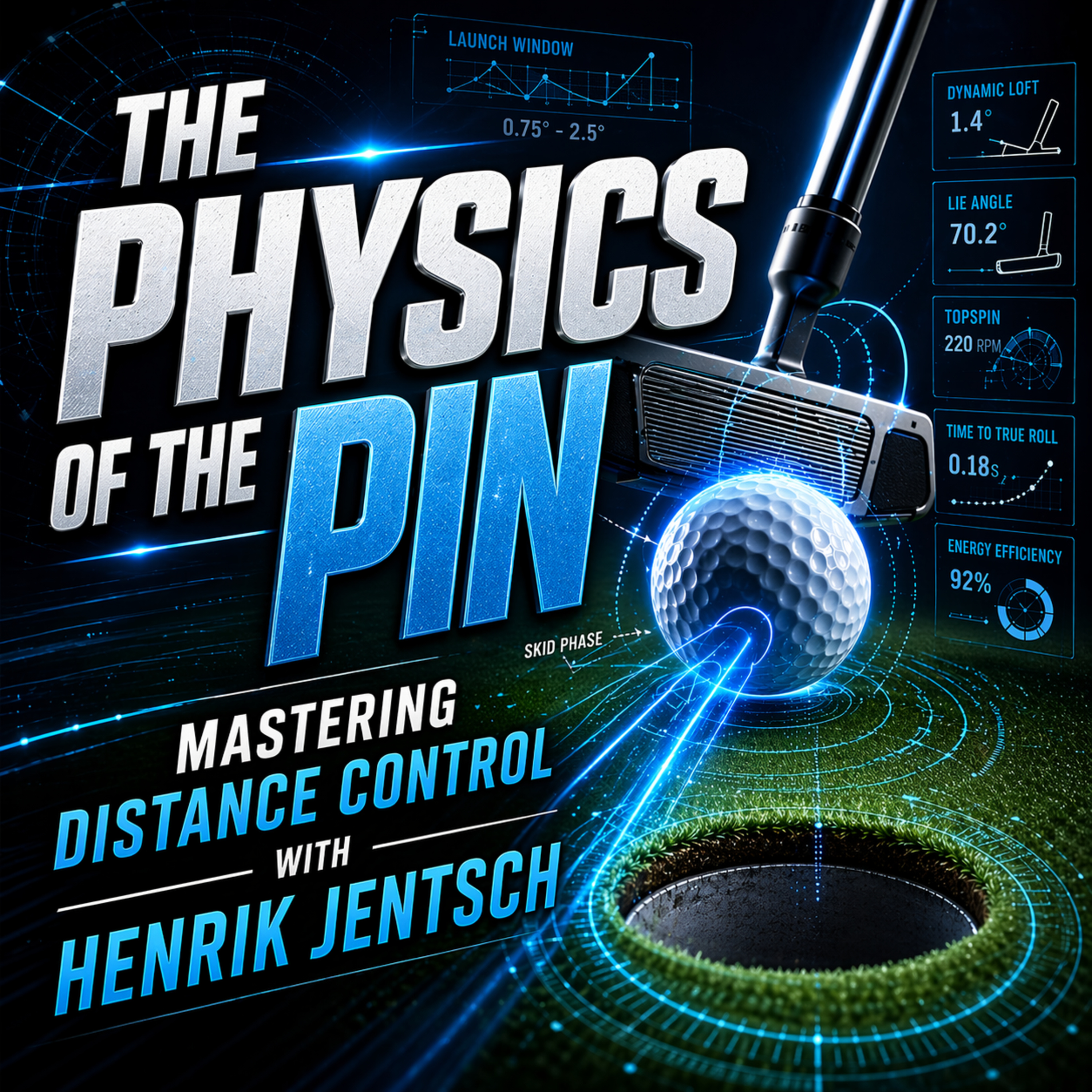
#573 The Physics of the Pin — Mastering Distance Control with Henrik Jentsch episode artwork

EPISODE · Apr 30, 2026 · 21 MIN

#573 The Physics of the Pin — Mastering Distance Control with Henrik Jentsch

from Golf 247.eu: The Global Platform for Innovative Technologies and Teaching Concepts. · host Golf247.eu

In putting, the biggest misconception is the obsession with line. While amateurs focus on reading break, the real difference between high-handicappers and professionals is distance control. Putting is not “feel”—it is a measurable system of biomechanics and physics. Consistency comes from calibrating energy output, not guessing.The core issue is inefficient energy transfer. Distance is not a direct reflection of stroke force but of how effectively energy is delivered at impact. That energy splits into three parts: forward motion, topspin, and losses through friction and ball deformation. Two players can apply the same effort, yet achieve different results due to efficiency. This is why “touch” is unreliable—it’s simply unmeasured energy control.A key factor is launch geometry. The ball sits in a small depression (“nest”) on the green, requiring a Controlled Positive Launch. Too low (<0.75°), and the ball is driven into the turf, increasing friction. Too high (>2.5°), and it bounces, losing energy unpredictably. This depends on both dynamic loft and lie angle. Incorrect lie shifts strike location and destroys distance consistency.Every putt also begins with a skid phase, where the ball slides before rolling. During this phase, it is highly sensitive to surface irregularities and loses the most energy. The goal is to minimize “Time to True Roll,” where the ball achieves stable forward rotation. The faster this happens, the more predictable the ball’s behavior and deceleration.The Puttalyze system replaces subjective feel with structured calibration. It focuses on reducing three-putts by improving energy control rather than mechanics alone. The objective is simple: save at least one stroke per round through predictable distance control.Three key principles:Maintain consistent dynamic loft for stable energy deliveryOptimize launch between 0.75°–2.5° to escape the “nest” efficientlyMinimize skid to achieve early True Roll and predictable speedDistance control is not guesswork—it’s physics. Master the energy, and performance follows.📺 The ExplainerPuttalyze-Appwww.Golf247.eu

In putting, the biggest misconception is the obsession with line. While amateurs focus on reading break, the real difference between high-handicappers and professionals is distance control. Putting is not “feel”—it is a measurable system of biomechanics and physics. Consistency comes from calibrating energy output, not guessing.The core issue is inefficient energy transfer. Distance is not a direct reflection of stroke force but of how effectively energy is delivered at impact. That energy splits into three parts: forward motion, topspin, and losses through friction and ball deformation. Two players can apply the same effort, yet achieve different results due to efficiency. This is why “touch” is unreliable—it’s simply unmeasured energy control.A key factor is launch geometry. The ball sits in a small depression (“nest”) on the green, requiring a Controlled Positive Launch. Too low (<0.75°), and the ball is driven into the turf, increasing friction. Too high (>2.5°), and it bounces, losing energy unpredictably. This depends on both dynamic loft and lie angle. Incorrect lie shifts strike location and destroys distance consistency.Every putt also begins with a skid phase, where the ball slides before rolling. During this phase, it is highly sensitive to surface irregularities and loses the most energy. The goal is to minimize “Time to True Roll,” where the ball achieves stable forward rotation. The faster this happens, the more predictable the ball’s behavior and deceleration.The Puttalyze system replaces subjective feel with structured calibration. It focuses on reducing three-putts by improving energy control rather than mechanics alone. The objective is simple: save at least one stroke per round through predictable distance control.Three key principles:Maintain consistent dynamic loft for stable energy deliveryOptimize launch between 0.75°–2.5° to escape the “nest” efficientlyMinimize skid to achieve early True Roll and predictable speedDistance control is not guesswork—it’s physics. Master the energy, and performance follows.📺 The ExplainerPuttalyze-Appwww.Golf247.eu

NOW PLAYING

#573 The Physics of the Pin — Mastering Distance Control with Henrik Jentsch

0:00 21:30

No transcript for this episode yet

We transcribe on demand. Request one and we'll notify you when it's ready — usually under 10 minutes.

Frequently Asked Questions

How long is this episode of Golf 247.eu: The Global Platform for Innovative Technologies and Teaching Concepts.?

This episode is 21 minutes long.

When was this Golf 247.eu: The Global Platform for Innovative Technologies and Teaching Concepts. episode published?

This episode was published on April 30, 2026.

What is this episode about?

In putting, the biggest misconception is the obsession with line. While amateurs focus on reading break, the real difference between high-handicappers and professionals is distance control. Putting is not “feel”—it is a measurable system of...

Can I download this Golf 247.eu: The Global Platform for Innovative Technologies and Teaching Concepts. episode?

Yes, you can download this episode by clicking the download button on the episode player, or subscribe to the podcast in your preferred podcast app for automatic downloads.
URL copied to clipboard!