
The Artipa Podcast. Interviews, background talks and voices from all Alpine countries. Listen to this and more in the podcast of the International Commission for the Protection of the Alps, www.cipa.org. What do young people need for a good life in the Alps?
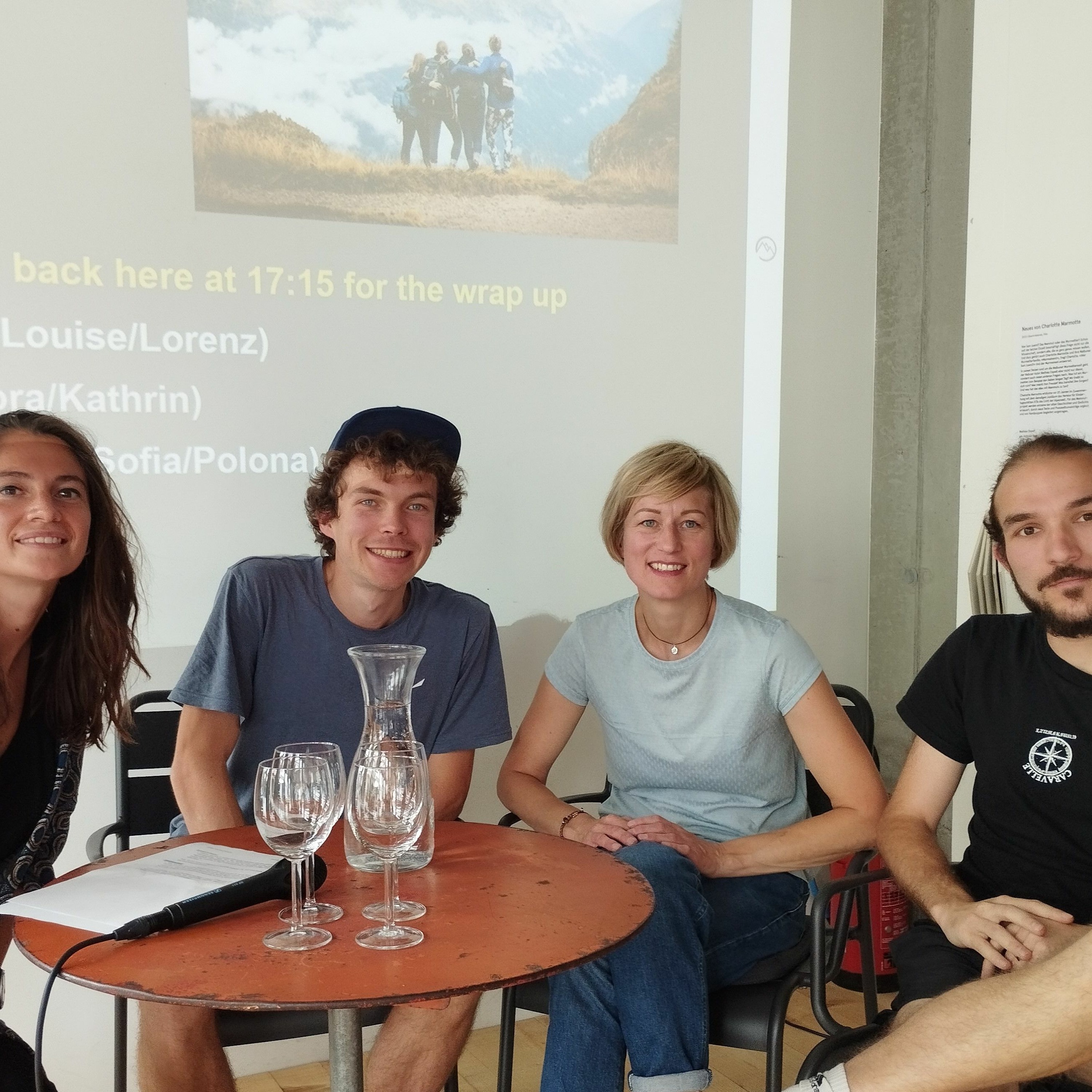
Hello and welcome to another episode of Audible Alps, the Cipa Podcast, this time in English language. My name is Michel Gums and in the next half hour you will hear a roundtable discussion about quality of life in the Alps from a youth perspective. took place on the 1st of July in Shanbli-Nstein. The discussion has been organized by the Zebra Youth Council, a group of young people from all over the Alps.
With this discussion, followed by a podcast workshop, the Youth Council celebrated its 10th anniversary this year. And these are the highly interesting round table participants. Yohana Konatski works at the Austrian Alpine Club. There she manages the Young Alpinist team as well as Sustain Label, a sustainability seal for youth organizations.
Axel Jot-Donini represents the youth forum of the Swiss Working Group for Mountain Areas, SAB, and its label, Youth-Rentley Mountain Villages. Tom Fandeplaskes, professional trail runner and ski mountaineer, as a member of the Athletes Alliance of Protect Our Winters Italy, he promotes sustainability and climate protection in mountain sports. The discussion was moderated by Sofia Farina, member of the Zebra Youth Council. So we invited these three speakers to talk to us about the quality of life in the Alps, and in particular the quality of life in the Alps from a youth perspective.
Everybody in the Alps and in general in mountain regions, young people tend to leave their native regions to move to urban centers for their early adult life and probably for jobs and for education. So I will start with a question that is the same for each one of you. So I will ask you from your own perspective and your own experience, what do you think that there are the advantages and disadvantages of living in a mountain region, and maybe also like an isolated mountain region like a tiny village in the mountains? And what solutions could be used for the disadvantages that you identify?
I think that the probability, advantages of living in the mountain region is quite quiet, and the quality of life is much more relaxed and living in a big city. You can really enjoy your time living in the mountains, but the thing is that from my perspective, there's a lack of cultural activity. The other point is as young people, if we want to study, most of the time we have to leave the village where we are from, and I think an important thing is that rather than just quitting the village and not coming back, the usual benefit of having young people that create their own center of interest and which they will continue while growing up. So for example, in my village, there are a lot of people that left the village, but every two weeks or every month we submit in the village because we have a center of interest that are in the village.
I think that's the key point of maintaining young people. Maybe we don't need to maintain them living in the village, but to maintain them attached to the place. Thank you. Yeah, I can add on to what Axel said, because I think it's interesting maybe to see I can't answer because I don't have the numbers, but how is it?
Are young people leaving the villages and staying in the urban in the cities or are they actually coming back after a few years, the latest when they have their own families? But this would be actually interesting to observe. I don't know if you're doing any research on that, but as you said, Axel actually that's quite interesting because I think the young people at a certain point in their life, I think it's normal that they if they come from village, they maybe want to see exactly the opposite. They want to experience cities, they want to experience their urban life, and I think it's okay.
It's okay. It's okay. Also to then appreciate what you have actually, and I observe it with young people quite a lot that maybe there is a time and of course there is time when they want to study, then there have no possibilities to stay in a village because also there is not enough transportation offer and other offers where that would make it easy. So then they move to a city and they lift their experience, what young people have to experience, which I think is also important, but why they realized actually quality of life in a village, in a mountain village is like really high and they come back.
So I may be a lot of the topiculate, but then very interesting I think because it's also in your mountain village, how connected were you? Do you have clubs? Do you have friends? What is making your life actually?
What is making you be really, I think the place where you were born is not the only aspect to identify with it. So what is that you have and what is the village offering you? And to sum up, I think better possibilities in terms of mobility, etc, would make this shift maybe a bit less. Yeah, thank you.
I think like you said, the definition of quality of life I think is different for everyone and it's different for every age. So and I think with, as you say, people, the thing we have, which we have seen in the past, which is happening a lot also a lot in the Italian mountains where valleys are getting on populated because the youth is leaving their towns. But I think with how everything is going in the past years, where cities are also more and more becoming hard to live in because of climate change, because of them getting really warm and polluted and because of a bit of a shifting mentality of what we define quality of life, where maybe it's not anymore, going to a city and becoming successful, making a lot of money and starting a family or whatever. I mean, there's certainly still a large portion of the population, which wants that.
But I think it's also a lot of a cultural change, which needs to happen where quality of life is really high in the Alps. It's different in Switzerland or in the other than maybe in some parts of Slovenia or the Italian Alps, but still like quality of life is really high. But maybe some people just don't see it as a high quality of life just yet. And I hope that will change.
And I think also a big part which has caused the quality of life to decrease in some part of the Alps is mass tourism, where valleys are losing their culture, it's becoming a monoculture of where the only business model is tourism. And that's the only way you will get a job or survive in the valleys. And so I think that's something that needs to change. And that's something where the economic model needs to change in some parts of the Alps.
And yeah, just the cultural change of like, what do we want in our life? What's important? What does raise our quality of life? Thank you very much.
I will now move to a specific question for each one of you. So I will start with Axel. And so in Switzerland, some municipalities are really trying to encourage young people to stay. And your label rewards the effort of these youth-friendly municipalities.
So in your opinion, which factors are the greatest positive impact and why? So I think that the first point is the public transport. I mean, if it's easier to move from your place, it will change a lot for young people. And so I mean, when you want to go out and you need to wait two hours just to take a bus, it's not the way you want your life to be.
There's a lot to do in the public transport. But what we need also to think about is where you need to pay more and more just to get a place to live in, because it's really attractive for tourists, for richer people, often. And we need to maintain a good price to live in, because yeah, so there's a great quality of life. And when much more people are moving there, that's at which cost.
So it doesn't mean that young people have to live in. And yeah, finally, the third thing is we need to bring more children in the Moon than regions. From this definitely an important aspect because what we tend to have now is that some people from the Moon than regions want to say that they are the more attached to the region than just to remind the region, never move out. And they're really close-minded with that kind of thing.
I think it's terrible. We need to have people that are open-minded in the Moon than regions. And I think that might be quite an important point just so that we can still live together. So yeah, probably the open-mindedness is also useful to promote the change in the economic system in which these valleys are based right now, like the mass tourism, like the current ski approach.
So then we move to Johanna. So you are in close contact with young Austrian people, we're passionate about monitoring. So aside from the performance aspect that comes with a high altitude of monitoring, do you get the impression that these young people are sensitive into environment and climate change? And if this interest in this topic is changing in time and in which ways?
Thank you for this question. I'm a product manager of this product, Yung Aipenist and Aipenist. And basically two years, not only high altitude of monitoring, but it's like old homes of alpinism from climbing to ski monitoring, etc. And at the end of the two years, they go on an expedition.
And the last time, before actually deciding where they're going, we had a lot of discussions because the question was, okay, it's a once in a lifetime chance that we can go, let's say Peru was, they eventually went to Peru, but it was Peru was on the agenda. And there were many voices saying, yeah, but is it actually, can it be justified that we go to Peru for mountaineering? Should we rather stay in the Alps and do something here? And so we really, really had discussions about that.
And you can see from that that this is in their minds already, it's like, it's a natural part already of their way of thinking. And I think I can also speak in general for people who are climbers for mountaineers, because we are so close to nature. And we know that what we do is in nature. And I think, or I hope to think that most of the people have this are more connected to nature and automatically think about it.
So yes, I can say young people, climbers mountaineers, they do, they do think about it. However, they decided to go to Peru, because also high altitude mountaineering is not possible in Europe, just as simple as that. And what was amazing when they came back, they came back with a new perspective, they actually saw the problems, the real problems out there. And they came back and appreciated.
Like one guy said, oh my god, I came back to Taro, I could just open the tap and drink water out of the tap. And what a luxury it is where we live. So maybe it's not, because sometimes I feel sorry that now, I mean, young people, it's so bad that they should not go abroad, etc. But sometimes, if it's like, once in a, I don't know, it gives them something that they even appreciate what they have here, even more.
Yeah, thank you very much. So it comes again to the question of the openness. And yeah, to be open-minded and to be aware of reducing our impact, not to be too strict. I also wanted to add that we had a very similar thing in Italy, because in Italy, this is the first year where the Alpine Italian enthalap created the Kaigo team.
So it's the first team of young mountaineers. And so they were selected like three months ago or two months ago. The call for applications included like a trip to Patagonia to climb there, but then the selected people, they kind of refused to go there. Or at least they raised the question, is it a good thing that we go to Patagonia?
Or maybe we should like stay closer and not take an airplane and so on. And there was a big discussion. So it's nice to see that we're doing the same. I can actually add something because a few weeks ago, I was invited to the Upper West, the South Tyrolian Alpine, they also have the alpinist team for like their future close to us.
So what's going to happen in the future? And it was so good to see because exactly the same issues came up like the traveling aspect. So it is bothering people a lot. Yeah.
Yeah, so this is also the transition to Tom that isn't, you represent the athletes community and so also kind of the alpinist community. And so maybe you can tell us more if you feel that in the community of not alpinists, but like trade runners or ski, ski mountaineers, if you see that there is this change in mentality and that would promote more sustainable and responsible choices. So more and more athletes are taking the chance to advocate for these changes. Yes, I think I definitely see something like that happening and not only in the athletes, but already in the federations.
And I mean, it's quite natural because as you also said, when you do a sport, especially at a professional level where you're every day in nature in the mountains, you see the effects of climate change every day happening all around you. So I think it's a lot more common to see, let's say, yeah, an alpinist or a trail runner raising these questions than I don't know a football player who goes to Qatar to play in an air conditioned stadium. But it's definitely something that's happening. One example, I can give not the athlete level already at a federation level is the Golden Trail series, which is let's say like the grand slam of trail running, where it's this tour of five races around the world, which are the biggest races of trail running.
And the way they're organizing this is that, I mean, of course, not all races are in the same place. So there is races in the United States and in Europe. And obviously, then athletes will need to take a plane and we'll need to travel to do this circuit. And the way to organize it is to have all the race in Europe in like one period of the year, and then have all the races in the United States in another period of the year.
Well, in the past, maybe you had like a beginning of the season, you had a race in the US, then you had one in Asia, then you had one in Europe, then again, one in the US and then one in Europe. Well, now, you know, athletes can do like the biggest race in the world, and they only have to take one plane, because they go to US, they do two races, then they come back to Europe and they do European races. And that's something that the Golden Trail series has thought about, and they've done this because they want to reduce their impact. And then also athletes are talking about a lot more.
And there's even athletes last year who refused to go to the world championships, which were in Thailand, because they, which was at the end of the year, and some athletes didn't go because they said, I've already traveled too much this year, and my impact has been too high. And I mean, yeah, the world championships are great. But if I as an athlete, like keep living my lifestyle like this, then then anyone has the right to do it. But then I think that's not right.
So that's definitely something that we are seeing. And it's really nice to see that. If that message is getting across to, let's say, other people who are not professional athletes, I'm not so sure yet how much that's having an impact. But I hope so.
And it's just important, like you say, like they still went to Peru, but they're talking about it. And so I think it's definitely in the future. It's just going to be more and more normal. Thank you.
So now back to Axel. Do you think that the young people's involvement in municipal affairs, such as participating to the local municipal council is an important aspect? Or do you believe that the focus should be primarily put on infrastructure and education if we try to limit the rural population? I think that it's definitely an important point to participate to the political life of your municipality.
The thing is don't expect to change the world. So we need to be aware that politics is a process that takes a lot of time. It's encouraging to see young people interested in politics. But we don't need to come to this people and say, channel everything.
We need to consider that and to give the young people the kids to understand what is politics, what you can change by doing politics, but as what you cannot change and what you can do by yourself, maybe outside of the politics, as I previously explained, for example, my youth organization in my village, you can do a lot outside of politics. Infrastructure is an important thing. So it's a lot of the quality of life. I mean, if you just have old buildings, you don't appreciate your village people will tend to live both points are important aspects.
The involvement of young people in politics remains a must that we should focus on and maybe with the time something bigger will happen. But right now, there are a few people who need to push that forward and there may be some new things will appear. So, Johanna, back to the topic of the involvement of young alpinists in the environmental coast. So I wanted to ask you if you can see some friction or contrast between the older people and the young people, like the other people are supportive of what the younger ones are proposing in terms of changes.
And if you can see that the attention to the environment, the climate change is taking also to other actions. So not only like thinking of not flying to Peru, but also like maybe the way these young people go to the mountains to go and perform their activities and whatever. I think the awareness among the young is now for environmental issues and climate change is higher than it used to be with the multinationals of earlier times because I think back then they were just pursuing their goals and just going for it. Whereas now people think more.
However, the above mentioned meeting we had with the Afo-S, with the South Carolian for the evening they invited three of like Dolomites pioneers. So three guys around 1890 who opened like new routes, etc. And the Dolomites really interesting, cool guys doing things like completely fearless. And the funny thing was that at the end their message was to the towards the young people protect the nature we have because it's they did it.
And so it seems to be also important for them. That was, I would say I think it's both. It's just maybe that now the awareness is it's more awareness and back then they were doing it and it was maybe more natural. I don't know.
But yeah. But and the second part, if it's it's not only what was it that it's not only on the alpine lives that oh absolutely absolutely it's in I mean there also yeah it's in there I think in the daily life it's for sure a subject but also in there I mean there now new like climbing guidebooks where to crack that you can approach by bike etc. So you can see there's the development in that and it's for sure not only limited to how they do their sports but like all the aspects of their life I believe. Thank you.
So I want to ask question to Tom for Tom. So you were born in the Netherlands and then you lived somewhere else in Europe but in the end when you could choose where to live you decided to come to Trentino and to live closer to the Alps. So I wanted to ask you what are the unique unique aspects for the alpine region that enhance the quality of life for young people and can attract young people also that are not born in the alpine region that can come from far away. Yeah thank you.
So yeah when I finished high school abroad I came back to live in Italy and first I went one year to live in a really small hut in the mountains in a place where I was the only inhabitant and for one year and I mean I was 18 at the time after high school and I asked my parents if I could do this thing and live in the mountains for one year like that and they said like yeah sure we'll give you the least amount of money possible to survive you stay there so that's what I did and like if I think about that now and what are the advantages of living in the mountains I mean there were not many advantages to living like that because I had to for groceries add to like either go by bike or in the winter walk in the snow down to the village to get groceries and come back up. I mean it was definitely not an easy life and where that hut was was in a very rural part of Italy where which is very different to where I live now in Trentino or Switzerland or to Tyrol and but yeah again it comes back to like what do we want in life and what is quality of life for us I think what the mountains and what living in the mountains really teaches you is that nothing comes easy and I don't know what to call it in English like the concept of limit which is something that in the cities you don't see like living in the mountains it shows you that you know even just by going in a hike or going climbing in the mountains it teaches you that you know humans are very small in the world and we cannot achieve everything we want and we cannot always reach the top of the mountain and but that is kind of beautiful and that is kind of what makes living in the mountains so great it's very natural it's very just peaceful it's very authentic and that's something which I think people are just starting to learn and appreciate more and which I think will attract more people to the mountains and one reason why maybe not many young people are yet coming back to the mountains and are still leaving for the cities is the way the mountains are communicated to the people right now because all the places which let's say are when people now go to the mountains they go for holidays they go to tintin they go to teole they go to these huge ski areas or super touristic valleys and these valleys are losing their culture they're losing they're not telling the mountains right so what's I mean taking a lift to to the agidumid doesn't teach you that you know climbing mountains is hard because you go to 4,000 meters with a lift and and the way these these valleys these tourist boards tell the mountains is wrong I think and that's so people go to the mountains and they have an experience which is very similar to the cities it's they they they're not having a real experience in the mountains and I think that if if we make this this change in how how we move in the mountains how we go to the mountains how tourism changes then I think just the quality of life in the mountains will will rise again because there will not be just one economic model there would not just be one business model and the mountains can really become again a community of a place of cultural exchange and and so on so and I think that is yeah that is the key to like getting people back by living in the mountains and raising a quality of life and keeping the youth there this was Tom Fandep Lasker he's professional trail runner and ski mountaineer he took part in a round table discussion together with Jana Konnatsky from the Austrian Alpine club and Axel Jotonini from the U-Form of the Swiss Working Group for mountain areas. The panel was organized by Zebra's youth council on the occasion of its 10th anniversary. This was the current episode of Audible Alps the Zebra podcast.
My name is Michel Gums. Thank you for listening.