
EPISODE · Apr 16, 2020 · 44 MIN
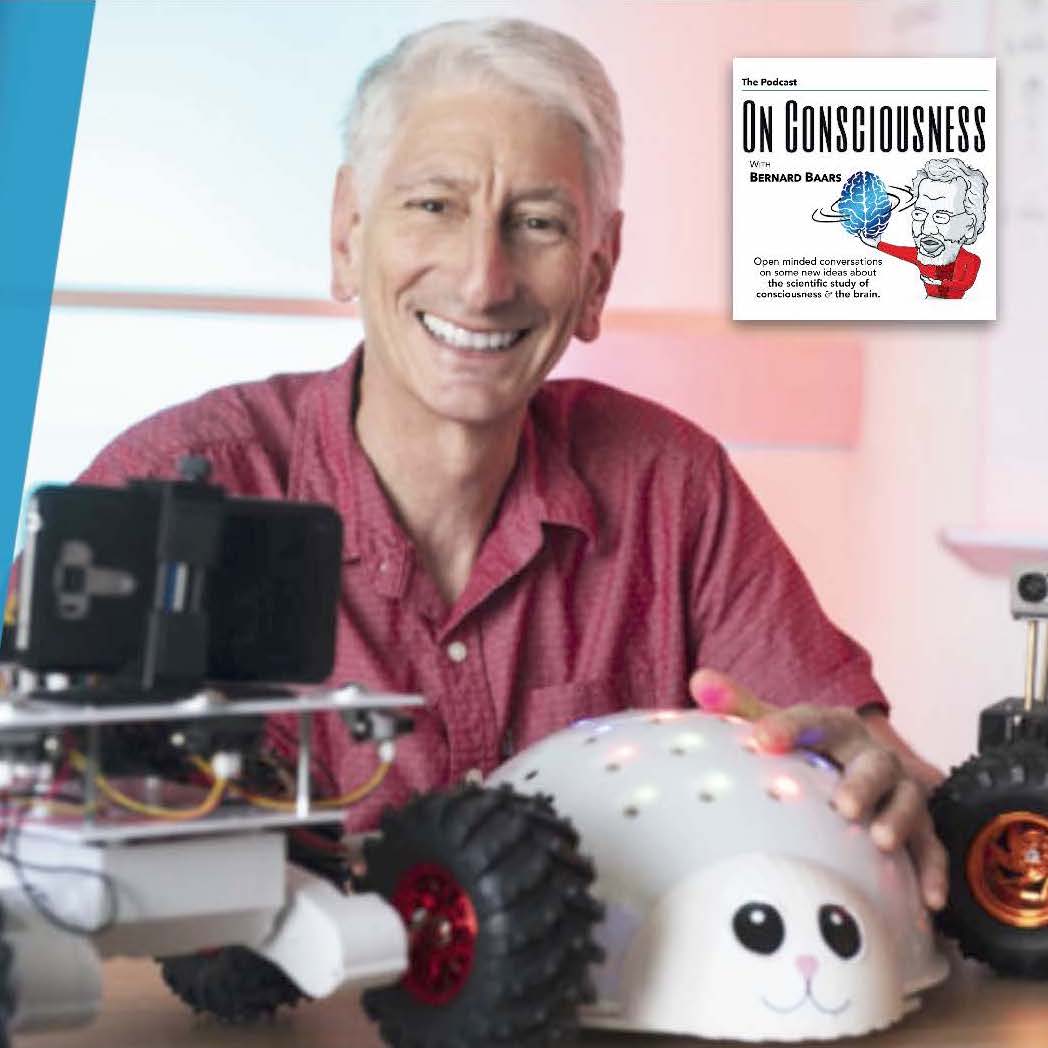
#6 — The Potential of Biologically Inspired Neural Modeling with Neurorobotics Expert, Jeffrey Krichmar
from Consciousness and the Brain
In this episode of "On Consciousness," neuroscientists Bernie Baars, Jeff Krichmar, and David Edelman engage in a freewheeling conversation that begins with mulling over the possible development of conscious machines -- or ‘conscious artifact,’ as Gerald Edelman put it -- sometime in the not-so-distant future. We unpack the various ‘bumps in the road’ in the quest to build intelligent, sentient machines--the problems of efficiency (with regard to energy utilization, brains run circles around any present-day computers) and dissipation of heat in increasingly miniaturized microcircuitry, among others. And though Bernie casts a critically important skeptic’s eye on the prospect of in silico conscious artifacts, we all eventually arrive at a sort of amicable consilience: a recognition that such a development is at least possible. After a tangential--but fun and diverting--foray into the thickets of human evolution and the serendipitous biocultural path that led to modern humans, we return to pondering the road leading to conscious artifacts. We conclude on an optimistic note, with the promise of the biologically based approach so steadfastly championed by Jeff and a small community of like-minded computational neuroscientists. Special Guest: Professor Jeff Krichmar, PhD, Department of Cognitive Sciences and the Department of Computer Sciences, University of California, Irvine: http://www.socsci.uci.edu/~jkrichma Hosts Cognitive psychobiologist and originator of GWT Bernard J. Baars, Author of "ON CONSCIOUSNESS: Science & Subjectivity - Updated Works on Global Workspace Theory" Neuroscientist and paleoanthropologist David Edelman, PhD, Visiting Scholar, Dept of Psychological & Brain Sciences, Dartmouth College Special Podcast VIP 40% Discount for Bernie Baars' new book, "On Consciousness: Science & Subjectivity - Updated Works on Global Workspace Theory" - GO TO: https://shop.thenautiluspress.com/collections/baars APPLY CODE AT CHECKOUT: "PODCASTVIP" Talking Points: 0:00 – David Edelman introduces himself and briefly describes his path to exploring consciousness (particularly in animals), starting as a human paleoanthropologist to studying the behavior of cephalopods. 3:11 – Jeff Krichmar introduces himself, summarizing how he went from being a computer scientist to one of the first neuroroboticists. 6:05 – Bernard Baars gives his thoughts on the trajectory of artificial consciousness and the hurdles in the scientific realm that one had to go through in the past, due to their interest in studying consciousness. 7:41 – David Edelman on the importance of defining consciousness and how the difference in brain activity during conscious (waking) and unconscious (sleeping) states makes consciousness an observable phenomenon that one can actively study. 11:30 – Bernard Baars on why attributing consciousness to a machine would be an ambitious task. 12:52 – Counterarguments by David and Jeff to Bernie’s proposal on how consciousness in machines can emerge. 17:33 – Jeff Krichmar on how energy efficiency is essential for the improvement of our computers in order to be able to simulate a human brain. 23:11 – Baars initiating a conversation revolving around the expensiveness and disadvantages of the human brain’s size. 28:30 – Edelman on how human sociality has impacted the survivability of the species. 32:08 – Edelman, Krichmar, and Baars discussing the possible existence, timeline, and road to “conscious artifacts” in the near future. 39:10 – Edelman and Krichmar close out the conversation with a brief discussion on the evolution of neural networks and the moral and ethical concerns in the field. **Watch the Bonus Video Episode: The History of Brain-Based Devices and Cognitive Robots with Neuroroboticist Jeff Krichmar Jeff Krichmar discusses how an overarching theory of the brain, known as Neural Darwinism, was tested using a series of increasingly complex Brain-Based Devices. These robots show cognitive behavior, such as perception, goal-driven behavior, learning and memory. This led to the development of the emerging fields of Neurorobots and Cognitive Robotics where Krichmar and other researchers are making smarter robots based on how brain activity lead to interesting behavior. Visuals Credits: Visualization of MRI brain scan data from a single person, showing nerve fiber bundles near or feeding into part of the hippocampus. Neuroscientist Tyler Ard, NIH-supported lab of Arthur Toga, Keck School of Medicine, University of Southern California, Los Angeles Jim Stanis, Arthur W. Toga, Ryan Cabeen, Laboratory of Neuro Imaging (LONI), USC Stevens Neuroimaging and Informatics Institute; NIH Brain initiative 2019 Network architecture of the long-distance pathways in the macaque brain. Dharmendra S. Modha, Raghavendra Singh. Proceedings of the National Academy of Sciences Jul 2010, 107 (30) 13485-13490; DOI: 10.1073/pnas.1008054107 Dynamic mapping of human cortical development during childhood through early adulthood. Nitin Gogtay, Jay N. Giedd, Leslie Lusk, Kiralee M. Hayashi, Deanna Greenstein, A. Catherine Vaituzis, Tom F. Nugent, David H. Herman, Liv S. Clasen, Arthur W. Toga, Judith L. Rapoport, Paul M. Thompson. Proceedings of the National Academy of Sciences May 2004, 101 (21) 8174-8179; DOI: 10.1073/pnas.0402680101
Embed this episode
What this episode covers
In this episode of "On Consciousness," neuroscientists Bernie Baars, Jeff Krichmar, and David Edelman engage in a freewheeling conversation that begins with mulling over the possible development of conscious machines -- or ‘conscious artifact,’ as Gerald Edelman put it -- sometime in the not-so-distant future. We unpack the various ‘bumps in the road’ in the quest to build intelligent, sentient machines--the problems of efficiency (with regard to energy utilization, brains run circles around any present-day computers) and dissipation of heat in increasingly miniaturized microcircuitry, among others. And though Bernie casts a critically important skeptic’s eye on the prospect of in silico conscious artifacts, we all eventually arrive at a sort of amicable consilience: a recognition that such a development is at least possible.After a tangential--but fun and diverting--foray into the thickets of human evolution and the serendipitous biocultural path that led to modern humans, we return to pondering the road leading to conscious artifacts. We conclude on an optimistic note, with the promise of the biologically based approach so steadfastly championed by Jeff and a small community of like-minded computational neuroscientists. Special Guest: Professor Jeff Krichmar, PhD, Department of Cognitive Sciences and the Department of Computer Sciences, University of California, Irvine: http://www.socsci.uci.edu/~jkrichma Hosts Cognitive psychobiologist and originator of GWT Bernard J. Baars, Author of "ON CONSCIOUSNESS: Science & Subjectivity - Updated Works on Global Workspace Theory" Neuroscientist and paleoanthropologist David Edelman, PhD, Visiting Scholar, Dept of Psychological & Brain Sciences, Dartmouth College Special Podcast VIP 40% Discount for Bernie Baars' new book, "On Consciousness: Science & Subjectivity - Updated Works on Global Workspace Theory" - GO TO: https://shop.thenautiluspress.com/collections/baars APPLY CODE AT CHECKOUT: "PODCASTVIP" Talking Points: 0:00 – David Edelman introduces himself and briefly describes his path to exploring consciousness (particularly in animals), starting as a human paleoanthropologist to studying the behavior of cephalopods. 3:11 – Jeff Krichmar introduces himself, summarizing how he went from being a computer scientist to one of the first neuroroboticists. 6:05 – Bernard Baars gives his thoughts on the trajectory of artificial consciousness and the hurdles in the scientific realm that one had to go through in the past, due to their interest in studying consciousness. 7:41 – David Edelman on the importance of defining consciousness and how the difference in brain activity during conscious (waking) and unconscious (sleeping) states makes consciousness an observable phenomenon that one can actively study. 11:30 – Bernard Baars on why attributing consciousness to a machine would be an ambitious task. 12:52 – Counterarguments by David and Jeff to Bernie’s proposal on how consciousness in machines can emerge. 17:33 – Jeff Krichmar on how energy efficiency is essential for the improvement of our computers in order to be able to simulate a human brain. 23:11 – Baars initiating a conversation revolving around the expensiveness and disadvantages of the human brain’s size. 28:30 – Edelman on how human sociality has impacted the survivability of the species. 32:08 – Edelman, Krichmar, and Baars discussing the possible existence, timeline, and road to “conscious artifacts” in the near future. 39:10 – Edelman and Krichmar close out the conversation with a brief discussion on the evolution of neural networks and the moral and ethical concerns in the field. **Watch the Bonus Video Episode: The History of Brain-Based Devices and Cognitive Robots with Neuroroboticist Jeff Krichmar Jeff Krichmar discusses how an overarching theory of the brain, known as Neural Darwinism, was tested using a series of increasingly complex Brain-Based Devices. These robots show cogni
NOW PLAYING
#6 — The Potential of Biologically Inspired Neural Modeling with Neurorobotics Expert, Jeffrey Krichmar
No transcript for this episode yet
Similar Episodes
No similar episodes found.
Similar Podcasts
No similar podcasts found.