
A podcast by Sipra. In podcast by L'Aceipra. In podcast by L'Aceipra. The Aceipra podcast.
The Aceipra podcast. Three-prin podcast. Interviews, background talks and voices from all Alpine countries. Listen to this and more in the podcast of the International Commission for the Protection of the Alps.
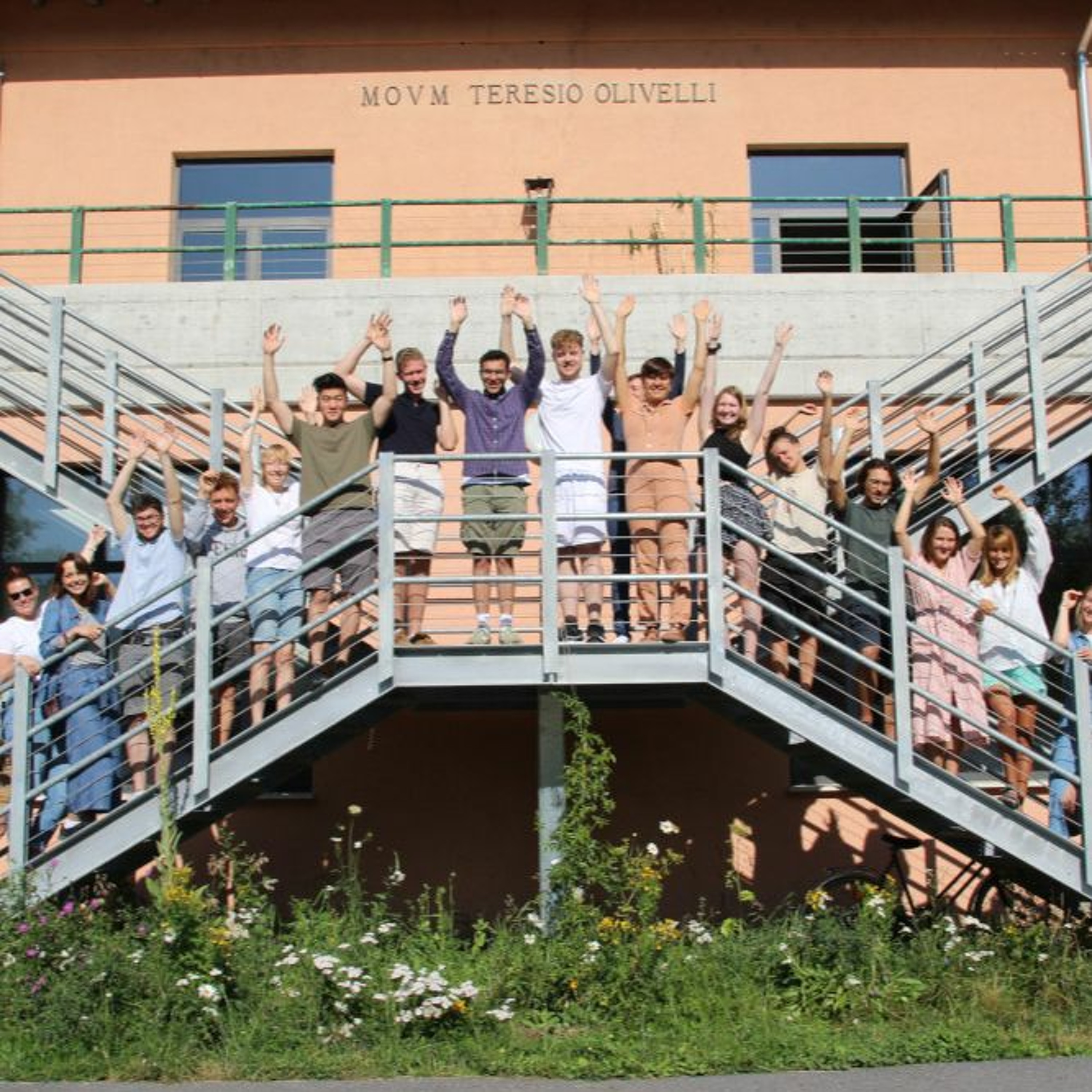
www.sipra.org.org. Port slash podcast. Hello and welcome to the current episode of Audible Alps, The Sipra podcast. My name is Michael Gums and today we report about the Alpine change maker base camp, which took place in the village of Schlandr's Cilangro at the Basis Finchgar Venoster in South Tyrol at the beginning of July, 2023.
But about which change are we talking here? We visited the base camp and my colleague Elena Heinzmann asked some of the participants. Which change would you like to see in the Alps? I would like to see more cooperation, more inter-generational cooperation where local knowledge is used to improve and optimize our use of current technologies.
And I envision a place where nature is thriving, even though impacted by climate change. Also thanks to people coming back to the places and building a new relationship with their environment. I would like to see in a bit the Alps again. So new people but also who want to rest in their small village can be because of new services and new local development also in a economic sector.
I would like to see citizens and policy makers more invested in fighting against climate change and feeling more comfortable with the idea they can act to fight against climate change. For example, reduce the carbon emissions of transport or about food. And I want them to be with more tools to act. I want to see a sustainable agri-food system because it's super-unstainable in itself.
And I want to eat and produce and consume radically, locally, locally, locally. Revitalizing valleys, identifying with landscapes, climbing more sustainably, using old irrigation systems innovatively, eating radically and locally. Eighteen participants from Slovenia, Austria, France, Italy, Germany and Switzerland worked on their project ideas at the second Altine Changemaker Basecamp. The project manager of the Basecamp, Marion Epstein from SIPA International, explains the idea behind all this.
The original idea was to create a space where transdisciplinary learning is possible outside a common educational framework. So the partners came from different institutions, a lot of them from high education though. And so we wanted to create something that empowers young people to realize their own ideas when it comes to sustainable living in the Alps in Alpine space. In 2021, the first Alpine Changemaker Basecamp took place in Valposquiavo, Switzerland.
For the second edition, the project team planned to go to Schlandas in South Tyro. But why there? Schlandas nowadays is a village in the middle of countless apple plantations. In the 1930s, the Italian fascist regime built a military base there which was abandoned in the 1990s.
Finally, in 2019, a team of young people turned one of the four huge military buildings into a social activation hub called Basis. It was intended to become a meeting point for creative people, for dreamers, but also for doers, in order to enhance the Valvenos region economically and culturally through mutual exchange. Kali Ege is one of the young people working there. She also participated in the first Changemaker Basecamp two years ago and now helped organizing the second one.
We really like the support change makers and we are a change maker here as well. So a place like Basis, you cannot find it easily in South Tyro elsewhere. This is one of our goals to bring people together, to let them live their inspiration, to network, to develop their projects. Basis also started as a business and service incubator.
Initially, this fits really well with what we want to do, being a platform and initiating change and change processes. Initiating change is also part of Kegor Kuytsas' job. He is service designer and co-founder of the agency S2R based in Faualberg, Austria. Kegor joined the Basecamp as one of several mentors who helped to further develop the project ideas.
To him, the Basis seems like a spaceship. My expectations were that the Basis is kind of a crazy hipster place, but I didn't expect that it's so cool and so big. It's also like a spaceship in the middle of the Finchgau because it's so different to all the other stuff around. Another mentor is Francisco Hanco, research associate at the Bavarian Academy for Nature Conservation and Landscape Management.
She sees mentoring the change makers as a big chance. We have the chance to inspire young people for their own project ideas and this is a really, really big chance because they have the power and they have the strength right now. They have the strong vision to change things and it's a really big chance to support them and to be mentored for them and to help them to exchange and try things out. Exchanging ideas and contacts.
This is also what the Basecamp started off with. In a speed-to-dating session, the participants introduced themselves to each other, here now some of them. I'm Melis and I'm 24 and I'm living in Gep in France next to Brienuson, next to the Italian frontier. And I'm studying science communication.
I'm doing a master's in science communication. And I'm doing an internship in NGO and I'm working on climate change in the Alps. I do want to go through the Alps by bike to facilitate the workshop. The objective of the workshop is to raise awareness of citizens and policymakers about climate change in the Alps.
And I want to do a documentary to show other forms of mobility and little videos of measures of adaptation to climate change in the Alps. And what are your expectations for the week? I hope the ideas will be more clear in my mind. I do want to know how to contact and build a network to be welcome in different cities and how to contact policymakers, for example, to make them understand that this topic is important and they really have to be aware of it.
And who contacts to maybe raise phones because it's a big part of the project. Because this project needs a lot of energy and I do need to spend a lot of time on it. My name is Yereenen. I'm 28 years old.
I'm a designer and I come from Verona. So my goal is to create and implement ways to optimize the user water in the Alpian region at the time of climate change and jobs. The way I'm doing this is by using an existing case study and looking for avenues to implement it. The case study is an irrigation system of three pounds that was used in Montevaldo in Verona.
We are here at the Alpian change maker base camp. So what are your expectations for the week? Well I hope to gather a lot of knowledge, inspirations and contacts that will allow me to see where my project could go and meeting a lot of inspiring people that are also tackling big problems and hopefully one day I can collaborate with. My name is Marco.
I'm 27. I'm still a student but also working for a ecomuseum. I'm from Tuscany but I moved to Turin for my master and to be a lot for working. My project is regarding Mila, an old Mila that I want to renovate and Mila where people can bring their raw materials and make their own flowers.
This is also Hennab to make some activities and workshops so the population and the community can organize and do some activity for the territory. What are your expectations for this week? Of course I expect to improve my project but also I'm curious to know the other project and make new friends and that's it. I'm Marina and I'm already 30 years old.
I already worked a little and I just finished my master's in Edilence and now went back to Fallaberg. I want to have local and short value chains because we can save so much emissions with that and also connect consumer and producer. So yeah my project is pretty broad. I have some ideas but I have mainly a main mission and my expectation and my wish would be to concretize what steps to take next.
My name is Tim. From Slovenia I'm studying landscape architecture. I'm doing my master's thesis right now in landscape identity and yeah I'm living in the north part of Yibiana. My project idea is about better management of landscapes and how you can build upon landscape identity to build more character.
So mostly I would like to see how to incorporate the knowledge I will learn during my master's thesis and to actually use how to make a project out of it. Building a physical project prototype with their own hands was one of the methods that helped the young changemakers to move forward. Computer lessons ranged from thinking and co-creation to inputs about Alpine governance structures, local politics as well as regional networking. mentors addressed specific questions in individual coaching sessions.
mentor Kegor explains his approach. My session was about co-creation due to the fact that I'm a service designer and I work a lot in the field design thinking. I gave them a chance that they use new perspectives from the others so that the idea will be more developed in a co-creative way. So the project owner just told the others the idea and the others had to develop this idea and the project owner was only allowed to watch.
Another approach was to create a map of the project as mentor Johannes Herboger explains he works at the Department for Urbanism and Society at the University of Liechtenstein. I'm a trained geographer and there's nothing more what geographers love than maps and we do a mapping session but not mapping the landscape or something like that but we try to map out the project universe of the project. So the idea is to put the project in the center of the map and then think about who are relevant stakeholders, actors with whom my project is associated. This can be project partners who are very close to the project but also more abstract network partners.
This can be like adversaries against the project so everybody who is associated with the project and as a second step they should map also what resources do these actors bring with them. So do they bring money, do they bring networks, do they bring political support, do they bring specific knowledge that is needed for a project and these things are brought together in a map to have a quick overview with whom the project is associated and which resources are there. Preserving local resources with new ideas. This is what the Citizens' Cooperative of the Upper Finchgau is doing.
After half an hour train ride with the local Finchgau ban, participants of the base camp visited the cooperative Ingluance, another village of the valley. We knew an economical way to develop the whole region and so they said we choose the Citizens' Cooperative as a vehicle to bring the whole region further. Ingluance, the cooperative operates the Kafe Selina. Mikhail Hofer, one of the creative minds behind the cooperative, explains what change it brought to the region.
Regions where nothing is really happening in the Tuscany, Liguria or Campania where private or public stakeholders does not really do anything. So maybe they saved the last bar of the village to be closed or they offer public transport and so on and so our use is always for the region, not for the partners or the members because it's always for the whole region. Among other things, the cooperative saved a diary in 2019 and with this also regional jobs as well as value creation on site. Other projects are about regional money, ecological farming, organizing local markets and events related to local culture and nature.
At the end of the week, participants of the base camp told us how their project ideas developed like Irene from Italy. Well, I have started to see ways for the different parts of my idea to come together in a project that could be long lasting and I also found people who are working on similar projects like with backgrounds that are complementary to mine. So who knows, maybe there is space for some collaborations in the future or at least like an exchange of practices and ideas. What was your personal highlight of this week?
Well, maybe our mascot Nando, which was a beautiful dog. And also just when we went climbing with some of the people here. I know this looks like that so not super project related but I really valued having a community and just having a nice environment where we felt comfortable with each other and we met some people. With what feelings do you leave the ICB now?
I am very glad I give myself some time to work on my ideas in this environment. So definitely satisfied in a way and also I have a much more clear idea on the playground that my ideas will be developed in. So yeah, as I said, I am happy for the people I met but also I feel now I have an idea of what is the landscape over from like a physical but also a governance and political point of view. My list, what I would like to know from you now is how did your idea develop during this week?
We worked in groups of people so I do have a lot of ideas coming from different people here. So I can really implement my project with new ideas. At first I think I really need to plan the journey and to think about places and cities I can go. And some of them gave me some information about places I can visit and do little videos.
So at first I think I really need to plan everything. And then when it's going to be planned I need more people to help me to produce the workshop. After this I think I will try to get phones. And what was your personal highlight during this week?
I really like yesterday morning with Gregor because we worked with the groups of people and we had to help the other to add things to the project. And we did like prototypes and it was really funny to do prototypes and see the lighting the eyes of the others. Hello Marco, we are here now at the last day of the Alpine TensorMaker Basecamp. And therefore I want to ask you how did your idea develop during this week?
So during this week my idea not developed so much but I received some important advice from the groups and from the mentors especially in the co-creation moment. I received the idea of expanding my idea of community to the community. So I have a mind to do some survey and go stick to the village and talk with the people. And what was your personal highlight of the camp?
My personal highlight of the camp is for sure the possibility to meet new people and large my network especially with my colleagues, my participants. I'm sure that at the first time meet the new people and the end I have some new friends. What feelings are you going back home now? I'm going back home more relaxed and positive because this project is in a good status and probably after season on winter so with the cold you can stay in front of your desk and work more on the back of his part.
And so good luck to me. Now I'm sitting here with Tim from Slovenia. He already told us in the beginning of the week a little bit about his idea and project that he's planning. How did this idea develop during this week?
So during the week over all the lectures we've had I think it's the idea or the course they did mostly the same but it gave me a little bit more of an idea of how to implement the project so maybe splitting up the project I proposed in the first time into smaller bits that can be more realizable, more manageable. The biggest inspiration and the best lecture we've had here was from Casiano from Polo Pascavo. Their company really focuses on landscapes so it puts it as a foundational design principle. What I would like to know from you, Varena, is how did your idea develop during this week?
That's an interesting question because my idea, I questioned to zero again and built up a new strategy so I came here with this super ambitious mission to change the whole region and what I now did I realized in this passion with feedback with all the others that I started with smaller scale projects. For example connecting people to food and place and seasons again by also using creative aspects. One idea for example is to make seasonal celebration days and also use the color, these rich colors of food, of seasonal food on farms and on farm events to connect people to the season. So which food is seasonal and with children so this is one idea on a smaller scale and what I realized to have this abstracted project what was my main idea is this takes time.
So any time to create networks, any time to build trust and this whole event emphasized a lot but it also really really empowered me to just talk to people once I see there's an important or interesting actor in the field of Abi food systems in my region to talk to them and to build these interesting networks but also to understand what their challenges are and this is my long term project to crystallize out a more abstract level of ideas and projects. And if you think about what happened during this week, what was your personal highlight so far? The highlight is to meet so many, first of all, so many different people. There is a physicist, there is a biologist, there is engineers and I mean I come from my bubble a little bit from this entrepreneur agricultural bubble.
This was a highlight, the highlight is the soft scale to feel empowered to just start, to talk to people, to see by just having these ideas change can happen and just do it. Like I feel really motivated and empowered to start. The participants of the Alpine change maker base can return to home with plenty of experiences and insights. In addition to the intensive examination of their own project, the informal exchanges help them the most.
Also Manto of Francisco Hancos review of the week is positive. I take away from me that there are so many good people out there that have a big knowledge that I could ask if I have another project because in my mind actually there came lots of ideas during this week so I'm also motivated to keep going on planning projects and thinking big and now knowing who I could ask and with whom I could connect. Manto of Kegor Kroyza looks back on the base camp and the projects with positive feelings as well. So many people have so cool diverse ideas, it's just a pity that out there not all people know about that, what power and energy is in these villages hidden all around the Alps.
It's really cool that at the buses you see again that so many things are happening, what you at home and your daily business you never recognize. Marion Epps the Kroyza project manager at SeaPel International felt that the second ACB was a success for everyone and gives a final advice what makes a project successful in her point of view. If your inmost attitude is reflected by your project and the personal needs that you have are reflected by what the region or the people there need then you have a high probability that the project gets implemented and will maybe be successful. The Alpine Change Maker Base Camp is a project by the Alpine Change Maker Network, an association of organizations from educational, regional development and environmental sectors.
This summer was the events second edition hosted by the social activation hub, Pazis Finca Venosta. This group is now evaluating its design and implementation. The Alpine Change Maker Base Camp is sponsored by the Maccatoa Switzerland Foundation. You can find out more about this project on our website www.seapr.org.
My name is Michel Gams, thank you for listening to this episode of our podcast Audible Alps. If you like it, please subscribe and all the best from the Alps. A podcast by Seapro. In podcast by the L'Aciapra.
In podcast by the L'Aciapra. The L'Aciapra podcast. The L'Aciapra podcast. Three print podcast.
Interviews, background talks and voices from all Alpine countries. Listen to this and more in the podcast of the International Commission for the Protection of the Alps. www.seapr.org. Org.
Org. Org. Org. Org.
Org. Org. Org. Org.
Org. Org. Org. Org.
Org. Org. Org. Org.
Org. Org. Org. Org.
Org. Org. Org.