
EPISODE · Jun 24, 2023 · 1H 24M
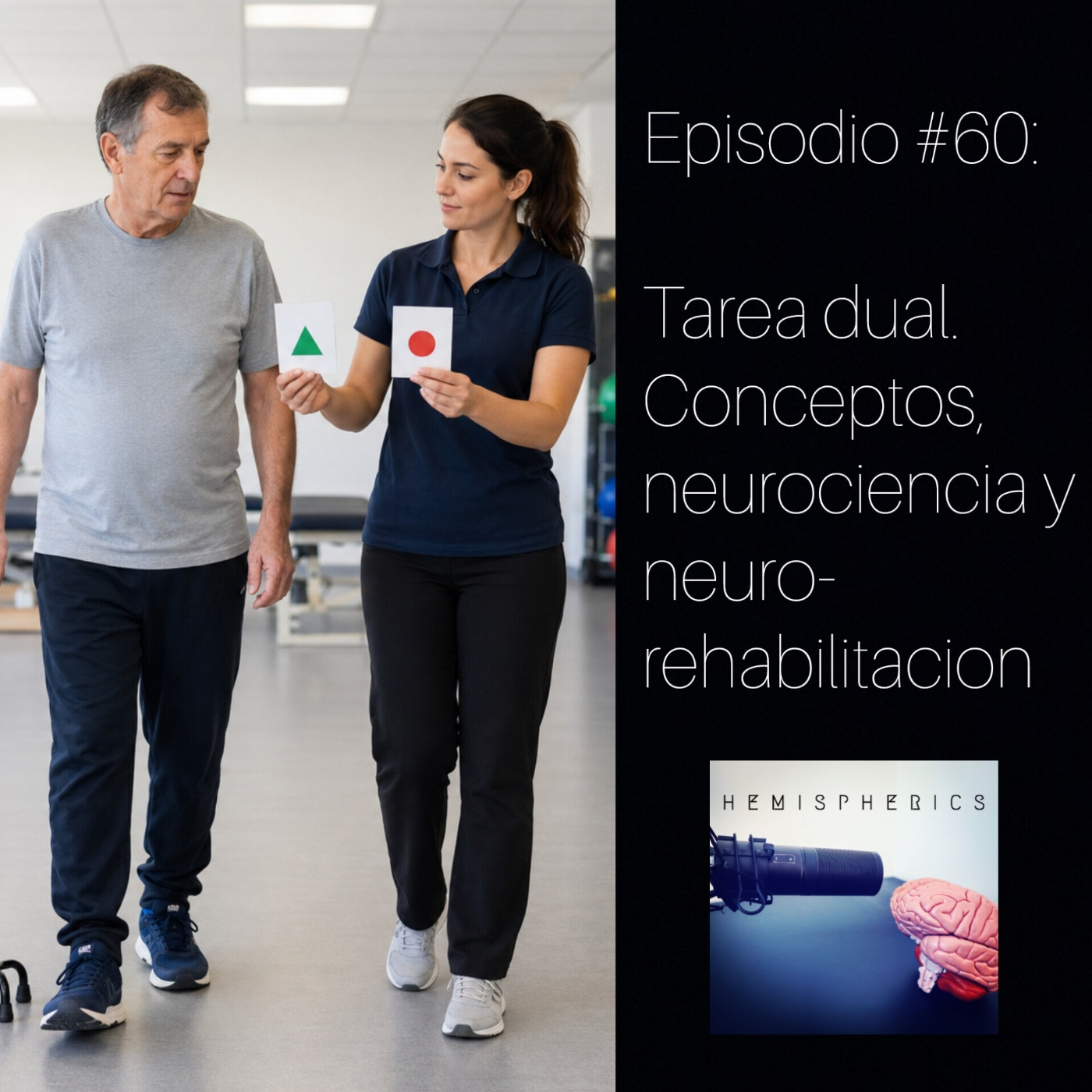
#60: Tarea dual. Conceptos, neurociencia y neurorrehabilitación
from Hemispherics
En el episodio de hoy, hablamos del bonito mundo de la doble tarea, un área que ya de por sí tiene sus características en la sociedad en general y que en el campo de la rehabilitación es una categoría fundamental que tarde o temprano hay que abordar. El tema es extenso a más no poder y ha sido un poco complicado hacer una síntesis, ya que tenemos información de estudios tanto a nivel general de lo que implica la atención a dos tareas, críticas sociales (desde la sociología), estudios de neuropsicología y toda la parte de entrenamiento dual en terapia física y en diferentes patologías. Para esta ocasión, lo que me propongo es dar un marco cultural y sociológico inicial que creo que es importante para entender la globalidad del asunto; después voy a introducir conceptos fundamentales relacionados con la doble tarea y la idea después es transitando hacia estudios de correlatos neurales de la doble tarea y cómo podemos entrenar esa habilidad en neurorrehabilitación, sobre todo en la que concierne a la terapia física. Referencias del episodio: 1. Leone, C., Feys, P., Moumdjian, L., D'Amico, E., Zappia, M., & Patti, F. (2017). Cognitive-motor dual-task interference: A systematic review of neural correlates. Neuroscience and biobehavioral reviews, 75, 348–360. https://doi.org/10.1016/j.neubiorev.2017.01.010 (https://pubmed.ncbi.nlm.nih.gov/28104413/). 2. Kuo, H. T., Yeh, N. C., Yang, Y. R., Hsu, W. C., Liao, Y. Y., & Wang, R. Y. (2022). Effects of different dual task training on dual task walking and responding brain activation in older adults with mild cognitive impairment. Scientific reports, 12(1), 8490. https://doi.org/10.1038/s41598-022-11489-x (https://pubmed.ncbi.nlm.nih.gov/35589771/). 3. Li, K. Z. H., Bherer, L., Mirelman, A., Maidan, I., & Hausdorff, J. M. (2018). Cognitive Involvement in Balance, Gait and Dual-Tasking in Aging: A Focused Review From a Neuroscience of Aging Perspective. Frontiers in neurology, 9, 913. https://doi.org/10.3389/fneur.2018.00913 (https://pubmed.ncbi.nlm.nih.gov/30425679/). 4. Mac-Auliffe D, Chatard B, Petton M, Croizé AC, Sipp F, Bontemps B, Gannerie A, Bertrand O, Rheims S, Kahane P, Lachaux JP. The Dual-Task Cost Is Due to Neural Interferences Disrupting the Optimal Spatio-Temporal Dynamics of the Competing Tasks. Front Behav Neurosci. 2021 Aug 19;15:640178. doi: 10.3389/fnbeh.2021.640178. PMID: 34489652; PMCID: PMC8416616 (https://www.ncbi.nlm.nih.gov/pmc/articles/PMC8416616/). 5. McPhee, A. M., Cheung, T. C. K., & Schmuckler, M. A. (2022). Dual-task interference as a function of varying motor and cognitive demands. Frontiers in psychology, 13, 952245. https://doi.org/10.3389/fpsyg.2022.952245 (https://pubmed.ncbi.nlm.nih.gov/36248521/). 6. Piqueres-Juan I, Tirapu-Ustárroz J, García-Sala M. Paradigmas de ejecución dual: aspectos conceptuales. Rev Neurol 2021;72 (10):357-367 (https://neurologia.com/articulo/2020200). 7. Plummer, P., Eskes, G., Wallace, S., Giuffrida, C., Fraas, M., Campbell, G., Clifton, K. L., Skidmore, E. R., & American Congress of Rehabilitation Medicine Stroke Networking Group Cognition Task Force (2013). Cognitive-motor interference during functional mobility after stroke: state of the science and implications for future research. Archives of physical medicine and rehabilitation, 94(12), 2565–2574.e6. https://doi.org/10.1016/j.apmr.2013.08.002 (https://pubmed.ncbi.nlm.nih.gov/23973751/). 8. St George, R. J., Jayakody, O., Healey, R., Breslin, M., Hinder, M. R., & Callisaya, M. L. (2022). Cognitive inhibition tasks interfere with dual-task walking and increase prefrontal cortical activity more than working memory tasks in young and older adults. Gait & posture, 95, 186–191. https://doi.org/10.1016/j.gaitpost.2022.04.021 (https://pubmed.ncbi.nlm.nih.gov/35525151/). 9. Strobach T. (2020). The dual-task practice advantage: Empirical evidence and cognitive mechanisms. Psychonomic bulletin & review, 27(1), 3–14. https://doi.org/10.3758/s13423-019-01619-4 (https://pubmed.ncbi.nlm.nih.gov/31152433/). 10. Watanabe, K., & Funahashi, S. (2014). Neural mechanisms of dual-task interference and cognitive capacity limitation in the prefrontal cortex. Nature neuroscience, 17(4), 601–611. https://doi.org/10.1038/nn.3667 (https://pubmed.ncbi.nlm.nih.gov/24584049/). 11. Ángel L. Martínez Nogueras (2020). Un repaso al paradigma de tarea dual desde la neuropsicología (1ª parte). (https://neurobase.wordpress.com/2020/03/20/un-repaso-al-paradigma-de-tarea-dual-desde-la-neuropsicologia-1a-parte/). 12. Johann Hari (2023). El valor de la atención. Por qué nos la robaron y cómo recuperarla (https://www.planetadelibros.com/libro-el-valor-de-la-atencion/365202). 13. McIsaac, T. L., Lamberg, E. M., & Muratori, L. M. (2015). Building a framework for a dual task taxonomy. BioMed research international, 2015, 591475. https://doi.org/10.1155/2015/591475 (https://pubmed.ncbi.nlm.nih.gov/25961027/). 14. Rémy, F., Wenderoth, N., Lipkens, K., & Swinnen, S. P. (2010). Dual-task interference during initial learning of a new motor task results from competition for the same brain areas. Neuropsychologia, 48(9), 2517–2527. https://doi.org/10.1016/j.neuropsychologia.2010.04.026 (https://pubmed.ncbi.nlm.nih.gov/20434467/). 15. D'Esposito, M., Detre, J. A., Alsop, D. C., Shin, R. K., Atlas, S., & Grossman, M. (1995). The neural basis of the central executive system of working memory. Nature, 378(6554), 279–281. https://doi.org/10.1038/378279a0 (https://pubmed.ncbi.nlm.nih.gov/7477346/9. 16. Just, M. A., Carpenter, P. A., Keller, T. A., Emery, L., Zajac, H., & Thulborn, K. R. (2001). Interdependence of nonoverlapping cortical systems in dual cognitive tasks. NeuroImage, 14(2), 417–426. https://doi.org/10.1006/nimg.2001.0826 (https://pubmed.ncbi.nlm.nih.gov/11467915/).
Embed this episode
NOW PLAYING
#60: Tarea dual. Conceptos, neurociencia y neurorrehabilitación
No transcript for this episode yet
Similar Episodes
No similar episodes found.
Similar Podcasts
No similar podcasts found.