
EPISODE · Mar 7, 2026 · 21 MIN
603-Causal Regulatory Variants in Human Disease
from Paper Talk
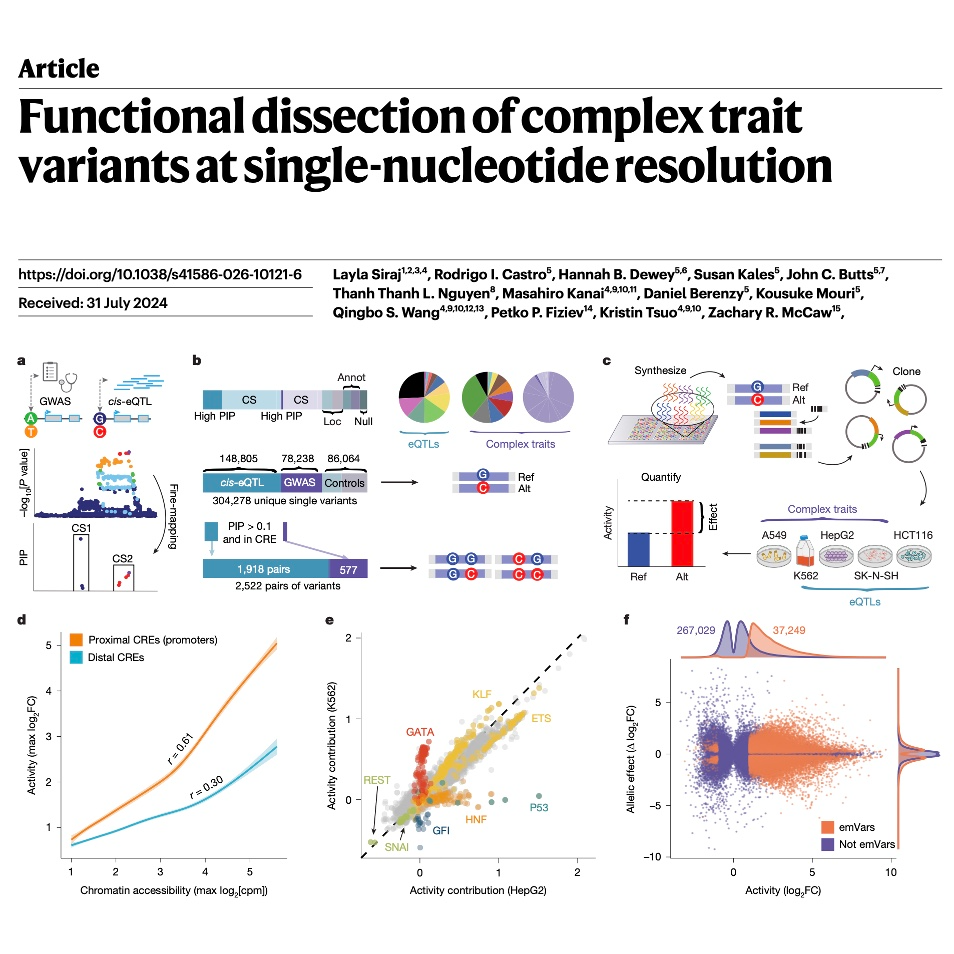
This study uses high-throughput reporter assays to bridge the gap between genetic associations and the actual biological mechanisms of disease. Researchers employed massively parallel reporter assays (MPRA) to screen over 300,000 DNA sequences, identifying specific causal variants that regulate gene expression across various human tissues. Through saturation mutagenesis, they mapped how single-nucleotide changes disrupt or create transcription factor binding sites, revealing both simple and complex regulatory patterns. The findings include evidence of regulatory epistasis, where multiple genetic variations interact non-additively to influence traits like blood pressure and cholesterol. By combining these experimental maps with predictive neural networks, the authors provide a comprehensive framework for understanding how non-coding mutations contribute to human health. This research ultimately transforms statistical correlations from large biobanks into functional insights at single-nucleotide resolution.References: Siraj L, Castro R I, Dewey H B, et al. Functional dissection of complex trait variants at single-nucleotide resolution[J]. Nature, 2026: 1-11.前往小宇宙评论区与主播互动
Embed this episode
Ready to play
603-Causal Regulatory Variants in Human Disease
No transcript for this episode yet
Similar Episodes
No similar episodes found.
Similar Podcasts
No similar podcasts found.