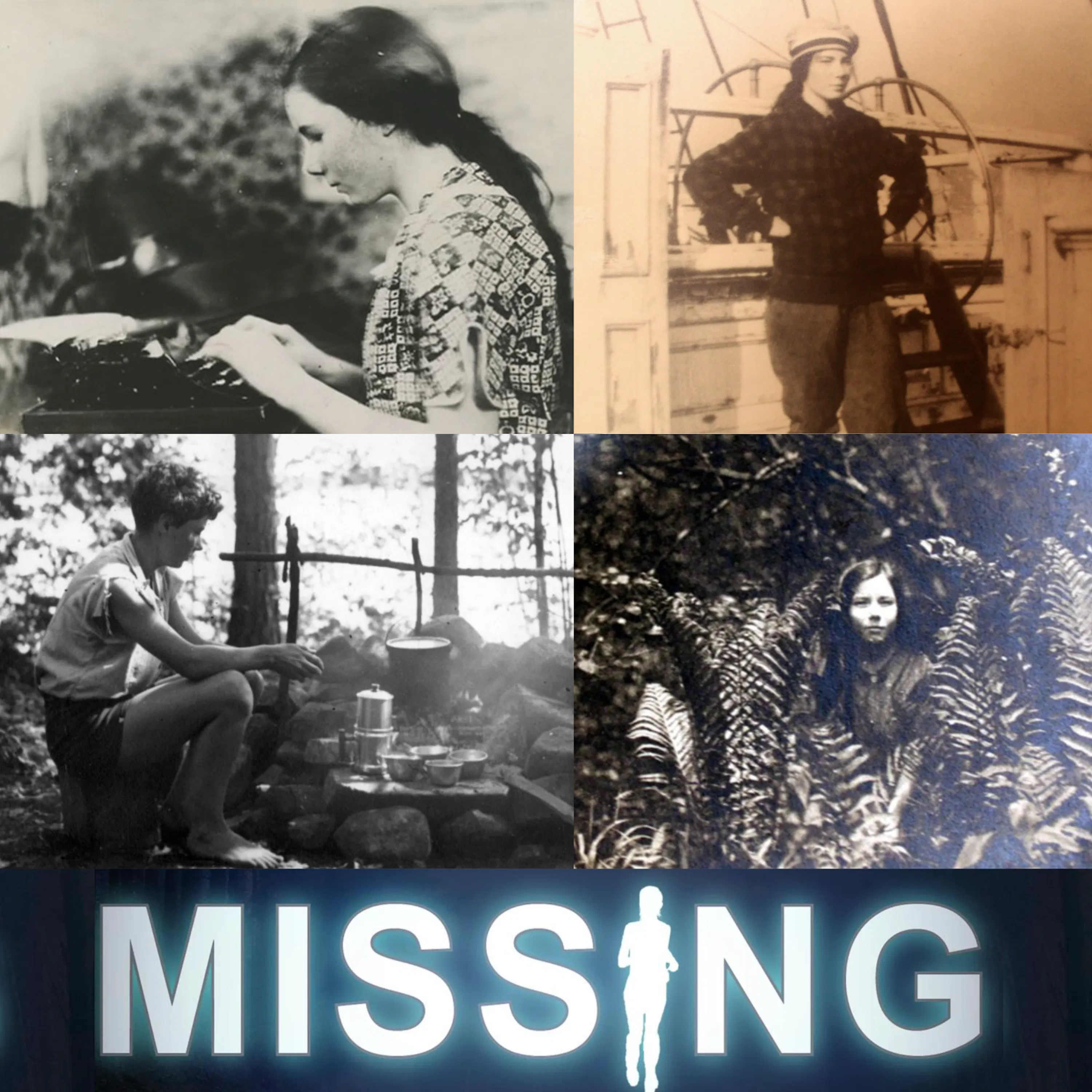
In today's new episode of Missing, we speak about the mysterious disappearance of Barbara Newhall Follett from Brookline, Massachusetts. Lance, how's it going today? This is quite a case here. Yeah, it's one of those historical ones that we really like. This one takes place in the 1930s and 40s, and Barbara Follett was like a child prodigy. Not like a child prodigy, she was a child writing prodigy, and mirrored the character that she created in this wonderful book called The House Without Windows.
But we'll get into that when we get into her disappearance. What did you think? Yeah, this is a really interesting story, certainly made a bit more complicated by her background and really great research by our friend Kathleen Studer. Big thanks for this one. While reading it, I really wasn't sure where it was going, so I'm very pleased to be speaking about it here today with you. All right, we're going to break real quick for commercial, and we will return with the story of Barbara Newhall Follett.
Barbara Newhall Follett was born in Hanover, New Hampshire on March 4, 1914, to parents Roy Wilson Follett and Helen Thomas Follett. And Roy went by his middle name, Wilson, and he was Harvard-educated and taught English first at Dartmouth and then later at Brown. And Barbara's mother, Helen, had been a schoolteacher. read or hear about people who have parents who are in the educational field, who are in education, something about that just makes me feel like they had a solid upbringing. And that could just be me being naive about things, but to have two teachers as your parents feels like you are sort of destined to have a good head on your shoulders. And Barbara definitely did, as we'll get into. Her father, Wilson, had been married previously. They had one child, a daughter named Grace. And Wilson and Barbara's mother, Helen, they had another daughter after Barbara named Sabra.
And Father Wilson was a writer. His novel, No More Sea, came in third for the Pulitzer Prize for Fiction in 1934. And Barbara would inherit his talent and become a child-writing prodigy. As you noted in the intro, Lance, and this is not an overstatement whatsoever. At three years old, Barbara became fascinated with her father's typewriter, and by age four, she was writing her own poetry. She seemed to have an early aptitude for reading and writing, as well as an active imagination that surpassed her peers. I mean, no big deal. I was writing poetry at four.
Didn't really make much sense, but, well, Barbara's mother, Helen, decided that homeschooling her would be the best way to develop these talents, even if the actual home education was very loosely managed. Barbara was allowed to indulge in her imagination, and by the age six, six years old, she was working on a 4,500-word story called The Life of the Spinning Wheel, the Rocking Horse, and the Rabbit on her own typewriter. 4,500 words? You can pull that out of me right now. Yeah, that is pretty wild. Certainly seems like it's about things that are familiar to her, but here's a little excerpt we can read.
Once upon a time, though I can't say exactly when, there lived in a far-off country, a spinning wheel, a rocking horse, and a rabbit. They knew many of the people in that country. They lived in a house with many pretty things in it, such as I'm going to tell you about. Amethysts, turquoise, opals, pearls, diamonds, and rubies, and precious stones of all kinds. You know what's the most impressive to me about this passage? This is in quotes here. Is that she uses a colon appropriately. Such as, I'm going to tell you about. Colon, amethyst, turquoise, opals. Just her grammar is, like, spot on. And that's...
So remarkable to me at six years old. I'm guessing she had some good editors in her parents. Probably. Maybe her dad helped her out a little bit. But what she did come up with in 1922, two years later when she was eight years old, she created her own imaginary land. And I know as children, we've probably all done it. We've had imaginary friends, imaginary play lands, sort of like imaginary worlds that we kind of get involved in. But I don't ever remember naming mine. She called her land Farksolia with an accompanying secret language called Farksu. And the story's main character, Verbini, spent time in the woods, had many animal friends.
And Barbara shared in a letter a poem she'd written in Farksu, the language. And she writes this poem, and I'm only going to give a little sample here because some of these words are very, very difficult to pronounce, and I don't want to do them any disjustice here. It starts off with Which is unbelievable. Like, this makes sense to her. Yeah, it's very cool. And there is a translation here, and it reads, That's remarkable. And Barbara's next story, one that we mentioned in the intro as well, is about a little girl who she names Epersip. And Epersip runs away from home and lives in the woods. And this is really haunting, because Barbara always wanted this...
adventure going on in her life. And the character Ipersip, she is at the beginning of Barbara's life wanting this adventure. So I think it kind of mirrors her. She started writing the story for her mother and planned to give it to her on her own ninth birthday. So when she turned nine, she wanted to give it to her mom. And below is Barbara's description of the story. Quote is about a little girl named Ipersip who lived on top of a mountain, Mount Varkobis. And it was so lonely that she went away to live wild. She talked to the animals and led a sweet, lovely life with them. Just the kind of life that I should like to lead. Her parents all tried to catch her with some friends of theirs. And every time she escaped in some way or other.
Interesting. Yeah, very well written, once again. And Barber spent the summer of 1923 editing and revising the story, but tragically, the Follett house burnt to the ground in October of 1923, and the original and only manuscript was destroyed. Again, pretty impressive. I mean, even if her father did help her out with it, I think he is kind of partially credited as an editor of the book, so...
But regardless, he had an incredible piece of source material that she had started with. So if he was editing it, I don't know how far he went with that edit writing-wise, but it is a remarkable book. I'm listening to the audiobook, and I highly recommend it. It's a quick listen if anybody wants to get sort of a glimpse into her writing style, especially when she's that young. 12 years old, that's published. And Barbara's second book, The Voyage of the Norman D, and that's just the letter D, The Voyage of the Norman D, was published in 1928, receiving critical acclaim. And Barbara's name was becoming well-known in literary circles. British author that some folks might recognize, A.A. Milne.
The famous author of the Winnie the Pooh books reached out to Barbara for her opinions on his new book, Now We Are Six. So the Knopf Publishing House offices were in New York City, where Wilson was spending more and more time. The rest of the Follett family still lived in New Haven, Connecticut, where he had been working at the Yale Press. And it was in New York City where Wilson met another Knopf employee named Margaret Whipple. She was 20 years his junior. Wilson soon left the family to move in with Margaret in Greenwich Village. Now this devastated Barbara as she was very close to her father. She convinced her mother to leave her younger sister with a guardian, and they were going to depart the Northeast to go on an adventure. So when she was 14 years old, they left New York on a sailing trip to Barbados.
They had no itinerary, no return date planned, just dreams and ideas for new literary successes to come. And they spent the next few months exploring the Caribbean before going through the Panama Canal on the way to the South Pacific and then the Hawaiian Islands. I mean, that sounds like such a thing to do, especially in this time period, right? Like, go to Barbados. All of these places are just not even close to being as developed as they are today. So this is like a legit adventure. Yeah, absolutely.
And from Hawaii, they traveled to the Washington state coast. And on that voyage, Barbara met a young sailor named Edward Anderson and fell in love. And the two would exchange letters for several years. So from there, she took a bus to Pasadena to stay with a family friend while her mother, Helen, returned to Hawaii to write a book about their adventures. At sea, this book is titled Magic Portholes. So pretty cool that her mother continued the adventure. She went to Hawaii and actually made the book. I mean, this is why they went on the adventures. And then Barbara enrolled at college when she was only 15 years old, her first experience in formal education, and she did not like it.
Understandably so, like 15 years old, she's still young, and that's what age in high school? That's like a sophomore? Yeah, but I guess because she had never even gone to any kind of school beyond being homeschooled, it must have been quite the culture shock for her. Yeah, yeah, I can see why she didn't like it, but it caused her to run away to San Francisco, where she checked into a seedy hotel in the Tenderloin under an assumed name. She's way too smart for her own good at 15. Yeah, this is wild. Yeah. And when authorities caught up with her, she tried to jump from the window.
And she was then taken to a juvenile detention center and eventually went to live with different family friends who were again in Pasadena. And the press soon caught wind of Barbara's legal troubles, being that she was the child prodigy who had written two published books by age 14, and people knew her name. Now her father Wilson and his new bride arrived to California as well from Maine, and her mother came over as well. A legal battle ensued which forced Barbara to choose her mother over her father. Barbara and her mother eventually returned to New York in June of 1930 on the heels of the Great Depression, and she found a job working as a secretary. She wrote a few more manuscripts, but they did not have the success of her first two.
And in 1931, Barbara Helen and her sister Sabra took a break from city life and they rented a cabin across the Connecticut River from Barbara's birth town of Hanover. And at this time, Barbara was 17, and it was during this trip that she met Nickerson Rogers, who had recently graduated from Dartmouth. So the two of them, with two other friends, made a camping trek to the tallest mountain in Maine, Mount Katahdin. Mount Katahdin is the northern terminus of the Appalachian Trail. So we talk a lot about the Appalachian Trail. It always pops up with these missing people, it feels like. And this is a famous footpath that's over 2,000 miles, and it runs from Georgia to Maine, all the way to Mount Katahdin.
So it goes through 14 states, and it's not for the faint of heart. I know it's a split path, but it's not for the faint of heart. So this trip was something that Barbara had been sort of dreaming about for a while, and she had even imagined making this trip with her father before he left the family. And that trip inspired Barbara to write the short story Rocks in 1933. And Barbara returned to the city and her job, but her heart was still filled with the desire for adventure. And the four new friends soon began planning an Appalachian Trail hike, all 2,200 miles of it.
Unfortunately, that Appalachian adventure never quite materialized, but Barbara and Nickerson did spend the end of 1932 hiking and camping all around New England. They spent two weeks on an island in Squam Lake, New Hampshire, which is a place that Barbara really, really enjoyed. And as the crisp fall air turned to winter, making it too cold and uncomfortable, they decided to head to Spain. They spent Christmas and the rest of the winter practicing their Spanish and traveling around Spain. And after that, they moved on to Switzerland, then Germany, finally sailing back to New York in November of 1933. I'm curious, is this something that people do today?
She doesn't sound like she has, like, a lot of independent wealth, right? That's hard to say. Yeah, I wonder. It seems like there must be some wealth in the family to be taking the extravagant trips that they do. Yeah, and I'm sure, like, maybe they're not staying at, like, five-star luxury hotels. But, yeah, this is a bit extravagant and probably costing them a little bit of money. And I'm sure, again, they probably do a little bit of, like, hiking and camping out and more adventurous, like, less leisurely things. But, you know, you're also missing a bunch of work time. You're not...
generating any income unless they're doing odd jobs here and there, but that's never stated. So just curious. I don't know if that matters at all, what her financial situation was at the time. So on July 4th, 1934, Barbara and Nickerson were married in Brookline, Massachusetts, where the couple decided to settle down. And Nickerson and his brother Howard were working at a company, a new company called Polaroid. Never heard of it. And Howard would actually be a key person in the invention of instant photography. And we have a picture here. Thank you to Kathleen. It's a picture of Nickerson Rogers holding a polarizer from an article about Polaroid.
Pretty neat. We'll be right back after a quick word from our sponsor. And a thank you to our sponsors. Back to the program. And by 1937, Barbara was expressing melancholy for her life slowing down and lacking adventure. And Nickerson's job was increasingly demanding and kept him away from Barbara as he was frequently sent away as a traveling salesman. So to keep busy, Barbara learned interpretive dance and spent time performing with a group and attending dance classes in California in 1939. And it was during this trip that she received a letter from Nickerson unfortunately stating that he wanted a divorce. She caught a bus back to Boston from California and tried to track him down to understand what exactly was happening in their relationship.
And Nickerson had started a relationship outside of his marriage, but after talking to him, Barbara convinced him to give their marriage another chance. And in 1938, the couple rented a farmhouse near Barbara's beloved Swam Lake in an attempt to repair their marriage. Interesting that she married a person who is similar to her father in that sense, started a relationship outside of the marriage, and wanted a divorce, so... It's an unfortunate pattern that always seems to occur there. And in a letter, Barbara writes of the farmhouse, Way back in October, we were prowling around the region near Squam Lake in New Hampshire when our eyes lit covetously upon an old farmhouse on a hill, a farmhouse that was in quite reputable condition compared with most of the abandoned houses thereabouts.
So the last letter that Barbara wrote to her friend Alice was on November 4th, 1939. And in it, she writes, In my last letter, I told you things were going well, and I thought they were. They continue to go well for a time, at least I thought so. And I was happy, and I decided that the worst part of the ordeal was over. But that was too easy. No such luck. I don't know what to say now. On the surface, things are terribly, terribly calm and wrong. Just as wrong as they can be. I am trying. We are both trying. I still think there is a chance that the outcome will be a happy one. But I would have to think that anyway in order to live. So you can draw any conclusions you like from that.
noted that she has an exclamation point at the very end. So you can draw any conclusions you'd like from that. Yeah, she uses a couple throughout. Her voice is pretty defiant, I have to say, in the writing. Yeah, you can really see that. It's pretty cool. Yeah, that's exactly what I was getting at. Like nowadays, I use exclamation points way too much because I feel like a period is too, like, final. And I'm trying to work my way out of that habit. But back then, you know, when you use an exclamation point, I'm sure that actually had a little bit more meaning than when it's used today. So yeah, it's a very defiant way of speaking and writing. But I wonder what was going on.
I wonder if there was just fighting or I wonder if there was another relationship. They were both, as she was saying, trying to work through this relationship. Hopefully there's a happy outcome, but she didn't sound like that was going to be the case. Well, she describes it as terribly calm. So to me, that sounds like that they're in the same location, just not really communicating much or well, I guess, or cutting through anything important. And then there's almost like a warning, I feel like, here at the end. She says, I would have to think that in order to live. So you can draw any conclusions you like from that. And that was in regards to...
making the relationship work. I think she's saying we wouldn't be here together if we weren't trying to make it work. We would have just separated by now. But she says in order to live, not just stay here. You know what I mean? That is interesting and noteworthy, I think. Absolutely. And to follow that up with, you can draw any conclusions you'd like from that, is inviting the reader of the letter to start drawing their own conclusions. Yeah. And so a month later, and after another fight with Nickerson, Barbara left their apartment with about $30, which translates to about $700 in $20, $25. And Barbara was never seen again.
And she was only 25 years old. Yeah, this is really interesting. Yeah, I don't know what to make of this. How this moment happens. There just isn't too much here as far as the circumstances. It sounds like she walked out the front door. Yeah.
And Nickerson reported her missing two weeks later. And again, I don't know really what to make of that because she was a very independent woman. She had a love of adventure. So maybe him waiting two weeks is the reason why he didn't report it. Maybe he just thought she was blowing off some steam on another adventure. But he did follow up and hire a private investigator to help in the search for Barbara, which subsequently turned out to be fruitless. Right. And January, February, and March of 1940 went by with no word from Barbara. And Nickerson went back to the police to turn up publicity, who put out this bulletin.
Brookline, April 22, 1940, at 3.38 p.m., McCracken. Missing from Brookline since December 7, 1939. Barbara Rogers, married, age 26, 5'7", 125, fair complexion, black eyebrows, brown eyes, dark auburn hair, worn a long bob, left shoulder slightly higher than right, occasionally wears horn-rimmed glasses. So the problem with this bulletin is it gave Barbara's married name, which is... Remarkable, because her well-known maiden name, Barbara Follett, would have been far more recognizable, but because they used Barbara Rogers, the public did not take notice of exactly who this was that was missing. And Barbara has remained missing to this day. And Barbara's mother spent the rest of her life trying to solve the mystery, and she felt that Nickerson hadn't done enough to find Barbara. She hinted that he might have been involved somehow, and it wasn't until 1966, when Helen published a study about Barbara, that the news media finally realized that Barbara Follett and Barbara Rogers were the same person, and that she was missing. That's crazy to me. That was 26 years later.
Yeah, that is wild. It seems like a lot of publicity for the mystery just vanished itself. Yeah, she was 26 years old when she disappeared, and I just find it interesting that it was 26 years later that they figured out that she was the Barbara Follett. So it went the entire span of her life before she went missing, before they realized who exactly Barbara Rogers was. We'll be right back after a quick word from our sponsor.
And a thank you to our sponsors. Back to the program. And now here in more modern times, in 2019, writer Daniel Mills published a theory in his article, A Place of Vanishing, Barbara Newhall Follett and the Woman in the Woods, about what might have happened to Barbara. And he learned about skeletal remains that had been found by Hunter in 1948, not far from the house that Barbara Ann Nickerson had rented near Squam Lake. And it's too bad because I really wanted Barbara to have left and gone on one of her adventures and lived the life that she had created with her character, Ipersip, in The House Without Windows. But the more we look into this, the more it seems like these skeletal remains odds are probably were her. A Harvard pathologist determined that these remains, which were found in tangled tree roots, were from a female around the age of 25 and had been there since at least 1939.
So that pretty much hits a lot of the tent poles here. And yes, New Hampshire authorities made the determination that they were most likely the remains of Elsie Whitmore, a 25-year-old who went missing in 1936 from nearby Plymouth. It's just sort of like an emotional rollercoaster. Daniel Mills, the writer... discovered that there were other items found with the remains, horn-rimmed glasses, size 7 shoes, and a purse. Daniel learned that Elsie did not wear glasses, wore size 5 to 5.5 size shoes, and Elsie's parents never accepted that the remains were in fact Elsie's. Interesting here. Also found was a flask and a medicine bottle that contained a trace amount of barbiturate. And Elsie's parents were shown the items found with the bones and did not identify them as belonging to Elsie.
So Daniel, this writer, believes that the remains are actually Barbara's. Seems very plausible, I would say. So the theory is, yeah, Barbara left the apartment in Brookline, took a train to Plymouth, and then walked the five miles to the house that they were likely still renting. And from there, she headed up the hill that overlooked Squam Lake, sat by a favorite tree, and took enough of the medicine in the bottle to end her life. So Kathleen has provided us with this article, Mystery Skeleton Found in the Woods. Plymouth, November 27th.
Grafton County Solicitor Robert Jones today indicated it might be a considerable number of days before he has any tangible evidence upon which to base investigation of a skeleton found near here in a heavily wooded area. Jones added that there was no evidence of a grave having been dug for the body found partially covered by pine needles in Holderness yesterday, less than a mile from the Campton Town line. He said that a seldom-used dirt road ran not too far from where the skeleton was found. And officials said the remains consisting only of bones, which were mostly disconnected, might be those of a woman who vanished 12 years ago. They say identification of certain articles may solve the disappearance of Mrs. Elsie Whitmore of Plymouth on June 29, 1936. Relatives will be asked to look over a woman's black pocketbook, makeup equipment, tortoise shell glasses, and pieces of what appeared to be a herringbone garment found near the bones. And no trace was found of Mrs. Whitmore, the mother of the 18-month-old daughter, after she vanished.
Massachusetts state pathologist Alan Moritz and an assistant joined state and county officials in the investigation, and the skeleton was sent to the state police laboratory at Concord for chemical analysis. Authorities discounted the possibility that the remains were those of Paula Weldon, familiar name, 18-year-old student from Stamford, Connecticut, who vanished from Bennington, Vermont, on December 1st, 1946. So interesting to see that in this story. Right, and Paula Weldon, as some of you listening might be aware of, we covered her disappearance during our Bennington Triangle coverage with Ross Griffiths. So, pretty interesting story there. This Daniel Mills, seems like he's done some pretty cool work on the story, and I have to say, it sounds like, I don't know whose skeleton that was, obviously, but it sounds like it might be more likely that it was Barbara's than Elsie's. Yes, unfortunately, that is what it sounds like.
And we'd want to direct listeners to the website Farksolia.org. Barbara's half-nephew, Stefan, runs this website, and it's a site that is dedicated to her. It's about her life, her letters, and he seems to agree with that theory as well in his biography of her on the website. He had hoped to be able to compare his DNA to the remains found by the hunter in 1948 to determine if they are Barbara's. However, the remains appear to have vanished.
just as Barbara vanished in 1939. So no remains are around to get a DNA comparison, and we have a pretty close relative here with a half-nephew Stefan wanting to contribute to the identification of this body. So to end this on an even more mysterious note, every physical piece of Barbara has seemed to have disappeared except for her wonderful writing. Well, thanks a lot for listening, everybody. Please follow us on social media at MissingCSM. Don't forget to like, subscribe, and follow, and share if you can. We'll be back next week with another new episode.