
A podcast by CIPRA. In podcast, de la CIPRA. The A CIPRA podcast. Three-prim podcast.
Interviews, background talks and voices from all Alpine countries. Listen to this and more in the podcast of the International Commission for the Protection of the Apps, www.cipra.org. Poor slash podcast. Hello and welcome to our Special Ops podcast series, Guide Visitor's Preserve Nature.
In today's episode we talk about nudging and Alpine tourism. My name is Michel Gantz and this is the third of four podcast episodes within this series, used by CIPRA International in cooperation with the Community Network Alliance in the Alps. All episodes are in English, the current episode is also available in German language, so if you speak German, feel free to change to the German episode. Now we are ready to dive into the topic of today's podcast episode, nudging in Alpine tourism.
The term nudge is used to describe measures that encourage people to act on their own initiative as desired. But how can visitors to sensitive natural areas in the Alpine region be persuaded to behave responsibly without bans or financial incentives? How is nudging used to guide visitors? How effective is it for sustainable tourism?
Does visitor management need psychologists and is nudging ethical? In order to be able to find answers to these questions, we organized a webinar, which took place on September 21 and was joined by over 150 persons from all over the Alps. Several experts gave their inputs on nudging in tourism, followed by a discussion round. One of these experts was Iva Maria Katoen, a trained ecologist and mediator, as well as managing director of Lechtabs, an office situated in the Austrian Lechtahl Valley.
Lechtabs focuses especially on participatory processes and conflict management in Alpine regions. Iva Maria Katoen guided through the webinar and gave a first definition of what a nudge could be. It is a really broadly discussed and sometimes it's not easy to find exact definitions and I share with you the one which is also published by Harvard ADO. There they call a nudge of subtle technique or an indirect encouragement designed to steer individuals towards a desired action so that they do what you would like them to do without coercion or without pressure in the sense and forbidding any options.
So keeping their freedom, individual freedom and to guide them to choices towards beneficial outcomes. Nudgeing can also be used in visitor management concerning this Iva Maria Katoen and her team focus on five elements. For example, the information provided beforehand before you get in the region where you want to be on holiday or even the information and the sensitization on site. These are two parts where you get your information.
But also the recreational and pathway infrastructure you find in the region itself or all of the company infrastructure and services like mobility, public mobility and issues like this. And last but not least also the question about visitor money though. In these five elements are very important and in all of these elements you could find and use matching as a dual or as an example. Yeah, in the question of how pathways are structured there is already this question about convenience and comfort and this is already something which helps to steer people into a desired way in this sense so that people go and use something which is comfortable for them.
There are a lot of things which influence our decisions when visiting Alpine regions. From our personal needs to the social environment as well as social norms and other external factors such as the current weather conditions. Natching can also play a role in this. But how does nudging actually work and what are the gray areas and challenges of nudging in tourism?
By definition nudging means designing a decision environment in such a way that a decision or the behavior person is systematically influenced. Another important aspect that this is done without restricting freedom of choice and by avoiding purely monetary incentives. So there are many economic incentives on how we can also change the behavior in tourism and mobility but a nudged by definition is not making use of a pure monetary incentive. Just giving people a discount for certain references is not a nudge by definition.
You just heard Yuan Basel, he works at the Institute of Tourism and Mobility at the Lucerne University of Applied Sciences in Switzerland. According to Yuan Basel, human emotions and human behavior play an important role in this. I think it's important to broaden the discussion a little bit why it's a term nudging or why it's this psychological founded approach so popular. In my opinion, the slides a little bit to what we now call the emotional economy so that our typical customer or typical visitor is characterized by three aspects according to global that's enthusiasm, inpatient and convenience.
So, frequently if you see visitors from a consumer perspective, those aspects are very important so like usually customers expect some sort of guidance when they attend for instance a National Park. They are very enthusiastic, that's why they share probably a lot of pictures on social media which also can strengthen certain behavior like if people go to a certain place, make a nice picture, a lot of people will follow and this can also lead to a aspect like over tourism so these aspects are very important to keep in mind when we think about the effectiveness of nudging. In tourism, typical examples are well placed messages in hotel rooms that nudge guests to use towels more than once. This saves resources.
Another important point is the image of a tourist destination which sometimes contradicts the actual visitor experience on site. For example, at destinations that actively advertise mountain biking. Like many destinations where there's a problem that especially now with popularity of e-mount biking, e-biking, general like people are not staying on the path with their e-bikes and destinations have a little bit of challenge because on the one hand they want to create a nice positive image of the destination as a place of relaxation, a place of freedom, a place of leisure and on the other hand if you enter the destination in just the band signs everywhere you're not allowed here, you're not allowed there. Somehow in contrast to this goal of creating a nice positive image of a destination and on the other hand sometimes it's not even effective like you create a negative image and it's not effective.
So are there other ways how to keep people on track like without these big band signs? That's one of the research questions we were asked by a destination and for instance you can use smart traces how to keep people on track to use certain signs without having this negative influence of these band logos. There are also some gray areas when we talk about nudging. It's always involved like if you use some sort of psychological technique there's always the risk that people see nudging as a manipulative mind trick like as soon as they're there the old look he is using psychological insights for the destination.
Sometimes it's a little bit of a stereotype that people think okay now I'll get many pollinators on. But nevertheless even it's not true it can change the image. That's the first important part to keep in mind. Another important aspect is that the effectiveness of nudging is not directly related if you have good intentions or not so nudges can work in both directions.
Dark areas are so-called dark notches and sludges as J un Basel explains. Dark notches can be default choices that are not serving the users but maximize profit for service providers such as booking platforms. They often create artificial scarcity within their offers. Sludges make a process more difficult in order to arrive at an outcome that is not in the best interest of the customers.
Examples include product rebates that require difficult procedures, subscription cancellations that can only be done with a phone call or highlighting negative consequences. In order to avoid these sludges one of the main researchers who coins the term matching with the data emphasizes that you should not for good. So like he recommends a certain nudging for good practice. So he says the first thing is that you should make it not just transparent and avoid misleading and deception.
So when people see a certain information they should really see okay that's on information that highlights a certain behavior and if I want if that's in line with my values etc. I can behave in a certain way. Also it should be easy as possible to decide against the nudging. So nudging should rather be transparent and there should be good reasons that it will improve the well-being of the decision-taker.
As Basel adds it must always take into account human nature. Ideally the image of a tourist destination correlates strongly with the effectiveness of measures that lead to a positive change in guest behavior. Sometimes maybe you can boost a little bit the value beliefs of your visitors like by handing out a certain map or a certain sticker or so on. So that activates irides fare or something like this and if this is on your bike at least according to psychologicality and that would be also my hypothesis.
People are more likely to follow the rules without seeing too many bands around in the destination. In our institute we advise various destinations in this topic how to use choice architecture in general like for certain destination goals. So we always ask the participants of the workshops there that two dimensions that are important to evaluate. So one is effectiveness and the other one addresses the image of the destination.
So sometimes measures are very effective like a very strict band or very high-flying but of course they don't go hand in hand with the image of the destination. And sometimes it's good for the image but it's not helping for instance keeping the mountain bikers on the right track. Keeping visitors on the right track and motivating them to behave respectful but without using bands or restrictions. This is what the natural park of Barnie, Provencal in the French Alps tested in a pilot project in 2022.
Many visitors come to the Gaus de la Miouche to enjoy the water and to de Plato de Saint-Laurin to observe birds of prey such as griffon vultures. This has also negative impacts on biodiversity and ecosystems there. For example through littering or people cutting lavender but the park authorities did not want to ban visitors and stay open for them. In 2022 they looked after new ways of visitor guidance through behavioral changes of visitors.
After a study phase with interviews about needs and impacts of visitors in nature the park organized workshops to identify what kind of behavior changes they would like to see. I keep my waste with me. I respect the river's ecosystem. I respect the natural sites to avoid degradation.
And I respect those who work and other site users. So these different messages were identified to be applied on the nudges that are going to be implemented on site. Contour Martinez works for the natural regional park of Barnie's Provencal. We created a banner at the parking lot with three different messages and actually only the third one was for the limo trace actually not to leave in waste on the site.
So the three messages were think about water because there is no water on site. Take good shoes because the site is kind of rocky. And also take litter with you because you can't leave anything on site. These messages were conveying messages of mindfulness and care so that the visitor in response show some care for nature that was actually talking to them and making them thinking about all these species.
It was also important to make visitors aware that they are guests in the natural park. A private space that is open to the public but with certain rules needed to preserve it. The plateau of the Sanor we created a totem at the entrance of the site with a message, a small message. Welcome to the plateau of Sanor.
Welcome to the inhabitants south of the plateau of Sanor. You are our guest. Well actually to show that the natural environment are innovative both by humans and monuments. We had the reminder of the concept of guests and the totem showed the transition from one threshold from one space, the public space to another space, a kind of private space with its own rule that you have to respect but the rule were not given to the visitors.
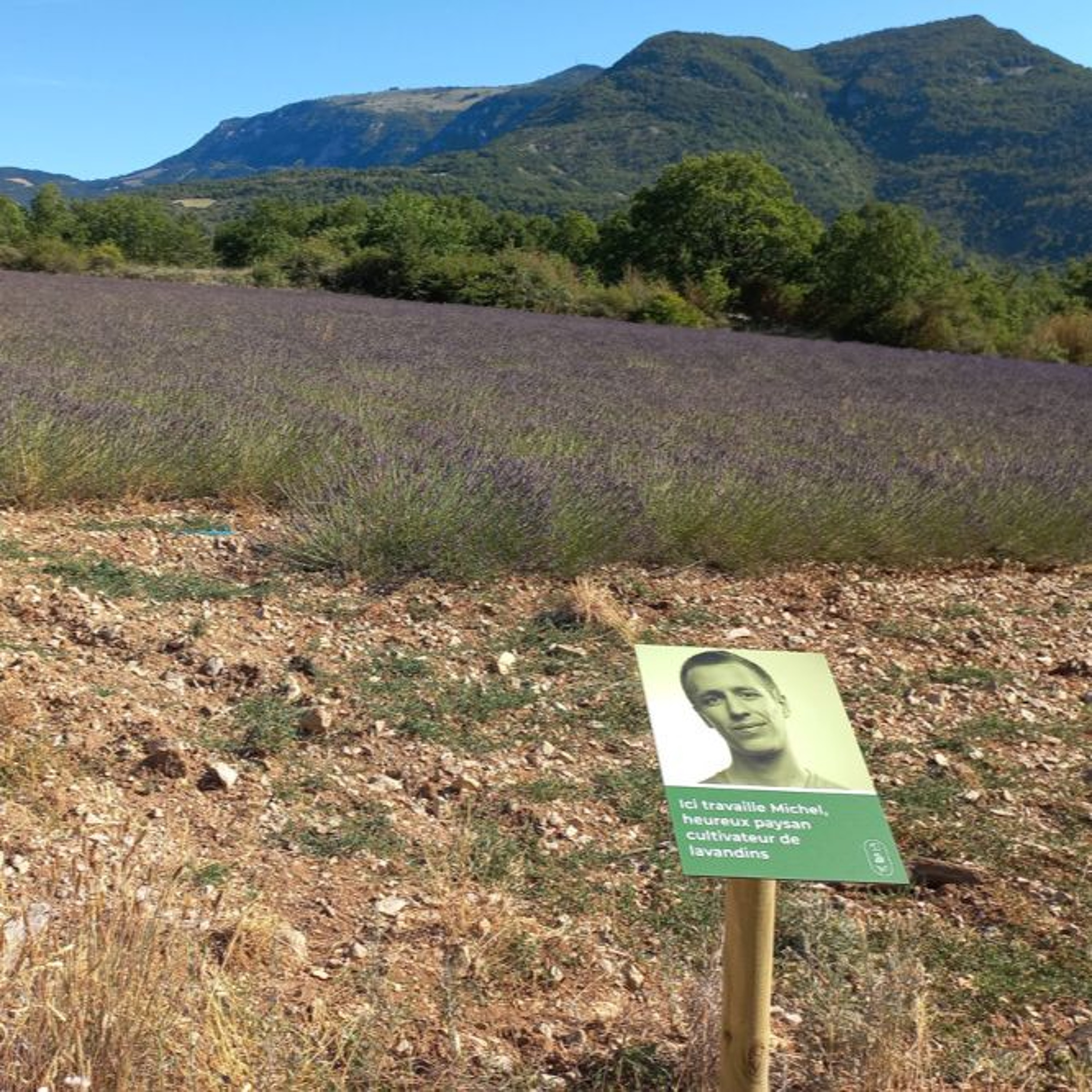
It was a post-dike and it was not supposed to stay longer than maybe three or four months only for the Sanor. Another measure was personalization as Condom Altines explains. And we also settled a personification of a panel for a personification of agricultural plots to remind that these white landscapes are actually fields providing the space and resources for farming activities. They were not to have abandoned land thanks to the use of the pictures of the farmers.
It created personification and sharing and the message was here is working in the Sanor for instance. Happy farmer, he has a cartoon and everything. So it creates attachment and thanks to the face you create something familiar to the visitors and it creates also respect what we think. And on site it was a very discreet farmer to tell the visitors that here there is a farmer working but there was no introduction or anything coercive.
Examples like these showed that notching can actually help changing behavior of visitors and raise their awareness for sustainability issues. But how can other actors in tourism make use of this knowledge? This is what the French corporation agency Avitem based in Marseille is working on in two projects, Najmaiteur and Behaviour Smart Community for Tourism as project manager Julia David explains. So for example for the knowledge sharing part with the project called Best, we have been working with Behaviour and Site Team and Behaviour Smart which are again really high level experts on the topic and they have held four webinars that are accessible online.
These are webinars aimed to really allow you to get familiar with the topic. So we really try to have a step by step approach. We start with some overall knowledge about behaviour science and human brain and decision making and then we dive into specific challenges related to tourism and how this can be relevant. So we have also tried to have a visual approach in all these projects and we share the information in several formats so when you will visit the web page of the webinars you will also have access to the visual summaries of these webinars.
These two kids and trainings about behavioural science are intended to share knowledge and raise awareness about behaviour change and tourism sustainability. The Thames Current Project first mile takes the next step and makes the topic of nudging understandable for tourism practitioners of SMEs, small and middle-sized enterprises in France, Italy, Slovenia and Norway. We have just launched it this year. It's called First Mile and it's a project that allows us to go more into the practical implementation let's say of behaviour smart tactics.
So it's a project funded by the Cosme program which is a European program that runs SMEs. And so with the First Mile we will develop tools and a program to accompany 80 SMEs across Europe in four countries to test small behavioural smart tactics or nudges we could call them like that as well to really have them run the first mile of their sustainability journey. So the idea would be that we will select SMEs that would like to engage in a certain way sustainability transition of their operation and we give them the support to really make the first steps knowing that of course nudges or behavioural interventions do not come alone they need to have the right environment, the right people to also follow up and they need to have enough funding to then integrate the change in the operation in the long term. Changing the behaviour of visitors through nudging can be one important step forward in sustainable tourism.
It should never be done by tricking or manipulating people. Good practice examples never work with coercion. They rather work with personalisation and positive messages for example by telling us the story about a sensitive natural landscape as well as about people, plants and animals living there. Natures address our needs and personal values instead of offering financial incentives.
We all love to discover the natural and cultural beauties of the Alps and we love doing so in a fair way, preserving them as a thriving space for plants, animals and humans living there. And for our visits and future. In this sense let us nudge for good. This was the third episode of our Special Ops Podcast series Guide Visitor's Preserve Nature.
How many visitors are too many? Where exactly is the limit of nature's caring capacity reached? This is the subject of the fourth and final podcast episode in December 2023. My name is Michael Gums, thank you for listening.
This project is supported by CPR International and the Community Network Alliance in the Alps. It is made possible by the German Federal Ministry for the Environment, Nature Conservation, Nuclear Safety and Consumer Protection. A podcast by CPR. A podcast by the L'Aci et la C'est.
The Aci et la podcast. Three print podcasts. Interviews, background talks and voices from all Alpine countries. Listen to this and more in the podcast of the International Commission for the Protection of the Alps.