
EPISODE · Aug 12, 2023 · 1H 4M
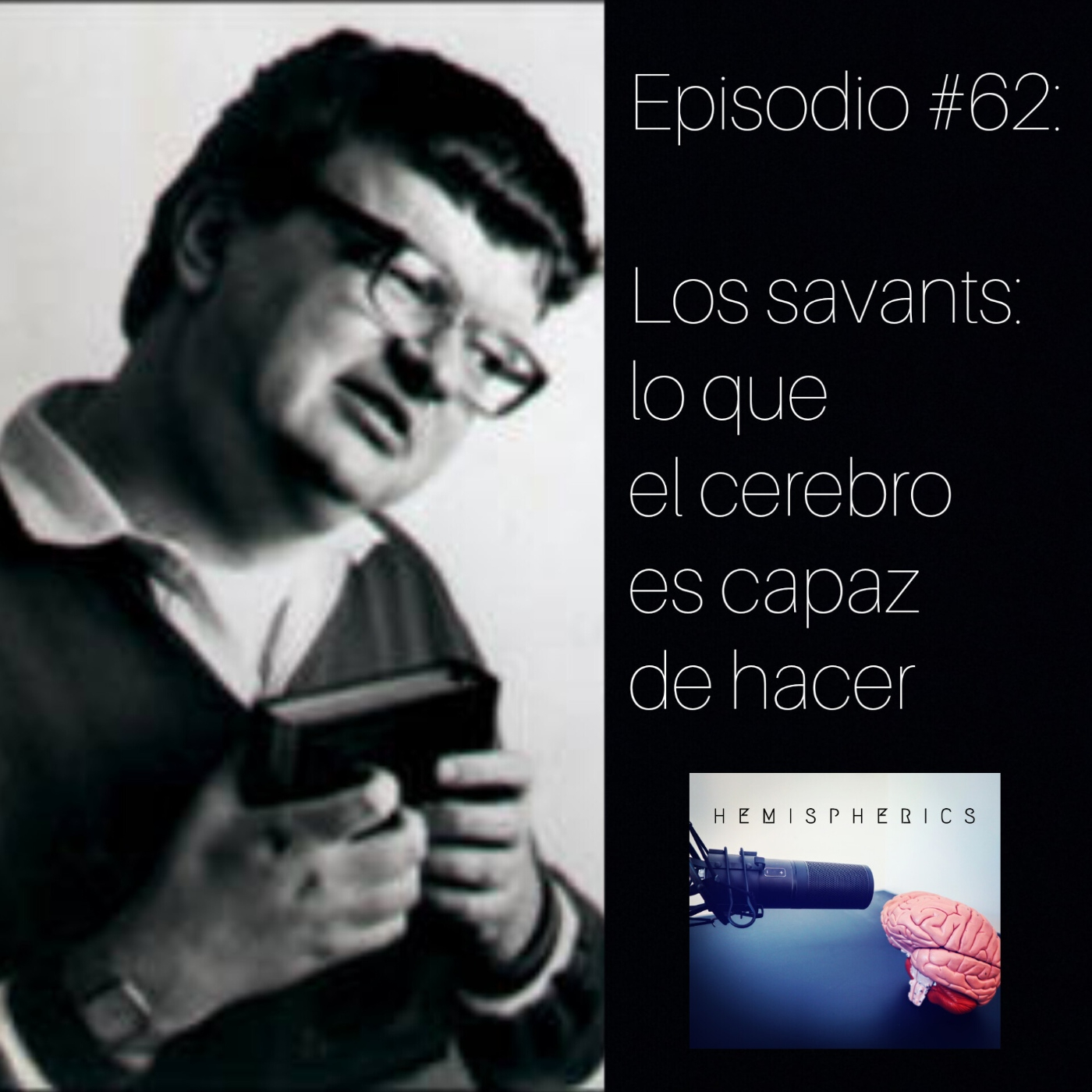
#62: Los savants: lo que el cerebro es capaz de hacer
from Hemispherics
En el episodio de hoy, hablo de un tema que se escapa un poco de la temática habitual del podcast. Este episodio es una “curiosidad de la neurociencia”; una indagación en un tema que desde hace muchos años me ha llamado la atención. Se trata de los savants. Los savants son personas que bien porque han nacido con problemas en el desarrollo o por una lesión cerebral adquirida, son capaces de tener habilidades extraordinarias. Parece ser que la mitad de los savant son autistas, uno de cada diez autistas es savant y uno de cada mil individuos que tienen dañado el cerebro o padecen retraso mental. Son personas que, sin necesidad de entrenamiento, aprendizaje o interés previo, tienen unas habilidades increíbles, sobre todo en el campo de la música, el cálculo o el dibujo. Referencias del episodio: 1. Treffert D. A. (2014). Savant syndrome: realities, myths and misconceptions. Journal of autism and developmental disorders, 44(3), 564–571. (https://pubmed.ncbi.nlm.nih.gov/23918440/). 2. Treffert DA. The savant syndrome: an extraordinary condition. A synopsis: past, present, future. Philos Trans R Soc Lond B Biol Sci. 2009 May 27;364(1522):1351-7 (https://www.ncbi.nlm.nih.gov/pmc/articles/PMC2677584/). 3. Barr MW. Some notes on echolalia, with the report of an extraordinary case. J Nerv Ment Dis 1898;25:20-30 (https://zenodo.org/record/1734113). 4. Mishkin M, Malamut B, Bachevalier J. Memories and habits: two neural systems. In: Lynch G, McGaugh JL, Weinberger NM, editors. Neurobiology of learning and memory. New York: Guilford Press;1984. p.65-77. 5. Kapur N. (1996). Paradoxical functional facilitation in brain-behaviour research. A critical review. Brain : a journal of neurology, 119 ( Pt 5), 1775–1790.https://doi.org/10.1093/brain/119.5.1775 (https://pubmed.ncbi.nlm.nih.gov/9236635/). 6. Boso, M., Emanuele, E., Prestori, F., Politi, P., Barale, F., & D'Angelo, E. (2010). Autism and genius: is there a link? The involvement of central brain loops and hypotheses for functional testing. Functional neurology, 25(1), 15–20 (https://pubmed.ncbi.nlm.nih.gov/20630121/). 7. Snyder, A. W., Mulcahy, E., Taylor, J. L., Mitchell, D. J., Sachdev, P., & Gandevia, S. C. (2003). Savant-like skills exposed in normal people by suppressing the left fronto-temporal lobe. Journal of integrative neuroscience, 2(2), 149–158. https://doi.org/10.1142/s0219635203000287 (https://pubmed.ncbi.nlm.nih.gov/15011267/). 8. Snyder, A. W., & Thomas, M. (1997). Autistic artists give clues to cognition. Perception, 26(1), 93–96. https://doi.org/10.1068/p260093 (https://pubmed.ncbi.nlm.nih.gov/9196693/). 9. Humphrey, N. (1998). Cave Art, Autism, and the Evolution of the Human Mind. Cambridge Archaeological Journal, 8(2), 165-191. doi:10.1017/S0959774300001827 (https://www.cambridge.org/core/journals/cambridge-archaeological-journal/article/abs/cave-art-autism-and-the-evolution-of-the-human-mind/7E969D1ACAB536BD809348B9B4FE5C4D#). 10. Spikins, P., Scott, C. & Wright, B. (2018). How Do We Explain ‛Autistic Traits’ in European Upper Palaeolithic Art?. Open Archaeology, 4(1), 262-279. https://doi.org/10.1515/opar-2018-0016 (https://www.degruyter.com/document/doi/10.1515/opar-2018-0016/html#APA). 11. Folgerø, P. O., Johansson, C., & Stokkedal, L. H. (2021). The Superior Visual Perception Hypothesis: Neuroaesthetics of Cave Art. Behavioral sciences (Basel, Switzerland), 11(6), 81. https://doi.org/10.3390/bs11060081 (https://pubmed.ncbi.nlm.nih.gov/34073168/). 12. Lai G, Pantazatos SP, Schneider H, Hirsch J. Neural systems for speech and song in autism. Brain. 2012 Mar;135(Pt 3):961-75. doi: 10.1093/brain/awr335. Epub 2012 Feb 1. PMID: 22298195; PMCID: PMC3286324 (https://www.ncbi.nlm.nih.gov/pmc/articles/PMC3286324/). 13. Beate H. A memoir of the savant syndrome. Bright splinters of the mind: a personal story of research with autistics savant. London: Jessica Kingsley Publishers; 2001. p. 160 (https://www.proquest.com/docview/198983834). 14. Muñoz-Yunta JA , Ortiz T, Amo C, Fernández-Lucas A, Maestú F, Palau-Baduell M. El síndrome de savant o idiot savant. Rev Neurol 2003;36 (S1):157-0 (https://neurologia.com/articulo/2003061). 15. Geschwind, N., & Galaburda, A. M. (1985). Cerebral lateralization. Biological mechanisms, associations, and pathology: I. A hypothesis and a program for research. Archives of neurology, 42(5), 428–459. https://doi.org/10.1001/archneur.1985.04060050026008 (https://pubmed.ncbi.nlm.nih.gov/3994562/). 16. Navarro-Pardo E, Alonso-Esteban Y, Alcantud-Marin F, Murphy M. Do Savant Syndrome and Autism Spectrum Disorders Share Sex Differences? A Comprehensive Review. Soa Chongsonyon Chongsin Uihak. 2023 Apr 1;34(2):117-124. doi: 10.5765/jkacap.230008. PMID: 37035793; PMCID: PMC10080262 (https://www.ncbi.nlm.nih.gov/pmc/articles/PMC10080262/). 17. Pring, L., Ryder, N., Crane, L., & Hermelin, B. (2010). Local and global processing in savant artists with autism. Perception, 39(8), 1094–1103. https://doi.org/10.1068/p6674 (https://pubmed.ncbi.nlm.nih.gov/20942360/). 18. Mottron L, Dawson M, Soulières I. Enhanced perception in savant syndrome: patterns, structure and creativity. Philos Trans R Soc Lond B Biol Sci. 2009 May 27;364(1522):1385-91. doi: 10.1098/rstb.2008.0333. PMID: 19528021; PMCID: PMC2677591 (https://www.ncbi.nlm.nih.gov/pmc/articles/PMC2677591/). 19. Park HO. Autism Spectrum Disorder and Savant Syndrome: A Systematic Literature Review. Soa Chongsonyon Chongsin Uihak. 2023 Apr 1;34(2):76-92. doi: 10.5765/jkacap.230003. PMID: 37035789; PMCID: PMC10080257 (https://www.ncbi.nlm.nih.gov/pmc/articles/PMC10080257/). 20. Treffert, D. A., & Treffert, D. A. (2021). The Sudden Savant: A New Form of Extraordinary Abilities. WMJ : official publication of the State Medical Society of Wisconsin, 120(1), 69–73 (https://pubmed.ncbi.nlm.nih.gov/33974770/). 21. Documental “Mentes prodigiosas”. https://www.youtube.com/playlist?list=PL10391BEC6C746C6D 22. Daniel Tammet: sinestesia numérica. https://www.youtube.com/watch?v=HqBzez4WKuU&ab_channel=nuecesyneuronas 23. Documental sobre savant en Discovery: https://www.youtube.com/watch?v=BhZTM-aB0lw&t=2290s&ab_channel=PROYECTOTHERAPI 24. Accidental Genius | Darold Treffert | TEDxFondduLac : https://www.youtube.com/watch?v=Wxe1PkyJev8&ab_channel=TEDxTalks
Embed this episode
NOW PLAYING
#62: Los savants: lo que el cerebro es capaz de hacer
No transcript for this episode yet
Similar Episodes
Similar Podcasts
No similar podcasts found.