
A podcast by Sipra. In podcast, de la sipra. De la sipra. De la sipra podcast.
Three-prin podcast. Interviews, background talks, and voices from all Alpine countries. Listen to this and more in the podcast of the International Commission for the Protection of the Arms. www.sipra.org.org.
Port slash podcast. Hello and welcome to our Special Arts Podcast Series Guide Visitors' Preserve Nature Experience. Today we will be talking about the carrying capacity of destinations in the Alps. My name is Maya Simon and I'm working at the Community Network Alliance in the Alps.
This is the fourth episode in the series produced by Sipra International and Alliance of the Alps. Our episodes are in English. Additionally, this episode will be available in Italian, so if you speak Italian, feel free to choose the Italian episode. What are police officers looking for in the Iga mountains and why is a surveillance camera installed there?
You may have heard of the Shrekci lady about Hindelung in Germany. According to one magazine, it is one of the most beautiful mountain legs in the Alps and has become a real tourist magnet attracting not only day trippers, but also many people who bevog there and leave lots of rubbish behind. However, the leg is located in the Algoyahukai nature reserve, where camping, bevocking, fires, drone flying and littering are all prohibited. Unfortunately, the problems could not be prevented by means of information boards, patrols or verbal warnings from rangers.
The only solution open to the may of Vatindelung was to install a surveillance camera at the leg and immediately count the police when campers were spotted. They would then receive fines. In leaving the overnight stays with us brought under control. During the day, crowds of people still come to the lake to take photos.
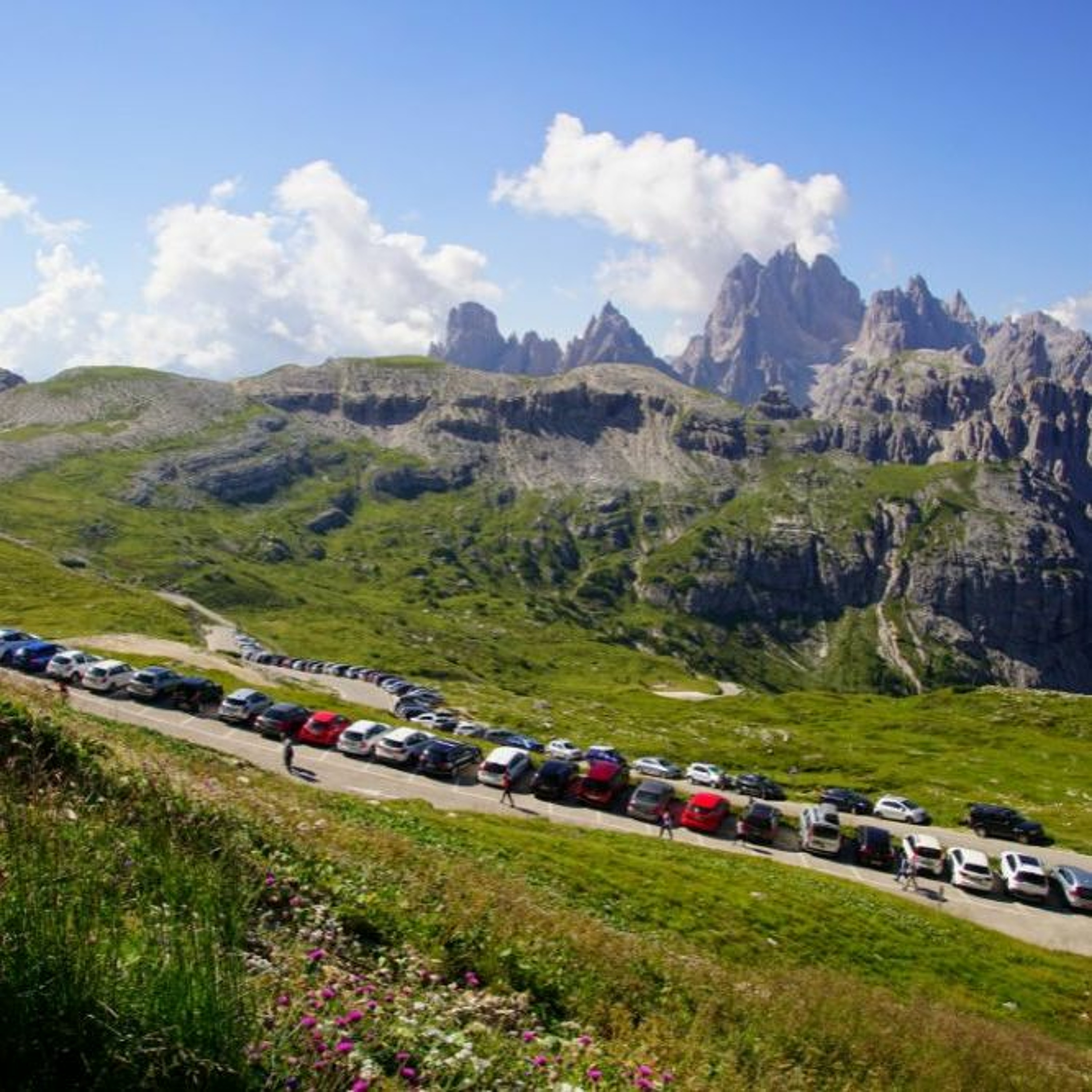
Can the nature receive hope with the crowds in the long run? How many people are too many people at the lake? The Shreksi is one of many examples in the Alps, whose carrying capacity has already been reached or even surpassed. Natural environment, local culture and geographically diverse habitats are the major attractions of mountain areas.
In many alpine destinations, tourist numbers are growing rapidly, which puts pressure on local infrastructures, the environment and the population. The Alps are considered a tourist hotspot in the midst of Europe. A tourist hotspot also always has a certain potential for conflict when the destination's carrying capacity is exceeded. Tourist hotspots and the carrying capacities of tourist regions were also the focus of a project by Tseepda, Germany.
As Deputy Director, Henrietta Atoll explains. We conducted a project over the last two years that was called Faxxfotrism, and basically tried to do some science communication and provide local actors and stakeholders in the tourist destinations with the newest research results that science and the researchers are producing at the universities or institutes or anything. And yeah, we had different chapters and one of the chapters also looked at the effects of tourism. And if you look at the effects of tourism in the Alps, of course you have a lot of positive effects, like the economic effects and maybe the effects for the inhabitants, that there's more infrastructure and a better offer of restaurants and pools and whatever.
But we also have a lot of negative impacts, of course, especially if you look at ecological effects and also maybe social effects. And most of the times those negative impacts are connected to too much of tourism. So if there's too many tourists, then we have a lot of people not being happy about tourism anymore in the villages themselves. And a word that is connected with all of that is the carrying capacity, because the carrying capacity tries to define the amount of tourists or the amount of tourism destination or a certain place can have as a limit.
So for example, I have 12,000 and one person more is negative and then when I say it, it works out. The term carrying capacity is used in several disciplines and in everyday language. So special attention should always be paid to the context in which the term is used and the understanding of the term should be specified accordingly. That definition of that word came really popular over the last few years.
Also of course in the discussion about overturism, so overturism, the too much of tourism that has negative impacts for a destination. Not to be mistaken for maybe the word crowding, which just decribes that there's a high number of tourists in a place, but not necessarily with negative impacts. These negative impacts mostly affect tourism destinations or the natural environment. That distinction can also be made between overturism and over-visiting, or visiting refers primarily to date ripples who are only at the destination for a few hours.
You might have heard of Halstadt in Austria. On some days up to 10,000 tourists come to this village of 800 inhabitants. Almost every one of them wants to take a selfie by the lake. The origin of the Asian love for Halstadt is presumably a South Korean Netflix series Spring Worlds from 2006, part of which was filled in Halstadt.
Since then many have wanted to see the place in real life. The fact that this Austrian village, including its lake and market square, has been duplicated in China, has brought further fame to the original. And now thousands of Halstadt's selfies on social networks are adding to the hype. The rush is continuous.
Tourists now come all year round, not just in summer. This is a problem for many Halstadt residents. Furthermore, it poses a dilemma for the locals. The tourists bring in a lot of money, which benefits the community, but it also leads to tensions among neighboring residents.
The focus of the global discussion on overturism is mostly on urban areas and describes the overstepping of social carrying capacity limits. However, in the context of rural areas, as many areas of the Alps, other carrying capacities have to be considered for the areas influenced by tourism. Carrying capacity is one of the concepts and methods of sustainable measurement and tourism planning. This concept was adopted by researchers and managers in the field of tourism and environmental sciences, in order to prevent negative social and environmental effects.
What is really important if you look at the carrying capacity is to understand that there are different perspectives on carrying capacity. So we have, of course, the social effects of tourism and here the carrying capacity is a lot of times subjective. As an inhabitant, what is my feeling of the acceptable number or denseness of tourism can differ from one neighbor to the next, depending on what they do, how they grew up, what they like. And it's not always quantitative, so you can't always put it in numbers.
And then we also have the ecological carrying capacity, which concentrates on how many persons, not necessarily tourists, but persons, can a certain place in nature. And that has to be defined, of course, if it's like a small area or maybe forest or is it a whole region or a whole nature park, for example. How many persons can visit this place without there being so many negative impacts on nature that it cannot recuperate on itself. And here it's really hard to define because there are so many factors playing into it.
Where do they go? How big is this space out of it? So in the last years there's been a development to not look at the quantitative point of view anymore, so not maybe try to get a number of the 12,000 tourists and not one more, but to look at the qualitative approach. And to maybe just define what kind of changes are acceptable, so that's called the limits of acceptable change.
So you can really go into the area that you want to define this concept for and say, okay, if we have these effects then it's too much, if there's only these effects then it's still okay. And that's development that has been going on in recent years. Martin ecosystems are among the ecosystems, particularly stressed by tourism. As tourism tends to be in regions and areas that are ecologically valuable and sensitive, there's a fundamental potential for cornflips of use.
Objectively, the ecological carrying capacity can hardly be determined as a value, as it depends on many influencing factors, the lot difficult to put into figures and do not do justice to the reality, even with the greatest care. In addition to the number of visitors, the degree of pollution and the extent of territorial change will also have a negative impact on nature. And there are very few indicators for measuring the impacts of tourism, therefore do not exist. In order to be able to determine the impacts, qualitative approaches are nevertheless increasingly being pursued.
The issue of carrying capacity is not only relevant in areas that are well-developed for tourism, but also in local recreation areas. The common bear in the province of Fort Al-Berg in Austria is a local recreation area for the foreign-aboring communities, yet also, mayor of one of the communities explains. We've got an inselberg that's an island mountain in the middle of the Rhine Valley right now that's become very popular with local residents and citizens in recent months and years. And it's actually become clear that this influx of locals looking for recreation is not actually good for the mountains.
So my view is that we have to react so that our children and our grandchildren can also use the mountain as we know it. As the common bear was not considered a tourist area by locals, four years nothing was done to sign post paths or prevent the creation of new trails. They have ever repeated conflicts between people walking, riding horses, mountain biking and climbing. The Four Municipalities commissioned the company Max2 from Innsbruck to find a way to reconcile all these interest groups while still preserving and partially restoring the natural space on the mountain.
The number of looking to see from an elusive high-level mountain. That's an intensive analysis which includes surveys on the mountain, online surveys and several citizens' workshops. We've now created a utilisation concept that clearly sets out the rules. So what do we want?
We want guidance for visitors. We want to achieve coexistence between bikers and hikers. And the whole thing will now be presented to the public over the next few weeks and hopefully we'll be able to involve schools and perhaps also raise awareness among citizens that it's important to do something, right? Because nothing is what we've done up until now and that is clearly not good for the forest.
It was noticeable that the people on the human bear cannot be assigned to just one user group. But to several. One day they are walking the dog there. The next day they are out mountain biking.
A strategy therefore has had to be developed in which as many participants as possible could recognise themselves. The concept has now been finalised and needs to be implemented to increase the acceptance of the new routes among user groups. Gator also wants to employ a trick. The idea is that if there are reforestation campaigns, if there are road renovations, if there are road closures, to do this through the scores.
So perhaps there could be a kuma week once a year or a week where pupils realise projects like this. And let's say a hiker or a mountain biker knows that these trees have been planted by school children. Well, I mean I think it would take a lot of nerve to walk or ride over them, right? Eliza Bichnig from the next two of its fortuels and concepts in Instlook adds an outsider's perspective.
I think that in the future conflicts will arise in local areas. And we can see this in many cities and urban centres where nature is very much in demand and conflicts therefore arise where there are so many people. I think it's important to understand who exactly is there and so where will the conflicts arise? Who are the groups and why are there conflicts?
Why don't they like each other? Or is there no offer? That may also be a reason. Perhaps there are actually sometimes very simple solutions.
I think it's important to understand the problem and the people, why there are these conflicts, to try to empathise with them and then create an offer based upon that. The Kuma-Merg is an example for social and ecological carrying capacity. In Alpine tourism, economic and infrastructural carrying capacity also play an important role. Economic effects arise from both day and overnight tourism.
Economic carrying capacity is determined by the current ratio of employment opportunities and the number of people in the labour force. The effect of exceeding the limit is unemployment. As of the social and environmental carrying capacity, economic carrying capacity is not absolute. Its capacity limits are dynamic and depend on many different factors.
The economic carrying capacity can be used to determine approximately how much tourism activity is at least necessary to enable the economic existence or livelihood of the regional population or businesses in tourism. Tourism and the Alps goes hand in hand with the development and expansion of infrastructural facilities. The infrastructural carrying capacity is one of the major problems of filnour in the Dolomites. Since being declared a world heritage site, the community has seen a huge increase in the number of visitors.
Daytroopers in particular flock to the small valley to make a stop at two special photo points. Robert Messner, the former mayor of Vilnour's success. Our problem at the moment is that we are being overrun by daytroopers and also photo forests. Vilnour's lies are a beautiful valley in the Puytsch Eisler Nature Park.
As a slow food travel destination, the idea is to offer tourists a relaxing holiday close to nature. The municipality is therefore planning to limit and better manage the high number of daytroopers. The solution is that the municipal authority has now commissioned a management steering plan from experts and representatives from the valley. This is now in place and the first measures are being implemented.
It suddenly boils down to restricting access so that only a certain number of people can move around in the protected area in order to maintain quality standards, both for people and for nature. They have therefore developed a concept that aims to make things easier for the valley, particularly in terms of local mobility. This is happening in three phases. The short term measures have already actually been taken with side-posting and limited access restrictions.
The second stage is a bit bigger and also relatively expensive, i.e. a little over 1 million euros with footways and the signposting of cycle routes and up tours. There will also be a bike-sharing seat, which is still being set up, where you can conveniently hire a bike using an app or a mobility card. The third step is then bigger with a mobility centre roughly in the upper third of the valley, with access restricted by means of barriers.
The mobility centre for public transport and shuttles, but also for on-call busits, e-bike-sharing and the start of hiking trails from that height. So that is the ultimate goal, to keep under control of the number of visitors who go hiking in the nature reserve. The capacities of a tourist destination cannot be unambiguously qualified as the case, for example, with public transport or museums. There is no single way of quantifying the carrying capacity for such different aspects, at the social, economic or environmental dimensions.
Not only will the carrying capacity vary according to different regional circumstances, but there is also no one-size-fits-all approach for a set of the city. The process of carrying capacity measurement or calculation should be accompanied by an external overview or expertise to support from a neutral position to destination in each step of the chosen methodology. There are also specific calculation approaches. For example, the physical carrying capacity is the maximum number of visitors who can be physically presented at a given place in time.
It is calculated using the following equation. The area suitable for tourists is multiplied by the amount of space that each visitor needs, so as to be able to move easily and not interfere with other physical phenomena or people, which are the physical conditions. The area is also known as the number of visitors to a particular place. With the use of many different criteria, the carrying capacity limits for cities, for infrastructure, and even for nature can be calculated.
When considering sensitive natural areas, the human impacts on plants or soil, water and animals in the region are particularly relevant. Carrying capacity should be a basic component for the planning of any tourist destination and is considered the benchmark both for tourism regulation and management. In order to control unwanted activities, an assessment of carrying capacity can be used to charge the tourist impact on space and the environment. It represents an important component when planning spatial development in tourism and is one of the mechanisms used to establish the standards for sustainable tourism.
It is important to act with foresight. Each municipality and each area must find individual solutions but can of course learn from other destinations. With our Specialized Podcast Series, we aim to get the knowledge and contribute to the exchange of experience across the Alps. If you would like to hear more about visitor guidance in the Alps, please listen to the C-Brut channel on SoundCloud.
You will find the links in the description. The limits of tourism in the Alps are also discussed in the current episode of Eitm-Rausen, a German language podcast produced and presented by Paul Künseo from C-Brut, Austria. He talked to a member of the Municipal Council of High Stutt, a small municipality in the middle of a beautiful scenery of mountains and lakes that is overrun by day trippers from all over the world. How does the municipality deal with the situation and why do inhabitants even protest against over tourism?
You can find a link to the podcast Eitm-Rausen in our show notes. This was the fourth episode of our Specialized Podcast Series, Guide visitors' Preserve Nature Experience. More information about this podcast series is available on albmyaljans.org and C-Brut.W. My name is Maya Simon and I thank you for listening.
This project is supported by C-Brut National and the Community Network for Lines in the Alps. It is made possible by the German Federal Ministry for the Environment, Nature Conservation, Nuclear Safety and Consumer Protection. A podcast by C-Brut. In podcast, the podcast is the last one.
The C-Brut Podcast. In podcast, the podcast is the last one. In podcast, the podcast is the last one. Interviews, background talks and voices from all Alpine countries.
Listen to this and more in the podcast of the International Commission for the Protection of the Alps. www.sipra.org. forward slash podcast.