
EPISODE · May 10, 2023 · 33 MIN
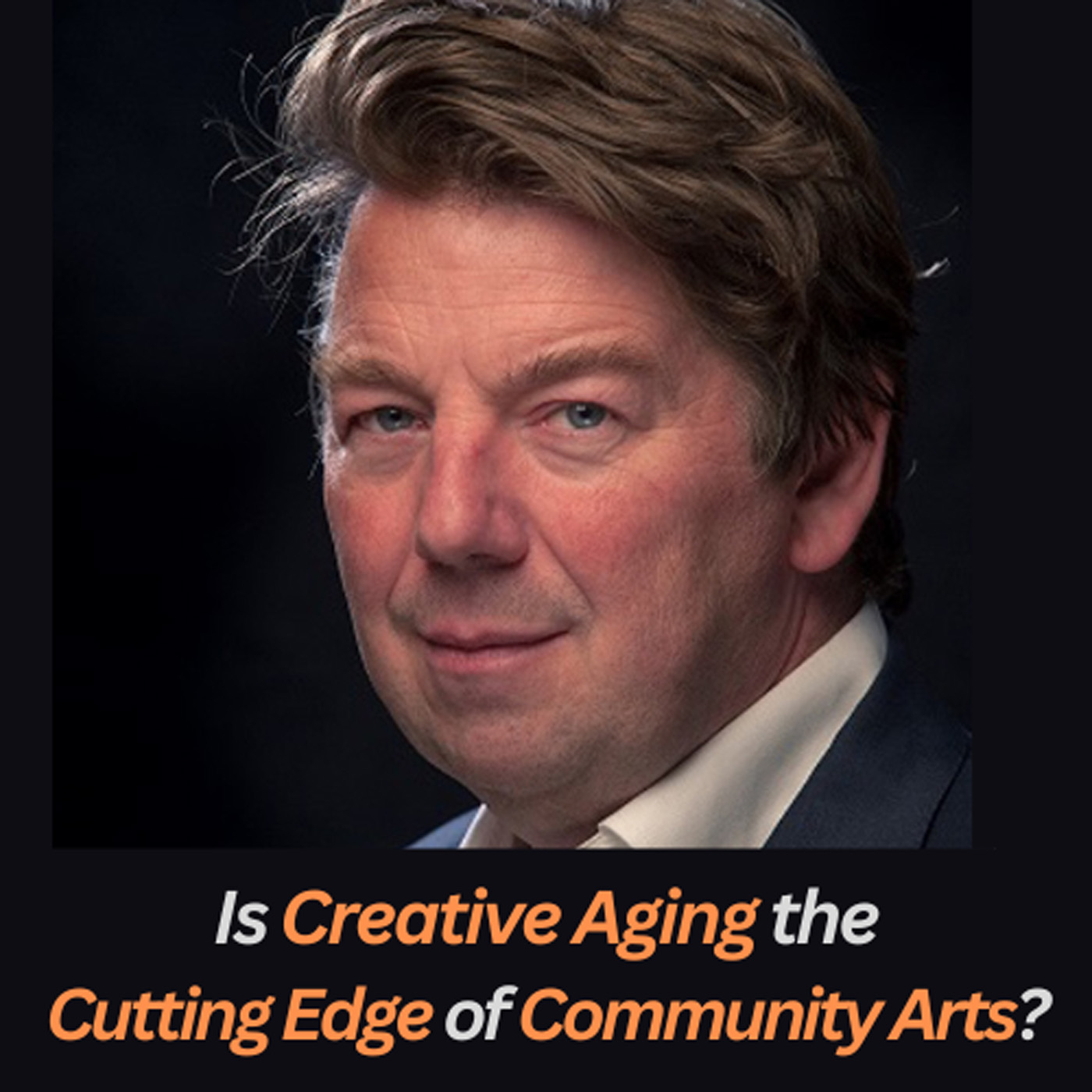
71: Is Creative Aging the Cutting Edge of Community Arts?
from ART IS CHANGE: Strategies & Skills for Activist Artists & Cultural Organizers
In this episode international arts and aging leader Dominic Campbell will share his thoughts about some intriguing questions: Can an active creative culture change the scary stories we tell ourselves about getting older? Can large scale festivals help communities find common ground in their work with older citizens? What is creative aging and why is it being embraced by gerontologists, and brain scientists across the planet?BIODominic Campbell is the originator and co-leader of Creative Aging International. As Ireland's Bealtaine Festival’s Director he steered the festivals growth and expansion over eight years. Formerly an Artistic Director of Ireland’s national celebration, St Patrick’s Festival, he transformed its three shows into ninety within four years growing production and managerial teams alongside the financial support required.Dominic went on to design and produce national celebrations marking the expansion of European Union in 2004 and Centenary celebrations for James Joyce. For “The Day Of Welcomes” marking EU expansion, he devised and produced 12 simultaneous festivals pairing EU expansion countries with Irish towns and cities engaging 2,500 artists from 32 countries.He mentored festivals in Wales (Gwanwynn), Scotland (Luminate), and has developed projects with partners in Australia and The Netherlands. In 2012 he established the first global conference on Creativity In Older Age opened by Irish President Michael D Higgins.In 2016 he became an inaugural Atlantic Fellow for Equity and Brain Health at the Global Brain Health Institute a project between Trinity College Dublin and University College Southern California an ambitious worldwide program seeking social and public health solutions to reduce the scale and adverse impact of dementia.Recognized by The Irish Times as one of the top ten key cultural influencers in Ireland he seeks strategic and business partners to develop Creative Aging International.Notable MentionsGlobal Brain Health Institute: The Global Brain Health Institute (GBHI) is dedicated to protecting the world’s aging populations from threats to brain health. “We strive to improve brain health for populations across the world, reaching into local communities and across our global network. GBHI brings together a powerful mix of disciplines, professions, backgrounds, skills, perspectives, and approaches to develop new science-based solutions. “The Atlantic Fellows for Equity in Brain Health: The Atlantic Fellows for Equity in Brain Health program at GBHI provides innovative training, networking, and support to emerging leaders focused on improving brain health and reducing the impact of dementia in their local communities and on a global scale. It is one of seven global Atlantic Fellows programs to advance fairer, healthier, and more inclusive societies.Chuck Feeney is an American businessman and philanthropist who made his fortune as a co-founder of the Hong Kong based Duty Free Shoppers Group. He is the founder of The Atlantic Philanthropies, one of the largest private charitable foundations in the world. Feeney gave away his fortune in secret for many years, until a business dispute resulted in his identity being revealed in 1997.[2] Feeney has given away more than $8 billion.[3]Veronica Rojas: Veronica was a guest on Change the Story / Change the World in April of 2023. She has shown her work nationally and internationally. She has been a Visual Aid Grant recipient and has been nominated to The Eureka Fellowship Grant and the Joan Mitchell Foundation Grant. In 2011 Veronica got the Jerome Caja Terrible Beauty Award. Veronicas’ paintings have been reviewed in Artweek Magazine, Bay Area Express, Metro Active and the TV program Latin Eyes. Currently, Veronica is an Atlantic Fellow for Brain Health and Equity at the Global Brain Health Institute.Caribbean Carnival: is the term used in the English speaking world for a series of events, held annually throughout almost the whole year in many Caribbean islands and worldwide.[2]The Caribbean's carnivals have several common themes, all originating from Trinidad and Tobago Carnival also known as the Mother of Carnival , whose popularity and appeal began well before 1846, and gained global recognition in 1881 with the Canboulay Riots in Port Of Spain.[3] #Trinidad Carnival is based on folklore, culture, religion, and tradition (thus relating to the European use of the word, not amusement rides, as the word "carnival" is often used to mean in American English.St. Patrick's Festival parade in Dublin, Ireland: The iconic National St. Patrick’s Day Parade returns to the streets of Dublin every March 17, with pageants, marching bands and over a million participants. Through contemporary and traditional Irish arts, culture and heritage, the Festival connects families, friends and communities across Ireland, and Ireland’s global tribe of 80 million. Damasio’s Somatic Marker Hypothesis: In economic theory, human decision-making is often modeled as being devoid of emotions, involving only logical reasoning based on cost-benefit calculations.[3] In contrast, the somatic marker hypothesis proposes that emotions play a critical role in the ability to make fast, rational decisions in complex and uncertain situations.[1]Patients with frontal lobe damage, such as Phineas Gage, provided the first evidence that the frontal lobes were associated with decision-making. Frontal lobe damage, particularly to the vmPFC, results in impaired abilities to organize and plan behavior and learn from previous mistakes, without affecting intellect in terms of working memory, attention, and language comprehension and expression.[4][5]<a...
Embed this episode
What this episode covers
In this episode international arts and aging leader Dominic Campbell will share his thoughts about some intriguing questions: Can an active creative culture change the scary stories we tell ourselves about getting older? Can large scale festivals help communities find common ground in their work with older citizens? What is creative aging and why is it being embraced by gerontologists, and brain scientists across the planet?
Ready to play
71: Is Creative Aging the Cutting Edge of Community Arts?
No transcript for this episode yet
Similar Episodes
No similar episodes found.
Similar Podcasts
No similar podcasts found.