
EPISODE · Jul 29, 2026 · 11 MIN
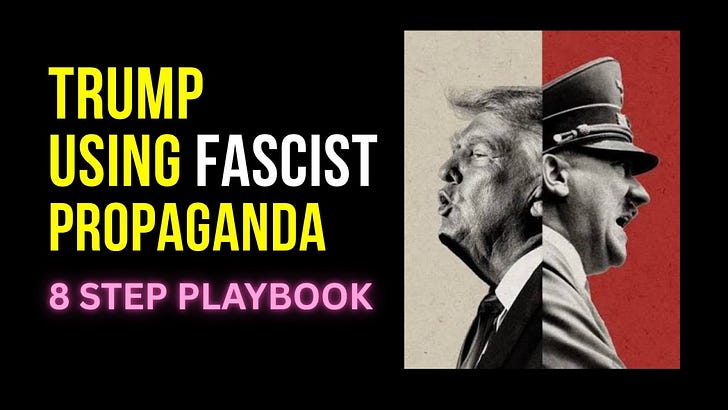
8 Fascist Tactics Trump is Using on Americans Right Now
from The Lucas Bean Show · host Lucas Bean
During World War II, the United States government did something that most Americans have never heard of. They did not just fight Hitler. They studied him. They wanted to understand exactly how his propaganda worked so they could beat it.In 1943, the Office of Strategic Services, the wartime intelligence agency that would later become the CIA, commissioned psychoanalyst Walter Langer to build a psychological profile of Adolf Hitler. The report was classified for decades. When it was finally declassified, what it contained was not just a profile of one man. It was a playbook. Eight rules Hitler used to control an entire country through propaganda.Every single one of those rules is backed by decades of modern psychological research. And every single one of them is being used right now.Rule One: Never Allow the Public to Cool OffTrump has created a new crisis every single week since he took office. Immigration. Tariffs. Greenland. Panama. Canada. There has not been a single week where Americans could sit down and process what just happened before the next explosion hit. This is not chaos. This is strategy.Neuroscientist Geraint Rees at University College London scanned the brains of people with different political beliefs and found that conservatives have a larger, more reactive amygdala. The amygdala is the fear center of the brain. It processes fear, anxiety, and rage.When the amygdala is activated, the prefrontal cortex shuts down. That is the part of the brain responsible for critical thinking, reasoning, and long-term decision making. The brain cannot do both at the same time. It cannot be afraid and think clearly at the same time.If you keep the crises coming, you keep the amygdala firing. If you keep the amygdala firing, critical thinking never turns back on. A calm population is a thinking population. A thinking population is dangerous to a leader who cannot survive scrutiny. So the leader never lets them calm down.Rule Two: Never Admit a Fault or Being WrongTrump has never apologized for anything in his entire political career. Not for mocking a disabled reporter. Not for calling veterans losers. Not for the Access Hollywood tape. Not for January 6th. Not once. Not ever.This is not stubbornness. This is a psychological weapon.Researcher Brené Brown at the University of Houston spent over two decades studying shame. She found that people with low shame resilience cannot separate a mistake from their identity. For these people, admitting they did something wrong does not feel like correcting an error. It feels like being exposed as worthless.Trump’s followers have fused their identity with his. His wins are their wins. His losses are their losses. If Trump admits fault, his followers have to process what it means that they followed a man who was wrong. For people with low shame resilience, that does not feel like learning. It feels like dying. So Trump never admits fault. Not to protect himself. To protect the psychological structure his followers built around him. One apology and the entire thing cracks.Rule Three: Never Concede That There May Be Some Good in Your EnemyEvery Democrat is evil. Every journalist is the enemy of the people. Every critic is human scum. Every Republican who breaks ranks is a traitor. There is no middle ground. There is no nuance. There is no acknowledgment that the other side might have a point about anything.Psychologist Jacques-Philippe Leyens at the Université Catholique de Louvain in Belgium studied what happens when one group stops seeing another group as fully human. He developed his theory after watching the Belgian public react to the Rwandan genocide in 1994. The press and the public showed far more concern for ten Belgian soldiers killed in the conflict than for 800,000 Rwandans who were slaughtered.Leyens called this infrahumanization. The unconscious belief that your group experiences the full range of human emotions but the other group does not. They feel pain, but not the way we feel pain. They suffer, but not the way we suffer. They are human, but not as human as we are.Once that switch flips, empathy becomes impossible. You cannot feel compassion for someone you do not see as fully human. And if you cannot feel compassion for them, you can justify anything you do to them. Trump does not just disagree with Democrats. He strips them of humanity. Vermin. Scum. Enemies from within. That language is not careless. That language is the prerequisite for everything that comes next.Rule Four: Never Leave Room for AlternativesThere is only one man who can fix it. He said it himself. I alone can fix it. Not the party. Not the platform. Not the institutions. Him.Psychologist Arie Kruglanski at the University of Maryland spent decades studying the need for cognitive closure. He found that some people have a powerful psychological need for definitive answers. They cannot tolerate ambiguity. They cannot sit with uncertainty. They need the story to be simple and the answer to be final.Alternatives create ambiguity. If there are other leaders, other solutions, other approaches, then the follower has to evaluate, compare, and choose. That requires critical thinking. That requires tolerating uncertainty while they figure it out. A leader who eliminates all alternatives eliminates the need to think. There is one answer. There is one leader. There is one truth. For people with a high need for closure, that does not feel like authoritarianism. It feels like relief.That is why every Republican alternative to Trump was destroyed. Not because they were wrong. Because their existence created ambiguity. And ambiguity is intolerable to people who need certainty to function.Rule Five: Never Accept BlameEverything that goes wrong is someone else’s fault. The Democrats. The deep state. Obama. Biden. China. The media. The judges. The prosecutors. Never him. Not once. Not ever.Psychologist Ziva Kunda at the University of Waterloo studied how people process information that threatens their beliefs. She found that the brain does not evaluate evidence objectively. It evaluates evidence based on what conclusion the brain wants to reach.She called this motivated reasoning.If a person is motivated to believe Trump is right, their brain will process every piece of evidence through that filter. Good news is proof he is right. Bad news is proof someone is sabotaging him. Contradictory evidence is proof the conspiracy is bigger than they thought. If Trump never accepts blame, his followers never have to process blame. The mental model stays intact. The leader is perfect. The enemies are the problem. And the follower never has to face the terrifying possibility that they gave their loyalty to someone who did not deserve it.Rule Six: Focus on One Enemy at a Time and Blame Them for EverythingImmigrants. That is the current enemy. Your job is gone because of immigrants. Your rent is too high because of immigrants. Your neighborhood is dangerous because of immigrants. Your kids’ schools are failing because of immigrants. One enemy. Every problem.Psychologist Arie Kruglanski at the University of Maryland studied why ordinary people join extremist movements. He found that the primary driver is not ideology. It is the need to feel like your life matters. He called this significance quest theory.When people feel invisible, unimportant, and irrelevant, they will grab onto anything that gives their suffering a cause and their life a mission. A single enemy does both. It explains why your life is hard and gives you someone to fight. Yesterday you were a guy with a dead-end job and no direction. Today you are a patriot defending your country from an invasion. You did not get a raise. You did not accomplish anything anyone noticed. But you are standing between America and the enemy at the gate. And that feels like purpose.A scattered set of complex problems is impossible to fight. A single enemy is simple. Simple is satisfying. And satisfying is addictive.Rule Seven: People Will Believe a Big Lie Sooner Than a Little OneThe election was stolen. Not a small exaggeration. Not a spin on the numbers. A massive, total, complete fabrication that every court rejected, every audit disproved, and every election official including Republicans confirmed was false.And tens of millions of people believe it anyway.Psychologist Lee Ross at Stanford University studied what happens when a person forms a belief based on information that is later completely discredited. He found something terrifying. The belief survives. Even after the person is told the original information was false. Even after they are shown proof. Even after they accept intellectually that the information was made up.Ross called this belief perseverance. The brain does not store beliefs like files that can be deleted. It builds a web of connections around each belief. Explanations. Justifications. Memories. Identities. By the time the original information is discredited, the web is already built. And the web does not collapse just because the foundation is removed.A big lie works better than a small one because a big lie generates a bigger web. A small lie is a single claim that can be checked and dismissed. A big lie becomes a worldview. It reorganizes everything. It becomes the lens through which every piece of new information is filtered. The election was stolen is not a claim. It is an operating system. And you cannot uninstall an operating system by showing someone a fact.Rule Eight: Repeat the Lie Often Enough and People Will Eventually Believe ItTrump said fake news over 2000 times in his first term alone. He said the election was stolen hundreds of times. Fox News repeated it. Newsmax repeated it. Right-wing podcasts repeated it. Truth Social repeated it. Every day. From every source his followers trust.Psychiatrist Robert Lifton studied survivors of Chinese Communist brainwashing in 1961 and documented how cult leaders control whether their followers think at all. He called it thought stopping.The human brain is always scanning for information that might threaten what it believes. Cult leaders pre-load a response inside the follower’s head. The second a threatening thought appears, a phrase fires automatically. And the brain shuts off before the thought can fully form.Fake news. Witch hunt. Deep state. TDS.These are not arguments. These are programmed responses. They were installed through repetition. Thousands of repetitions over years. Attached to fear and anger. Repeated until the brain does it automatically.You spend hours building an argument. Gathering sources. Collecting evidence. Making your case. And a Trump supporter kills it in two words. Fake news. Before the thought even registers. It works because the follower has no idea it is happening to them. A Trump supporter genuinely believes they are thinking.The Playbook Is RunningThe United States government wrote this playbook down in 1943. Eight rules. Every single one backed by decades of modern psychological research. They wrote it so Americans would recognize it if it ever happened again.It is happening again. And Stephen Miller is running it from inside the same government that wrote the warning.The OSS profiled Hitler so America could defeat fascism. 80 years later, a fascist is using the same playbook from inside the White House. And half the country is too programmed to see it.SourcesWalter C. Langer, “A Psychological Analysis of Adolph Hitler: His Life and Legend,” Office of Strategic Services, 1943Geraint Rees, Ryota Kanai, Tom Feilden, Colin Firth, “Political Orientations Are Correlated with Brain Structure in Young Adults,” Current Biology, Volume 21, Issue 8, April 2011, University College LondonBrené Brown, “Shame Resilience Theory: A Grounded Theory Study on Women and Shame,” Families in Society, Volume 87, Number 1, 2006, University of HoustonJacques-Philippe Leyens, “Retrospective and Prospective Thoughts About Infrahumanization,” Group Processes and Intergroup Relations, 2009, Université Catholique de LouvainArie W. Kruglanski, “The Psychology of Closed Mindedness,” Psychology Press, 2004, University of MarylandZiva Kunda, “The Case for Motivated Reasoning,” Psychological Bulletin, Volume 108, Number 3, 1990, University of WaterlooArie W. Kruglanski, Jocelyn J. Bélanger, Michele Gelfand, Rohan Gunaratna, Malkanthi Hettiarachchi, Fernando Reinares, Edward Orehek, Jo Sasota, Keren Sharvit, “Terrorism: A (Self) Love Story,” American Psychologist, Volume 68, Number 7, 2013, University of MarylandLee Ross, Mark R. Lepper, Michael Hubbard, “Perseverance in Self-Perception and Social Perception,” Journal of Personality and Social Psychology, Volume 32, Number 5, 1975, Stanford UniversityRobert Jay Lifton, “Thought Reform and the Psychology of Totalism: A Study of Brainwashing in China,” W.W. Norton, 1961 This is a public episode. If you'd like to discuss this with other subscribers or get access to bonus episodes, visit lucasbean.substack.com/subscribe
Embed this episode
Ready to play
8 Fascist Tactics Trump is Using on Americans Right Now
No transcript for this episode yet
Similar Episodes
No similar episodes found.
Similar Podcasts
No similar podcasts found.