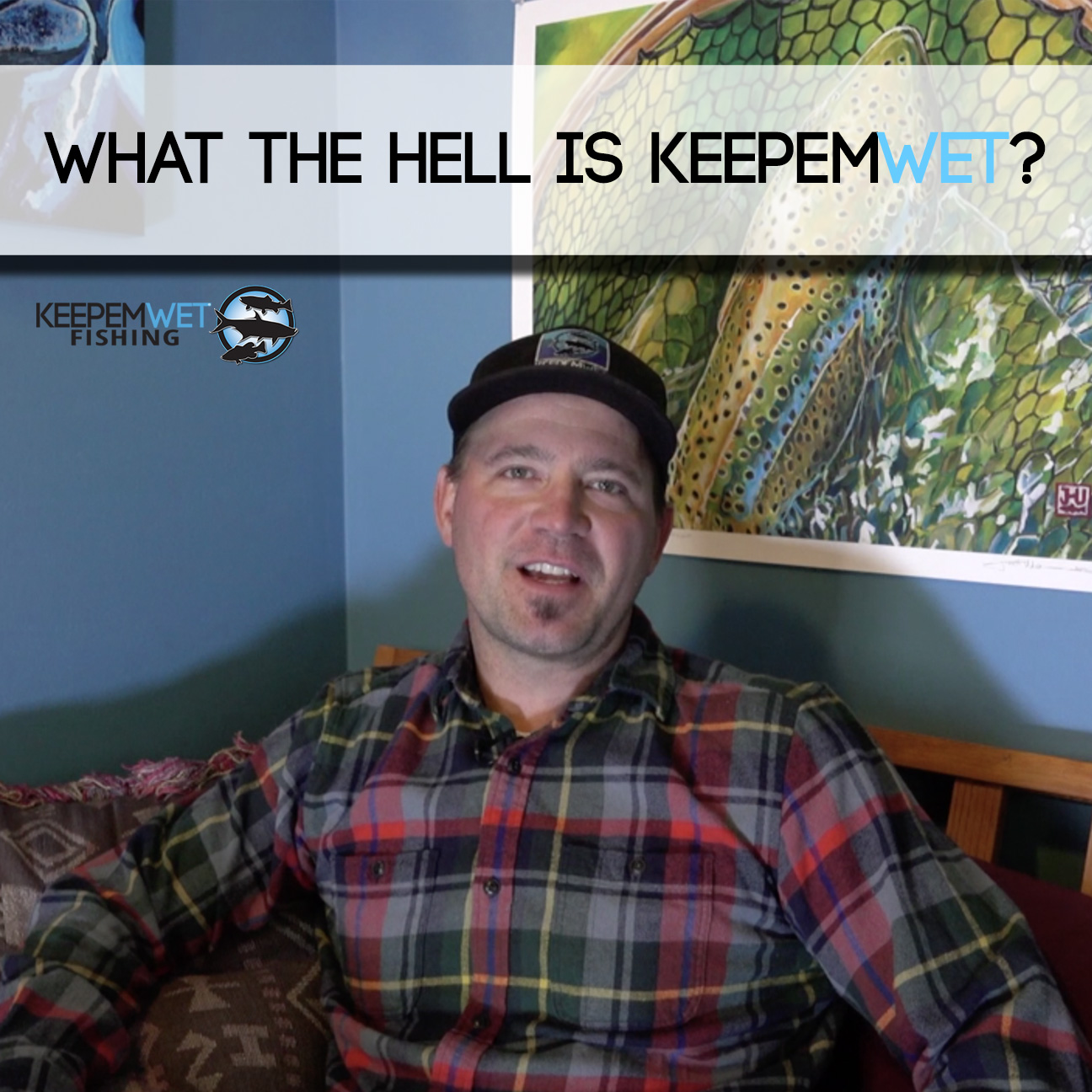
Hey there, I'm Brian Husky, and in addition to the stories I've shared here so far, I also have a lot of fishing related content that I'm looking forward to sharing. What I'm going to start off with here is the backstory of a phrase in fishing that's become very popular all over the globe relating to catch and release practices. It's called Keep'em What? If you've looked at many fishing photos on social media, you've probably seen the hashtag.
Well, that phrase, now paired with nearly 200,000 photos on Instagram alone, originated right here. And from the first time I scribbled it down as a footnote, it's had quite a journey. Here's how it all happened. It all started with Instagram.
That's the first place that I noticed hashtags taking off, and their great potential to link topics. What drove me nuts, however, was how many photos I was seeing of fish up on the dry bank hanging from their gills, kung fu, gripped, or flopping in the bottom of a boat. And tag or describe is catch and release. I wondered how many people realized that many of these fish I was seeing were not likely to survive.
Yet the practice continued to feed that precious social media audience. Fish is tossed back into the water after suitable photos are captured, and hands are washed clean, both figuratively and literally of any accountability. Cast, more likes, more followers, love us some catch and release. I thought about all the people drawn to fishing because of the stunning imagery they'd seen, and viewed this kind of practice as the norm of what catch and release looks like.
New anglers were simply replicating what they'd seen as examples, and youngsters born and raised by what they'd seen on their screens were seeking digital credibility with their peers. With camera phones in every angler's pocket, in the insatiable expansion of social media, it just seemed to mean like catch and release needed a voice, a way of nudging anglers to consider that how they handled and released fish made all the difference in whether it lived or died, despite what their hashtag said. I recalled a trout photography presentation I'd given years back, and one of my subtitles keep them wet. I was describing the multitude of photogenic elements that wet fish offered compared to the alternative.
Colors pop just like wet paint pops, a fish in the water lends to getting the camera down closer, making for better photo outcomes. Incredible reflections of the surroundings are often captured on a wet fish, and close up shots of fish in the water may also reveal interesting elements of the habitat, the river bottoms, the rocks, insects and such. Quite frankly, I was trying to trick this audience into better catch and release practices without coming off as jamming fish-friendly conservation down their throats. I wanted them to think of what they were getting out of the wet fish photo tips, even though in the end it was just as much for the benefit of the fish.
So that title phrase suggested a primary element of better catch and release practice, and packed together as a hashtag had a catchy spark to it. I wanted to communicate many things at once, and a fish that was kept wet in the water, or at least wet in the first place, would likely avoid many of the additional handling impacts, like being bear hug, gnarme-resled, squose and organ-scrushed, dropped on the rocks or in the bottom of a boat, etc. I packed the trio of words together and a hashtag was born. Now I'm not the confrontational type, so I never injected it into anyone else's content, but quietly began pairing the tag with my own trout and steelhead Instagram posts.
From that time in early 2013, the tag caught on with friends and colleagues in fly fishing culture. Industry friends from Patagonia and the fly fishing film tour began using it as a promotional slogan. Within a month or so, people I'd never heard of were using the tag, and it took off like wildfire. Native fish society contact me and ask if they could borrow the title for a catch and release campaign that they had been creating.
A bit later, a buddy pointed out quarrels breaking out on social media, conflict, name calling, and spats over the use of the tag. People were leveling accusations at each other as hypocrites for using the hashtag while also posting more traditional photos of fish out of the water. The tag was being used as a divisive insult and polarizing the fishing community. I was completely blown away at how out of context and confrontational it was becoming.
So with the help and encouragement from my buddy Paul Moenister, I decided to take ownership of the phrase and its meaning as I'd intended it. We set out to define Keep-A-Mwut as synonymous with the multitude of science-based principles of catch and release, and assembled a coalition to promote these examples in this new era of social media. We reached out to Dr. Andy Danalchuk, a leading fishery, scientist, and professor at University of Massachusetts Amherst.
Andy expressed support and enthusiasm for this Keep-A-Mwut concept and joined the team. I reached out to my friends at different companies within the fly fishing industry and explained the support we were seeking to promote better catch and release practices. Companies, media outlets, and conservation organizations joined us left and right, and Keep-A-Mwut Fishing was born. It's also very important for me to point out what Keep-A-Mwut Fishing is not.
In the sense that I don't want our efforts to be misunderstood or misrepresented, we are not suggesting folks can't or shouldn't take pictures of their prize catch. Simply pointing out considerations for how that can be done while reducing the impact to released fish. Smart preparation and timing are all that's needed for that perfect, fast, grip-and-grant photo. Wet fish drip so when a lifted fish stops dripping, it's time to put it back in the water.
Also, we're in no way opposed to harvesting a fish. Fill the cooler with three-range goodness. We simply hate to see fish wasted by tossing them back mortally injured or compromised. Following a few years of foundation building, Keep-A-A-Mwut Fishing is growing up now into a legit organization recognized around the globe.
I've committed myself to this work full-time, and with the help of friends and colleagues, we are laying long-term plans and charting a course far into the future. We've refined our messaging and branding to educate and power and inspire anglers of all stripes and craft. We've identified fantastic new opportunities for great work to be done, especially that of bridging the respective fishery science and angling communities. We've created a team of angling ambassadors representing some of the most respected and well-known names in fly fishing, art and photography.
All this is backed by our stable of science ambassadors, an assembly featuring many of the world's foremost catch-and-release scientific experts. Looking ahead, my hope is for keeping wet fishing to unite anglers of all kinds while promoting catch-and-release practices that benefit everyone. In the future, I think it can expand beyond fish handling to larger habitat and conservation topics, tying in relationships and becoming a high-flow conduit between the science and angling communities. Despite the political leanings or stereotype profiles of the vast range of angler groups around the world, they all want to catch more fish, period.
Science is revealing a litany of new variables that impact overall catch rates. And Keep-A-A-A-Mwut Fishing wants to share that understanding. We want winds for anglers, for fisheries, and for all of us to benefit from a healthier population of both.