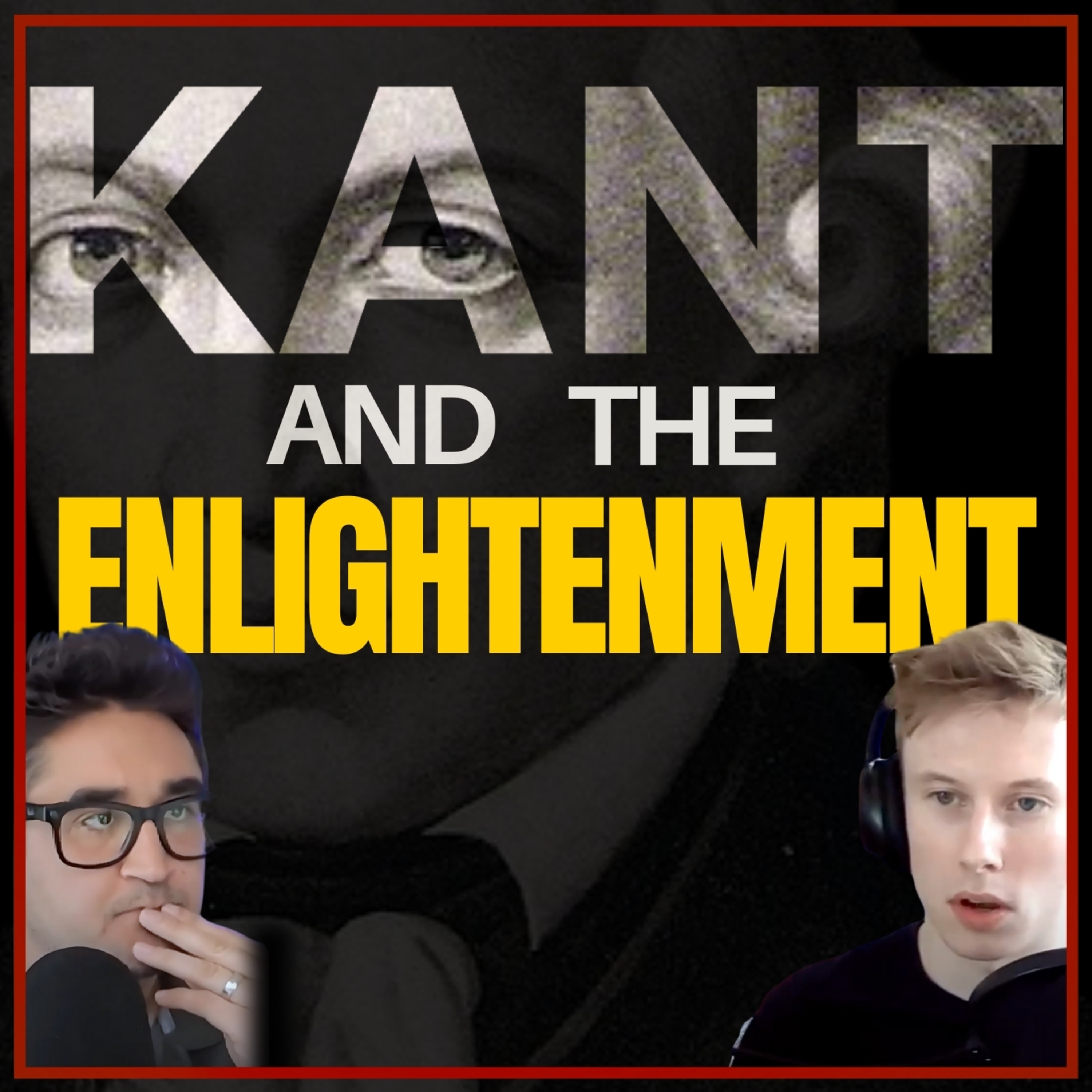
#80 (C&R Series, Chap. 7) - Dare to Know: Immanuel Kant and the Enlightenment episode artwork

EPISODE · Jan 28, 2025 · 1H 6M

#80 (C&R Series, Chap. 7) - Dare to Know: Immanuel Kant and the Enlightenment

from Increments · host Ben Chugg and Vaden Masrani

Immanuel Kant was popular at his death. The whole town emptied out to see him. His last words were "it is good". But was his philosophy any good? In order to find out, we dive into Chapter 7 of Conjectures and Refutations: Kant’s Critique and Cosmology, where Popper rescues Kant's reputation from the clutches of the dastardly German Idealists. We discuss Deontology vs consquentialism vs virtue ethics Kant's Categorical Imperative Kant's contributions to cosmology and politics Kant as a defender of the enlightenment Romanticism vs (German) idealism vs critical rationalism Kant's cosmology and cosmogony Kant's antimony and his proofs that the universe is both finite and infinite in time Kant's Copernican revolution and transcendental idealism Kant's morality Why Popper admired Kant so much, and why he compares him to Socrates Quotes Enlightenment is man's emergence from his self-imposed immaturity. Immaturity is the inability to use one's understanding without guidance from another. This immaturity is self-imposed when its cause lies not in lack of understanding, but in lack of resolve and courage to use it without guidance from another. Sapere Aude! "Have courage to use your own understanding!" --that is the motto of enlightenment. An Answer to the Question: What is Enlightenment? (Translated by Ted Humphrey, Hackett Publishing, 1992) (Alternate translation from Popper: Enlightenment is the emancipation of man from a state of self-imposed tutelage . . . of incapacity to use his own intelligence without external guidance. Such a state of tutelage I call ‘self-imposed’ if it is due, not to lack of intelligence, but to lack of courage or determination to use one’s own intelligence without the help of a leader. Sapere aude! Dare to use your own intelligence! This is the battle-cry of the Enlightenment.) - C&R, Chap 6 What lesson did Kant draw from these bewildering antinomies? He concluded that our ideas of space and time are inapplicable to the universe as a whole. We can, of course, apply the ideas of space and time to ordinary physical things and physical events. But space and time themselves are neither things nor events: they cannot even be observed: they are more elusive. They are a kind of framework for things and events: something like a system of pigeon-holes, or a filing system, for observations. Space and time are not part of the real empir- ical world of things and events, but rather part of our mental outfit, our apparatus for grasping this world. Their proper use is as instruments of observation: in observing any event we locate it, as a rule, immediately and intuitively in an order of space and time. Thus space and time may be described as a frame of reference which is not based upon experience but intuitively used in experience, and properly applicable to experience. This is why we get into trouble if we misapply the ideas of space and time by using them in a field which transcends all possible experience—as we did in our two proofs about the universe as a whole. ... To the view which I have just outlined Kant chose to give the ugly and doubly misleading name ‘Transcendental Idealism’. He soon regretted this choice, for it made people believe that he was an idealist in the sense of denying the reality of physical things: that he declared physical things to be mere ideas. Kant hastened to explain that he had only denied that space and time are empirical and real — empirical and real in the sense in which physical things and events are empirical and real. But in vain did he protest. His difficult style sealed his fate: he was to be revered as the father of German Idealism. I suggest that it is time to put this right. - C&R, Chap 6 Kant believed in the Enlightenment. He was its last great defender. I realize that this is not the usual view. While I see Kant as the defender of the Enlightenment, he is more often taken as the founder of the school which destroyed it—of the Romantic School of Fichte, Schelling, and Hegel. I contend that these two interpretations are incompatible. Fichte, and later Hegel, tried to appropriate Kant as the founder of their school. But Kant lived long enough to reject the persistent advances of Fichte, who proclaimed himself Kant’s successor and heir. In A Public Declaration Concerning Fichte, which is too little known, Kant wrote: ‘May God protect us from our friends. . . . For there are fraudulent and perfidious so-called friends who are scheming for our ruin while speaking the language of good-will.’ - C&R, Chap 6 As Kant puts it, Copernicus, finding that no progress was being made with the theory of the revolving heavens, broke the deadlock by turning the tables, as it were: he assumed that it is not the heavens which revolve while we the observers stand still, but that we the observers revolve while the heavens stand still. In a similar way, Kant says, the problem of scientific knowledge is to be solved — the problem how an exact science, such as Newtonian theory, is possible, and how it could ever have been found. We must give up the view that we are passive observers, waiting for nature to impress its regularity upon us. Instead we must adopt the view that in digesting our sense-data we actively impress the order and the laws of our intellect upon them. Our cosmos bears the imprint of our minds. - C&R, Chap 6 From Kant the cosmologist, the philosopher of knowledge and of science, I now turn to Kant the moralist. I do not know whether it has been noticed before that the fundamental idea of Kant’s ethics amounts to another Copernican Revolution, analogous in every respect to the one I have described. For Kant makes man the lawgiver of morality just as he makes him the lawgiver of nature. And in doing so he gives back to man his central place both in his moral and in his physical universe. Kant humanized ethics, as he had humanized science. ... Kant’s Copernican Revolution in the field of ethics is contained in his doctrine of autonomy—the doctrine that we cannot accept the command of an authority, however exalted, as the ultimate basis of ethics. For whenever we are faced with a command by an authority, it is our responsibility to judge whether this command is moral or immoral. The authority may have power to enforce its commands, and we may be powerless to resist. But unless we are physically prevented from choosing the responsibility remains ours. It is our decision whether to obey a command, whether to accept authority. - C&R, Chap 6 Stepping back further to get a still more distant view of Kant’s historical role, we may compare him with Socrates. Both were accused of perverting the state religion, and of corrupting the minds of the young. Both denied the charge; and both stood up for freedom of thought. Freedom meant more to them than absence of constraint; it was for both a way of life. ... To this Socratic idea of self-sufficiency, which forms part of our western heritage, Kant has given a new meaning in the fields of both knowledge and morals. And he has added to it further the idea of a community of free men—of all men. For he has shown that every man is free; not because he is born free, but because he is born with the burden of responsibility for free decision. - C&R, Chap 6 Socials Follow us on Twitter at @IncrementsPod, @BennyChugg, @VadenMasrani Come join our discord server! DM us on twitter or send us an email to get a supersecret link Become a patreon subscriber here. Or give us one-time cash donations to help cover our lack of cash donations here. Click dem like buttons on youtube Follow the Kantian Imperative: Stop masturbating and/or/while getting your hair cut, and start sending emails over to [email protected].

Immanuel Kant was popular at his death. The whole town emptied out to see him. His last words were "it is good". But was his philosophy any good? In order to find out, we dive into Chapter 7 of Conjectures and Refutations: Kant’s Critique and Cosmology, where Popper rescues Kant's reputation from the clutches of the dastardly German Idealists. We discuss Deontology vs consquentialism vs virtue ethics Kant's Categorical Imperative Kant's contributions to cosmology and politics Kant as a defender of the enlightenment Romanticism vs (German) idealism vs critical rationalism Kant's cosmology and cosmogony Kant's antimony and his proofs that the universe is both finite and infinite in time Kant's Copernican revolution and transcendental idealism Kant's morality Why Popper admired Kant so much, and why he compares him to Socrates Quotes Enlightenment is man's emergence from his self-imposed immaturity. Immaturity is the inability to use one's understanding without guidance from another. This immaturity is self-imposed when its cause lies not in lack of understanding, but in lack of resolve and courage to use it without guidance from another. Sapere Aude! "Have courage to use your own understanding!" --that is the motto of enlightenment. An Answer to the Question: What is Enlightenment? (Translated by Ted Humphrey, Hackett Publishing, 1992) (Alternate translation from Popper: Enlightenment is the emancipation of man from a state of self-imposed tutelage . . . of incapacity to use his own intelligence without external guidance. Such a state of tutelage I call ‘self-imposed’ if it is due, not to lack of intelligence, but to lack of courage or determination to use one’s own intelligence without the help of a leader. Sapere aude! Dare to use your own intelligence! This is the battle-cry of the Enlightenment.) - C&R, Chap 6 What lesson did Kant draw from these bewildering antinomies? He concluded that our ideas of space and time are inapplicable to the universe as a whole. We can, of course, apply the ideas of space and time to ordinary physical things and physical events. But space and time themselves are neither things nor events: they cannot even be observed: they are more elusive. They are a kind of framework for things and events: something like a system of pigeon-holes, or a filing system, for observations. Space and time are not part of the real empir- ical world of things and events, but rather part of our mental outfit, our apparatus for grasping this world. Their proper use is as instruments of observation: in observing any event we locate it, as a rule, immediately and intuitively in an order of space and time. Thus space and time may be described as a frame of reference which is not based upon experience but intuitively used in experience, and properly applicable to experience. This is why we get into trouble if we misapply the ideas of space and time by using them in a field which transcends all possible experience—as we did in our two proofs about the universe as a whole. ... To the view which I have just outlined Kant chose to give the ugly and doubly misleading name ‘Transcendental Idealism’. He soon regretted this choice, for it made people believe that he was an idealist in the sense of denying the reality of physical things: that he declared physical things to be mere ideas. Kant hastened to explain that he had only denied that space and time are empirical and real — empirical and real in the sense in which physical things and events are empirical and real. But in vain did he protest. His difficult style sealed his fate: he was to be revered as the father of German Idealism. I suggest that it is time to put this right. - C&R, Chap 6 Kant believed in the Enlightenment. He was its last great defender. I realize that this is not the usual view. While I see Kant as the defender of the Enlightenment, he is more often taken as the founder of the school which destroyed it—of the Romantic School of Fichte, Schelling, and Hegel. I contend that these two interpretations are incompatible. Fichte, and later Hegel, tried to appropriate Kant as the founder of their school. But Kant lived long enough to reject the persistent advances of Fichte, who proclaimed himself Kant’s successor and heir. In A Public Declaration Concerning Fichte, which is too little known, Kant wrote: ‘May God protect us from our friends. . . . For there are fraudulent and perfidious so-called friends who are scheming for our ruin while speaking the language of good-will.’ - C&R, Chap 6 As Kant puts it, Copernicus, finding that no progress was being made with the theory of the revolving heavens, broke the deadlock by turning the tables, as it were: he assumed that it is not the heavens which revolve while we the observers stand still, but that we the observers revolve while the heavens stand still. In a similar way, Kant says, the problem of scientific knowledge is to be solved — the problem how an exact science, such as Newtonian theory, is possible, and how it could ever have been found. We must give up the view that we are passive observers, waiting for nature to impress its regularity upon us. Instead we must adopt the view that in digesting our sense-data we actively impress the order and the laws of our intellect upon them. Our cosmos bears the imprint of our minds. - C&R, Chap 6 From Kant the cosmologist, the philosopher of knowledge and of science, I now turn to Kant the moralist. I do not know whether it has been noticed before that the fundamental idea of Kant’s ethics amounts to another Copernican Revolution, analogous in every respect to the one I have described. For Kant makes man the lawgiver of morality just as he makes him the lawgiver of nature. And in doing so he gives back to man his central place both in his moral and in his physical universe. Kant humanized ethics, as he had humanized science. ... Kant’s Copernican Revolution in the field of ethics is contained in his doctrine of autonomy—the doctrine that we cannot accept the command of an authority, however exalted, as the ultimate basis of ethics. For whenever we are faced with a command by an authority, it is our responsibility to judge whether this command is moral or immoral. The authority may have power to enforce its commands, and we may be powerless to resist. But unless we are physically prevented from choosing the responsibility remains ours. It is our decision whether to obey a command, whether to accept authority. - C&R, Chap 6 Stepping back further to get a still more distant view of Kant’s historical role, we may compare him with Socrates. Both were accused of perverting the state religion, and of corrupting the minds of the young. Both denied the charge; and both stood up for freedom of thought. Freedom meant more to them than absence of constraint; it was for both a way of life. ... To this Socratic idea of self-sufficiency, which forms part of our western heritage, Kant has given a new meaning in the fields of both knowledge and morals. And he has added to it further the idea of a community of free men—of all men. For he has shown that every man is free; not because he is born free, but because he is born with the burden of responsibility for free decision. - C&R, Chap 6 Socials Follow us on Twitter at @IncrementsPod, @BennyChugg, @VadenMasrani Come join our discord server! DM us on twitter or send us an email to get a supersecret link Become a patreon subscriber here. Or give us one-time cash donations to help cover our lack of cash donations here. Click dem like buttons on youtube Follow the Kantian Imperative: Stop masturbating and/or/while getting your hair cut, and start sending emails over to [email protected] Increments

NOW PLAYING

#80 (C&R Series, Chap. 7) - Dare to Know: Immanuel Kant and the Enlightenment

0:00 1:06:47

No transcript for this episode yet

We transcribe on demand. Request one and we'll notify you when it's ready — usually under 10 minutes.

Bible Read Me Charles Van Deursen Most people may have never read the Holy Bible from cover to cover for several good reasons. A couple of hinderances might be that the texts reflect an ancient culture and that much of it is not in chronological order. Here you will enjoy listening to a summary of daily portions of Scripture grouped in one week increments, chosen in the order that they occurred in history. By this time next year you will have gained a better understanding of the big picture of the Bible narrative as well as intriguing details that will help you to connect the events of ancient days with the life that you are now living. Just as wise King Solomon wrote, "There is nothing new under the sun," but many times it can be difficult to find the time to dig out and apply these nuggets of golden truth to your daily life.Charles Van Deursen presents the Scripture summaries in a literal, grammatical-historical context while using the language in the way that Christian Women’s Weight Loss | Faith, Food, Fitness Ondrea Lynn - Certified Personal Trainer and Nutrition Coach for Christian Women Are you tired of fighting the scale 24/7? Are you sick of fad diets that only get you temporary results? Do you wish you had an easy plan to follow so you don’t have to stress out about how to lose weight? Are you looking for a simple foundational weight loss framework that can fit into your busy day so it becomes a lifestyle? Do you wish you could workout in 15-minute increments instead of hours at the gym? Do you wish you have an exercise plan that gets you results while working out at home? Are you looking for ways to naturally speed up your metabolism? Do you want your pizza and spinach too? Are you ready to break free from binge eating, over eating, and sugar addiction? Are you ready to be free from past trauma and hurts that drive you to sabotage? Do you desire a stronger relationship with Jesus, even on your weight loss journey but unsure how that looks? Hey, I’m Ondrea Lynn and I’m so excited that you are here with me on Christian Women Weight Loss! I remember what Increments with Alishah Novin Alishah Novin Increments is a show for technologists about leveraging the in-between moments. Those moments you come up for air, and take a beat.They say music is about the space between the notes, and just like music - growth happens in those moments between projects. Increments won't always give you answers, but will create the space for you to find them Siblinghood of Recovery Angie Reno When I found out my son was deep in the throes of Substance Use Disorder (SUD), chaos became the norm. As each step became more challenging, the information on SUDs, treatment, healing, and basically everything that comes with an SUD Family crisis, became overwhelming. Inundated with so much information, I felt like I had crossed space and time and landed in a new world. I actually had: I had entered the world of Recovery. My goal through this Podcast is to condense what I learned into small increments, and provide anyone willing to listen a message of hope. The world of Recovery is filled with parents, children, and family members who walk together. We share what we learn, listen with heart, and provide a community of support. We are a Siblinghood of Recovery.

Frequently Asked Questions

How long is this episode of Increments?

This episode is 1 hour and 6 minutes long.

When was this Increments episode published?

This episode was published on January 28, 2025.

What is this episode about?

Immanuel Kant was popular at his death. The whole town emptied out to see him. His last words were "it is good". But was his philosophy any good? In order to find out, we dive into Chapter 7 of Conjectures and Refutations: Kant’s Critique and...

Can I download this Increments episode?

Yes, you can download this episode by clicking the download button on the episode player, or subscribe to the podcast in your preferred podcast app for automatic downloads.
URL copied to clipboard!