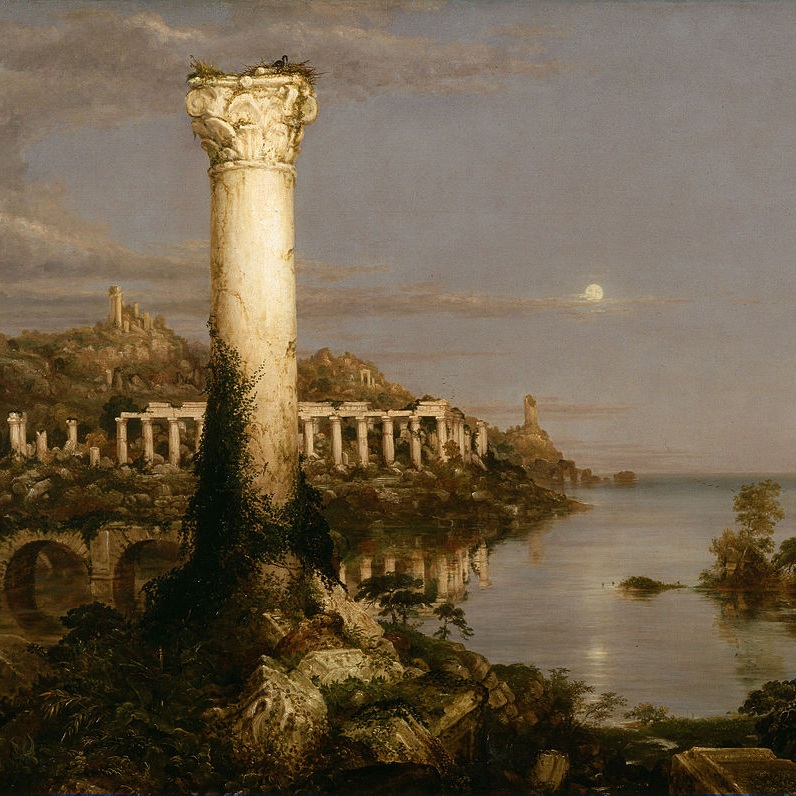
The scene opens. There's a tumbleweed blowing across, we're barren landscape. There's toxic filth dripping from the limbs of the trees. The sky is burnt, orange, black, and red.
You are there with what I can only imagine are implements of death. It is a wasteland. And you approach a ramshackle set of nailed together sheet metal, and you see above three men and emblazoned in painted blood red letters, says classical stuff. No, it's good.
Welcome to our tribe, ladies and gentlemen. But you're gonna have to prove yourself. It's really easy. You just listen.
There's three people in charge here. Arthur Jan Hanenburg, the lord. That's me. Graham Donaldson.
He's from Canada. Hi. And Thomas Fletcher, Maggie. Yeah.
Yeah. So welcome to classical stuff. You should know things are really nice here. We have ice cream.
It's better than the rest of the wasteland. You know that the wasteland is not like Mad Max. It might as well. It might as well better that way.
Could be improved if it had been. Well, yeah, if you can bring in like shoulder pads with spikes on them in some sort of shotgun situation, I'll be a lot happier. Welcome to Thunderdome Boys. All right.
So what we were talking about today is a poem by T.S. Eliot called The Wasteland. We're also talking about the art of literary illusions. Now, not illusions, Michael.
But literary allusions. Were you allude to something? So this is something that the internet is thrives off of, is illusions. It's basically memes and joke, internet jokes are just allusions to things.
In fact, me saying, not illusions, Michael was an allusion to rest of development where the magician, Job, doesn't talk about his illusions, not his tricks. A magician named Gob. Oh, that shows. The first three seasons, that show agreed.
Anyway, so yes, literary illusions and the power that they have and how Eliot creates a poem that's basically just a giant pile of broken allusions and is talking about sort of our modern world and our modern existence is like this broken pile of illusions. Thomas, do you remember a couple of podcasts ago? Your definition of art? Yes.
Do you remember roughly what it was, except for the moral part, the sentiment part or the? Oh, I can get to the exact quote. It's that it's conveying something that otherwise could not be if it were just an argument. Let me give it to you.
That's right. No, that's right. Yeah. So conveying something other than just an argument.
In the way, I have a thesis of The Wasteland. And my thesis is that T.S. Eliot is creating a poem and he is trying to convey a feeling about a sense of failure of the modern world or a sense of failure of human progress. And that basically, like we were promised flying cars and we didn't get them or we were promised a greater, a great future.
And he's writing this in the 1920s. And the great future we had was the absolute desolation of World War I. Well, he didn't have two-day prime delivery. He did.
Yeah. So I mean, if you feel pretty good with progress. But so he, my thesis for Wasteland is that he is trying to use this poem that is expressing a sentiment and a feeling that this world that we were hoping for with all of our, Art, Science, Technology, and Progress has not come to pass or it has come to pass. And we've been reaping something that we didn't expect.
We were going to be reaping. So I have a quote that I would like to start off this podcast with. And it is an excerpt from Prince Albert's introduction to the Great Exhibition of 1851. So their Great Exhibition.
So Prince Albert was the queen consort. He was married to Queen Victoria in England. And in the 1850s, 1851, they had this first called the Grand Expedition or the Great Expedition. And it was where all the pieces of science and technology of the day came together in a big old tent.
Actually, it was a big old crystal palace. And it was basically like South by Southwest. It was like to showcase all the cool stuff that was happening in the world and all the possibilities that we have, the light bulb and telegraphs and Twitter and all these things were being showcased. And to start this, Prince Albert says this, this sort of speech.
And this is the sentiment of the 19th century that I think Elliot says doesn't come to pass or the loss of the sentiment is what he is bemoaning in the wasteland. So this is what, this is sort of the great hope of 50 or 60 years before World War I. This is the great hope of what all of our science, technology, and progress is working us towards. Here we go.
So this is Prince Albert. Nobody, however, who has paid any attention to the peculiar features of our present era will doubt for a moment that we are living at a period of most wonderful transition, which tends rapidly to accomplish that great end to which indeed all history points the realization of the unity of mankind. Not a unity which breaks down the limits and levels the peculiar characteristics of the different nations on Earth, but rather a unity, the result and product of those very national varieties and antagonistic qualities. The distances which separated the different nations and parts of the globe are rapidly vanishing before the achievements of modern invention, and we can traverse them with incredible ease.
The languages of all nations are known, and their acquirement placed within the reach of everybody. Thought is communicated with the rapidity and even by the power of lightning. On the other hand, the great principle of division of labor, which may be called the moving power of civilization, is being extended to all branches of science, industry, and art. Whilst formerly the greatest mental energies strove at universal knowledge, and that knowledge was confined to the few, now they are directed on specialities, and in these, even to the minutest points.
But the knowledge acquired becomes at once the property of the community at large. For whilst formerly discovery was wrapped in secrecy, the publicity of the present day causes that no sooner is a discovery or invention made than it is already improved upon and surpassed by competing efforts. The products of all quarters of the globe are placed at our disposal, and we have only to choose which is the best and cheapest for our purposes, and the powers of production are instructed to the stimulus of competition and capital. So man is approaching a more complete fulfillment of that great and sacred mission, which he has to perform in this world.
His reason being created after the image of God, he has to use it to discover the laws by which the Almighty governs his creation, and by making these laws a standard of action, to conquer nature to his use, himself a divine instrument. Alright, so, and then it goes on a little bit to introduce what, you know, this great exhibition. So you can hear the philosophy of Prince Albert in there, and it's, I mean it's Prince Albert, it feels like he would be, that speech could be, you know, adapted and put into any startup nowadays. Like, this startup, we're going to change the world through the powers of integrated, you know, stack servers or whatever.
So anyway, so you have that sentiment, that this global this rapidly globalizing world that even our antagonistic antagonistic principles are going to come together and we're going to like hammer out a better tomorrow. And this is I would say the sentiment of the 19th century, this is in the 19th century, they were looking back and saying we've come to this place now, because we've harnessed harnessed reason, born out of the ignorance of the Dark Ages, like we have sort of we've had this Renaissance, and this Renaissance has moved for the ball of science, and here we are reaping the benefits of science and technology, moving towards a more perfect humanity. This is Prince Albert's vision for the future, and this is very much still like, it's less so in Europe now, but we sort of in the United States and Canada, the North America has kind of inherited that sort of, you know, technocracy of tomorrow, this sort of idea that through science and technology, we will perfect mankind. He even says that this is like God's mission for man, it was like he endowed us with reason and it's our job to go off and like make the world a garden through science and technology and reason.
So this was, I'm positing, this was sort of a popular sentiment in Europe at this time, and I don't think it's too far-fetched to say that this was like a strong belief. Eventually, as these nations began to, you know, expand themselves, yeah, you got to you got to this place where there was inevitable conflict, and World War I, before the war started, there was this belief that it was going to be, you know, the phrase that they said what the world was going to be, it was going to be the war to end all wars, that was the phrase about World War I, the war to end all wars, and so if we just like all the powers got together and we just had one big throwdown, like in the last podcast, we'll figure out who gets to marry Emily, right? We'll figure out who gets to inherit this glorious future. So it's gonna be the war to end all wars, we'll have a big gentleman's duel, and then when it's done, the countries that were beaten will be like, you know, well, well played, old shop, and we'll just go into the background of history, we will acquiesce to, you know, the victors, and this was the sentiment of leading up to the war, and it was going to be over by Christmas and everybody wanted their peace on this great war, so you know, get involved.
Obviously, the war of World War I was not this, it was a cataclysmic event, and it started off the 20th century on its bloody path, not only its bloody path of technology, armed technology sort of used to, you know, more easily destroy mankind, but then coupled with competing views, then you had, you know, you had the barbarism of World War I, and then the fascism and communism of World War II, and the miracle of us not killing each other after that. So Prince Albert's vision didn't happen, this sort of modern liberalism that Prince Albert was hoping for doesn't come to place, and Elliot is writing a poem, he himself, when he was writing this, had a mental episode, and the poem that he wrote was much, much longer than the one I'm going to read, but he wrote this poem, and my thesis is, is that it is trying to create an artifact, crystallizing this sentiment of a ruined broken system, a ruined broken tower, in fact, that's one of the images, is that the tower has fallen and mankind has been, mankind has been sort of dispersed, sort of the tower of Babylon. So we were promised a unified vision of mankind coming together with the power of science and technology, it resulted in this vast bloody conflict, and now we are living in the ruins of this hope, and what do we have? So that's the thesis, and he uses, and he uses literary illusions to paint this picture.
So I've kind of, I didn't really know how to go about doing this, I'm actually going to read the entirety of the wasteland, it's going to take about nine minutes. So I hope that's cool with you guys, we've read long passages before, it's a very beautiful poem, and I think by hearing it, you'll hear, it's basically like different voices. I heard when I was taught the wasteland, my teacher said it was kind of like your flipping channel, so you get these little, these little sort of jumps and change of narration. So I will do my best to try to highlight it in the way that I read, but I'm going to read to you the wasteland and then talk a little bit about how what seems to be a heap of broken images, which is what he actually calls it, actually has this unity to it that is, that I think has a message about about the modern world.
Will there be an admission? Maybe. Nine minutes is, that's a lot to ask, Graham. Is it?
No, I'm just okay. Maybe I'll skip some stuff. No, I'm not going to translate any of the German or any of the French, I can translate a little bit later. Actually, no, I'll think I'll translate it through all the way through just to be helpful to go back.
If you have a copy of the wasteland, I don't know if you do, you can follow along. It's also online. Yeah, but it starts off with, what's those little things you put at the top of a poem is a pre script, post dedication, a dedication. It's not dedicated.
Oh, it's four. It's four as a pound. Anyway, so he has this little thing in Latin and Greek, and I will translate it to this. And it says, for once I myself saw with my own eyes the sibble at CUMI hanging in a cage, and when the boy said to her, sibble, what do you want?
She replied, I want to die. Does anybody know the story of the sibble in the cage? No, what is it? She was cursed.
I think by Juno, by Hera, I can't remember exactly why, but her curse was that she would never die, but she was going to keep getting older. So eventually she shrank and she shrank and she shriveled and she shriveled and she could still tell the future. She kept aging and getting smaller and crinkler and tell basically they kept her in a jar like a little cage. And put her on like a mantelpiece.
I think it was she was giving a wish and she said, she said, I want to live forever. And she was like, all right, but you're going to keep aging. She's like, ah, dang it. I've got to be more specific.
And so that let there be a lesson to my ninth graders to be specific. Yeah, so she got so she kept getting older and older and got more whizened and whizened that she became this tiny little creature and they put her in a jar and kept her on someone's mantel and she can tell the future. Okay. Book one, the burial of the dead.
Oh, and AJ, you'll like this if you think about how Chaucer begins, which is essentially the first thing written in English language that we can, I mean, that's not necessarily true, but Chaucer is considered like the first readable English poem that we have. And it starts with, well, how does it start? Remember? One that Apple?
Yeah. One that Apple in beautiful April, everyone wakes up from gross winter and wants to go on a beautiful pilgrimage. It's great. Because it's great.
I don't think it was the first English poem ever written. It was just the first great work in vernacular English that wasn't in French or Latin. Yes. Okay.
April is the cruelest month, breeding lilacs out of the dead land, mixing memory and desire, stirring dull roots with spring rain. Winter kept us warm, covering earth and forgetful snow, feeding a little life with dried tubers. Some were surprised us, coming over the star and burner sea with a shower of rain. We stopped in the colonnade and went on in sunlight into the hoffgarten and drank coffee and talked for an hour.
Bin Garkine Hrushin stammen ouch le tauen ech deutsch. And when we were children staying at the Archdukes, my cousin, he took me out on a sled and I was frightened. He said, Marie Marie, hold on tight. And down we went in the mountains.
There you feel free. I read much of the night and go south in the winter. What are the roots that clutch? What branches grow out of this stony rubbish?
Son of man, you cannot say or guess for you know only a heap of broken images where the sun beats and the dead tree gives no shelter, the cricket no relief, and the dry stone no sound of water. Only there's shadow under this red rock come in under the shadow of this red rock. And I will show you something different from either your shadow at morning, striding behind you, or your shadow at evening, rising to meet you. I will show you fear in a handful of dust.
Frish vetovin de chaimen zau, mine echiscind, voe valdus de dau, or du. I don't know. And that's German translates to, fresh blows the wind to the homeland. My Irish child, where are you waiting?
You gave me hyacinths first a year ago. They called me the hyacinth girl. Yet, when we came back, late from the hyacinth garden, your arms full and your hair wet, I could not speak, and my eyes failed. I was neither living nor dead, and I knew nothing.
Looking into the heart of light, the silence. Ode un lio das mio, which is German for waste and empty, is the sea. Madam Sustasris, fair clairvoyant, had a bad cold. Nevertheless, is known to be the wisest woman in Europe, with a wicked pack of cards.
Here, said she, is your card, the drowned finish and sailor. Look, our pearls, and to his eyes. Look, here is Belladonna, the lady of the rock, the lady of situations. Here is the man with three staves, and here the wheel, and here is the one eyed merchant, and this card, which is blank, is something he carries on his back, which I am forbidden to see.
I do not find the hanged man. Fear death by water. I see crowds of people walking round in a ring. Thank you.
If you see dear Miss Equatine, tell her I bring the horoscope myself. One must be so careful these days. Unreal City. Under the brown fog of a winter dawn, a crowd flowed over London Bridge.
So many. I had not thought death had undone so many. Size, short, and infrequent, where exhaled in each man fixed his eyes before his feet. Flowed up the hill and down King William Street, to where Saint Mary Walnoth kept the hours, with a dead sound in the final stroke of nine.
There I saw one I knew and stopped him crying, Stetson, you who were with me in the ships at my lie. That corpse you planted last year in your garden, has it begun to sprout? Will it balloon this year, or has a sudden frost disturbed its bed? Oh, keep the dog far hence, that's fringe to man, or with his nails, he'll dig it up again.
You hypocrite lecture, monsamblabla, mofre, which translates French to you, hypocrite reader, my twin, my brother. Maybe a task I should have you listener and you guys do is see if you can keep track of any of the literary illusions. Like what is he alluding to? Hanabary, did you pick up that one walking in this Unreal City, talking to shades of people?
That would have been Dante. He also said I did not think I'd have undone so many. That's another quote from Dante. Yeah, exactly cool.
Book two, a game of chess. The chair, she sat in, like a burnished throne, glowed on the marble. Where the glass held up by standards wrought with fruited vines, from which a golden cubedon peeped out. Another hid his eyes behind his wing, doubled the flames of seven branched candelabra, reflecting light upon the table as the glitter of her jewels rose to me from satin cases poured in rich profusion.
In vials of ivory and colored glass, unstoppered, looked her strange, synthetic perfumes, unjunct, powdered or liquid, troubled, confused, and drowned the senses and odors, stirred by the air that freshened from the window. These ascended in fattening the prolonged candel flames, flung in their smoke into the Laqueria, stirring the pattern on the coffered ceiling. Huge sea wood fed with copper burned green and orange, framed by the colored stone, in which sat light a carved dolphin swam. Above the anti-commantle was displayed, as though a window gave upon the Sylvan scene the change of fillemel by the barbarous king so rudely forced.
Yet there, the Nightingale filled all the desert with inviolable voice, and still she cried and still the world pursues chugged to dirty ears, supposed to mimic how Nightingale sounds. And other withered stumps of time were told upon the walls, staring forms leaned out, leaning, hushing the room enclosed. Footsteps shuffled on the stair, under the firelight, under the brush, her hair spread out in fiery points, glowed into words, then would be savagely still. My nerves are bad tonight, yes, bad to stay with me, speak to me, why do you never speak, speak?
What are you thinking of? What thinking? What, I never know what you are thinking, think. I think we are in rat's alleys where the dead men lost their bones.
What's that noise? The wind under the door. What's that noise now? What is the wind doing?
Nothing. Again, nothing. Do you know nothing? Do you see nothing?
Do you remember nothing? I remember those are pearls that were his eyes. Are you alive or not? Is there anything in your head?
But oh, oh, oh, oh, that Shakespearean rag, it's so elegant, so intelligent. What shall I do now? What shall I do? I shall rush out as I am and walk the street with my hair down.
So what shall we do tomorrow? What shall we ever do? The hot water at ten, and if it rains, a closed car at four, and we shall play a game of chess, pressing lidless eyes and waiting for a knock upon the door. When Lil's husband got demobbed, I said, I didn't miss my words.
I said to her myself, hurry up, please, it's time. Now, I'll be coming back, make yourself a bit smart. He'll want to know what you've done with that money he gave you to get yourself some teeth. He did.
I was there. You have them all out, Lil, and get a nice set, he said. I swear, I can't bear to look at you. I know more can't die, I said, and think of poor Albert.
He's been in the army four years. He wants a good time. And if you don't give it him, there's others will, I said. Oh, is there, she said.
Something of that, I said. Then I'll know who to thank, she said, and gave me a straight look. Hurry up, please, it's time. If you don't like it, you can get on with it, I said.
Others can pick and choose if you can't. But if Albert makes off, it won't be for lack of telling. You want to be ashamed, I said, to look so antique, and her, I can't help it, she said, pulling along face. It's them pills I took to bring it off, she said.
You have five already and nearly died of young George. The chemist said it would be all right, but I've never been the same. You are a proper fool, I said. Well, if Albert won't leave you alone, there it is, I said.
Would you get married for if you don't want children? Hurry up, please, it's time. Well, that Sunday Albert was home. They had a hot gammon.
They asked me into dinner to get the beauty of it hot. Hurry up, please, it's time. Hurry up, please, it's time. Good night, Bill, good night, Lou, good night, tah, good night, good night, good night, ladies, good night, sweet ladies, good night, good night.
Maybe we'll pause after each part. All right, allusions in there. When did you pick up on? You want good night, ladies?
We taught this book this year. That's Hamlet, good night, sweet ladies. That's Ophelia, when she goes mad. That's her last lines.
Any others? I don't know what you call the part about the Shakespearean rag. Yeah, I mean, that's sort of supposed to be like the music in the background popping in, that sort of ragtime music. The change of Philmel by the barber's king.
Yes, do you remember the story of Philmel and King? Philmel was a beautiful young maiden, and the king was the king of ancient Rome, or he was the king of Rome before, maybe it was the king of Rome, but he was the king, and he wanted to marry Philmel if he did not want to marry him. So the king raped her, and he was like, oh crap, she's going to tell everybody. So he cuts out her tongue so that she can't tell anybody.
She comes home absolutely distraught. Her sister and parents are like, what happened? She can't tell anything. So what Philmel does is she weaves, she's an accomplished like weaver.
She weaves a tapestry showing what happened, that the king raped her and cut out her tongue. The people see this tapestry and they're so full of righteous anger that I think they go and they kill the king and they say no more kings ever again. I think I'm here on the story right. But in the end, Philmel who has no tongue and lives a life of sadness, the gods take such pity on her that they turn her into a nightingale.
And the nightingale is different than the birds, in that all the birds sing in the morning, but the nightingale is the only bird that sings when the sun is setting, and so this nightingale gets a wrapped audience. It gets to speak and sing and no one else is singing. So Philmel who could not talk as now a nightingale gets to sing and everyone listens to her, but as the sun is setting, so it's kind of this mournful melancholy kind of thing. All right, I was booked too.
Furthermore, we're missing any other way. Oh, yeah, I mean, oh, oh, oh, where it starts off, oh, oh, oh, that Shakespeare in rag. Whenever any character dies in Shakespeare, Hamlet dies as last words are, oh, oh, oh, oh, oh, and same with King Lear on King Lear dies as last words are, oh. So the question is, all right, if you're an actor, how do you play that?
Do you go, oh, oh, oh, as you're dying, or is it supposed to be sounds of like guttural death, or is it the character trying to start off one more speech before death, you know, like, oh, being the opening of, like, you know, oh, for a muse of fire, right, like is the character still trying to talk, but death takes them away. So there's that, that scene in the bar with Lil in Elbert and these two girls talking, one girl is saying like, hey, you look pretty nasty, your husband's coming home from war, shouldn't she like, pretty yourself up for him? He gave you money to buy new teeth. And she says, I can't, those pills that I took really did a number on me, the pills that I took to bring it off, she said, and then the narrative says, you had five already and nearly died of young George, Sue, I'm probably alluding to the fact that this person has had five abortions, so it has taken pills in order to abort a child, abort her child, and it's, they've done a number on her, like, it's been pretty nasty stuff.
And she says, what do you get married for? If you don't want kids, and these pills that she's taken to, to get rid of her unborn children, have aged her, and now her friends saying like, Albert's coming home and you look ugly because either she's been cheating on Elbert, always at war, or her and Elbert don't want kids or whatever. Anyway, so it's kind of this, this, you get this, you know, this scene of these rich lovers, we're talking about who aren't talking to each other and one of them is talking in the other one's thinking and they play a game of chess and they talk about how they're going to go on a car and drink tea and but there's a sort of loveless relationship. And then you have this lower class couple that also doesn't have currency between the male and the female, they want different things and they are betraying each other and Albert seems to be in it only for the looks and anyway, so it's just kind of this, that whole scene of the game of chess is all about relationships that don't work, the relationship between the sexes that is broken, and then the illusions to handle it in Ophelia.
All right, part three, the fire sermon. The enemy know what the fire sermon is? No, it's the sermon that Buddha, it's one of the Buddhist famous sermons and it's basically like, you need to let all of your earthly passions die in the fire. So the way of the way to enlightenment is to remove all strong desires, that's sort of the fire sermon.
And then the question is, all right, is that true? Do you want to remove desires or not? All right, the fire sermon. The river's tent is broken.
The last fingers of leaf, clutch and sink into the wet bank. The wind crosses the brown land unheard. The nymphs are departed. Sweet tames run softly till I end my song.
The river bears no empty bottles, sandwich papers, silk handkerchiefs, cardboard boxes, cigarette heads, or other testimony of summer nights. The nymphs are departed and their friends, loitering heirs of city directors departed, have left no addresses. By the waters of Lehman and I sat down and wept. Sweet tames run softly till I end my song.
Sweet tames run softly, sorry, for I speak not loud or long. But at my back in a cold blast I hear the rattle of bones and chuckle spread from ear to ear, a rat crept softly through the vegetation dragging its slimy, slimy belly on the bank. While I was fishing in the dull canal on a winter evening round behind the gas house, musing upon the king, my brother's wreck, and on the king of my father's death before him. White bodies naked on the low damp ground and bones cast in a little low dry garret, rattled by the rat's foot, only, year to year.
But at my back from time to time I hear the sound of horns and motors which shall bring sweetie to Mr. Mrs. Porter in the spring. Oh, the moon shone bright on Mrs.
Porter and on her daughter. They wash their feet in soda water. They all save Waddanfonscha, Tondalacopole, which is French for it. Oh, these children's voices singing in the dome or the apps or the front of the church.
And then so twit, twit, twit, chug, chug, chug, so really forced to ruin, supposed to be the sound of a nightingale. Unreal city. Under the brown fog of a winter noon, Mr. Eugenides, the Smyrna merchant, unshaven, with a pocket full of currents, CIF, London, documents at sight, Astomy, and Demotic French, to luncheon, at the Cannon Street Hotel, followed by a weekend at the Metropole.
At the Violet Hour, when the eyes and back turn upward from the desk, when the human engine waits like a taxi throbbing, waiting. I, Tiresias, though blind, throbbing between two lives, old man with wrinkled female breasts, can see at the violent hour the evening hour that strives homeward, and brings a sailor home from sea. The typist home at tea-time clears her breakfast, lights her stove, and lays out food and tins. Out of the window, perilously spread her drying combinations touched by the sun's last rays.
On the dive in our pile, at night her bed, stalking slippers, camisoles, and stays. I, Tiresias, old man with wrinkled dogs, perceived the scene and foretold the rest. I, too, awaited the expected guest. He, the young man, carbunkular, arrives.
A small house agent's clerk, where one bold stare, one of the low on whom assurance sits as a silk hat on Bradford milliner. The time is now propitious, and he guesses the meal is ended. She is bored and tired, endeavours to engage her in caresses, which still are unapproved, if undesired. Flushed and decided he assaults at once, exploring hands and counter no defence.
His vanity requires no response and makes a welcome of indifference. And I, Tiresias, have four suffered all, enacted on this same dive in our bed. I, who have sat by thieves below the wall, and walked among the lowest of the dead. The stove's one final patronizing kiss, and gropes his way, finding the stairs on lit.
She turns and looks a moment in the glass, hardly aware of her departed lover. Her brain allows one half-performed thought to pass. Well, now that's done, I'm glad it's over. When lovely woman stoops to folly and paces about her room again alone, she smooths her hair with automatic hand, and puts a record on the gramophone.
This music crept by me upon the waters, and along the strand, up Queen Victoria Street, oh, city, city, I can sometimes hear, besides a public bar and lower tame street, the pleasant whining of a mandolin, and a clatter and a chatter from within, where fishermen lounge at noon, where the walls of Magnus Martyr hold, inexplicable splendor of Ionian white, and gold. The river sweats, oil and tar, the barges drift with a turning tide, red sails wide, to leeward swing on the heavy spar, the barges wash drifting logs, down the Greenwich Reach past the Isle of Dogs. Wei, la, la, la, la, la, la, la, la, la, Elizabeth and Lester, beating Ours, the stern was formed, a gilded shell, red and gold, the brisk swell rippled both shores, southwest wind carried down stream, the peal of bells, white towers, wei, la, la, la, la, la, la, la, la, trams and dusty trees, high, very bore me, Richmond and Q undid me, By rich men I raised my knees, supine on the floor of a narrow canoe, My feet are at morgate, and my heart under my feet. After the event he wept, he promised a new start.
I made no comment. What should I resent? On market sands I can connect nothing with nothing. The broken fingernails of dirty hands, My people humble, people who expect nothing.
To Carthage then I came, burning, burning, burning, burning, oh lord, Thou pluckest me out, oh lord, Thou pluckest, burning. Part 4. Death by water. Fleebest the finishing, a fortnight dead, Forgot the cry of gulls and the deep sea swell and the profit and loss.
A current under sea picked his bones and whispers, And he rose and fell, he passed the stages of his age and youth entering the world pool. Gentile or Jew, oh you who turned the wheel and looked to windward, Consider Fleebest who is once handsome and tall as you. Part 5. What the thunder said.
After the torchlight, red on sweaty faces, After the frosty silence in the gardens, After the agony in stony places, the shouting in the crying, Prison in palace and reverberations, A thunder of spring over distant mountains, He who was living is now dead, We who were living are now dying with little patience. Here is no water but only rock. Rock and no water in the sandy road. The road winding above among the mountains, Which are mountains of rock without water.
If there were water we should stop and drink. Amongst the rock we cannot stop or think, Sweat is dry and feet are in the sand. If there are only water amongst the rock, Dead mountain mouth of curious teeth that cannot spit. Here one can either stand nor lie nor sit.
There is not even silence in the mountains, But dry, sterile, thunder without rain. There is not even solitude in the mountains, But red, sullen faces sneer and snarl, From doors of mudcracked houses. If there were water and no rock, If there were rock and also water and water, A spring, a pool among the rock. If there were the sound of water only, Not the cicada and dry grass singing, But sound of water over a rock, Where the hermit thrush sings in the pine tree, Drip, drop, drop, drop, drop, drop, drop.
But there is no water. Who is the third who walks always beside you? When I count there are only you and I together. But when I look ahead, up the white road, There is always another one walking beside you.
Gliding wrapped in a brown mantle hooded. I do not know whether a man or a woman. But who is that on the other side of you? What does that sound high in the air, Murmural, murmur of maternal lamentation?
Who are those hooded hoards swarming over endless plains, Stumbling and cracked earth, Ringed by the flat horizon only. What is the city over the mountains, Cracked in reforms and bursts in the violet air? Falling towers, Jerusalem Athens, Alexandria, Vienna, London, unreal. A woman drew her long black hair out, Tight and fiddled whisper music on those strings, And bats with baby faces in the violet light, Whistle and beat their wings and crawled, Head downward, down a blackened wall.
An upside down in air were towers, Toiling reminiscent bells that kept the hours, And voices singing out of empty cisterns and exhausted wells. In this decayed hole among the mountains, In the fate moonlight, The grass is singing over the tumbled graves. About the chapel, there is the empty chapel. Only the wind's home.
It has no windows and the door swings, Dry bones can harm no one. Only a cock stood on the roof tree, Go, go, go, go, go, go, go. In flash of lightning, Then a damp gust, bringing rain. Banjo was sunken and the limp leaves waited for rain, While the black clouds gathered far distant over himavant.
The jungle crouched humped in silence, Then spoke the thunder. Dada, what have we given? My friend, blood, shaking my heart, The awful daring of a moment's surrender, Which an age of prudence can never retract by this and this only. We have existed, Which is not to be found in our obituaries, Or in memories draped by the beneficent spider, Or under seals broken by the lean solicitor in our empty rooms.
Da, diadvam. I have heard the key turn in the door once, And turn once only. We think of the key, Each in his prison, Thinking of the key, Each confirms a prison only at nightfall. Aetherial rumors revive for a moment Broken, Coriolanus.
Da, Damiata. The boat responded gaily to the hand-expert with sail and ore. The sea was calm, Your heart would have responded gaily When invited, Beating obedient to controlling hands. I sat upon the shore, Fishing, With the air d'ed plain behind me.
Shall I at least set my lands in order? London Bridge is falling down, falling down, falling down. Poise, Cholas, Na, Focke, Kegli, Afina, Quandofiam, Utich Aladon, Oh, Swallow, Swallow, La Prince, Da, Quatina, Latour, Abolie. These fragments, I have short against my ruins.
Why then I'll fit you, Haranamos, Madigan, Da, Diadvam, Damiata, Shanti, Shanti, Shanti. And that's the poem. That's the poem. Okay, so maybe a little longer than nine minutes.
But, So, We talked in the middle there. We talked in the middle there. Okay, so, Keys that I think are important. Now, at Hennenberg, I know you notoriously hate this poem.
Indeed, Yes. Why? Because it is, I can explain later. I want to let you finish this.
I want to go into why I dislike this poem. The Keys that I think, So, When I was taught poetry, I was taught that you always need to look for central metaphors. Try to find the metaphors through which the poem is alluding to or evoking. And then when you have those central metaphors, they will be organizing principles for understanding what this poem is doing.
There's plenty in the wasteland. But I think the important ones are as follows. One is the myth and the story of the Fisher King. Now, the Fisher King is a story that comes from Arthurian romance.
And the Fisher King is this. He was a king, or sometimes he is the son of a king. And he was the first one. So, he was a king and he was wounded.
He got stabbed in the guts or stabbed in the growing, which is, you know, bummer. And because he is wounded, he is not fertile. He cannot bear children. And the health of his kingdom has been affected.
So, like, So goes to the king. So goes to the kingdom. So, the king is wounded and cannot bear children. The kingdom is infertile and can't grow any crops.
So, the Knights of King Arthur's court, they come to this land. It's completely desolated and wasted. And there's this king. And he's like, the rains aren't coming.
And there's this famine. And I'm slowly dying. Please bring me the holy grail to cure me and my kingdom. And in the meantime, to try to feed his people, the king is fishing.
And he's going and he's like, just praying that he catches enough fish to feed his people because the lands are not producing grain. So, you have this idea of a king that has been sort of his powers of generation and his powers of fertility have been cut out from under him. And his people are dying because of it. Right.
So, and then what he's needing is a miracle. He needs Christ's holy grail to cure him. He needs this, this outside force of God to come and bring health back to his wasted kingdom. So, there's one metaphor that helps you understand this poem.
The second one is- Can I ask you the question? Yes. Does he explicitly reference the fisher king? Yeah.
So, it was a guy that was at the end where he says, shall I put my lands in order? I sat upon the shore fishing with the arid plane behind me, shall I at least set my lands in order? And then the other one where he was, he was sitting by the banks of the Thames and he was saying sweet tames roll softly as I sing my song and he's looking at all the garbage from like a summer's picnic. And now it's dead and he's sitting there fishing.
And then also Elliot has made reference. There's apparently, and these are sort of beyond my capacities, but there are a lot of like direct quotations from the Fisher King's story in Mallory in here. So, there's a Fisher King. So, there's this idea that a king who has no health and he's waiting for God to cure him.
He needs the knights to go off and get this. A second organizing principle, our second good metaphor in this is the Tower of Babylon. So, the story of the Tower of Babylon, man and his arrogance try to unify everything that they could, build a tower, come together as one unified people and take over heaven. Let us build a tower and the Tower of Babylon.
Oh, sorry, the Tower of Babylon. So, the Tower of Babylon, let us build this tower and we can take over heaven and what does God do? He smashes their tower and he messes up their language. All right, in this poem you have lots of different languages and you have all these different people talking to each other.
No one really understands what's going on. Some people aren't talking, some people are, it's a poem of confusion. Why aren't you talking? Why aren't you speaking?
And at the end we have, oh yeah, those translations at the end were Pwasakos Na Foko Kegliafina is, I'm told, Italian for, then he hid himself in the fire that refines. Stante, he hides himself in the refining fire, the circle of the lustful. Quando fiam uti celladon is Latin for, when shall I be as the swallow? So like, what am I going to be turned to a bird?
And then the Prince of Aquitaine at the ruined tower is the last French thing, so the Prince of Aquitaine and then this reference to a tower that has been ruined. So, you have the Tower of Babylon in here. So, God confusing our languages because of our desire to take over heaven. And now you have all these characters who are living in, now we're sort of in these ruins and the poem ends with these fragments I have short against my ruins.
So, that's the sort of the second metaphor. The third one is by the waters of Laban I sat down wept. That's from Assam where the Jews were taken into captivity by the Babylonians and the Babylonians destroyed the temple. And when the waters of Laban were the marcations of the Jewish kingdom, and so when they crossed out of over Laban, over the waters of Laban, they were now in captivity.
And the Babylonians make fun of them. They're like, hey, why don't you sing one of your temple songs? And they sat by the waters of Laban and wept because they're temple, they're structure. The thing that organized their life had been ruined and destroyed and they were now in captivity with hostile people.
So, those are sort of the metaphors that I look to to help understand what is happening in this story. You have people looking back or people in positions right now where they are in ruins, looking at the ruins of the used to be these unifying principles. The Tower of Babylon, we will make this thing, we will take over heaven. The temple, we have this place that gives our life order and unity and purpose.
And the king, we had a prosperous nation. I was a king, I was healthy and my people could grow crops. And now all those things are gone. The tower is broken, the temple has been destroyed and we are in captivity and I am dying.
And what all of those people are praying for, or hoping for is some kind of savior, some kind of salvation, some kind of somebody coming in. You have other elements in this poem of the road to Emmaus where the two people are walking and they're like, Jesus is dead. I mean, we thought he was the guy. We thought he was going to bring us the kingdom.
And now he's dead. And then they turn around and they realize that somebody's walking with them and it's Christ coming back. So, this is what, so the other element for the Bible in there is the water from the rock. We are in the desert and we have no health.
We have no water. We need water from the rock. And God comes in miraculously and brings them life in the desert. So, why I think those are important organizing metaphors is because that's what this poem is about.
It is, we now live in a time of ruins where we have these books. We have these stories. We have these poems. We have these things of an older age, of a time that's gone before and people who believed in that unity.
And we no longer believe in that unity. World War I has destroyed that sense of progress in moving forward. And so for Eliot, all we can do now is he says, these fragments I've shored against my ruins. If you shore something that's like waters are rising.
And this whole book is fear drowning. The waters are coming and they're going to drown us all. So, Eliot kind of has this sense of the unity we once had is gone. And all we have is to take these little fragments of stories that we used to believe and like shove them up together, like this poem does, and shove them up against the rising waters.
It's super depressing. But to him, that is the age we live in right now. This modern world is this wasted land where we don't live in a unified system of where we all sort of live, we all do sacrifices in the temple. Or we all, we now live in this time of captivity, this time where everything has sort of been fragmented and broken.
And that filters down from the top all the way to our relationships. All you have in here are relationships between men, women that don't work. That terrible scene that Tyreseus views is this kind of like hook up. She is coming home from work and she lives by herself in this little small flat.
She doesn't even have a bed. She's got a couch. This guy who's like a clerk comes over and they have dinner and he tries to like seduce her and she doesn't care. And so he just like has sex with her.
And then he's like, cool, I'm out. And he leaves and then she's like, ooh, glad that's done and puts on a record, right? Like Elliot's saying this is sort of what we have now. This is we don't have Elizabeth and Lester.
We don't have these great love stories of Forbidden Lover. You know, we don't have these these old tales of Tyreseus, not Tyreseus of the Irish guy and the Viking, well, at the beginning, Tristan and us all day. We don't have those stories. We now have sort of, you know, these empty, meaningless sexual interactions.
So there's a unity to it. The fact that it's a big broken pile of images is the point. He's saying we live in a big broken pile of images. Elliot's conclusion is one, I don't believe it.
His conclusion is take the images you like and build a wall against the rising waters. That's sort of his last point. Build a wall against the rising tide. I'm very different.
I say, you know, rebuild the temple or wait for, you know, the road to Manus that Christ is the answer to the shattered hopes of mankind. But so, Hanneberg, the reason I wanted to do this podcast is because I've wanted to convince you that there is structure and there is overarching meaning. And it is saying something more than just what I think you think it is, which is just sort of like arrogant gibberish. Oh, no, I see the structure.
It's still arrogant gibberish, at least in my opinion. Parts of them are. I think it could still be edited. But are we attributing arrogance to it because it is detailed?
Like what? No. Like the motive seems like it seems strange to call it arrogant. It is excessive.
I don't know what the word or difficult. I think you've edited it still. Obtuse. It is intentionally obtuse.
It is intentionally obtuse. Yes. There's a high bar of requiring knowing literary illusions and I myself don't even know all of them. But is that a problem in and of itself?
Yes. Really? So, I mean, I can't give my whole case against this poem here. I agree with everything he's saying.
I mean, I don't know that he's wrong. What I have a problem with is the, first of all, it's on first read, it's not enjoyable at all. I don't think that anybody without extensive study or at least a guide could like flatly enjoy that poem or get much out of it. But the same.
So it's so too with Virgil. So too. That's not true. I can read Virgil and get a basic, decent story out of it.
I can read. Don't say I get a basic, decent story out of it. But this is an impression. This is so think of this as like an impressions of feelings as opposed to a narrative.
And when you read it out loud, and I used to when we used to teach this, although Annenberg lobbied for us to teach something different, which is fine with all their conversation. But when I used to read this out loud to my students, at the end of it, the reaction was always, I kind of feel sad and I don't know why. And I feel like that impression is the point. The feeling sad for something lost is what I think Wasteland makes you feel.
But that's not what they said. They said, I feel sad and I don't know why. And that is not what the issue is. I can use that is a starting point I can use.
But that's my point. It's so good that even if you don't understand the illusions, there's still the sadness. That's what you're saying, Graham. I don't think people will be like, oh, that was great.
I don't think anybody thinks that. No, my point is that it's a starting point, right? You said I can do something with that starting point. My point is that you come out the other side of that poem and all you have is a general sadness that can maybe be used as a starting point.
Again, I can't give my entire outline of why. We've got nine minutes. We've got nine minutes to explain why I just like this kind of poetry. Yeah, maybe this is a two-parter and we bleed into the next one.
I don't know. This has been a long time coming as Annenberg and my poetry throw down. Oh, and you expect me to do it in a minute. Just give me some.
All right, well, first, I'm not prepared for this this morning, so it's not going to be as coherent as it could be. So I want you to do it. My issue, yeah, yeah, sure. I mean, eight minutes in an episode.
So my issue with this kind of poetry is that it is needlessly obtuse and doesn't express its ideas as well as it could. And perhaps he's doing the best job that could be done with it, right? Perhaps he's the first to do it, right? And that everyone that came after him is aping his style and doing a poor job of it.
That could also be true. I agree with you on that. A lot of people are aping a style. One of the unfortunate legacies of Wasteland is people trying to be obtuse and claiming it to be intelligent.
Yeah, so that is one of my biggest pieces of poetry is because that kind of poetry that he is doing is a really easy thing to do to try to seem intelligent and be like, oh, you just don't get it. When really, there's nothing there, you're dressing up a bad idea, right? My notion about specifically this kind of poetry is that it is needlessly obtuse. He could say these same things in an easier to digest way.
And then I tend to like these ideas in prose because it couches them with other ideas that make it more robust, right? It is conceivable that he write this poem in a way that is easier for the layman to understand rather than shove different impressions at me and bore me out of my mind and make me go look through a thousand books to get all of his literary illusions, right? It is possible that he could do that, right? I think my biggest problem with it is the needless obtuseness to seem poetic when really, if you have a good idea, you don't have to dress it up.
But so my experience of it is... I like listening to what you said about the poem more than the poem itself. So here's the point. So you have this poem and it's this pile of obtuseness.
I think you're right. But I think it leaves you with the feeling of walking through a big broken house. Like if a big wrecking ball came through a house and you're walking around and you see little snippets of something and sometimes you see things and you're like, I don't even know what that is. And yeah, it takes some time to like look at it and pick it apart and maybe you have to go do some research and say, oh, that's good, nice wee ladies, this is Ophelia.
Okay, why is he talking about Ophelia in this scene? Well, Ophelia was this person who wasn't loved, but then because of all of the political intrigue and all this craziness, like she went mad because her boyfriend killed her father. Is there something about misplaced expectations in this poem? And then you've got, it's almost like a mystery.
You've got this little thread to go on. But if he had sort of spelled it out for you, I feel like it's not the same thing as walking through basically like a war zone. The style backs up the message. The style backs up the point.
My point is that you could, I still think you could do the same thing without being so needlessly obtuse. You could still have a fragmented bunch of different things altogether. You could still have all those literary illusions, but you could do it in a way that was at least more pleasurable to read. No, his little Y L I L I L I things and the elements of music, I agree are a little, it feels like this would have been a better mixed media thing.
Like if you wanted to, if you wanted to. And the pieces of translated verse, right? My issue is that whenever I read a book and they have a bunch of extra languages in there and purposely don't translate them, that is typically the author like smart signaling, saying, I'm a genius, I know different languages and you don't. And that drives me crazy.
Yeah, but I mean, that's not hard to translate. Right. Sure. It's not hard to read it in the margins.
Yeah, sure. But still, like I'm, yeah, that's my general issue is that I think there is poetry out there that is good and it's like, takes Shakespeare, for example. He has incredibly complex ideas in these lengthy, complex speeches all in difficult form, but each one of those is worth studying and a pleasure to read. You and I both have just finished reading King Lear and is not a lot of King Lear's madness, rantings, or even Ophelia, her madness, rantings.
It is pregnant with reason. Like there seems to be, like, there seems to be an idea there, but it's not easy to understand. And you can just write off and say, oh, well, Lear's crazy, so I don't listen to what Lear's saying, or when Ophelia is talking about all these flowers, she's just crazy. Or if we do a little bit of research, we realize these flowers mean something.
But that's fine. And I'm fine for doing that for a small ranting by King Lear, but it's set in a greater context and the tale and the greater context of the tale gives it more meaning. I don't want to read King Lear's rantings for two hours. I don't want that.
Nobody wants that. They want the story of King Lear. I don't know. This is like more comment maybe on poetry, broadly, not just the Wasteland.
Correct. Yeah, yeah. And that's the funny thing is that it seems like I do enjoy epic poetry partially because there is a story and it's easy to track. It seems like when everyone thinks about academia, they think every academic must instantly love all forms of poetry.
And that's not true. I think it's Marcus Aurelius, who in his dedication of his book said, thank heavens for this person that they steered me away from poetry and into the political life. Like I'm glad poetry is a trap. And reading that was the first time I was like, oh, I don't have to enjoy every single genre of poetry.
And this is one, the needless of twosness that bothers me. But it's like me climbing into my ivory tower and then shutting all the doors at the bottom of the tower is what it feels like to me. It doesn't need to be. No, but it's the leaving of impressions, right?
And that's what bothers me. It's an unclear idea left with an impression. And I don't want that to be a poetry. That was our definition of art earlier.
That it conveys something. That it conveys something that you can't convey through argument. Maybe you can't convey this to the feeling through the... A feeling of confusiveness, he accomplishes by writing a confusing poem.
Exactly. I get that same feeling, at least partially from King Lear, except it's... I think it's a great poem. I mean, this is my eight-minute version of why I don't like this poem and we'll probably continue to dislike this poem.
And I used to write poetry like, one of the other things is the first to write poetry. No, no. Like, in this style, where it was needlessly obtuse, I would pull things out of here and have lots of extra references. I stopped doing that because I realized that what I was doing was not forming a complete whole good thought.
I was dressing up bad thoughts. I know Elliot's not doing that. But even just two podcasts ago, we were talking about that we should approach text with humility and be able to say, okay, maybe there's something deeper going on here. And I feel like you're saying, nah, screw that.
Look, I see that it's deep, but I'm done with it. I mean, I understand that he's doing something deeper there. I don't like the way that he's doing it. I mean, at the end, that's fair.
It's not like something because of the style of it. Yeah, that's just the honest truth. Like, there's poetry I like and there's poetry I don't. And this is kind of, I don't.
I'll just keep working on it. We'll try, yeah, yeah, yeah. I'm an adult man. I can dislike your own stories.
So that's right. Yeah. All right. So this has been a classical stuff you should know episode that, you know, I wish there were more motorcycles, personally.
But when's the world? Oh, you mean in Mad Max? Yeah, you know, like some cars and chains. A few chrome motors and spray paint.
You're more of a Mad Max man, which you're trying to say. I'm a simple man. I enjoy gasoline and loud engines. Okay, thanks for listening.
You can email us at classicalstuffatveritasacademy.net. You can check us out on Twitter at C-L-S-S-C-A-L. You can look at our website, classicalstuff.net. We got all kinds of cool things there.
I pick a painting or drawing or something for every episode. And so we'll see if this one is from Mad Max. It just might be me taking the Mad Max poster and doing a little bit of a photoshop. You know, wizardy with it.
Put Elliot in there. Yep, we didn't get anything wrong. And I will never go back on my statement about this poem. And thank you.
So, folks. Bye. Ciao, ciao.