856-CARE: for Whole Slide Image Analysis
from Paper Talk
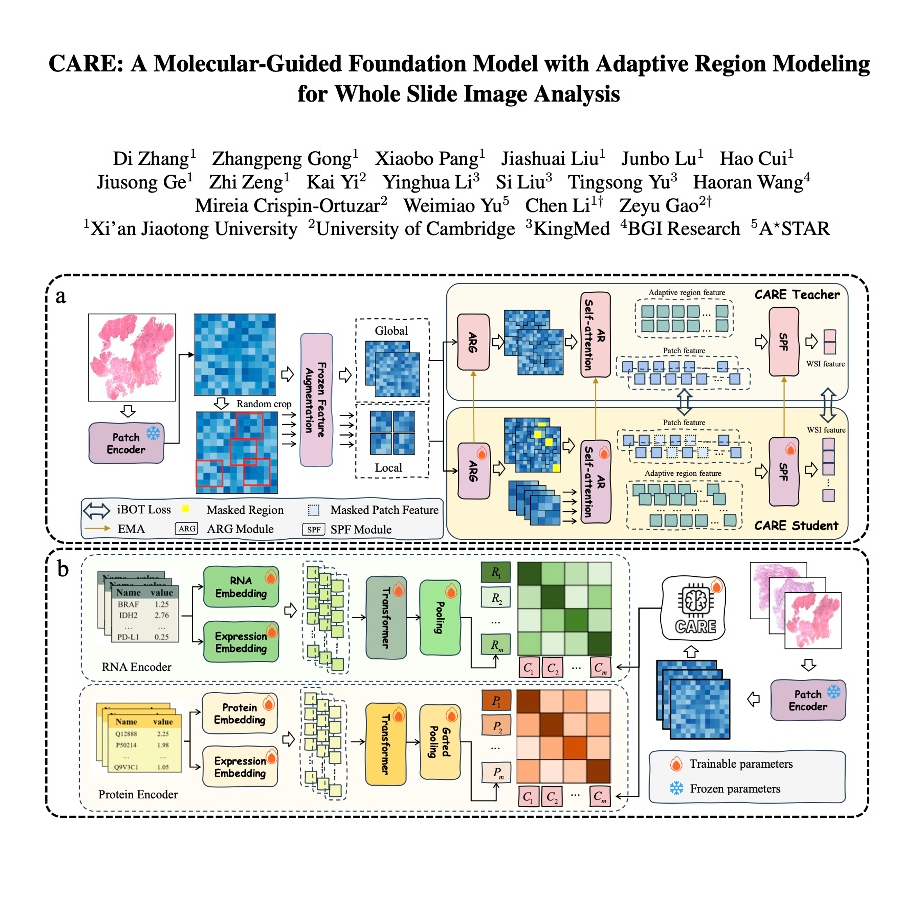
The paper introduces CARE (Cross-modal Adaptive Region Encoder), a novel foundation model designed to improve computational pathology by moving beyond rigid, grid-based image analysis. Unlike traditional models that treat whole-slide images (WSIs) as collections of isolated square patches, CARE utilizes an adaptive region generator to partition tissue into irregular, morphologically meaningful chunks that respect biological boundaries. The model undergoes a two-stage pretraining process, first learning morphological structures through self-supervised methods and then refining those representations by aligning them with molecular data, such as RNA and protein profiles. This biologically guided approach allows CARE to identify significant regions of interest (ROIs) and aggregate them into comprehensive slide-level embeddings. Despite using significantly less pretraining data than its competitors, CARE demonstrates superior performance across 33 clinical benchmarks, including cancer classification and survival analysis. Ultimately, the research offers a more interpretable and data-efficient framework for diagnostic AI by better mimicking the workflow of human pathologists. References: Zhang D, Gong Z, Pang X, et al. CARE: A Molecular-Guided Foundation Model with Adaptive Region Modeling for Whole Slide Image Analysis[J]. arXiv preprint arXiv:2602.21637, 2026. 前往小宇宙评论区与主播互动
Embed this episode
No transcript yet.