
EPISODE · Sep 19, 2024 · 19 MIN
863: Physicists Create Heaviest Antimatter Nucleus | Bird Species May Team Up For Migration
from Science Friday · host Science Friday
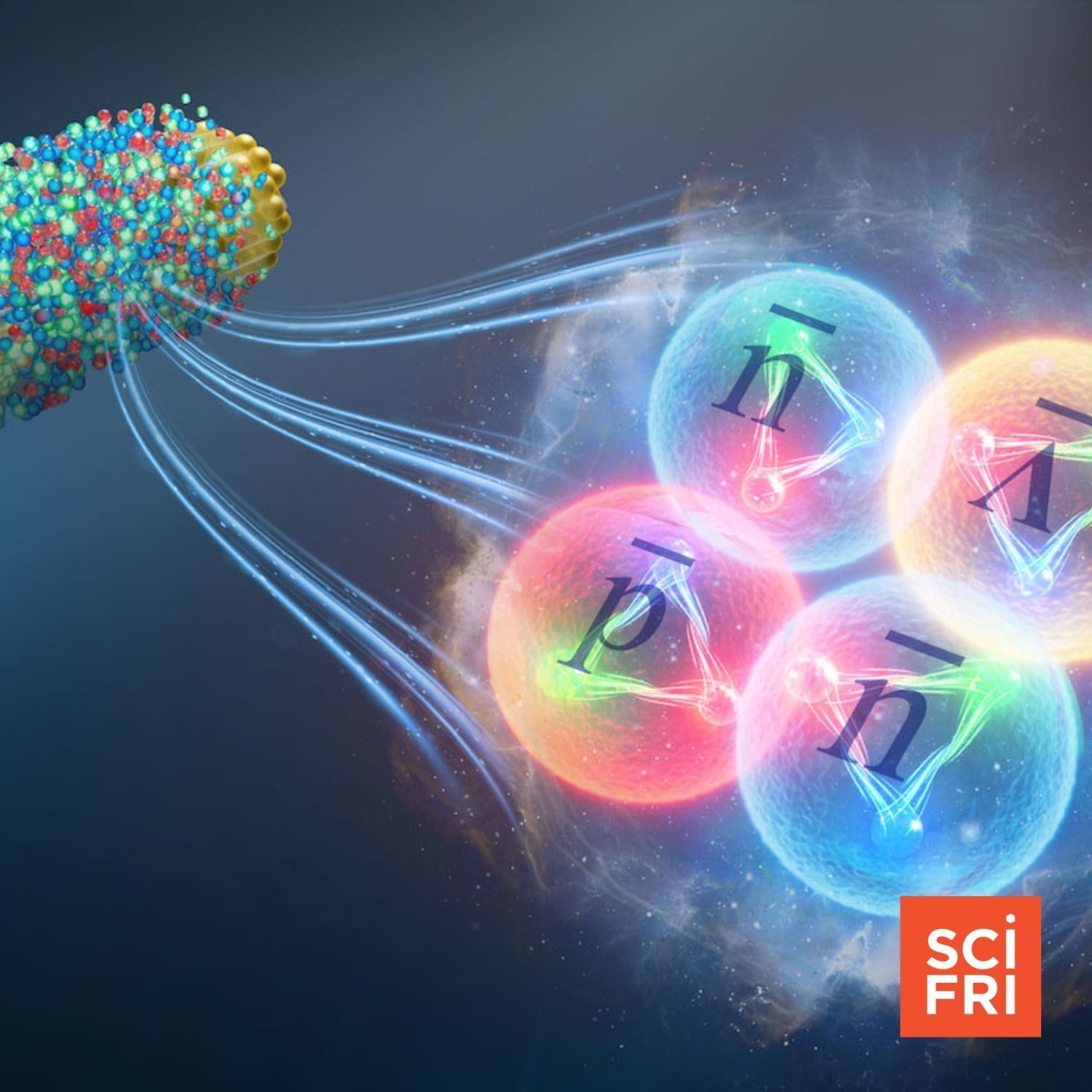
The heaviest antimatter nucleus to date was spotted in a particle accelerator. It could provide new insights into the nature of matter. And, research indicates different songbird species might intentionally travel together during migration, giving each other a possible boost in survival.Physicists Create Heaviest Antimatter Nucleus YetAntimatter is one of science’s great mysteries. It is produced all around us for fractions of a second, until it collides with matter, and the particles annihilate one another. But what is it?Antimatter is just like matter, except for one thing. Its particles have the same mass as ordinary matter, but an opposite charge. For example, an electron has a negative charge, so an anti-electron—called a positron—weighs the same, but has a positive charge.Antimatter is a natural product of some types of radioactive decay and cosmic ray collisions, but it can also be made in particle colliders here on Earth. But making antimatter particles this way is difficult and expensive—let alone controlling them enough to create an entire anti-atom. NASA estimates that creating a gram of antimatter would cost about $62.5 trillion.But why does antimatter matter? It may hold the key to understanding one of the universe’s biggest mysteries: why there’s something rather than nothing. Cosmologists say that during the Big Bang, matter and antimatter should have been created in equal amounts. But everything around us today is mostly matter, meaning either that there was an excess of matter created, or that matter and antimatter don’t quite follow the rules physicists expect.Recently, scientists at Brookhaven National Laboratory’s Relativistic Heavy Ion Collider spotted 16 instances of the heaviest exotic antimatter nucleus observed to date: antihyperhydrogen-4.To explore what this breakthrough means for antimatter research, SciFri producer Charles Bergquist talks to Dr. Jamie Dunlop, associate department chair for nuclear physics at Brookhaven National Laboratory.Different Bird Species May Team Up For MigrationThis season, billions of birds will take to the skies as they flock to their wintering grounds. With so many different species on the move, they’re bound to run into each other. A new study in the journal Proceedings of the National Academy of Sciences suggests that this mixing and mingling might not be coincidental.In fact, different bird species could have their own social networks that might boost each others’ survival.SciFri producer Kathleen Davis talks with lead author Dr. Joely DeSimone, migration ecologist at the University of Maryland Center for Environmental Science Appalachian Laboratory, about untangling avian relationships.Transcripts for each segment will be available after the show airs on sciencefriday.com.Subscribe to this podcast. Plus, to stay updated on all things science, sign up for Science Friday's newsletters.
Embed this episode
NOW PLAYING
863: Physicists Create Heaviest Antimatter Nucleus | Bird Species May Team Up For Migration
No transcript for this episode yet
Similar Episodes
No similar episodes found.