
EPISODE · Dec 20, 2025 · 33 MIN
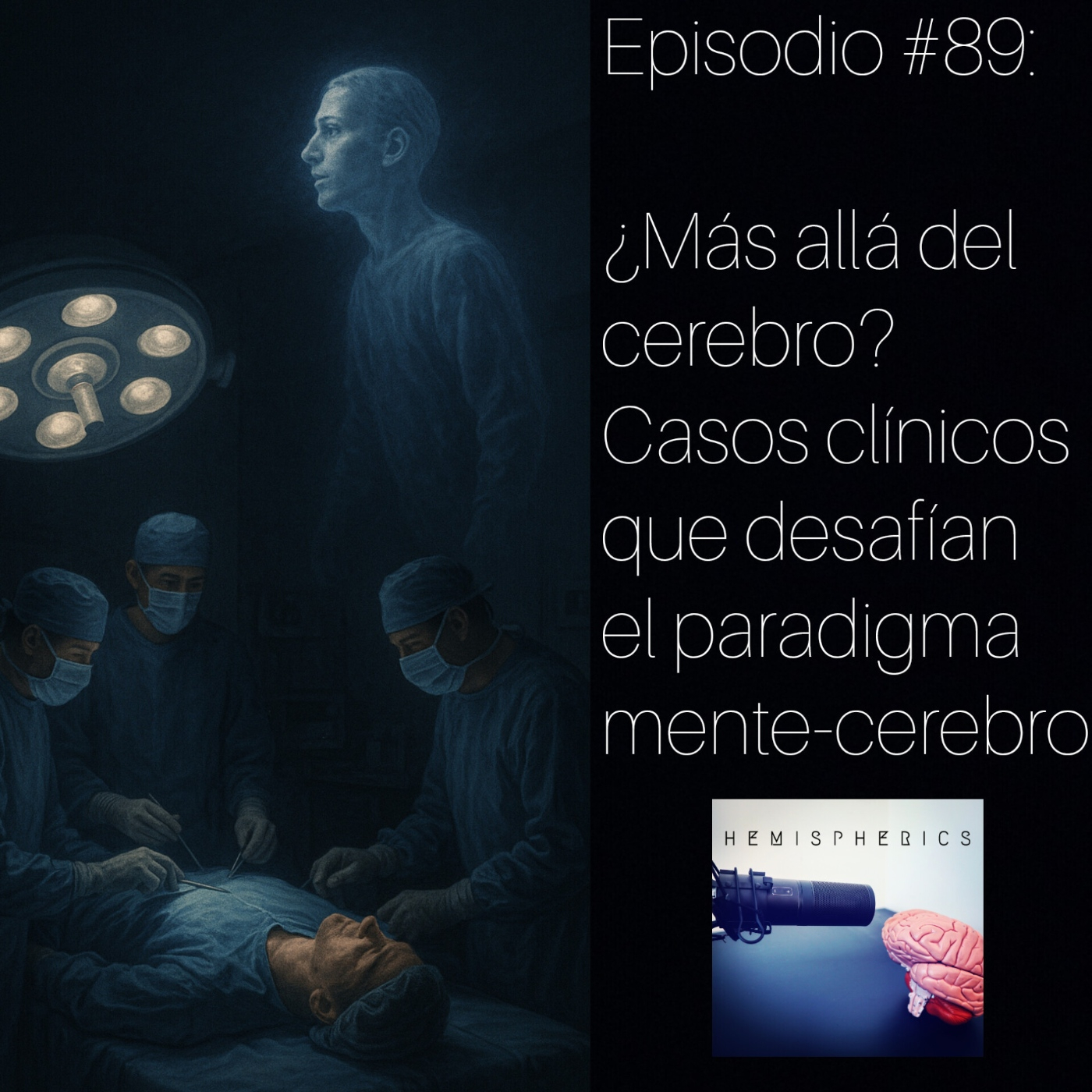
#89: ¿Más allá del cerebro? Casos que desafían el paradigma mente-cerebro
from Hemispherics
¿Puede existir la mente cuando el cerebro apenas está ahí? En este episodio de Hemispherics exploramos casos clínicos extremos —hidrocefalias masivas, hemisferectomías, microcefalia— y estados límite de conciencia como la lucidez terminal, la conciencia bajo anestesia o las experiencias cercanas a la muerte. Historias reales, bien documentadas, que desafían la idea simplista de que “la mente es solo el cerebro”. No para abrazar lo místico, sino para ampliar el marco: plasticidad extrema, redes alternativas, conciencia distribuida y los límites reales de lo que hoy sabemos. Un viaje a los bordes de la neurociencia, donde las respuestas no son claras… pero las preguntas son fascinantes. Referencias del episodio: 1. Asaridou, S. S., Demir-Lira, Ö. E., Goldin-Meadow, S., Levine, S. C., & Small, S. L. (2020). Language development and brain reorganization in a child born without the left hemisphere. Cortex; a journal devoted to the study of the nervous system and behavior, 127, 290–312. https://doi.org/10.1016/j.cortex.2020.02.006 (https://pubmed.ncbi.nlm.nih.gov/32259667/). 2. Feuillet, L., Dufour, H., & Pelletier, J. (2007). Brain of a white-collar worker. Lancet (London, England), 370(9583), 262. https://doi.org/10.1016/S0140-6736(07)61127-1 (https://pubmed.ncbi.nlm.nih.gov/17658396/). 3. Green, A. J., Yates, J. R., Taylor, A. M., Biggs, P., McGuire, G. M., McConville, C. M., Billing, C. J., & Barnes, N. D. (1995). Severe microcephaly with normal intellectual development: the Nijmegen breakage syndrome. Archives of disease in childhood, 73(5), 431–434. https://doi.org/10.1136/adc.73.5.431 (https://pubmed.ncbi.nlm.nih.gov/8554361/). 4. Kofman, K., & Levin, M. (2025). Cases of unconventional information flow across the mind-body interface. Mind and Matter, 23(1), Article 13. https://doi.org/10.5376/mm2025.13 (https://www.ingentaconnect.com/content/imp/mm/2025/00000023/00000001/art00003). 5. Lewin R. (1980). Is your brain really necessary?. Science (New York, N.Y.), 210(4475), 1232–1234. https://doi.org/10.1126/science.7434023 (https://pubmed.ncbi.nlm.nih.gov/7434023/). 6. Merker B. (2007). Consciousness without a cerebral cortex: a challenge for neuroscience and medicine. The Behavioral and brain sciences, 30(1), 63–134. https://doi.org/10.1017/S0140525X07000891 (https://pubmed.ncbi.nlm.nih.gov/17475053/). 7. Parnia, S., Spearpoint, K., de Vos, G., Fenwick, P., Goldberg, D., Yang, J., Zhu, J., Baker, K., Killingback, H., McLean, P., Wood, M., Zafari, A. M., Dickert, N., Beisteiner, R., Sterz, F., Berger, M., Warlow, C., Bullock, S., Lovett, S., McPara, R. M., … Schoenfeld, E. R. (2014). AWARE-AWAreness during REsuscitation-a prospective study. Resuscitation, 85(12), 1799–1805. https://doi.org/10.1016/j.resuscitation.2014.09.004 (https://pubmed.ncbi.nlm.nih.gov/25301715/). 8. Parnia, S., Keshavarz Shirazi, T., Patel, J., Tran, L., Sinha, N., O'Neill, C., Roellke, E., Mengotto, A., Findlay, S., McBrine, M., Spiegel, R., Tarpey, T., Huppert, E., Jaffe, I., Gonzales, A. M., Xu, J., Koopman, E., Perkins, G. D., Vuylsteke, A., Bloom, B. M., … Deakin, C. D. (2023). AWAreness during REsuscitation - II: A multi-center study of consciousness and awareness in cardiac arrest. Resuscitation, 191, 109903. https://doi.org/10.1016/j.resuscitation.2023.109903 (https://pubmed.ncbi.nlm.nih.gov/37423492/). 9. Ross, J. P., Post, S. G., & Scheinfeld, L. (2024). Lucidity in the Deeply Forgetful: A Scoping Review. Journal of Alzheimer's disease : JAD, 98(1), 3–11. https://doi.org/10.3233/JAD-231396 (https://pmc.ncbi.nlm.nih.gov/articles/PMC10977389/). 10. Sandhu, K., & Dash, H. (2009). Awareness during anaesthesia. Indian journal of anaesthesia, 53(2), 148–157 (https://pubmed.ncbi.nlm.nih.gov/20640115/). 11. Teresi, J. A., Ramirez, M., Ellis, J., Tan, A., Capezuti, E., Silver, S., Boratgis, G., Eimicke, J. P., Gonzalez-Lopez, P., Devanand, D. P., & Luchsinger, J. A. (2023). Reports About Paradoxical Lucidity from Health Care Professionals: A Pilot Study. Journal of gerontological nursing, 49(1), 18–26. https://doi.org/10.3928/00989134-20221206-03 (https://pmc.ncbi.nlm.nih.gov/articles/PMC11100277/). 12. Timmermann, C., Roseman, L., Williams, L., Erritzoe, D., Martial, C., Cassol, H., Laureys, S., Nutt, D., & Carhart-Harris, R. (2018). DMT Models the Near-Death Experience. Frontiers in psychology, 9, 1424. https://doi.org/10.3389/fpsyg.2018.01424 (https://pubmed.ncbi.nlm.nih.gov/30174629/).
Embed this episode
NOW PLAYING
#89: ¿Más allá del cerebro? Casos que desafían el paradigma mente-cerebro
No transcript for this episode yet
Similar Episodes
Similar Podcasts
No similar podcasts found.