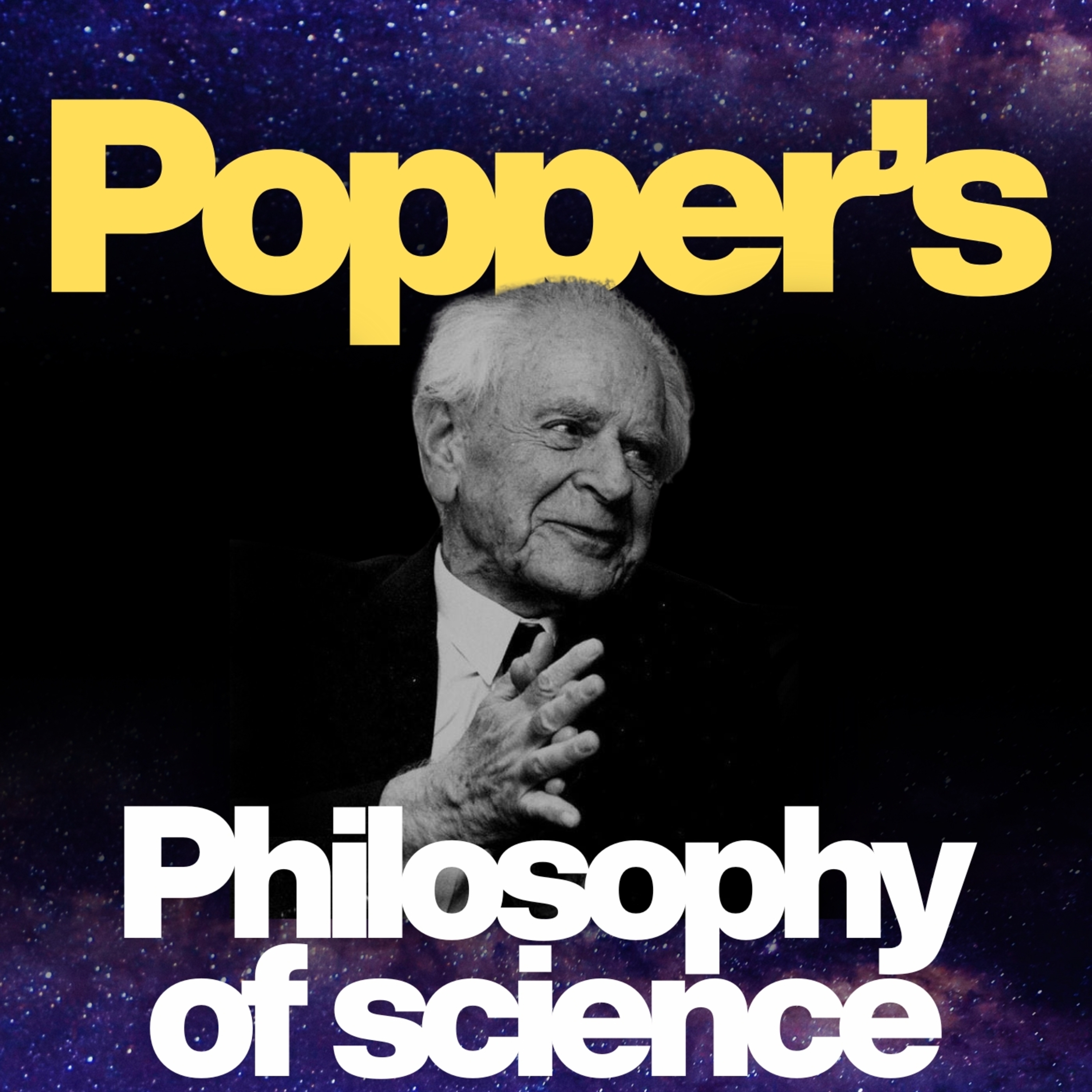
#93 (C&R Chap 10, Part I) - An Introduction to Popper's Theory of Content episode artwork

EPISODE · Oct 16, 2025 · 1H 47M

#93 (C&R Chap 10, Part I) - An Introduction to Popper's Theory of Content

from Increments · host Ben Chugg and Vaden Masrani

Back to basics baby. We're doing a couple introductory episodes on Popper's philosophy of science, following Chapter 10 of Conjectures and Refutations. We start with Popper's theory of content: what makes a good scientific theory? Can we judge some theories as better than others before we even run any empirical tests? Should we be looking for theories with high probability? Ben and Vaden also return to their roots in another way, and get into a nice little fight about how content relates to Bayesianism. We discuss Vaden's skin care routine If you find your friend's lost watch and proceed to lose it, are you responsible for the watch? Empirical vs logical content Whether and how content can be measured and compared How content relates to probability Quotes My aim in this lecture is to stress the significance of one particular aspect of science—its need to grow, or, if you like, its need to progress. I do not have in mind here the practical or social significance of this need. What I wish to discuss is rather its intellectual significance. I assert that continued growth is essential to the rational and empirical character of scientific knowledge; that if science ceases to grow it must lose that character. It is the way of its growth which makes science rational and empirical; the way, that is, in which scientists discriminate between available theories and choose the better one or (in the absence of a satisfactory theory) the way they give reasons for rejecting all the available theories, thereby suggesting some of the conditions with which a satisfactory theory should comply. You will have noticed from this formulation that it is not the accumulation of observations which I have in mind when I speak of the growth of scientific knowledge, but the repeated overthrow of scien- tific theories and their replacement by better or more satisfactory ones. This, incidentally, is a procedure which might be found worthy of attention even by those who see the most important aspect of the growth of scientific knowledge in new experiments and in new observations. C&R p. 291 Thus it is my first thesis that we can know of a theory, even before it has been tested, that if it passes certain tests it will be better than some other theory. My first thesis implies that we have a criterion of relative potential satisfactoriness, or of potential progressiveness, which can be applied to a theory even before we know whether or not it will turn out, by the passing of some crucial tests, to be satisfactory in fact. This criterion of relative potential satisfactoriness (which I formu- lated some time ago,2 and which, incidentally, allows us to grade the- ories according to their degree of relative potential satisfactoriness) is extremely simple and intuitive. It characterizes as preferable the theory which tells us more; that is to say, the theory which contains the greater amount of empirical information or content; which is logically stronger; which has the greater explanatory and predictive power; and which can therefore be more severely tested by comparing predicted facts with observations. In short, we prefer an interesting, daring, and highly informative theory to a trivial one. C&R p.294 Let a be the statement ‘It will rain on Friday’; b the statement ‘It willbe fine on Saturday’; and ab the statement ‘It will rain on Friday and itwill be fine on Saturday’: it is then obvious that the informative contentof this last statement, the conjunction ab, will exceed that of its com-ponent a and also that of its component b. And it will also be obviousthat the probability of ab (or, what is the same, the probability that abwill be true) will be smaller than that of either of its components. Writing Ct(a) for ‘the content of the statement a’, and Ct(ab) for ‘thecontent of the conjunction a and b’, we have (1) Ct(a) <= Ct(ab) >= Ct(b). This contrasts with the corresponding law of the calculus of probability, (2) p(a) >= p(ab) <= p(b), where the inequality signs of (1) are inverted. Together these two laws, (1) and (2), state that with increasing content, probability decreases, and vice versa; or in other words, that content increases with increasing improbability. (This analysis is of course in full agreement with the general idea of the logical content of a statement as the class of all those statements which are logically entailed by it. We may also say that a statement a is logically stronger than a statement b if its content is greater than that of b—that is to say, if it entails more than b does.) This trivial fact has the following inescapable consequences: if growth of knowledge means that we operate with theories of increasing content, it must also mean that we operate with theories of decreasing probability (in the sense of the calculus of probability). Thus if our aim is the advancement or growth of knowledge, then a high probability (in the sense of the calculus of probability) cannot possibly be our aim as well: these two aims are incompatible. C&R p.295 Socials Follow us on Twitter at @IncrementsPod, @BennyChugg, @VadenMasrani Come join our discord server! DM us on twitter or send us an email to get a supersecret link Become a patreon subscriber here. Or give us one-time cash donations to help cover our lack of cash donations here. Click dem like buttons on youtube How much content does the theory "dish soap is the ultimate face cleanser" have? Send your order of infinity over to [email protected]

Back to basics baby. We're doing a couple introductory episodes on Popper's philosophy of science, following Chapter 10 of Conjectures and Refutations. We start with Popper's theory of content: what makes a good scientific theory? Can we judge some theories as better than others before we even run any empirical tests? Should we be looking for theories with high probability? Ben and Vaden also return to their roots in another way, and get into a nice little fight about how content relates to Bayesianism. We discuss Vaden's skin care routine If you find your friend's lost watch and proceed to lose it, are you responsible for the watch? Empirical vs logical content Whether and how content can be measured and compared How content relates to probability Quotes My aim in this lecture is to stress the significance of one particular aspect of science—its need to grow, or, if you like, its need to progress. I do not have in mind here the practical or social significance of this need. What I wish to discuss is rather its intellectual significance. I assert that continued growth is essential to the rational and empirical character of scientific knowledge; that if science ceases to grow it must lose that character. It is the way of its growth which makes science rational and empirical; the way, that is, in which scientists discriminate between available theories and choose the better one or (in the absence of a satisfactory theory) the way they give reasons for rejecting all the available theories, thereby suggesting some of the conditions with which a satisfactory theory should comply. You will have noticed from this formulation that it is not the accumulation of observations which I have in mind when I speak of the growth of scientific knowledge, but the repeated overthrow of scien- tific theories and their replacement by better or more satisfactory ones. This, incidentally, is a procedure which might be found worthy of attention even by those who see the most important aspect of the growth of scientific knowledge in new experiments and in new observations. C&R p. 291 Thus it is my first thesis that we can know of a theory, even before it has been tested, that if it passes certain tests it will be better than some other theory. My first thesis implies that we have a criterion of relative potential satisfactoriness, or of potential progressiveness, which can be applied to a theory even before we know whether or not it will turn out, by the passing of some crucial tests, to be satisfactory in fact. This criterion of relative potential satisfactoriness (which I formu- lated some time ago,2 and which, incidentally, allows us to grade the- ories according to their degree of relative potential satisfactoriness) is extremely simple and intuitive. It characterizes as preferable the theory which tells us more; that is to say, the theory which contains the greater amount of empirical information or content; which is logically stronger; which has the greater explanatory and predictive power; and which can therefore be more severely tested by comparing predicted facts with observations. In short, we prefer an interesting, daring, and highly informative theory to a trivial one. C&R p.294 Let a be the statement ‘It will rain on Friday’; b the statement ‘It willbe fine on Saturday’; and ab the statement ‘It will rain on Friday and itwill be fine on Saturday’: it is then obvious that the informative contentof this last statement, the conjunction ab, will exceed that of its com-ponent a and also that of its component b. And it will also be obviousthat the probability of ab (or, what is the same, the probability that abwill be true) will be smaller than that of either of its components. Writing Ct(a) for ‘the content of the statement a’, and Ct(ab) for ‘thecontent of the conjunction a and b’, we have (1) Ct(a) <= Ct(ab) >= Ct(b). This contrasts with the corresponding law of the calculus of probability, (2) p(a) >= p(ab) <= p(b), where the inequality signs of (1) are inverted. Together these two laws, (1) and (2), state that with increasing content, probability decreases, and vice versa; or in other words, that content increases with increasing improbability. (This analysis is of course in full agreement with the general idea of the logical content of a statement as the class of all those statements which are logically entailed by it. We may also say that a statement a is logically stronger than a statement b if its content is greater than that of b—that is to say, if it entails more than b does.) This trivial fact has the following inescapable consequences: if growth of knowledge means that we operate with theories of increasing content, it must also mean that we operate with theories of decreasing probability (in the sense of the calculus of probability). Thus if our aim is the advancement or growth of knowledge, then a high probability (in the sense of the calculus of probability) cannot possibly be our aim as well: these two aims are incompatible. C&R p.295 Socials Follow us on Twitter at @IncrementsPod, @BennyChugg, @VadenMasrani Come join our discord server! DM us on twitter or send us an email to get a supersecret link Become a patreon subscriber here. Or give us one-time cash donations to help cover our lack of cash donations here. Click dem like buttons on youtube How much content does the theory "dish soap is the ultimate face cleanser" have? Send your order of infinity over to [email protected] Increments

NOW PLAYING

#93 (C&R Chap 10, Part I) - An Introduction to Popper's Theory of Content

0:00 1:47:23

No transcript for this episode yet

We transcribe on demand. Request one and we'll notify you when it's ready — usually under 10 minutes.

Bible Read Me Charles Van Deursen Most people may have never read the Holy Bible from cover to cover for several good reasons. A couple of hinderances might be that the texts reflect an ancient culture and that much of it is not in chronological order. Here you will enjoy listening to a summary of daily portions of Scripture grouped in one week increments, chosen in the order that they occurred in history. By this time next year you will have gained a better understanding of the big picture of the Bible narrative as well as intriguing details that will help you to connect the events of ancient days with the life that you are now living. Just as wise King Solomon wrote, "There is nothing new under the sun," but many times it can be difficult to find the time to dig out and apply these nuggets of golden truth to your daily life.Charles Van Deursen presents the Scripture summaries in a literal, grammatical-historical context while using the language in the way that Christian Women’s Weight Loss | Faith, Food, Fitness Ondrea Lynn - Certified Personal Trainer and Nutrition Coach for Christian Women Are you tired of fighting the scale 24/7? Are you sick of fad diets that only get you temporary results? Do you wish you had an easy plan to follow so you don’t have to stress out about how to lose weight? Are you looking for a simple foundational weight loss framework that can fit into your busy day so it becomes a lifestyle? Do you wish you could workout in 15-minute increments instead of hours at the gym? Do you wish you have an exercise plan that gets you results while working out at home? Are you looking for ways to naturally speed up your metabolism? Do you want your pizza and spinach too? Are you ready to break free from binge eating, over eating, and sugar addiction? Are you ready to be free from past trauma and hurts that drive you to sabotage? Do you desire a stronger relationship with Jesus, even on your weight loss journey but unsure how that looks? Hey, I’m Ondrea Lynn and I’m so excited that you are here with me on Christian Women Weight Loss! I remember what Increments with Alishah Novin Alishah Novin Increments is a show for technologists about leveraging the in-between moments. Those moments you come up for air, and take a beat.They say music is about the space between the notes, and just like music - growth happens in those moments between projects. Increments won't always give you answers, but will create the space for you to find them Siblinghood of Recovery Angie Reno When I found out my son was deep in the throes of Substance Use Disorder (SUD), chaos became the norm. As each step became more challenging, the information on SUDs, treatment, healing, and basically everything that comes with an SUD Family crisis, became overwhelming. Inundated with so much information, I felt like I had crossed space and time and landed in a new world. I actually had: I had entered the world of Recovery. My goal through this Podcast is to condense what I learned into small increments, and provide anyone willing to listen a message of hope. The world of Recovery is filled with parents, children, and family members who walk together. We share what we learn, listen with heart, and provide a community of support. We are a Siblinghood of Recovery.

Frequently Asked Questions

How long is this episode of Increments?

This episode is 1 hour and 47 minutes long.

When was this Increments episode published?

This episode was published on October 16, 2025.

What is this episode about?

Back to basics baby. We're doing a couple introductory episodes on Popper's philosophy of science, following Chapter 10 of Conjectures and Refutations. We start with Popper's theory of content: what makes a good scientific theory? Can we judge some...

Can I download this Increments episode?

Yes, you can download this episode by clicking the download button on the episode player, or subscribe to the podcast in your preferred podcast app for automatic downloads.
URL copied to clipboard!