
EPISODE · Apr 4, 2026 · 34 MIN
#94: La sinergia flexora...¿una cárcel espinal?
from Hemispherics
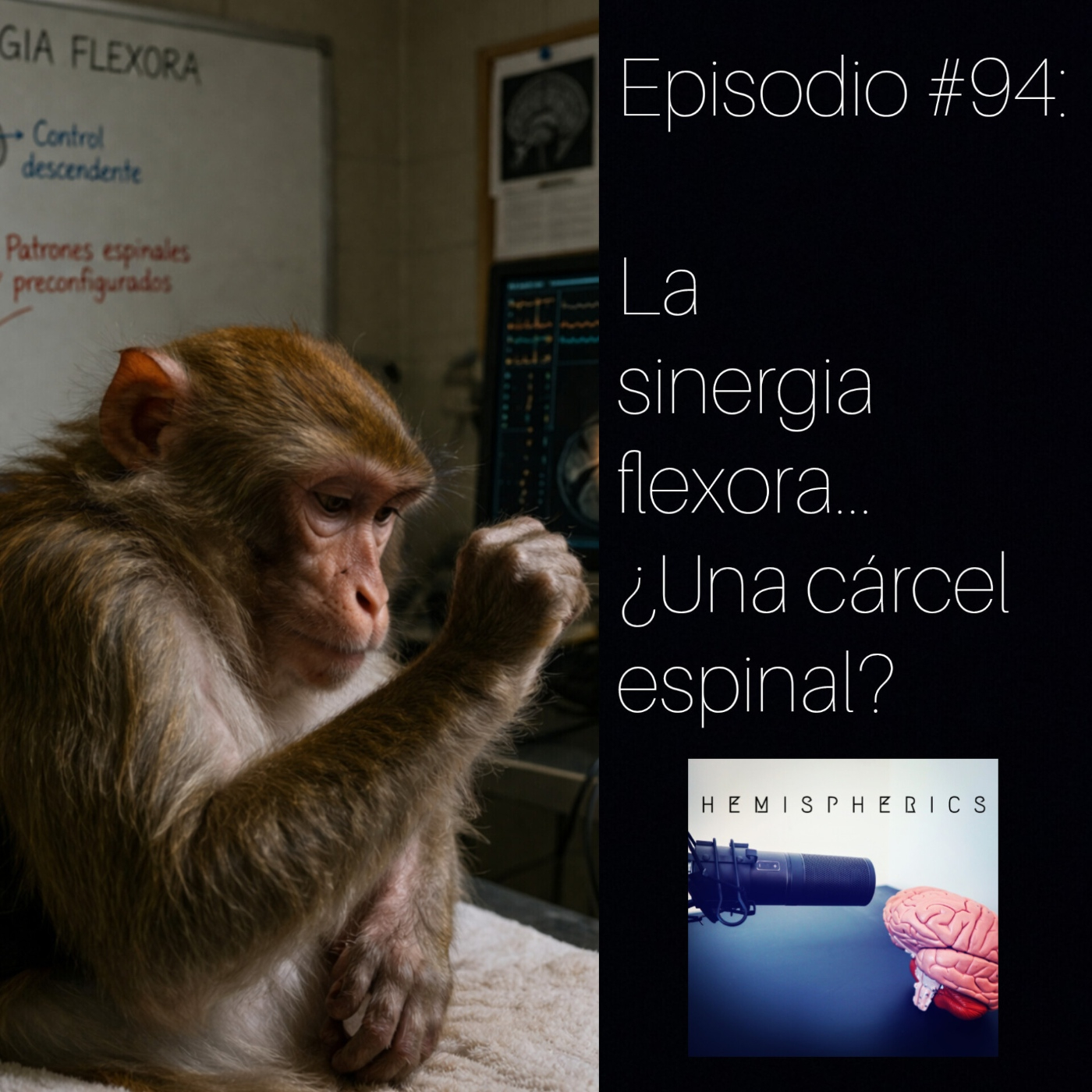
En este episodio de Hemispherics nos metemos de lleno en una de las preguntas clásicas de la neurorrehabilitación: ¿de dónde sale realmente la sinergia flexora? A partir de trabajos muy recientes con participación de Krakauer, exploramos una idea que puede cambiar la forma en la que entendemos este fenómeno: y es que quizá la sinergia no sea algo que el cerebro “genere” tras la lesión, sino la expresión de patrones preexistentes en la médula espinal que emergen cuando se pierde suficiente control descendente. A lo largo del episodio desmontamos el modelo clásico centrado en la vía reticuloespinal, analizamos evidencia experimental en primates y proponemos una visión integradora donde corteza, tronco y médula interactúan en distintos niveles. Un episodio para replantearse no solo el origen de la sinergia, sino también cómo la abordamos en clínica. Referencias del episodio: 1. Baines, A., Poll, A., Baker, A. M., Krakauer, J. W., & Baker, S. N. (2026). Arm Control and its Recovery after Selective Lesions of Sensorimotor Cortex and the Red Nucleus: A Kinematic Study in Non-Human Primates. bioRxiv : the preprint server for biology, 2025.08.06.668715. https://doi.org/10.1101/2025.08.06.668715 2. Baines, A., Glover, I. S., Baker, A. M. E., Krakauer, J. W., & Baker, S. N. (2026). Extent of damage to descending output from cortex rather than to specific cortical regions drives the emergence of flexor synergy in non-human primates. bioRxiv : the preprint server for biology, 2026.03.04.709517. https://doi.org/10.64898/2026.03.04.709517 3. Brunnstrom, S. (1970). Movement therapy in hemiplegia: A neurophysiological approach. Harper & Row. 4. Dewald, J. P., Pope, P. S., Given, J. D., Buchanan, T. S., & Rymer, W. Z. (1995). Abnormal muscle coactivation patterns during isometric torque generation at the elbow and shoulder in hemiparetic subjects. Brain : a journal of neurology, 118 ( Pt 2), 495–510. https://doi.org/10.1093/brain/118.2.495 (https://pubmed.ncbi.nlm.nih.gov/7735890/). 5. Dewald, J. P., & Beer, R. F. (2001). Abnormal joint torque patterns in the paretic upper limb of subjects with hemiparesis. Muscle & nerve, 24(2), 273–283. https://doi.org/10.1002/1097-4598(200102)24:23.0.co;2-z (https://pubmed.ncbi.nlm.nih.gov/11180211/). 6. Hug, F., Avrillon, S., Ibáñez, J., & Farina, D. (2023). Common synaptic input, synergies and size principle: Control of spinal motor neurons for movement generation. The Journal of physiology, 601(1), 11–20. https://doi.org/10.1113/JP283698 (https://pmc.ncbi.nlm.nih.gov/articles/PMC10098498/). 7. Glover, I. S., Baker, A. M. E., Krakauer, J. W., & Baker, S. N. (2026). A spinal origin for the obligate flexor synergy in the non-human primate: Implications for control of reaching. The Journal of neuroscience : the official journal of the Society for Neuroscience, e1878252026. Advance online publication. https://doi.org/10.1523/JNEUROSCI.1878-25.2026 (https://pubmed.ncbi.nlm.nih.gov/41802867/). 8. Kiehn O. (2016). Decoding the organization of spinal circuits that control locomotion. Nature reviews. Neuroscience, 17(4), 224–238. https://doi.org/10.1038/nrn.2016.9 (https://pubmed.ncbi.nlm.nih.gov/26935168/). 9. McPherson, J. G., Chen, A., Ellis, M. D., Yao, J., Heckman, C. J., & Dewald, J. P. A. (2018). Progressive recruitment of contralesional cortico-reticulospinal pathways drives motor impairment post stroke. The Journal of physiology, 596(7), 1211–1225. https://doi.org/10.1113/JP274968 (https://pubmed.ncbi.nlm.nih.gov/29457651/). 10. McPherson, L. M., & Dewald, J. P. A. (2022). Abnormal synergies and associated reactions post-hemiparetic stroke reflect muscle activation patterns of brainstem motor pathways. Frontiers in neurology, 13, 934670. https://doi.org/10.3389/fneur.2022.934670 (https://pubmed.ncbi.nlm.nih.gov/36299276/). 11. Owen, M., Ingo, C., & Dewald, J. P. A. (2017). Upper Extremity Motor Impairments and Microstructural Changes in Bulbospinal Pathways in Chronic Hemiparetic Stroke. Frontiers in neurology, 8, 257. https://doi.org/10.3389/fneur.2017.00257 (https://pubmed.ncbi.nlm.nih.gov/28659855/). 12. Tapia, J. A., Tohyama, T., Poll, A., & Baker, S. N. (2022). The Existence of the StartReact Effect Implies Reticulospinal, Not Corticospinal, Inputs Dominate Drive to Motoneurons during Voluntary Movement. The Journal of neuroscience : the official journal of the Society for Neuroscience, 42(40), 7634–7647. https://doi.org/10.1523/JNEUROSCI.2473-21.2022 (https://pubmed.ncbi.nlm.nih.gov/36658461/). 13. Zaaimi, B., Edgley, S. A., Soteropoulos, D. S., & Baker, S. N. (2012). Changes in descending motor pathway connectivity after corticospinal tract lesion in macaque monkey. Brain : a journal of neurology, 135(Pt 7), 2277–2289. https://doi.org/10.1093/brain/aws115 (https://pubmed.ncbi.nlm.nih.gov/22581799/).
Embed this episode
NOW PLAYING
#94: La sinergia flexora...¿una cárcel espinal?
No transcript for this episode yet
Similar Episodes
No similar episodes found.
Similar Podcasts
No similar podcasts found.