
EPISODE · Apr 18, 2026 · 54 MIN
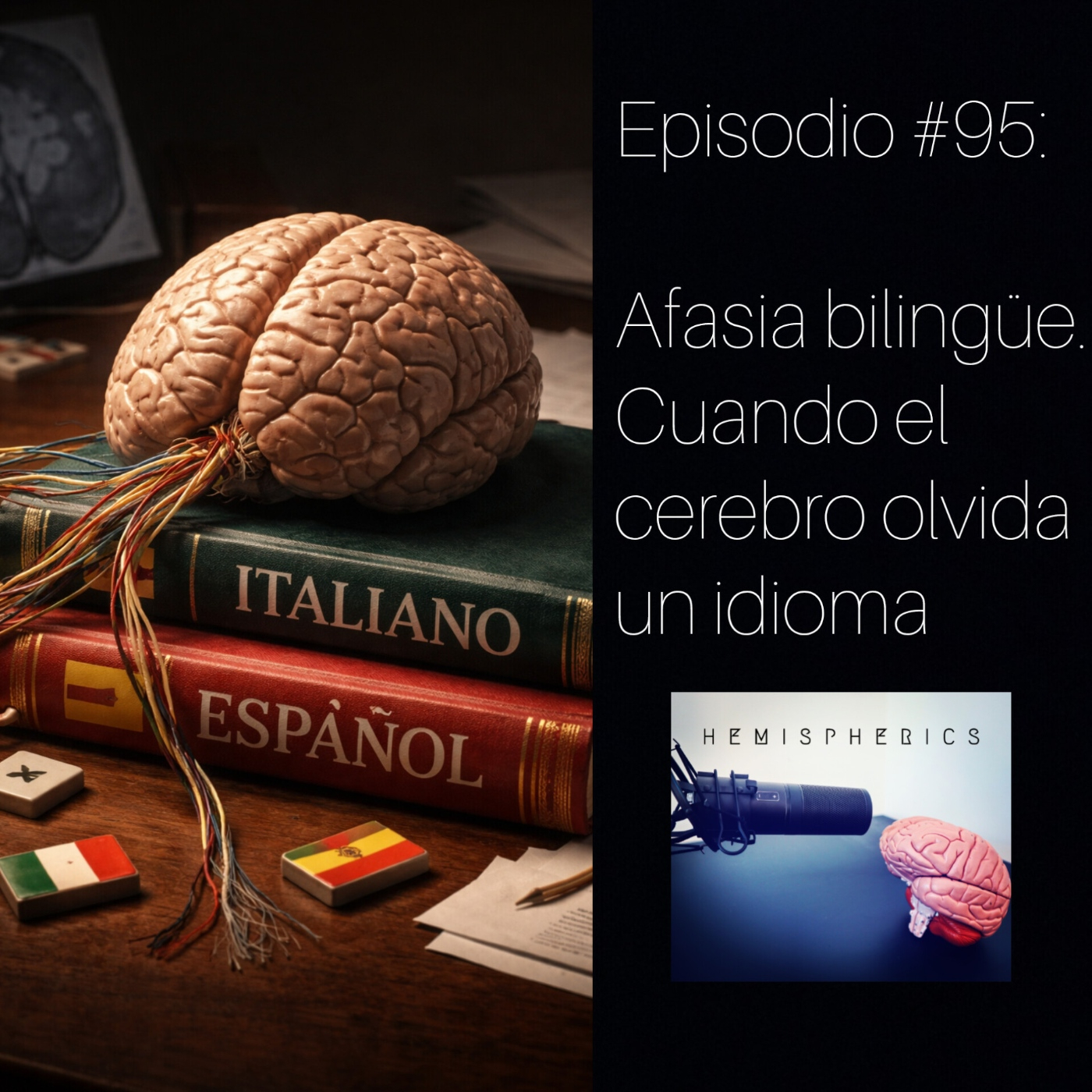
#95: Afasia bilingüe. Cuando el cerebro olvida un idioma
from Hemispherics
En este episodio nos metemos en un fenómeno tan curioso como clínicamente muy revelador: qué pasa cuando una persona bilingüe sufre un daño cerebral y, de repente, uno de sus idiomas parece desaparecer mientras el otro se mantiene. A partir de ahí, aprovechamos para repensar cómo se organiza realmente el lenguaje en el cerebro, alejándonos de la idea clásica de “zonas” y acercándonos a una visión mucho más dinámica, basada en redes que interactúan constantemente. Hablamos de por qué no todos los idiomas se afectan igual, qué papel tienen factores como el uso previo o la edad de adquisición, y por qué la recuperación puede ser tan variable entre pacientes. También aterrizamos todo esto en la clínica, viendo qué implicaciones tiene para la neurorrehabilitación y cómo trabajar con pacientes bilingües. En el fondo, es un episodio que va más allá de la afasia bilingüe y que nos ayuda a entender algo más profundo: que el lenguaje no está guardado en compartimentos, sino que es un sistema flexible que el cerebro reorganiza cuando algo se rompe. Referencias del episodio: 1. Abutalebi, J., & Green, D. W. (2007). Bilingual language production: The neurocognition of language representation and control. Journal of Neurolinguistics, 20(3), 242–275. https://doi.org/10.1016/j.jneuroling.2006.10.003 2. Abutalebi, J., Della Rosa, P. A., Gonzaga, A. K., Keim, R., Costa, A., & Perani, D. (2013). The role of the left putamen in multilingual language production. Brain and language, 125(3), 307–315. https://doi.org/10.1016/j.bandl.2012.03.009 (https://pubmed.ncbi.nlm.nih.gov/22538086/). 3. Abutalebi, J., Canini, M., Della Rosa, P. A., Green, D. W., & Weekes, B. S. (2015). The neuroprotective effects of bilingualism upon the inferior parietal lobule: A structural neuroimaging study in aging Chinese bilinguals. Journal of Neurolinguistics, 26(6), 602–609 (https://www.sciencedirect.com/science/article/pii/S0911604414000657). 4. Ardila, A., Lahiri, D., & Mukherjee, A. (2023). Bilingualism as a protective factor in aphasia. Applied neuropsychology. Adult, 30(5), 512–520. https://doi.org/10.1080/23279095.2021.1960837 (https://pubmed.ncbi.nlm.nih.gov/34392763/). 5. Berthier, M. L. (2005). Poststroke aphasia: Epidemiology, pathophysiology and treatment. Drugs & Aging, 22(2), 163–182. https://doi.org/10.2165/00002512-200522020-00006 (https://pubmed.ncbi.nlm.nih.gov/15733022/). 6. Bihovsky, A., Ben-Shachar, M., & Meir, N. (2024). Semantic feature analysis (SFA) treatment in L1 and L2 in bilingual aphasia: Effects of cognitive and language factors. Aphasiology, 38(4), 683–711 (https://www.tandfonline.com/doi/full/10.1080/02687038.2023.2226359). 7. Dekhtyar, M., Kiran, S., & Gray, T. (2020). Is bilingualism protective for adults with aphasia?. Neuropsychologia, 139, 107355. https://doi.org/10.1016/j.neuropsychologia.2020.107355 (https://pubmed.ncbi.nlm.nih.gov/31972233/). 8. Edmonds, L. A., & Kiran, S. (2006). Effect of semantic naming treatment on crosslinguistic generalization in bilingual aphasia. Journal of speech, language, and hearing research : JSLHR, 49(4), 729–748. https://doi.org/10.1044/1092-4388(2006/053) (https://pubmed.ncbi.nlm.nih.gov/16908872/). 9. Goral, M., Levy, E. S., & Kastl, R. (2007). Cross-language treatment generalisation: A case of trilingual aphasia. Aphasiology, 103(1-2), 203–204. https://doi.org/10.1016/j.bandl.2007.07.116 (https://pubmed.ncbi.nlm.nih.gov/20221311/). 10. Hickok, G., & Poeppel, D. (2007). The cortical organization of speech processing. Nature reviews. Neuroscience, 8(5), 393–402. https://doi.org/10.1038/nrn2113 (https://pubmed.ncbi.nlm.nih.gov/17431404/). 11. Indefrey, P. (2006). A meta-analysis of hemodynamic studies on first and second language processing. Human Brain Mapping, 27(10), 799–810. https://doi.org/10.1002/hbm.20250 (https://onlinelibrary.wiley.com/doi/abs/10.1111/j.1467-9922.2006.00365.x). 12. Jouravlev, O., Mineroff, Z., Blank, I. A., & Fedorenko, E. (2021). The Small and Efficient Language Network of Polyglots and Hyper-polyglots. Cerebral cortex (New York, N.Y. : 1991), 31(1), 62–76. https://doi.org/10.1093/cercor/bhaa205 (https://pubmed.ncbi.nlm.nih.gov/32820332/). 13. Malik-Moraleda, S., Ayyash, D., Gallée, J., Affourtit, J., Hoffmann, M., Mineroff, Z., Jouravlev, O., & Fedorenko, E. (2022). An investigation across 45 languages and 12 language families reveals a universal language network. Nature neuroscience, 25(8), 1014–1019. https://doi.org/10.1038/s41593-022-01114-5 (https://pubmed.ncbi.nlm.nih.gov/35856094/). 14. Malik-Moraleda, S., Jouravlev, O., Taliaferro, M., Mineroff, Z., Cucu, T., Mahowald, K., Blank, I. A., & Fedorenko, E. (2024). Functional characterization of the language network of polyglots and hyperpolyglots with precision fMRI. bioRxiv : the preprint server for biology, 2023.01.19.524657. https://doi.org/10.1101/2023.01.19.524657 (https://pubmed.ncbi.nlm.nih.gov/36711949/). 15. Nadeau, S. E. (2019). Neural basis of language: A population encoding perspective. Language, Cognition and Neuroscience, 34(1), 1–18. https://doi.org/10.1080/23273798.2018.1506034 16. Paplikar, A., Mekala, S., Bak, T. H., Dharamkar, S., Alladi, S., & Kaul, S. (2018). Bilingualism and the severity of poststroke aphasia. Aphasiology, 33(1), 58–72. https://doi.org/10.1080/02687038.2017.1423272 17. Pliatsikas, C. (2020). Understanding structural plasticity in the bilingual brain: The Dynamic Restructuring Model. Bilingualism: Language and Cognition, 23(2), 459–471. https://doi.org/10.1017/S1366728919000130 18. Price C. J. (2012). A review and synthesis of the first 20 years of PET and fMRI studies of heard speech, spoken language and reading. NeuroImage, 62(2), 816–847. https://doi.org/10.1016/j.neuroimage.2012.04.062 19. Russell-Meill, M., Marte, M. J., Carpenter, E., & Kiran, S. (2025). Navigating the Complexity of Bilingual Aphasia: Current Insights and Future Directions. Brain sciences, 15(9), 989. https://doi.org/10.3390/brainsci15090989 (https://pubmed.ncbi.nlm.nih.gov/41008350/).
Embed this episode
NOW PLAYING
#95: Afasia bilingüe. Cuando el cerebro olvida un idioma
No transcript for this episode yet
Similar Episodes
No similar episodes found.
Similar Podcasts
No similar podcasts found.