
A podcast by Sipra. In podcast, de la sipra. The A-Sipra Podcast. Three-Brid podcast.
Interviews, background talks and voices from all Alpine countries. Listen to this and more in the podcast of the International Commission for the Protection of the Alps. www.sipra.org. Port slash podcast.
Imagine a place where the air smells of wildflowers, where rivers are untamed, where communities live in harmony with nature and question social norms of our common world, where sustainability is not just a buzzword but a way of life. This isn't a dream. The places exist and they are what we call utopias. My name is Michel Gams.
Welcome to our podcast, where we embark on a journey to visit utopias in the Alps from Slovenia to France. Utopias as utopos, non-places are places that do not exist but that are invented to tell things about our common world. The goal is to create narratives and a common world that could fit in the sustainable development goals of the United Nations. Utopias can be what we call good examples and sometimes utopias are just mental creations, projects or people.
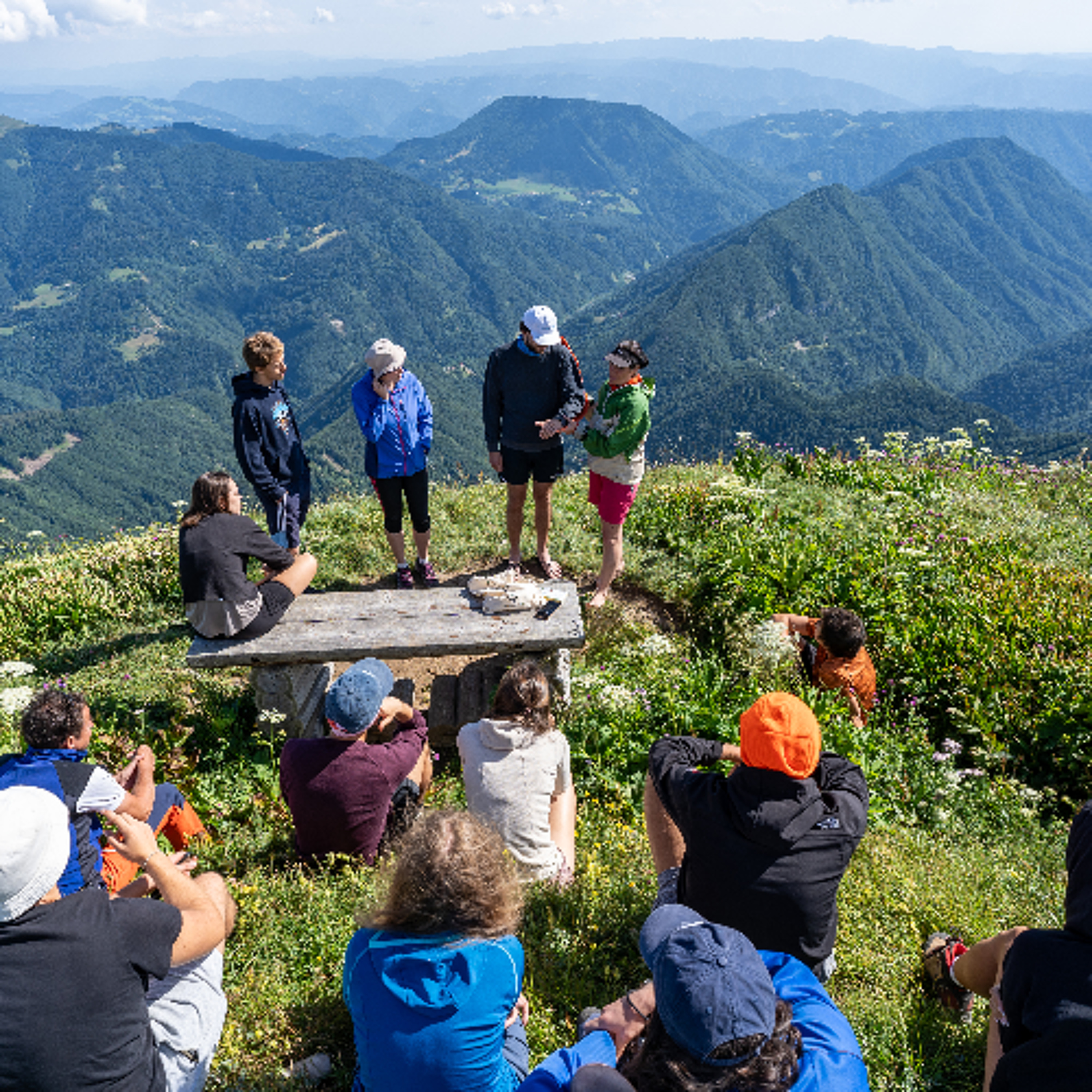
They are designed to let young people explore the Via Alpina route, a path that connects the eight alpine states. In 2024 and 2025, within our project, Via Alpina youth, walking the change, multiple visit utopias have been visited today, will meet the people behind the scenes who organize these excursions and those who make them thrive by choosing a different path in the world that moves faster every day. So pack your curiosity and dive right in with us. I'm happy to have Maya Kogorshek with me.
She is the project manager of Via Alpina youth, Helomaya and thank you very much for being with us today in this podcast. Helomihael, thanks for inviting me to the talk. Please tell us a little bit more about the initial project at the Maya. So the Via Alpina youth project is based on the Via Alpina hiking route.
It's quite a big project that began in 2023 and it's now in a finish line. And the aim of the whole project is to share knowledge, ideas and opportunities related to sustainable lifestyles, inclusion and nature conservation along the Via Alpina route. In this pneumatic section of the visit utopia that you mentioned before, young people had the opportunity to visit and discover places in each of the different stories that somehow tell or showcase different and positive stories about the possible future. Otherwise, the partners had pretty free hands and they could really choose the topics that they have interest in and that resulted in a very wide topic range from untouched nature, social projects inspiring individuals to history, museum and sport activities.
Maya, why do you think it is important to have these utopias? I think that utopias are important because they offer hope and direction at the time where many people feel overwhelmed by crisis and bad news. They show that sustainable alternatives already exist and what is in my opinion also very important, they often create spaces for connection, dialogue and community. These are the things that we all need if we want to stay motivated and engage for shaping social change.
Besides this, they also remind us that change is possible even through small local actions and personal decisions and that each of us can make a difference. So they inspire courage, strength and they inspire, give us courage and strengthen our sense of belonging. The nice thing about utopias is that they show that a more sustainable and caring way of living together is already happening and I really hope that these excursions were also inspiration for young people to somehow try to engage in their communities. So what you said is that these utopias already showcase that small steps can make a big difference.
What was the biggest challenge in organizing these visit utopias all over the Alps? The project many different partners took part. We have different experiences in organizing these kinds of events and that's why we had different challenges where some people, some partner organizations maybe struggled with forming a youth group and like expanding their work to other target groups, so to young people. Others like creative ideas of what utopia could be.
I think we all had the one challenge and that was that we wanted to make a video campaign from the utopias and despite we organized a video workshop it was pretty visible that none of the partners actually is keen of working with digital material. Photos are not a problem but creating an inspiring video was pretty challenging for many partners. So let's dive in maybe to first visit utopias actually in your old home country Maya Slovenia. Our colleague Diana Zatakovic organized several visit utopias from meeting a female mountain rescuer to an inclusion project as well as building dry stone walls.
Let's hear what she has to say about these experiences. All three events were truly inspiring in their own way. I was especially impressed by the level of interest from young people because we received many applications and in the end for each visit utopia we had to make a selection simply because the number of spots were limited due to the budget and in one case also due to the mountain safety considerations but yeah I have to say that I saw that young people are motivated and curious and they're eager to learn and explore and even hike for several days. And this is quite the opposite of what some older generations are saying because some of them are saying that young people nowadays are lazy or uninterested but what I saw is that this is not true.
It is just important that we need to find a way how to reach these young people and also we need to find the right way to communicate with them. And I was also stuck by how deeply some young participants were connected with the cultural heritage. What did you personally learn from visiting these utopias? I learned that when you really take the time to look there are actually countless good practices happening quietly in the background.
Many of these topics never make it into the mainstream media or on social media but on another hand, exact these stories of these local people are the one that holds an incredible amount of knowledge and inspiration. So I realized that it's really important to shine a light on these issues and it's important to bring attention on the stories that usually don't receive much attention. So for example, community-based living or the role of women in the mountain rescue teams. So for me, visiting these places showed me how valuable it is to bring these conversations forward and it's really valuable to make space for voices that are often overlooked.
How many young people participated altogether in these visit utopias? In total, there were 40 young people that participated in our visit to top activities but I'm actually really happy that we also had some other volunteers joining from different age groups. So all together in all our events, there were 65 individuals that took part and I found this really valuable because we also created this bridge between generations. So young people and older volunteers could share the knowledge and experiences and I think this really enriched the whole learning process for everyone who were involved.
What was their feedback and what was especially surprising to you? We received a lot of positive feedbacks and I'm really happy that these opportunities allowed young people to experience things that they never got to experience in their life because some of the participants shared with us that they never had the experience before to sleep in the mountain hut. Others had told us that they never seen how a housing cooperative functions in practice or that they were not even aware that there is a possibility to live in this way. And yeah, seeing young people getting inspired, it was really nice and they also told us that they were really excited to see these good practices in person.
And what they also shared is that they loved meeting new people. They created some friendships and they also discovered that even though they were young people from different backgrounds, they actually had a lot in common. So they shared that they could experience in our events this sense of community and connection. Do you have a favorite moment or experience connected to these utopias?
Yes, I would like to share something that happened in one of our last year's events. So among all the learning, exploring and hiking, also a bit of love is part of it. And now I could actually say that we have an utopian couple. It's actually a small but sweet reminder that when you bring people together in inspiring places, also unexpected magical connections can happen.
And I found it really beautiful. This was Diana Zatakovic sharing her memories about the visit utopia excursions in Slovenia. Let's move on to Italy. Fabio Tullio from Cyprietaly co-organized the visit to an art project in the Dolomites that reflects on the devastation caused by Vaya, a storm that hit the region in 2018 and destroyed large parts of the Dolomite forests.
For us here in the Dolomite, the Pycovaya project represents a very powerful utopia. We must remember that in 2018, storm Vaya was a tragedy that destroyed about 42 million trees and 42 thousand sectors of forest. This project led by K is a utopia because it refused to look at what happened only as a disaster. They took the falling wood, the cut-overs of the trees and built a theatre right there in the landscape with a design that aspires to a river.
Fabio, why do you think this art project is a utopia? It's a utopia of a regeneration. It shows us that we shouldn't just limit ourselves to cleaning up the image of climate change. But we can create a culture, art and beauty starting right from that disaster.
Imagine a future where the forest isn't seen just a timber resource, but as a complex ecosystem where humans, art and nature communicate. It is a constructive hope. A stage to build dialogue with between citizens, local literature, artists and scientists on the theme of the climate crisis. What impressed you most about it?
What struck me most was the ability to bring different worlds together. Usually for its three science, administrators, citizens, artists and businesses are separate entities. Here in Kadore, we try to connect everything. We saw science understanding how the woods react to the storm and the attack of the barc beetle, mixing perfectly with local craftsmanship, artistic performance and courageous political choices.
Standing there in front of those trees knocked down by the storm, which then became a work of art, it was emotional. It wasn't just an artisolation, but a lesson in resilience. It strikes me a lot to see how local, know-how, became a tool to communicate complex scientific concepts. An opportunity to communicate importance of not surrounding dominant thinking, which is often driven only by economic interests.
If I cannot one other thing, I believe this visit showed the youth that the Alps are changing fast, but it also showed that we are not helpless. The visit to opias aren't about finding a perfect world that really exists somewhere. They're about finding people who have the courage to rethink their relationship between humans and nature, and rebuild something new when the old world goes into crisis. For the Valkino youth, seeing the forest, the impacts of Vaya and the bark beetle, the genesis of Palko Vaya, and meeting these different professionals and stakeholders, it was proof that our mountains are still alive.
And we are just waiting for us to tell new, courageous stories. This was Fabio Tullio talking about the visit to topias in the Dolomites. We stay in the region, also Tsipra's south-tiral organized some visit to topias. We asked Roland Plank, who works there, to share his experience.
Roland, your excursions to wear about sustainable agriculture, social inclusion and arts. Please tell us more about them. It was great to meet so many different and interesting people. Last year we met two farmers who worked with organic agriculture.
Farmer Marc Coppery explained his view on organic vegetable farming. Farmer Valentin Ina Hova showed us his organic farm. This year we visited Vakis Manit in Pronach. They found a secret training spell, showed us how people with difficulties are included in the work of the social enterprises.
At the end of the project, we met online. We shared our experience and talked about inclusion with the director of the art workshop and gallery accent in Pronach. How did you stumble upon these utopias? Both visit the topia streets, started with building a group of young adults.
Together we decided what we wanted to see. In 2024 we chose to learn how agriculture can be more sustainable in our region. So we did simple internet research. We found a presentation by Marc Copp.
He changed his farm from a milk farm to an organic vegetable farm. By looking for his contact, we found another organic farm in the same town. This was Valentin's farm. We also found a great video about him on the Farm Influencer's website.
After watching it, we knew we wanted to meet him too. That is how our first utopias work started. This year, 2025, the group wanted to focus on inclusion. We know the coordinator of the art workshop and gallery accents started singularly very well.
So we asked her to explain inclusion and show us her work. She said yes, of course. But she also explained that the artists, three works, we have strong difficulties, so full inclusion is hard to her. She invited us to visit Viscite Vagizmani too.
The cow's dead place practiced real work inclusion. So we visited both places to understand the differences and the different needs. What did participants say about it? The feedback was very positive.
Many said they learned new things, visiting the organic farms and then eating together in an organic restaurant. But participants think about their own habits. For everyone, it was nice to see that these places exist close to their homes. Without the visits, some people might think these ideas are utopias and not possible in real life.
In its southwestern part, the Vjalpina passes through a border area between Italy and France. Valestreta can be accessed from Badonecia, one of the few Italian alpine locations connected by rail. In a short time, you can travel from the center of Turin to the high mountains, discovering vastly different landscapes as well as the challenges and opportunities of the region. Francesco Pasternelli from Seper Italy organized a visit utopia there.
We organized the exclusion in the Badonecia area near the French border where the Vjalpina passes through because the Badonecia is a mountain destination that can be reached by train from Toledo, where participants can from. From the train station, it was possible to reach the starting point of the exclusion by a shuttle bus, so we demonstrate how important our public transport for workers. Not only Italian valley are accessible by a public transport, which limited, doesn't have a private car. The participants were mostly young people from the town of Torino, where there is a good public transport service, unlike in the rural and mountain areas.
They also had the opportunity to experience day or night in a mountain hut, which was a new experience for many of them. In Germany, two visit utopias took place, one in an untamed riverbed, another one at Oberseart-Sperk, tackling the topic of nationalist ideologies in nature conservation. In Switzerland, a group of young people visited a microfarm with a beautiful view above Lake Constance. Another visit utopia took place at a farm called Rassenbergi, a meaningful project centered around biodynamic agriculture and social participation of people with specific needs in the Bernice-Hilly landscape.
The owners of the place also want to encourage social projects around the farm. The visit utopias in Switzerland were organized in cooperation with Pronatura Switzerland. Ticra France organized the visit utopia at the Laotterye-Arland Garden, located right in the heart of the Cron National Park in France. It is raising tourists' awareness about climate change through science.
A second excursion took place at the Mariné Glacier. Yule Kailar from Ticra France tells us more about these visit utopias. One was the Laotterye Garden. It's a garden with 2,000 plants in 2,000 metres altitude.
It's also a living map of the UU mission, Soylde for Europe, for improving the soil health. It's a really interesting place to visit because it's a French researchers and national researchers. They're working there in this unique place in the Alps for having a hub of scientific experimentation and biodiversity. We can go there to visit the garden to meet their researchers and to better understand biodiversity in the Alps.
The structure also proposed eco-voluntary scientifically, which means you can help them to collect and to strengthen their research by visiting them. The second utopia we organized together was the organization Avila, who did a three-day hiking trip through the Uvaia territory. We organized one day to visit the glacier and to better understand the health stages of the rocky glaciers in this era. This is related to the global warming processes which is going on.
We had the chance to have two interns at this period. They contacted our member organizations to get young people. They contacted the University of Grenoble and also an association called Claparacit, Grenoble. And so, especially our two interns were really organizing it from the scrap, which means they organized it from their wishes, from their ideas, what they wanted to see and to discover.
Now we return back to Lichtnstein. The project manager of the Alpina Yuff, Maya Kogarachik is still here with me. You also organized a visit to Topia here in the Lichtnstein Alps. It was a January snow hike in the mountains.
What does a snow hike have to do with utopia? With this utopia, we wanted to share the knowledge about flora and fauna in the Lichtnstein mountains and also talk about the climate change happening here. We invited Van der Kati, a hiking guide, to take us to the snow hike and talk about these topics along the way. She also included some mindfulness exercises because raising awareness of our body and supporting a grounded state of mind is also important part of connecting with nature.
And the second core idea behind this utopia was accessibility. We were imagining a future where the mountains are truly open to everyone, including people who normally don't have either the opportunity, the equipment or the network of people with whom they could visit the mountains. So who actually were these people who participated? Yeah, we were a very mixed group from actually all around Europe.
It was interesting to put together such a big group of young people that never was on a snow hike before. Everyone finished a day with a smile on their face and I think that's a feedback that each organizers wishes for. They learned new stuff about the nature in the mountains. They learned new skill, like snow hiking is not that easy.
Despite it looks like they met new people. And what I see as additional value was that there were quite some people that recently moved to Lichtenstein and still need to practice their German. And this was a nice safe space where they could also practice this language skill. And maybe get to know also other like-minded people.
In general, what was your main learning from all these visitotopias and other excursions along the VLP during this whole project? My main learning from all the visitotopias and excursions along the VLP now is that change truly grows from small local actions. And that the change is possible if people really believe in their ideas. I saw that sharing motivating stories and creating moments of hope is incredible, important and that young people actually appreciate these kinds of experiences.
And in the project I also realized how powerful is it to bring young people together and take them into the nature. Because very often we have all the activities in inside spaces in a very formal setting. And actually it's a very different story if we take young people outside, we are in nature in a different setting. And we can connect with young people on a totally different level.
So not just with young people, we can also connect with ourselves and with nature. What was your personal highlight or maybe a certain moment that you still remember in a very positive way concerning these visitotopias and also the other excursions in the project? So if I can choose from the whole project, I would definitely say the hiking camp in the Dolomites and in the surrounding of Shalomone. We were there with young people of different age, nationalities and social backgrounds and being together five to six days, hiking in rain, cold, with backpacks, tired, sun, rain, many different stuff.
So a lot of challenges also and not only sunshine and blue skies. Yes, there were quite some challenges but since the group was not too big and since we really tried to make it a safe space and a good space, we could tackle these challenges good. And for me it's very nice to see how people who never were hiking or have been so long outside go out of the experience with a smile and wish to do it again. You already mentioned some learnings but is there anything else learning that you would like to add here?
I learned that cross-border cooperation is essential especially when searching for positive stories. It's important that we collaborate, that we share the stories and that we learn from each other because we all tackle with same challenges and it's nice to see that there are sparks of hope all around us. Thank you very much Maya and thank you dear listeners for joining this audio journey to visit utopias all across the Alps. I hope you enjoyed this episode.
It was produced within the project via Alpina Youth and co-financed by the European Union. My name is Michel Gams and enjoy your time out there in the Alps together with friends. A podcast by Sipra. In podcast and the L'Acipras.
The L'Acipras. The L'Acipras. In podcast. Interviews, background talks and voices from all Alpine countries.
Listen to this and more in the podcast of the International Commission for the Protection of the Alps. www.sipra.org.org. Port slash podcast.