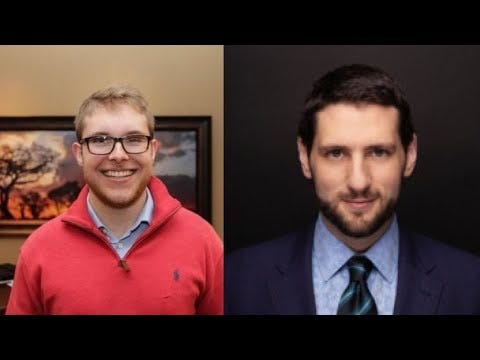
97: William Eden - VC, Parenting and Longevity
from Narratives Hosted by Will Jarvis
In this episode, I'm joined by entrepreneur in residence William Eden to discuss biotech venture capital, parenting, longevity, American decadence and a whole lot more. Transcript:William Jarvis 0:05 Hey folks, welcome to narratives. narratives is a podcast exploring the ways in which the world is better than in the past, the ways that is worse in the past, or it's a better, more definite vision of the future. I'm your host, William Jarvis. And I want to thank you for taking the time out of your day to listen to this episode. I hope you enjoy it. You can find show notes, transcripts and videos at narratives podcast.com. Will Eden 0:39 Today, I'm joined by Will Eden, Will is currently an entrepreneur in residence and an investor in the biotech space. He studied economics at Dartmouth College and worked as an economist at the Federal Reserve Bank of New York during the financial crisis, after the Fed will move out to the Bay Area and work for a digital health startup in a personalized medicine startup. He then worked with Peter Thiel for six years, leading his personal early stage biotech venture capital investments team. I hope you enjoyed this conversation with will. I want to get started with something that's been top of my mind recently, I recently invested in and had a podcast with someone who is building a new cryonics company, and it's focused on pets, the idea is to build out, there's some real infrastructure. So you know, if we build it out with veterinary hospitals, and make it a kind of a norm with pets, we can eventually you know, migrate that to hospitals, and then it can be an option just like, you know, cremation or getting put in the ground, you know, crash could be a third option, instead of like, flying out the you know, Arizona, and your brains liquefied in between, right. It's a interesting approach. Yeah. So I'm going to talk about longevity, you know, where do you think we are right now, in terms of longevity research? You know, do you think we'll hit escape velocity in your lifetime in my lifetime? Or are we should we be betting more on products and brain preservation? Unknown Speaker 2:00 Right. So I will say, I think that it is possible that it's within our lifetime. But I do think that the field would have to look a little bit different to probably get there. Gotcha. I am a little pessimistic on what things look like right now. That said, fields can change very quickly. And I do think that we've hit a tipping point where certain aspects of the aging question are coming into mainstream focus. Will Eden 2:28 So you know, I would highlight things like San lytic drugs, and stem cells have really kind of entered the mainstream. And, you know, I do think those are pieces of the whole puzzle. And as soon as you get pieces of it, I think the potential for that to sort of cascade and to hit all of the other areas of aging that we'd have to solve is certainly possible. And I think the main thing that we've needed as a field is something really convincing. Right? We do have some interesting studies in rodents, some interesting studies in you know, much simpler life forms, which don't really resemble humans. Unknown Speaker 3:08 And those were stunning enough to get like the research community interested in this question, but we need a clear condenser on it living older human right now, right? Like, if you could take someone with like, completely white hair, and then turn it brown, I think folks would be like, Oh, wow. Right? Or if you could somehow give them like a drug that just eliminated all of like, the wrinkles on their face or something, right. And, you know, obviously, I'm suggesting something more cosmetic, but that's the thing that we see all over, right, like, like, right, we see the signs of aging everywhere we see it on our own face when we look in the mirror. And I don't think I'm convinced there has to be cosmetic. But I think that that's one that would just be like, really shocking, Will Eden 3:55 right? Great, great sales pitch, right? Not really, very logical sales pitch. Right? So that said, I do think that cryo is probably more likely to work in the short term. And by work, I mean, we get to a point where the cryopreservation is good enough that we think the brain structure still contains all of the info that was inside someone's head. Gotcha. In terms of reviving someone from cryo? That's probably a harder problem than the life extension problem. Not necessarily, but possibly, but I think trying to get the preservation really, really good is probably the easiest problem in that whole space. Will Jarvis 4:33 Gotcha. So it's just a lot but it to me at least, it seems a lot more straightforward. Like I think we kind of we have a pretty logical roadmap and we may have one for you know, longevity as well. I just don't know less about it. I'm curious do you see it as a as a talent problem? Is it a money problem? Is it an approach problem? Oh, boy, right now, is it all three? I mean, we've seen a lot of capital go into the space right? And then last, like five years, but But yeah, what's your sense of that? Unknown Speaker 4:59 Yeah, you're grasping the trillion dollar question. Yeah, I think different fields are bottlenecked on different things. And with aging, if you take the SENS approach, right, there's like, you know, seven or eight things you kind of have to do. And if you miss any one of them, you'll still age and die. And if you basically buy that model, which I don't think is totally crazy, then then yeah, the problem is effectively, that there hasn't been enough buy in very broadly, which means you don't get the money, and you don't get talent, and you don't get the leadership involved, right. And I would say, in terms of the biotech space as a whole, before I started investing in the space, I sincerely believed that the bottleneck was something like good ideas intersect, and sometimes funding when there was a good idea. But now that I am actually investing in the space, it's a lot more often that I see a great idea. And I look at the team and the company and the structure and how they're trying to execute that idea. And I think to myself, Man, this really isn't going to work. I love the idea. But I don't think that this is going to succeed in its current form. And that's a very hard thing to see. And that's a very hard message to give founders because they really hate to hear that, right. But like, I do sincerely believe in biotech as a whole, you know, it comes down mostly to talent and leadership holding us back, I would say, currently, in longevity, I don't necessarily think that's true, I do still think there are some like paradigm level breakthroughs that probably still have to be done. And most of even the basic research going on isn't really directed at aging, quite aging, right. It's mostly not directed at the fundamental levers that we could possibly pull here. So that one, I think, is actually a more complicated problem and isn't just a talent problem. Will Eden 7:09 Gotcha. Gotcha. And on the talent problem, is the leadership problem. Is that just a on the leadership problem? Is that a pure management challenge where people just aren't competent managers? And on the talent side, is it that they're just, you know, all the smart people go to work at open AI, or go into physics or something like that. And there's some weird sorting mechanism going on. That is Unknown Speaker 7:29 one hypothesis, right? I don't fully understand what's going on. Some folks are theorizing that there's just fewer talented and competent folks overall in the world. And there's something about the maybe the like, education systems, something about the system of incentives, something about how things are too, like, rigid, and it's possible that there are just less people like this overall period. The other hypothesis is basically the one you're saying, which is there are tons of folks who are very talented, but they'r… This is a public episode. If you would like to discuss this with other subscribers or get access to bonus episodes, visit willjarvis.substack.com
Embed this episode
No transcript yet.