
EPISODE · Apr 15, 2026 · 1 MIN
A 9th Grader Did What $55 Million in Government Spending Could Not: The Demi Johnson Story
from Education is Elevation · host The Conscious Lee
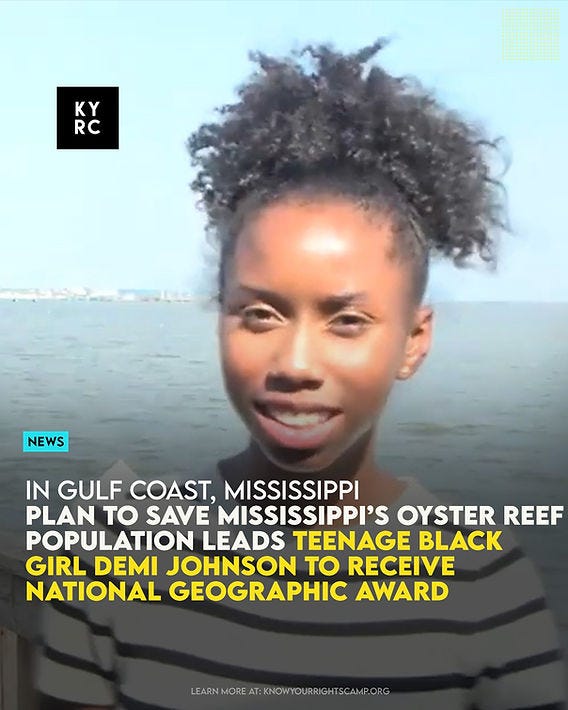
A ninth grader received the National Geographic Award for a plan to save the Mississippi oyster reef population.Let that sit for a second.Her name is Demi Johnson. She’s from Gulfport, Mississippi, right there on the Gulf Coast where I’m at. And this young lady produced 1,100 oysters that would spawn millions of larvae into the ecosystem. Not in a government laboratory. Not with a multi-million dollar contract. Not with a team of marine biologists on payroll. She did it through the Mississippi Oyster Gardening Program, maintaining wire cages of juvenile oysters at Schooner Pier in Biloxi, cleaning debris and predators off her oyster garden once a week with help from the Department of Marine Resources. She started this work in the seventh grade. By ninth grade she was a top-15 finalist in National Geographic’s Slingshot Challenge, competing globally, and was one of only two students recognized in the entire United States.And what did she receive for this brilliance? A $1,000 scholarship.Now let me give you the other side of the receipt. Since Hurricane Katrina damaged or destroyed more than 90 percent of Mississippi’s oyster reefs in 2005, two state agencies have spent $55 million trying to restore the Mississippi Sound oyster population. Fifty-five million dollars. And according to ProPublica and the Sun Herald, the state invested millions of those dollars to rebuild reefs in ways that did not respond to changing conditions. In one project alone, the Department of Environmental Quality spent nearly $2.5 million deploying limestone onto reef beds, and monitoring showed more reef loss than gain. Between 30 and 90 percent of the material they sprayed sank into the mud where oysters cannot even grow. A third-generation oyster fisherman named Keath Ladner put it plain: they are just wasting money, and the fishermen know this.Even the executive director of the Mississippi Department of Marine Resources, Joe Spraggins, acknowledged the absurdity of the spending at a fisherman’s meeting in 2021 when he said he could probably go buy 100,000 sacks of oysters in Texas every year and give them to the fishermen to sell and come out cheaper.Feel me?So we got $55 million in government restoration spending. We got limestone sinking into mud. We got agencies admitting the approach is not working. And then we got a Black girl from Gulfport who grew 1,100 oysters at a pier in Biloxi that are projected to spawn millions more. And she got a thousand dollars. When I was in ninth grade I was not thinking about ecosystems or the environment and damn sure not oysters. But Demi Johnson was thinking about it. She was executing on it. And her site is expected to produce more biological impact than projects that cost the state tens of millions.The only thing that comes to mind is will she receive any of the millions and millions of dollars the state of Mississippi has invested in this oyster reef based on the success and how she was able to restore the same reef that they have been trying to fix? Maybe I am missing something.The History They Will Not Teach YouNow here is where the story deepens, because this is not just about oysters. This is about the fact that Black people have been central to the oyster industry in this country since before emancipation and y’all will never hear about it in a classroom.Biloxi, Mississippi was known as the Seafood Capital of the World during the late 19th century. Millions of pounds of oysters and shrimp were hauled out of the Mississippi Sound every year. After emancipation, Black people who had been enslaved in the shellfish industry were able to find financial freedom as oystermen. Think about that. The same waters where Black labor was exploited under bondage became the waters where Black men carved out economic independence after the war. It was one of the few industries where discrimination was, in relative terms, slacker on the waves than it was on land. Black men owned boats. They harvested oysters. They built businesses.And then there is Thomas Downing. Born in 1791 on Chincoteague Island, Virginia, to parents who had been enslaved and freed. Downing grew up raking oysters and fishing along the Chesapeake coast. He eventually made his way to New York City, where in 1825 he opened Downing’s Oyster House at 5 Broad Street, right in the heart of Manhattan’s financial district, steps from Wall Street. This was not a dive bar. This was fine dining with chandeliers, carpeting, and a clientele that included bankers, politicians, and dignitaries. The man was shipping pickled and fried oysters internationally. Queen Victoria allegedly received his oysters overseas.But here is the part that will never make the textbook. While New York’s white elite were dining upstairs at his oyster house, Thomas Downing was hiding fugitive slaves in the basement. His restaurant was a stop on the Underground Railroad. He co-founded the all-Black New York City Anti-Slavery Society in 1836, funded schools for Black children, and fought to desegregate New York’s trolley system. In 1838, he was beaten for refusing to give up his seat on a segregated railcar. That was over 100 years before Rosa Parks. When Downing died in 1866, the New York Chamber of Commerce closed for the day to honor him. He became a United States citizen just one day before he died, through one of the first Civil Rights Acts.That is Black history. That is the oyster’s connection to Black liberation. And the fact that in 2024 a Black ninth grader from the Gulf Coast is the one solving the oyster reef crisis that the state government cannot spend its way out of is not a coincidence. It is a continuation. It is ancestral. It is on brand.Education Is Elevation is a reader-supported publication. To receive new posts and support my work, consider becoming a free or paid subscriber.Climate Change Is the Context They Keep IgnoringNow let me be clear. We cannot have a conversation about the Mississippi oyster reef without talking about climate change, even though certain politicians want to act like the phrase itself is a hoax. The Gulf Coast is one of the most vulnerable ecosystems on the planet when it comes to rising sea temperatures, ocean acidification, and the increased frequency of catastrophic storms.Hurricane Katrina destroyed more than 90 percent of Mississippi’s oyster reefs in 2005. Five years later, BP’s Deepwater Horizon disaster dumped over 200 million gallons of oil into the Gulf of Mexico. Then in 2019 and 2020, the Army Corps of Engineers opened the Bonnet Carré Spillway to manage Mississippi River flooding, pouring freshwater into the Mississippi Sound and killing off juvenile oyster populations that require salty or brackish water to survive. Each one of these events is compounded by a warming planet. Marine temperatures in the Gulf exceeded 100 degrees Fahrenheit near southern Florida in 2023. Ocean acidification is altering the seawater chemistry that oysters need to build their shells. Rising sea levels threaten the intertidal zones where reefs exist.And here is the part that matters for this story specifically. Oyster reefs are not just seafood. They are climate infrastructure. A single adult oyster can filter up to 50 gallons of water per day. Multiply that across an entire reef and you are talking about massive water quality improvement. Oyster reefs provide habitat for over 300 marine species. They serve as natural breakwaters that reduce coastal erosion and buffer shorelines from storm surge. They sequester carbon in a way that is cost-effective and energy efficient. In other words, oysters fight climate change while climate change fights oysters. And the person who figured out how to tip the balance back in our favor was a Black girl from Gulfport with a Girl Scout project and no government contract.But we are cutting EPA funding. We are rolling back environmental protections. We are pulling out of climate agreements. The same states spending millions on restoration are electing officials who deny the science that explains why the restoration is needed in the first place. That ain’t it though. The cognitive dissonance is the disaster. And the fact that a child is doing the work that government agencies and corporate interests have failed to do should embarrass every adult in the room. Facts over feelings.The Question Nobody Wants to AnswerThe question I keep coming back to is simple. Mississippi has invested tens of millions of dollars into oyster reef restoration. Demi Johnson demonstrated a scalable, community-based approach that works. Her 1,100 oysters are projected to spawn millions of larvae. She received international recognition from National Geographic. She competed globally and was one of two American students recognized.Will she receive any of the investment money? Will her method be scaled? Will the state fund her approach with the same enthusiasm it funds limestone barges that sink into the mud? Or will she get a pat on the head, a $1,000 scholarship, and a good luck on your future while the same agencies continue spending millions on strategies that their own monitoring data says are failing?Because if a ninth grader can outperform $55 million in government spending with 1,100 oysters and a wire cage at a pier, that is not just impressive. That is an indictment. That is a receipt. That says the problem was never a lack of money. The problem was a lack of imagination, a lack of community engagement, and a refusal to center the people closest to the water in the solutions. The fishermen have been saying it for years. A state senator from Mississippi introduced legislation to let the fishermen who know and understand the fishery have the opportunity to restore the reefs. Because the people who live it know more than the people who study it from a distance.This is bigger than oysters. This is about who we trust with solutions. This is about whose brilliance gets funded and whose brilliance gets a news cycle and a thousand-dollar check. This is about the fact that the same structures that extract Black labor and Black genius from communities are the same structures that refuse to reinvest in those communities when the genius shows up with the answer.Demi Johnson is the answer. The question is whether the system is ready to listen to a Black girl from the Gulf Coast.Education is elevation.PAID SUBSCRIBER EXPLICIT ASKI’m fighting to fill a critical void left by the retreat of public education media. I document and teach the histories, legal frameworks, and cultural knowledge that are being systematically erased or distorted. With no corporate backing or wealthy sponsors, this work depends entirely on readers like you. As a Black educator and researcher my work depends entirely on a community of readers, not corporate sponsors. If everyone reading this became a paid subscriber, we could build a full-time digital sanctuary: a new, independent source of PBS-depth reporting and curriculum, centered on Black expertise. But right now, less than 1% of my followers are paid subscribers.Education Is Elevation is a reader-supported publication. To receive new posts and support my work, consider becoming a free or paid subscriber.5 KEY TAKEAWAYS1. The Investment Gap Is the Story. Mississippi has spent $55 million on oyster reef restoration with poor results. Demi Johnson, a Black 9th grader from Gulfport, achieved measurable ecological impact through a volunteer community-based program and received $1,000. The disparity between institutional spending and community-based results reveals who the system trusts with solutions — and who it does not.2. Black People Have Been Central to the Oyster Industry Since Emancipation. From post-Civil War oystermen in Mississippi and the Chesapeake Bay to Thomas Downing’s Underground Railroad station beneath his fine dining oyster house in Manhattan, Black labor, Black innovation, and Black resistance have been woven into the oyster’s story in America for over 150 years. This history is systematically untaught.3. Oysters Are Climate Infrastructure, Not Just Seafood. A single oyster filters 50 gallons of water per day. Reefs protect shorelines, house 300+ marine species, and sequester carbon. The decline of oyster reefs is an ecological emergency compounded by the very climate change that threatens them — and that too many politicians refuse to acknowledge.4. Community-Based Solutions Outperform Top-Down Bureaucratic Spending. Demi Johnson’s approach through the Mississippi Oyster Gardening Program — a volunteer initiative using wire cages and weekly maintenance — produced results that $55 million in government contracts could not replicate. The fishermen and the communities closest to the water have always understood the reef better than the agencies studying it from a distance.5. Brilliance Without Investment Is Exploitation by Another Name. Recognizing Demi Johnson’s achievement without funding her method at scale is the same pattern Black communities have endured for centuries: extract the innovation, praise the individual, and refuse to invest in the community. The question is not whether her approach works. The question is whether the system will fund it.ANNOTATED BIBLIOGRAPHY / RELATED READINGS* “Mississippi Has Invested Millions of Dollars to Save Its Oysters. They’re Disappearing Anyway.” — ProPublica & Sun Herald (2023). * “Meet the Ninth Grader Who’s Helping Restore Mississippi’s Oyster Reefs” — PBS NewsHour (2024). Profile of Demi Johnson’s work through the Mississippi Oyster Gardening Program, her National Geographic recognition, and the ecological significance of her 1,100 oysters.* “Gulfport Teen Receives National Geographic Award for Plan to Save Mississippi’s Oyster Reef Population” — WLOX (2024). * “Meet Mississippi’s National Geographic Award-Winning Teen” — Reckon News (2024). * Thomas Downing (1791-1866) — Encyclopedia Virginia. * “How Oysters Became a Source of Economic Freedom for Emancipated Black Folks” — Earth in Color (2023). * “Could Billions of Oysters Protect Us from the Next Big Storm?” — National Geographic (2023). Thanks for reading Education Is Elevation! This post is public so feel free to share it. This is a public episode. If you'd like to discuss this with other subscribers or get access to bonus episodes, visit theconsciouslee.substack.com/subscribe
Embed this episode
NOW PLAYING
A 9th Grader Did What $55 Million in Government Spending Could Not: The Demi Johnson Story
No transcript for this episode yet
Similar Episodes
No similar episodes found.
Similar Podcasts
No similar podcasts found.