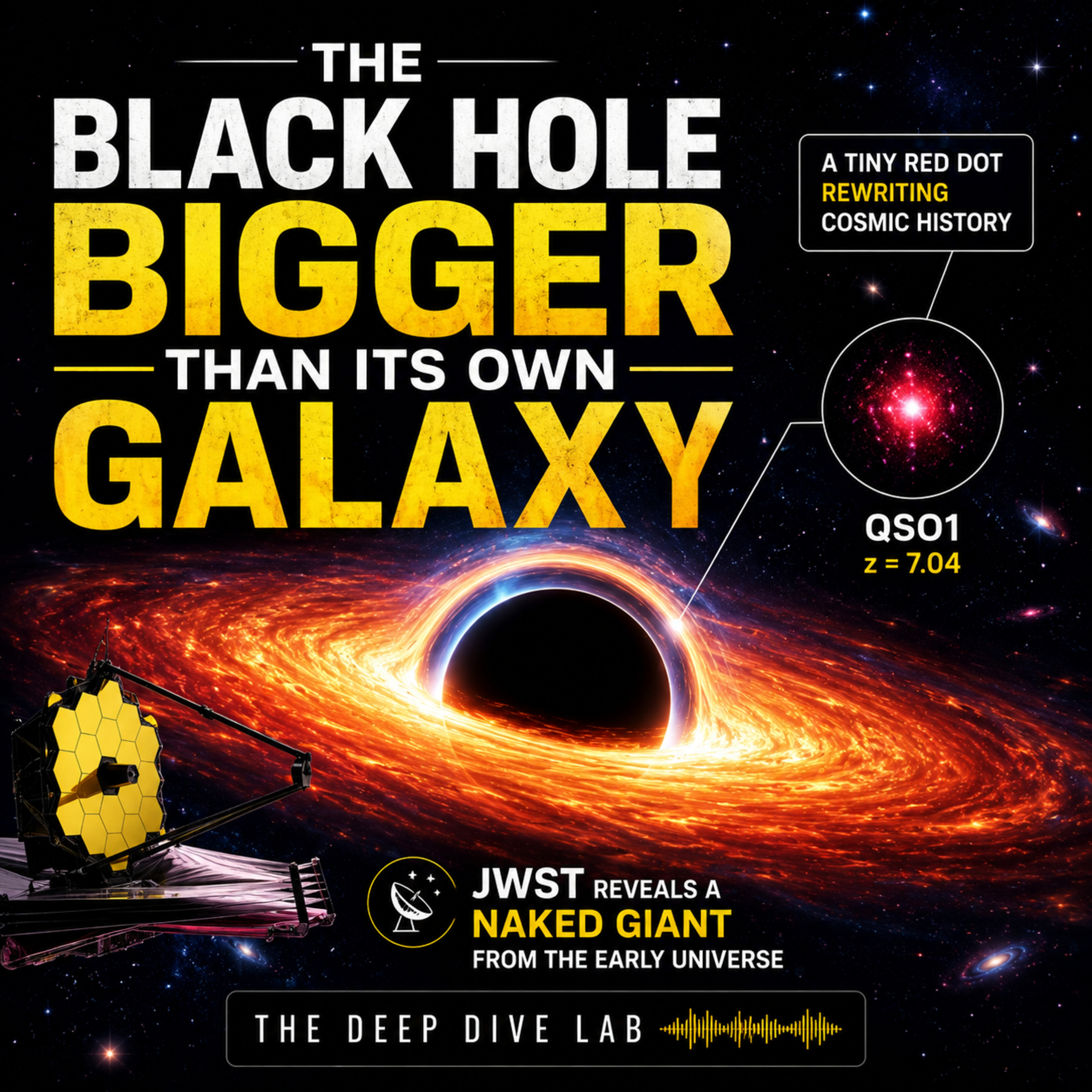
A Black Hole More Massive Than Its Entire Galaxy? episode artwork

EPISODE · Jun 12, 2026 · 20 MIN

A Black Hole More Massive Than Its Entire Galaxy?

from The Deep Dive Lab: Unraveling Materials Science · host Son Hoang

🌌🕳️ How can a black hole be more massive than the galaxy that hosts it?In this episode of The Deep Dive Lab, we explore one of the most astonishing discoveries of the James Webb Space Telescope (JWST): a mysterious object known as QSO1, one of the newly discovered Little Red Dots lurking in the early universe.Using gravitational lensing and advanced dynamical measurements, astronomers directly weighed the black hole at the center of QSO1 and found that it contains roughly 50 million solar masses. Even more surprising, the black hole may outweigh the entire stellar population of its host galaxy.This discovery challenges long-standing theories of galaxy formation and raises profound questions about the origins of cosmic structure. Did black holes form before galaxies? Could they have acted as the seeds that shaped the first galaxies in the universe? And what does QSO1 reveal about the mysterious "Cosmic Dark Ages" just a few hundred million years after the Big Bang?Join us as we dive into one of the most important astronomy discoveries of the JWST era and explore how a tiny red dot may be rewriting the history of the cosmos.📚 Sources:• Juodžbalis, I. et al. A Direct Black-Hole Mass Measurement in a Little Red Dot at High Redshift. Nature (2026).• Furtak, L. J. et al. A High Black-Hole-to-Host Mass Ratio in a Lensed AGN in the Early Universe. Nature (2024).• Maiolino, R. et al. A Black Hole in a Near-Pristine Galaxy 700 Million Years After the Big Bang. MNRAS (2026).#JWST #BlackHole #Astronomy #Cosmology #EarlyUniverse #JamesWebb #LittleRedDots #GalaxyFormation #SpaceScience #Astrophysics #SciencePodcast #DeepDiveLab 🚀🌌🔭🕳️

🌌🕳️ How can a black hole be more massive than the galaxy that hosts it?In this episode of The Deep Dive Lab, we explore one of the most astonishing discoveries of the James Webb Space Telescope (JWST): a mysterious object known as QSO1, one of the newly discovered Little Red Dots lurking in the early universe.Using gravitational lensing and advanced dynamical measurements, astronomers directly weighed the black hole at the center of QSO1 and found that it contains roughly 50 million solar masses. Even more surprising, the black hole may outweigh the entire stellar population of its host galaxy.This discovery challenges long-standing theories of galaxy formation and raises profound questions about the origins of cosmic structure. Did black holes form before galaxies? Could they have acted as the seeds that shaped the first galaxies in the universe? And what does QSO1 reveal about the mysterious "Cosmic Dark Ages" just a few hundred million years after the Big Bang?Join us as we dive into one of the most important astronomy discoveries of the JWST era and explore how a tiny red dot may be rewriting the history of the cosmos.📚 Sources:• Juodžbalis, I. et al. A Direct Black-Hole Mass Measurement in a Little Red Dot at High Redshift. Nature (2026).• Furtak, L. J. et al. A High Black-Hole-to-Host Mass Ratio in a Lensed AGN in the Early Universe. Nature (2024).• Maiolino, R. et al. A Black Hole in a Near-Pristine Galaxy 700 Million Years After the Big Bang. MNRAS (2026).#JWST #BlackHole #Astronomy #Cosmology #EarlyUniverse #JamesWebb #LittleRedDots #GalaxyFormation #SpaceScience #Astrophysics #SciencePodcast #DeepDiveLab 🚀🌌🔭🕳️

NOW PLAYING

A Black Hole More Massive Than Its Entire Galaxy?

0:00 20:32

No transcript for this episode yet

We transcribe on demand. Request one and we'll notify you when it's ready — usually under 10 minutes.

Frequently Asked Questions

How long is this episode of The Deep Dive Lab: Unraveling Materials Science?

This episode is 20 minutes long.

When was this The Deep Dive Lab: Unraveling Materials Science episode published?

This episode was published on June 12, 2026.

What is this episode about?

🌌🕳️ How can a black hole be more massive than the galaxy that hosts it?In this episode of The Deep Dive Lab, we explore one of the most astonishing discoveries of the James Webb Space Telescope (JWST): a mysterious object known as QSO1, one of the...

Can I download this The Deep Dive Lab: Unraveling Materials Science episode?

Yes, you can download this episode by clicking the download button on the episode player, or subscribe to the podcast in your preferred podcast app for automatic downloads.
URL copied to clipboard!