
EPISODE · May 24, 2026 · 34 MIN
A Chronicle of Crowns - Part II
from Kobi One Podcast · host Kobi One
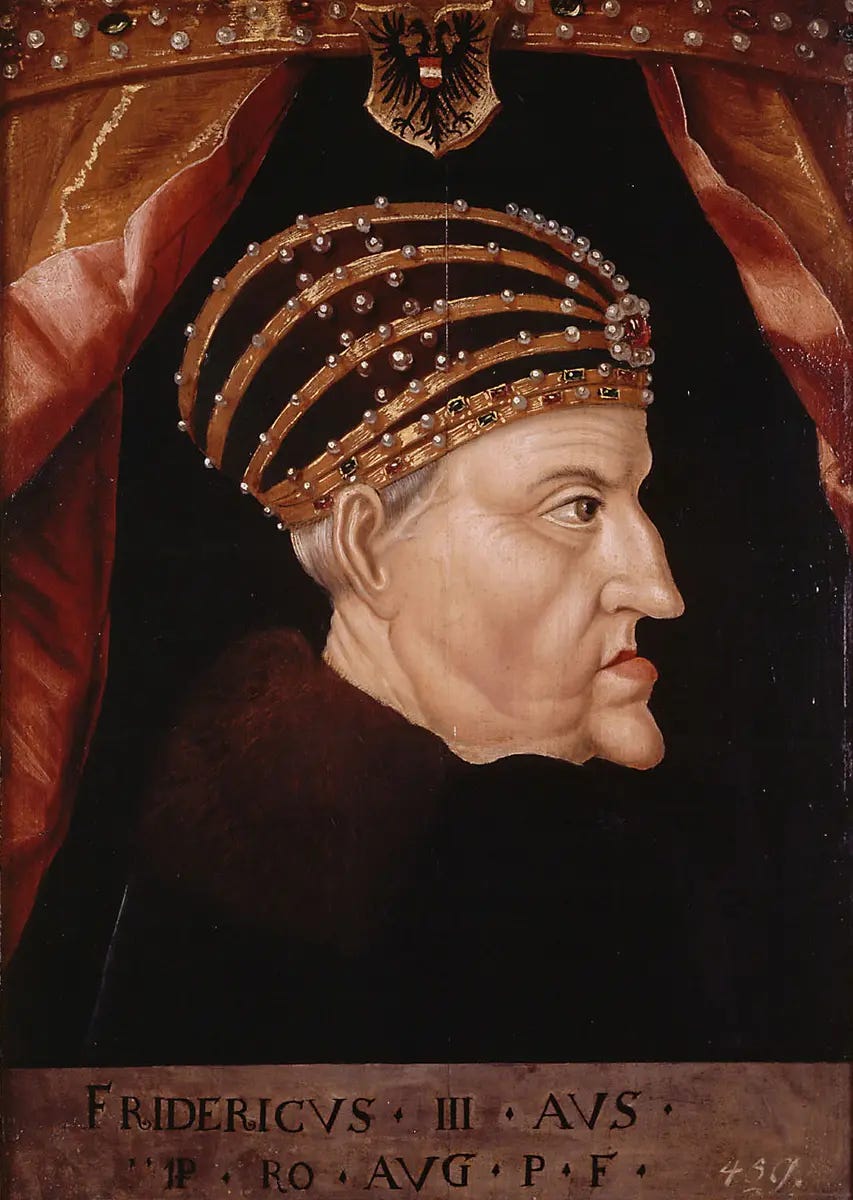
He wakes up, sunlight already creeping through the shutters, something forces itself upon his consciousness. A blood-curdling scream. And people, a great big many of them, cheering. How long did he sleep? What was going on?He opens the shutters, the morning sun blinds him for some seconds. Then, terror sets in. On the wooden post in the centre of De Markt, the main square of Bruges, he sees his friend, his confidant, his sheriff, Pieter Lanchals.The guilds of Bruges were having the sheriff tortured right there, on the square in front of this newfound prison, to send a bloody message. The message was clear. The guilds were reclaiming power from Habsburg control. And here he was, stuck in the Craenenburg House, watching idly by in helpless terror as his friend was bled dry in his name over the same post where they, together, did the very same to many others before.Those of you that were there for part 1 of this series might have surmised who this man is, watching his friend being tortured in public, imprisoned in Bruges. His name, Maximilian of Habsburg. And he is not feeling too great at the moment. But he will have his day of revenge, the echoes of which still reverberate in Bruges, hundreds of years later.Before we get that far however, we take a couple of steps back, back into the far-flung past of the Habsburg dynasty. We go, to Switzerland! Better dress appropriately, it will be cold up in the mountains.ACT ONE — WHO WERE THE HABSBURGS?It’s around 1025 AD, we are in the Swiss cantons at a height of 505 meters and through the foggy mist of time we close in on a keep. Looking down from the walls of this perfectly situated and grand tollhouse you could see the beautiful river Aar carving out its legacy in stone through these cantons for thousands of years already. And with it come merchants from high and low.And here they were, Count Radbot of Klettgau and his brother-in-law Werner, Bishop of Strasbourg, the brothers of the Habichtsburg, ready to tax the ever living daylights out of all who passed.The castle sat on the hill above the Aar River and the road that ran alongside it. Both the river and the road were major trade routes connecting the Alpine passes to the Rhine and onward to the North Sea markets; wool, grain, salt, silver, wine, all moving through this corridor constantly. Anyone who wanted to use the ford or the road paid.The count’s men would be stationed at the crossing point below the castle. You couldn’t cross the river or pass through without going through the checkpoint. The castle above was both the administrative centre and the visible threat. You want to pass? You pay. And you get a good look at what’s coming for you if you don’t. Military intimidation itself wasn’t the only power wielded, however.The bishop of Strasbourg, Radbot’s brother-in-law who co-founded the castle, gave the whole operation a religious legitimacy. Church involvement in toll collection was quite commonplace and very useful. You didn’t mess with God and if you did, man would be ready to defend God’s honour. Read: steal your money.The rivers were particularly valuable because boats carried much larger loads than carts. A toll on river traffic at a controlled crossing point was passive income at scale. You built the castle once and the trade routes did the work for you indefinitely. Which is exactly what the Habsburgs did. Build once, collect forever. The same logic they later applied to marriage; acquire the asset and let it generate returns.This worked well for quite some time, until the Swiss did what they would do to Charles The Bold of Burgundy 60 years later, push them out of the cantons. In fact, those that remember from the previous episode, our Charles the Bold’s defeat was threefold, three battles lost. Though less dramatic and much slower, the Habsburgs, here in their infancy as a dynasty, lose their grip on the cantons in a threefold defeat as well.First two battles occurred, be they 71 years apart, Morgarten 1315 and Sempach 1386. These were the first two blows. The nail in the coffin for the version 1.0 of the Habsburg-Swiss edition, came in 1415 with the loss of Aargau. Duke Frederick IV, nicknamed the Duke of Empty Pockets because of the glaring hole therein, supported the wrong side during a Church council dispute. That was all it took. The perfect excuse for the perfect storm. The Swiss Confederacy, called upon by the Holy Roman Emperor, reclaimed Aargau and the Habichtsburg with it. The Habsburgs were driven towards Austria.Before we dutifully follow them there, I find of note, the two different ways of writing the original name of this tollhouse, this keep on the Aar; the Habichtsburg or the oldest recorded version, Havichsberch.Number one would be the keep of the hawk, after a hawk that once sat perched on the castle walls, which seems to be trying too hard. Number two then, the oldest version, would refer to the castle at the crossing, which seems to do all the work and none of the effort. Named after a tollhouse would be very fitting. Scholars and historians went with number one, I am neither.ACT TWO — THE AUSTRIAN HABSBURGSI mention in part 1 how there is a difference between old Rome and Julius Caesar and the Roman-Catholic empire of the middle ages. To understand where the Habsburgs came from, we have to understand this difference better.Old Rome, the Roman EmpireThis is the empire that Julius Caesar and Augustus built. At its height it controlled everything from Britain to Mesopotamia. It split into Western and Eastern halves in 285 AD. The Western Roman Empire collapsed in slow motion forever and ever and some people stipulate it just moved to Great Britain and afterwards America. Either way, the official date of death for Rome is pinpointed at 476 AD, when the last emperor was deposed by a Germanic chieftain. Also that is quite the statement seeing as the Eastern half, with Constantinople already being the capital of the empire, continued as the Byzantine Empire for a long time after. That Rome that is so heavily romanticised — pun intended — the legions, the senate, the emperors in togas, that was officially out the door.I will make a podcast episode on both Julius Caesar and his business with the old Belgians, the Belgae, and how the collapse of the Western Roman Empire wasn’t a collapse but a slow dance between the old Romans and the Germanic tribes such as the Franks and the Burgundians. Both these stories deserve their telling in full.The Holy Roman Empire, the confusing oneIn 800 AD the Pope crowned the Frankish king Charlemagne, also known as Charles the Great, as Emperor of the Romans in an attempt to revive the idea of a unified Christian empire in the West. It had nothing to do with the original Rome geographically or institutionally. It was a Germanic-based collection of kingdoms, duchies and city states in central Europe held together loosely by the idea of Christian unity and the authority of the emperor. It was a power move.Voltaire famously said it was neither holy, nor Roman, nor even an empire. Here, he finds a friend in me.The Habsburgs moved to Austria and continued building their riches in the same way as before, build once, collect forever. They built, and paid for, monasteries all throughout Europe. Then they offered them protection in return for a percentage on whatever they made.The Holy Roman Emperor Frederick II and the Habsburgs got quite close and when he died, terminating a 30 year stretch, the Holy Roman Empire collapsed like an unlucky crème brûlée. After changing emperors like a merry-go-round, an emperor was decided upon. There existed in this Roman-Catholic order no hereditary passing of the crown. This is how Rudolf of Habsburg became the Holy Roman Emperor many years after Charlemagne, in 1273. He was but a minor Swiss count, his family previously driven out by the Swiss Confederacy on behalf of the — yes — Holy Roman Emperor, with no long standing ties or deep-seated roots in these regions. He seemed like a perfect candidate to become that very Holy Roman Emperor. He was elected by seven Prince-Electors, who hoped this fragile and weak looking man would be easily steered, easily controlled.They were wrong.The world mistook his physical frailty for him being easily manipulated, malleable. Rudolf was however very wealthy, shrewd and quite ruthless. Through diplomacy and marriage, he expanded his family’s holdings significantly. His daughters ventured out into every single powerful dynasty available. Within a single generation, the tentacles of the Habsburg Hydra had spread and attached itself to all of Austria and were worming their way through half of Europe. The marriage machine was put on extra time. The Prince-Electors knew by now what they had wrought and did what they had done before. Soon as Rudolf died, they opted out of Habsburg control and went with Adolf of Nassau.Rudolf’s son Albrecht, the One-Eyed, had set his heart on the crown however and had orchestrated a battle in which he defeats and kills Adolf of Nassau in 1298 and steals back from him the crown he so desired. The Dutch royals of today are still far-flung family members of this now deceased Adolf of Nassau.The now One-Eyed emperor Albrecht himself was brutally murdered by his own nephew, Johan, but a decade later, in 1308. Not happy with the way the emperor, his uncle, handled his inheritance, by not giving any of it to him directly, he and his accomplices awaited him at a bridge and cleaved his head right in twain. Revenge was swift and brutal. Albrecht’s children decapitated Johan’s entire family and court, they left not a man woman or child alive. This did not help the Habsburg desire for the crown however. It would take the dynasty 132 years to reclaim it for themselves. Do not however for a second think they sat idly by.The grandson of mister one-eye, yet another Rudolf — yeah, not great when it comes to creativity, but very good at recycling, very avant-garde — would forge a document known as the Privilegium Maius. In this document many wondrous claims are made, such as the Habsburgs being actually descended from Julius Caesar himself, amongst others. All hogwash and poppycock to be sure. Oh by the way, poppycock isn’t nearly as posh as it sounds. It stems from Dutch pappe kak, which means diarrhoea. Rudolf the howevermanieth even invented a new title of Archduke. If he couldn’t be emperor he was still damn well going to be more duke than all the other dukes. Sadly enough for him, the documents were provably falsified and the world kind of told him to get arch-duked.During this period the dynasty came very close to its end for no male heirs were forthcoming until Cymburgis of Mazovia, wife of Archduke Ernst of Austria, popped out a boy. I use the term popped rather loosely because Cymburgis is chronicled to be an insanely energetic woman known to crack nuts with her fingers whilst whistling and hammer nails into wood with her fists. Though Cymburgis was clearly first in line whilst God was handing out energy levels and strength, her son seemed to have missed the queue altogether. Frederick III, Cymburgis’ son, would be chosen as emperor in the year 1440. Enough time had passed and the Prince-Electors had forgotten that appearances might well lead you astray.Frederick III had inherited none of his mother’s energy and all of her looks. He was a chubby, introverted boy with a big and very long nose and already plagued by the now infamous Habsburg jaw. He would pale easily at the prospect of any real physical exercise and preferred gardening. He appeared so sleepy he earned himself the nickname of Heiligen Römischen Reiches ErzSchlafmütze, The Holy Roman Archsleepyhead. They thought, now here is a malleable son of a gun. History does not repeat, man indeed does.To make the irony all the more sweet, Frederick III was crowned by papal decree, by the big man himself, Pope Nicholas V. Crowned and cloaked with Charlemagne’s swag, it was now official. The Habsburgs now had the made-up title of Archduke, the actual title of Holy Roman Emperor — which was then again totally made up 600 years earlier, but I digress — and had officialised the entirely fabricated Privilegium Maius, which embedded the dynasty with a right to rule that would plague the world for centuries to come.And this, my friends, is where we find our protagonist of part 1, Charles the Bold and his meet-up in Trier with none other than mister Archsleepyhead himself, Frederick III and his son, Maximilian of Austria. Here we are back at the meeting that leads directly to the demise of the Burgundian era. The fall of Burgundy was, for the Habsburgs, accompanied by the sound of victorious trumpets for they scored the marriage of the century because of it.Mary of Burgundy marries Maximilian of Austria after the death of her father to keep the French talons from gripping into Burgundian flesh and it actually worked. The French were kept at bay and Ghent rejoices, flowers greet Maximilian when he first arrives in Ghent. Maximilian had never seen Mary before this day, nor had he ever set foot in the palace of Ghent, Hof ter Walle, before. If he hadn’t realised just yet the unimaginable wealth he had married into, the sight of this palace would have set him straight. It counted a good 300 rooms, 28 chimneys, a private zoo containing amongst others a bear and lions, and had within the palace grounds its very own lake, which in turn had its own island, reachable only by boat. Wealthy did not quite cut it.In part 1 we touched upon the proxy marriage, so it would be fitting to include here a detail of the actual wedding ceremony.Love was in the air it seems, when they met at the gates of Hof ter Walle. Though Max had that distinct Habsburg jaw, he was, unlike his father, blessed with his grandmother’s energy and strong physique. Mary only spoke French and Max only spoke German so their first conversation was probably not of note, but the total bungling of the wedding ceremony by Maximilian’s unpractised hands is. Mary had hidden in her corset a carnation and Max was supposed to liberate it from Mary’s hidden corners. He had been duly briefed by Mary’s handmaidens on the general whereabouts thereof but seemed unable to locate it at all. Luckily the Bishop of Trier jumped in to assist the bumbling Max. He asked of Mary to open her corset a bit more and out came the flower.The relationship would be chronicled to be quite amorous and they seemed genuinely keen on each other but alas, Mary falls from a horse during the hunt, breaks her neck and dies. When the Flemish cities found out about the last-minute clause that she had added very shortly before her death, they went into an uproar. The cities had been persuaded to allow Mary and Max to exercise an equal amount of power, to rule together equally, and for their Ghent-born children to be next in line. At Mary’s death, they would normally elect a steward and regent for Ghent until Philip the Handsome came of age. But Mary had apparently signed over regency of Ghent to Max in the event of her death. So now Ghent, and with it all other major Flemish cities, were ruled over by an Austrian Habsburg who had no interest whatsoever in the welfare of the cities and their inhabitants but a great deal of interest in all the money they were generating. The fire was lit, the pressure cooker was almost exploding and then...POPACT THREE — THE REBELLIONWe are back in Bruges in the year 1488. Ghent had started yet another rebellion against the Habsburgs and Maximilian had assembled the Staten-Generaal (the prelude to the Belgian form of government) to discuss the Ghentian rebellion and what to do to stop it. The people of Bruges were also fed up with being lorded over by a foreigner. Who did this Austrian man think he was anyway, waving his chin around these parts? The people of Bruges hounded Maximilian into the Craenenburg House on De Markt of Bruges — a house you can visit to this day — and Max refused negotiations. This is how we get to the wooden post. Or almost.First, it is important to state that Bruges, Ghent and Ypres were three of the biggest cities in all of Europe during this period. When, in the 14th century, Amsterdam counted but 3,000 inhabitants, Ghent stood tall at 65,000 inhabitants, only to be surpassed by Paris at 80,000. Ypres, a city remembered by few today, was as big as London in those days. And between the cities there was serious cooperation. The people of Bruges and Ghent had, in the 12th century, connected the seaport of Bruges all the way to the heart of the Ghentian grain harbour through a manmade canal that was 45 kilometres long, dug entirely by hand. That is 17 years of digging, 17 years of sweating together. The people of Bruges, and all the other major Flemish cities, sided with Ghent. All but Antwerp. This is of note for our story.As Maximilian sat in the same house he and his now deceased wife had so often frequented and stayed at, he refused to cave to the cities’ and the guilds’ demands. He put his foot down and that was where it stayed. No negotiating with terrorists. For three long months he watched his friends and men being taken to the wooden post and tortured and eventually, after a lot of anguish and pain, killed. And now it was his dear friend Pieter Lanchals who was screaming out in pain. When his head was taken, all strength and will had left Maximilian and he finally caved to all the demands made by the cities.During all of this, while Maximilian sat imprisoned, Ghent was in the throes of a siege. Maximilian’s father, Archduke sleepyhead, had rallied an army of mercenaries. When he called out for help, none of the Flemish cities came to his aid except for Antwerp. The Austrians and the Antwerpians laid siege to Ghent from what we today call Wondelgem. If you were to follow the route the old canal made from the old seaport of Bruges via Damme towards Ghent, you would cross Wondelgem just before arriving at the walls of the city, about 2 to 3 kilometres from the walls. This was an excellent place for a siege, thought Frederick III. Cut them off from the most important trade route they have, starve the city financially and threaten the city militarily. But the Austrian had not studied up on his etymology. The Ghentians are Flemish, which can trace its name back to mean the people of the flooded land. We know a thing or two about water.The canal they were now blockading had been dug as a cooperative effort between Ghent and Bruges. To get from one place to the other, they had to dig through hills and such. The water level was far from even, so waterlocks were installed. Primitive, single-gated waterlocks. Built into the main walls of the city, 2 to 3 kilometres removed from where the Austrians and their mercenaries now sat, stood a massive wooden waterlock. Whilst being besieged, the Ghentians opened their lock and left it open, letting water gush out to an epic extent. All of a sudden the Austrians found themselves laying siege in a swamp. Cut off from fresh supplies, the water getting to what food they had, the moisture becoming a breeding ground for disease, and then the secret army of female spies destroyed from within.Eighty women, paid the same wage as their male colleagues, infiltrated the Austrian mercenary camps, carried intelligence between the cities, sowed confusion and discord from inside the enemy lines. One of them, Josine Hellebout from Ypres, carried out eleven separate missions between June 1488 and October 1489 alone. The siege lasted but 40 days and was abandoned.Max caved. The siege failed. The cities took the upper hand once again. But Pope Innocent VIII excommunicated the rebels, chose in favour of Max and repudiated all the concessions that had been wrested from him under duress. Everything Maximilian had promised and admitted under the pressure of captivity was now officially void.And then, the curse.After his release Maximilian’s soldiers plundered Bruges and tore down its fortified walls. In memory of Pieter Lanchals, Long Neck, the swan on his coat of arms, Maximilian decreed that the people of Bruges must keep 100 white swans on the canals of the city for all eternity. If the number dropped below 100, Bruges would fall to ruin and never recover. Approximately 250 swans roam the canals of Bruges to this day. The municipality takes the curse seriously and actively maintains the population.But Maximilian’s revenge on Bruges went further than swans and soldiers. In 1488, infuriated by his conflicts with Bruges, Maximilian ordered all foreign merchants to move fifty miles east to Antwerp. Bruges was already suffering from the silting of the Zwin, the tidal channel that gave it access to the sea, whereas Antwerp’s deep river docks were easily accessible on the tide.The Zwin, the Golden Inlet, was the channel that had made Bruges the richest city in northern Europe. A storm in 1134 had created it, opening a natural channel that stretched to Damme, which became the commercial outpost for Bruges. For three centuries it was the economic artery of the city and became nicknamed the warehouse of Europe. Large ships stopped at Damme and transferred their cargo to smaller boats that could reach Bruges through the locks. The 45 kilometre canal that the people of Bruges and Ghent had dug together by hand ran through this same system.The Zwin had been silting up for decades. Money and maintenance could have slowed it, but Maximilian conducted a kind of economic warfare against the rebellious towns of Flanders. He ordered foreign merchants to leave Bruges in favour of Antwerp. His blockade of Sluis, the port town of Bruges, continued until October 1492. The city that had imprisoned him lost its merchants by imperial decree. The city that had stayed loyal, Antwerp, inherited them.The sea today sits approximately 20 kilometres from Damme. The Zwin is a nature reserve for birds. The canal connecting Bruges and Ghent barely exists. The seaport that made Bruges the Venice of the North disappeared because one man had gotten his feelings hurt.In 1480 Antwerp had 33,000 inhabitants. By 1526 it had almost doubled in numbers to a staggering 55,000. Within forty years of Maximilian’s decree, Antwerp had become the largest city in the world. The water giveth, and the water taketh. Control the waterways, control the world, classic Habsburg.And as you might know from the first instalment of Strange Origins, this is by far not the end of the Habsburg tale. In fact, from my perspective, this is where it all really sets off. The Spanish have finally warded off the Moors and got unified. The king and queen of the two respective halves make a deal with the marriage machine devil and wed their daughter, in succession to the crown of Spain, to a Habsburg known as Philip the Handsome. And here the political dance of chairs becomes almost comical in nature and so over the top dramatic, almost as if scripted from a tragic Greek epic.The marriage between Philip the Handsome and Juanita la Loca, Joanna the Mad, and all the madness that would ensue would become food for many a play, book or in this case podcast. But that podcast will be in a next edition of the Kobi One podcast, A Chronicle of Crowns, part 3.Thank you and see you then.SONG @ THE CURSE => PYREX - THE CURSE https://www.youtube.com/watch?v=HNI-EGQBfL4&list=RDHNI-EGQBfL4&start_radio=1All other music either not copyrighted or my own;https://open.spotify.com/album/5szDxctMvey8k3K6EBZTp1?si=nGxu5QKDSWmwlSWXF9hKqgBUY ME A COFFEE BABY!!buymeacoffee.com/kobecooman3READ MORE @ https://substack.com/@kobione Get full access to Kobi One at kobione.substack.com/subscribe
Embed this episode
NOW PLAYING
A Chronicle of Crowns - Part II
No transcript for this episode yet
Similar Episodes
No similar episodes found.
Similar Podcasts
No similar podcasts found.