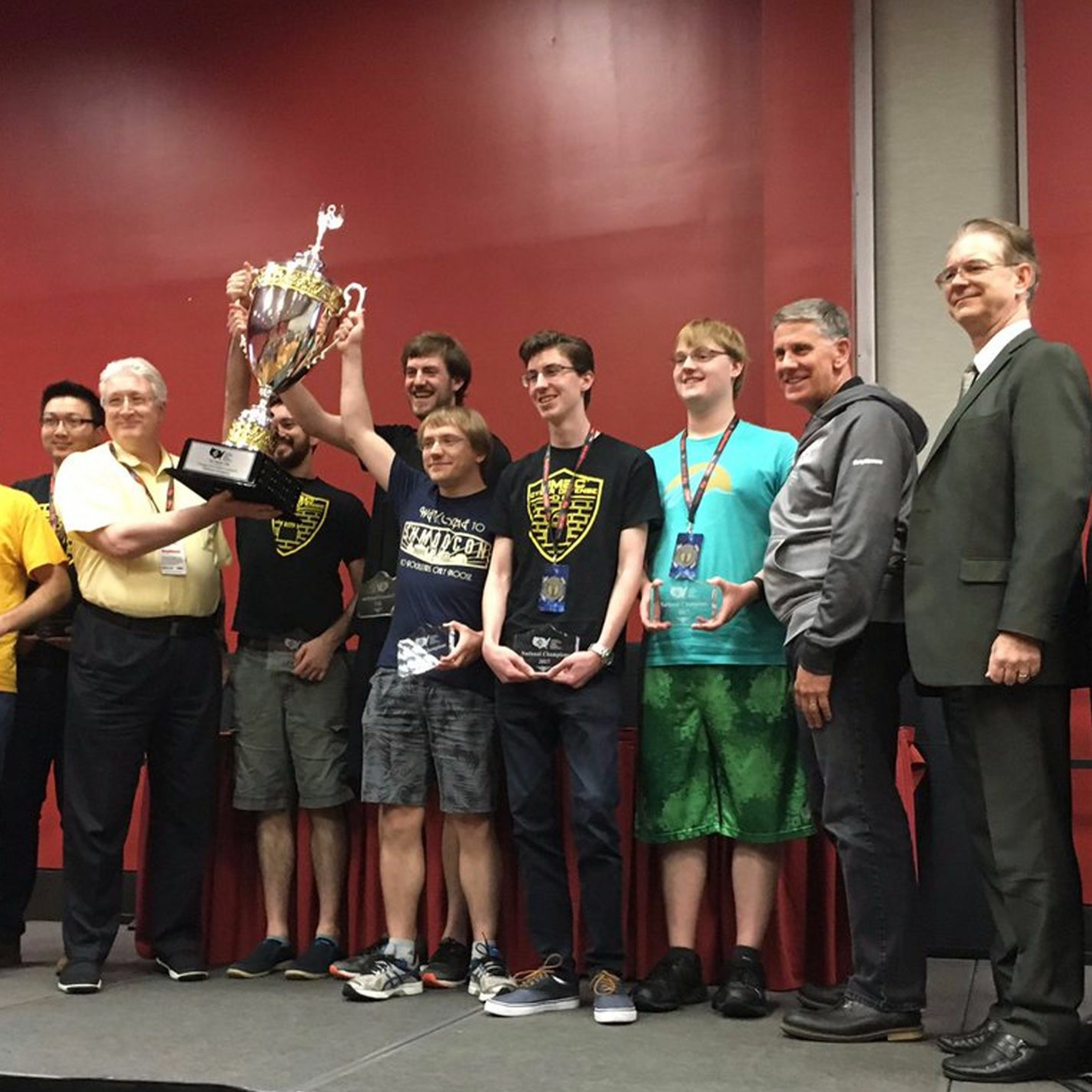
I'm Amy Schafer at the Center for New American Security, where we're thrilled to have as our guests two of the winning team members from the 2017 National Collegiate Cyber Defense Competition. Christian and Justin, thank you so much for joining us today. Thank you for having us. Thank you.
So tell me about NCCDC. Yeah, so what NCCDC does is basically a competition where it's rules from all across the country to come to compete. Each does 10 different regions, and so each region has, you know, between, you know, 10 and even up to 50 schools that are competing for it. To see who can defend the networks the best.
And so each of those regions come together and the best out of each join the national competition. And so basically how the competition works is you have a network that you're given, which is kind of like a company network. And the premise is that the IT team that was there just left, and there was a huge security incident that occurred during that time. And so we're coming in to defend the network and get it back up and running.
So there's an active team that's attacking our networks and we're there to defend it. And we're given around 30 years circuit leaders and, you know, there's only eight of us on a team. And so it's a lot of chaos and, you know, a lot of fun, sort of like. Actually, one more thing I want to add to that.
Not only are we defending them, defending the network from the attackers, but we're also running it at the same time. We have to keep up the normal services that the company is actually running like their website or point of sale systems or databases. And we have to deal with customers at the same time. So it's a bit stressful to deal with both the business side and the attacking side at the same time.
So in addition to the technical expertise, you'd also be sort of fielding phone calls and having to discuss what's going on with customers while you're actively working on these 30 computers. Yes, absolutely. How do you even begin to train for something like that? So we have our club at UMBC.
We have weekly meetings where we will teach new members, you know, cybersecurity topics. And that actually helps us prepare a lot because we learn a lot when we teach it to new people. Not only that, we have a lab that we set up, so we will set up and simulate a network which we are given and we will attack and defend ourselves to sort of prepare ourselves for what we might expect. But ultimately, I think we, you know, prepared to be surprised because that will always happen.
And so it definitely starts late at your freshman year, even if you're not part of the competition. So, you know, people are coming in and learning from these instructions, you know, they're starting to be prepared for the competition years in advance. And so once they get to the point where, you know, they're a junior senior, they've had the experience they need to ultimately win the game. So we actually had two or team members who started knowing very little about security and, you know, four years later, now they're here at M1 Nationals.
Wow, it kind of shows how learnable it's going to be. If you get started early with something like your club, that's fantastic. Absolutely. So what led both of you to this type of worker to join the UMBC team?
Yes, so for me, it started back around middle school. I had a friend who was really interested in this stuff as well. And so we kind of tag teamed and grew more experience through that. And then eventually I started getting into game hacking.
And so what fascinated me was there are these teams where they would do a lot of checks, you know, on your computer rather than on their servers. And so you could do whatever you wanted with the checks. So I'm like, oh, you know, I'm definitely flying around like now. That's totally what I can do.
Or, you know, like everybody on the map can, you know, I can just damage them whenever I want. And so that fascinated me how this was possible. And then I learned, oh, you know, cyber security has a lot of different aspects that are very similar to that. And so that's what really got me into the field.
Absolutely. So how about you? And for myself, it's kind of the same thing. I think curiosity was really what got me into it because I heard about these hackers and I just had no idea how they did it or what they exactly did.
So that curiosity really kind of drove me to figure out, you know, what, how to actually do what they do. And so the game hacking thing kind of got me into it too, you know, when I figured out that I could deny service to my friends when Xbox Live. You know, kind of, you know, really treat me then too. Absolutely.
So I think we've seen a lot of discussion in the national security space as to how we can ensure that rising stars such as yourselves want to be in the national security field potentially working for the Department of Defense or the government. To your mind, what would be the most interesting or compelling things that the government or the DOD could offer to compete against these sort of Silicon Valley powerhouses? Yeah. So I think a big thing is getting people interested in security at a young age.
You know, also a lot of people have in Silicon Valley, they have needs where security is definitely in you, but they also have like, you know, other needs where it's like software development. But one thing that's unique to the government and, you know, the industry surrounding that is that ultimately you're defending our way of life. You know, there's, there's all the time people trying to break into our networks and, you know, even like making systems and such. And if they were just allowed to do that, you know, our whole financial system would come and all that stuff.
And so they're going to spend a lot of money into making sure that doesn't happen. And so one aspect that, you know, you don't get in the sector where, you know, you're going into Silicon Valley and such as that you are defending, you know, the people of this nation through the things that you do. And to me, I find that like really compelling reason as well. And the government's also been putting more money into things like scholarships.
So for example, there's a scholarship for service where they're willing to pay your college and they encourage you to get internships in the government and such. And during the time you have a salary so you can focus on your studies. And so when you get out, you know, you're going straight into the government and you're able to start that early on in your college career and really get that experience when it starts out. Yeah, I think really emphasizing the mission is something that would help a lot.
It's definitely something that probably sector really can't offer, I believe. They have some, you know, cool things. But I think like the mission, you know, the ultimate goal of defending, you know, our networks, our nation is something that would really interest a lot of people. Absolutely.
So last question. If there are people out there listening who have kids who are interested in computer science or who want to grow up to be like you, what's the best advice you have for them? Curiosity, I think is, you know, really too insight. Curiosity is something that would be very helpful because if you just have that question of how does this work?
Why does this work? They will do wonders. Yeah, like there's a lot of tools coming out nowadays that really help get people who are young involved in these kinds of things. So like Raspberry Pi's for example, and they are pre-built with things that allow you to mess around with code and stuff like that.
There's also like workshops that people are doing where, you know, you can come in and they give you a little, you know, introduction into like those kinds of things and you get to do some hands-on work with, you know, cyber security really good things. So like definitely bringing people into that is a great way to get them interested and starting to learn more about the fields. Wonderful. Well, thank you both so much for your time and another huge congratulations to the entire University of Maryland Baltimore County team and their big win at the National Collegiate Cyber Defense Competition.
It's been a pleasure talking to you both. Thank you very much. Thank you very much.