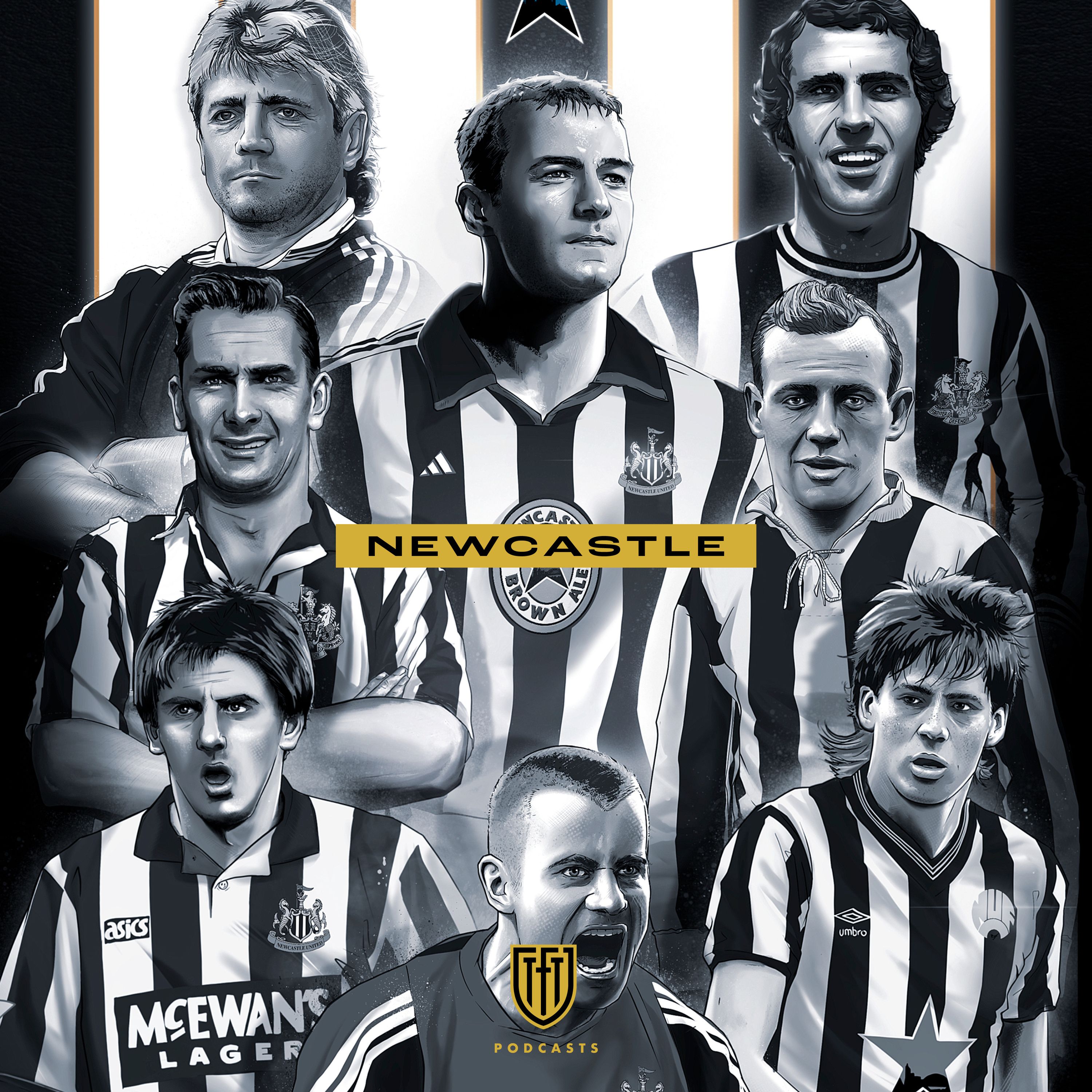
Welcome to The Lobb, your home of in-depth coverage and analysis by These Football Times, a movement of journalism you can trust. Each week, we endeavour to bring you the very best coverage of the game, exploring stories from the past and present with analysis by expert guests from around the world. Find more of our award-winning content online and in print. In the meantime, enjoy the podcast. All right, lads and lasses, welcome to the Geordie special edition of The Lobb podcast. With These Football Times, I'm Aidan Williams, and we're venturing up to the true north of England, through the fog on the Tyne, listening to Lindisfarne in Gaza.
and putting on our classic 90s black and white shirts. Winding our way up to the cathedral on the hill that is St. James' Park, taking our seat tie up in level seven, no doubt. Anyone who's made that trip knows exactly what I'm talking about. I've done that a few times. It's where the family enclosure is too, Stephen, so so have I. It's magazine time here at These Football Times, a special one for me. If the clues so far haven't given away...
We're talking my very own Newcastle United. They're the focus of our magazine attentions this time around. Now, while I appreciate none of my fellow potters share my heritage and footballing affiliation, this is not, I promise, just going to be an Aidan Williams monologue in rough Geordie vernacular. I have a couple of colleagues to try and rein me in a little. You've already heard from one of them. He's our very own curly-haired star stuck in the 1980s, so I guess he's the Kevin Keegan of the episode for us. Stephen, evening. Good evening, good evening. My curls are purely natural. They are not permed. Someone said that I was bothered to compare me to at the weekend before the Liverpool following day.
Like John Power's younger brother, I think I got on Saturday. So yeah, I can be the Keegan of the show. I'm happy with that. Yeah, well, you have a foot in both Keegan camps in this country anyway, don't you? So that sounds about right. And also we have an FA Cup obsessive who thinks the competition was far better in the past. What could be more Newcastle United than that? He is very much under instruction to only discuss 1950s Cup exploits. Nothing bad that happened in the 70s, Dave. We'll see how that goes. Good evening. Yes, that's not going to last for very long, is it? As somebody whose clue is never, ever going to get a TFT magazine, it's nice to be talking about at least a team in stripes.
Is this the closest we're going to get? Okay, then. So the magazine itself will be out on the 2nd of January, featuring the usual mix of fabulous artwork and features all with a magnificent black and white hue. Just to run through what is in the magazine, we have early 20th century glory. We have to go back that far, sadly. Early 20th century glory and the great Huey Gallagher, the first iconic Newcastle number nine. Then we move on to Jackie Milburn and the 1950s FA Cup successes and the Fairs Cup from 1968-69. And then all that success suddenly disappears. So we have to discuss other things from that point on. There's an Alan Kennedy interview talking of cup runs as well from the 1970s.
There's a piece on the 80s Mavericks of Waddle Beardsley and Gascoigne, who all obviously disappeared off elsewhere for their real peaks, sadly. There's two penned by yours truly here on the Tynanway Derby. Very parochial, a very one-sided piece. I'm sure you will not be surprised to hear. And also I delve into Keegan's Entertainers. There's separate pieces on Cult Hero of Tino Asprea. There's Alan Shearer. There's a Sir Bobby Robson era. Laurent Robert even gets a piece in here, a bit of a cult status and a crazy fun piece it says here in my notes. So there we go. We'll see how that one comes over. There's more modern stuff about the...
PIF takeover and Eddie Howe and the current era, as well as odes to St. James' Park and the greatest Newcastle kits. Now, obviously, I am purely biased, but the greatest modern kit of the Premier League era is very much a Newcastle United one. Anyway, plenty to get stuck into there. Now, we are a club that's had to live in the past quite a lot, as that list goes on about, certainly if we want to talk of anything approaching actual glory. League champions a few times, believe it or not, in the early 20th century. FA Cup, heroes repeatedly in the 1950s, and then that European glory in the late 60s, and then, well, not a lot since then. Now, Stephen, you have written about the 1950s FA Cup.
successes, I believe. And Newcastle won the Cup three times in five years. At that stage, I think that was a run that was only betted by some of the real pioneering days of the tournament where not very many teams took part. I guess recent seasons have seen some of the usual suspects winning with similar regularity. But back then, that was quite the big achievement, I think, in that era, wasn't it? It was indeed. Fascinating. There's always been something that catches the eye when you run your finger down the winners of the FA Cup, certainly days before the Premier League kicked it, when it was truly kind of anyone's game.
And, you know, like Bolton in the 1920s, you know, stand out because there they are with three wins in the 20s and then Newcastle go and do it in the 50s. You know, Tottenham in the 60s, you know, back-to-back 61, 62, but again in 67. You know, so there's something quite, you know, that draws you towards, you know, what was it about that team that made them so successful in a very difficult competition to win? It's not a tournament, it's a competition. Cups are competitions, they're not tournaments. So we'll get that straight as well in my article, which does run to about 6,000 words. You'll be glad to know.
So within that, yeah, you know, this team, you know, the name Jackie Milburn has been one I've known for years, but to be able to kind of like get into that, I don't know, that kind of peel off the layers basically to find out who he was and just how good he was and what type of player he was and how that team played. It's the Robledo brothers. It's, you know, it's all of these things. You know, it's Bobby Mitchell on the wing learning about these players. So it's one of these articles where I've been able to learn as a go at the same time. There's things that I knew, there's things that I didn't know. And it's fascinating how it progresses. And, you know, the fact that Newcastle come out of the second world war as a second division club,
reach the semi-finals before winning promotion. So they've had this kind of like, you know, run at it, like landing on the moon, going around the moon, not landing. And then coming back, you know, that's 1948, 49. It was all 47, 48. And then to go on and beat Matthews Blackpool in 1951, you know, is a stunning achievement for a team that's recently out of the second division. You know, against a team that's got, you know, the icon of Matthews and Mortenson and Perry and all of those great names of that Blackpool era involved with them, who've recently played an FA Cup final, you know, themselves against Manchester United, I think, 48. So, you know, they had all of the pedigree and Newcastle.
when they reach the final in 51, it's the first time in 19 years that they've done so. So they're a rising force again. They've known great days, but at that point in time, it's Blackpool are the real deal, rather than Newcastle going into that final. And it's fascinating to plot their path to the final, which I know to do that. Ernie Taylor being part of that side for Newcastle as well, who goes on to move to Blackpool and win the Cup again in 53 in that Matthews final, even to go on and play for Manchester United post-Munich in the 1958 final.
special dispensation, I think, given to him to go and play for Manchester United and be part of that team that reaches the 58 Cup final and loses to Bolton. But yeah, that Newcastle side to go and retain the Cup in 52 as well. And those kind of during seasons of consistency in the league as well. So the fact that here's a Newcastle that are very much on an even keel, more than just on an even keel, they're proving themselves in the very early 1950s as being suddenly, not new money as such, but it's a new rise of a familiar entity, basically. But they put themselves into the mix of things very, very impressively.
And when they retained the cup in 52, they're the first team to do so since Blackburn Rovers in the 1890s. 60 years have passed. No team has retained the FA Cup in 60 years at this point in time where Newcastle go and do it. And they beat Arsenal in the 52 final. Prior to Newcastle winning 51, Arsenal, the last team to win the FA Cup, they'd beaten some team from Merseyside in the 1950 final, which may or may not play in red. Olive didn't play in red at Wembley that day. So yeah, this achievement in winning the cup in 52 is pretty phenomenal as well. Although be it against 10-man Arsenal in the end because they lose Wally Barnes. So no substitutes and all of that type of stuff.
This is still the fascination of that final is that despite Arsenal going down to 10 men for much of the game, it's Arsenal that go on the front foot because they've got nothing else they can do. They've just got to go for it. And Newcastle have to play this and absorb the pressure and hit on the break. And it makes it for a fascinating rather than the classic final people were billing it as potentially to be. But what's amazing about that, and I'll not go too much into it because you want people to read the article, but Newcastle's run to that final as well is a treacherous one. Arsenal included, they play four teams, four first division teams that finish above them.
that season in the league. You know, a season in which they finish eighth, you know, a creditable eighth in a really competitive first division. You know, four of the teams that they have to face down on that run finish above, you know, four of the seven teams to finish above in the league that year. And it's a phenomenal achievement to go and do that. And then it was fascinating as well unpicking the 54-55 side, which is wildly different. You know, there's still some familiar faces in there, but just finding, what was a surprise to me was finding out just how dysfunctional Newcastle had become at that point in time. You know, there's a flirtation with relegation the previous couple of seasons.
But there's a lot of churn at Newcastle at that point in time. So many of the players who've been part of the 51 and 52 cup winning side have moved aside. And then you've got this fresh set of players almost with a few familiar faces in there. And the fact that the managerial turnover as well is that Stan Seymour, who's everything at Newcastle because he's been an FA Cup winning player back in the day. And then he's been coach, he's been manager, he's been director, selector, and then eventually chairman by the time the 55 cup final comes along. And his successor as manager, it's a fellow called Dougold.
He's someone who's coached Belgium at the 1954 World Cup. He's coached Sparta Rotterdam. So he comes with his expansive continental ideas, which is fascinating to read through when you're reading through match reports from that season and the way that they are. It's a season in which they are the highest scorers, the joint highest scorers in the first division, yet no one in the top half of that division concedes more than Newcastle. And there's only four teams in the bottom half that concede more than Newcastle.
which, again, it's kind of like a prototype of many of the Newcastles that will come later on in that, you know, all and nothing at the same time kind of effect. Yet they blunder their way through almost through that 1954-55 FA Cup, which just makes that such an alluring success because they could have gone out on several occasions yet stumble their way through, playing a third division north side in the semi-final as well. You know, and it's just, it's a run that's got absolutely everything. And then in the end, they're up against Manchester City side that have the Revy plan, you know, and all of that. You know, and it's, you know, what they do is quite phenomenal to win those three FA Cups within such a short space of time. It is, I mean, even beyond that, you know, the fact that that plot line of where they go after that, you know, which I'm not going into with the article because it'd end up being 12,000 words if I went and did that. But for me, you know, I've been fascinated plotting that route through the 50s and the complexities and the layers of it as well, which is why it ends up running to such a ludicrous, you know, word count. There's so much in it that you can't leave out. You have to put in because it's massively relevant to the way that team changes.
yet the success continues. And Milburn's part in that from being, you know, this metronomic striker, you know, sometimes played on the wing to being, you know, on the brink of being dropped for the 55 final if Livingstone had been allowed to have his way, you know, Seymour on the board vetoing them, basically. And to score 45 seconds into that 1955 final as way of riposte, basically. You know, it's an amazing era for Newcastle, yet it is massively layered. And it's one of those great stories that it's kind of, I don't know, I think there's a lot of parts of that that many people who think they know the football.
who I include myself in that, in writing research in this article, is just not knowing about it. And it's been a joy to write. Oh, fantastic. And obviously, Jackie Milburn, War Jackie, as he's known in these parties, he's one of the few people to have a statue outside St. James's. And that obviously harks back to this era, the successes, the few successes that this club has had in, well, what should I say, post-Second World War era. Prior to that, it was a little more regular. But yeah, it's a fascinating time. And the photos of this time, these Cup triumphs are...
You see them pinned up in bars and pubs around the city still because there's been so little to follow it, of course. But that does mean that the iconic names and players of that era are still quite fresh to mind without, as you say, knowing the full detail very well. I think a lot of people aren't familiar with how it all came about beyond knowing that Jackie Milburn scored a lot, scored early, and we were synonymous with FA Cup success at that period. And David, I'm sure from your studies of FA Cup's past, it's interesting to think that the club probably still... is or feels sort of synonymous with the FA Cup, despite it all being so long ago. I think there's a fan base too. This has led to a general feeling that the Cup is really something important, despite our various ownership, not seeing it that way at times. But it's a special thing. You've stolen about the first half dozen paragraphs of my article there. I think that is the case. As I grew up in 64, growing up through the Cup Finals in the 70s, Newcastle were always one of those teams when the third round draw came out and they, you know, and here are the odds now. And Newcastle were always a team that were one of the favourites to win it.
because they had that success in the 50s. And it was 20 years before, but I think once you establish that pedigree in the FA Cup, and three cup wins in five years is out of the ordinary, less out of the ordinary these days perhaps, but back when football was football, it was really out of the ordinary. And that's always meant that Newcastle is one of those teams that's sort of blessed by the FA Cup and will always be in the conversation about the FA Cup. I mean, here we go again this season, Bromley in January in the third round, the start of another cup run all the way to Wembley perhaps. But you get that when the third round draw comes.
you get that feel Newcastle are one of those teams that should be there that should be in the conversation and I do remember I think I do remember anyway in 74 sitting down for the cup final and there was the grainy pictures the Pathé News footage of those cup finals in the early 50s that was on the BBC warm up to the final and I think Jackie Melbourne whether it was on the day or in the days leading up to the cup final he was there talking about it in various interviews and stuff and that's what I've always thought of Newcastle as even in the Keegan era when they were chasing the Premier League Newcastle are a cup team that's what they are The future may have something different, obviously, with the new ownership and stuff if they're ever allowed to spend any money. But Newcastle will always be a cup of tea. It's like what you were saying, I think, you were saying on the 80s series. I mean, you think that Chelsea is a second division football team, which better days. Sorry, Gary. We can dream.
But that's kind of what, it's what you grow up with, isn't it? That's what you, you know, that stage of the event. For me, Newcastle are one of those teams that should be getting to the latter stages of the Cubs and being in cup finals and that, because it is that period that Stephen's writing about is what sort of made Newcastle a special team in that post-war era and you'll never get away from it. And of course, John Lennon put one of those cup finals on the cover of Wars and Bridges. So, you know, that's another added point. You're definitely right. I think from the fan base perspective, Newcastle fans are just desperate for our trophy. We don't care what.
It's been so, so long. And like we were talking off air earlier, some of the clubs who have won things in the time since Newcastle United have. many of them are vastly, vastly smaller outfits than Newcastle and far less resource, even in Newcastle's lean times, some of the clubs who've managed to achieve success that Newcastle haven't. And, you know, everyone's realistic enough to know that a cup is the most likely path to that kind of glory. The league title is some way beyond. Who knows, maybe in the future, or, you know, we can all look at a year, it maybe should have happened a quarter of a century or so ago, but the cups, either cup is the most likely path to some glory. And yeah, it just makes a pleasing change in modern times that actually...
they are trying to do that again and focusing on trying to be successful in the Cubs. But we shall see how that goes. I mean, you mentioned it briefly there, Dave, you wrote about the 74 Cup run from Alan Kennedy's perspective. A theme for Alan Kennedy, I guess, is there's several in the decade that followed of local boys who played with their local club or one of the local clubs to them and then had to disappear off elsewhere for their real glory. But he had his moments with Newcastle. It was a hell of a campaign, that one. Yeah, the 74 Cup run, I mean, although it didn't end the way that one of you would have wanted and the way that one of you would have wanted.
I mean, it's one of those great epic, epic stories. I mean, it starts with Hendon getting a draw at St. James' Park and now Hendon, a non-league club, decent non-league club at that time. I think they'd won the FA Vasa or the trophy or whatever it was in the years leading up to it. And I'm not going to mention this again, honestly, but just a couple of years on from that day. You had to go there. I did have to go there. There was an embargo on this. No, in my head.
Alan Kennedy was going to go to the game at Eriewood and he went down the first one, which was postponed. He was halfway down to the second one when that got postponed. And the third one, he was playing for Newcastle youth team. So he couldn't go. And he was so pleased that he couldn't go. But he said, you know, when they got handed in the cup, there were still players from that team, obviously, still there. And he said, you know, there was this trepidation amongst the dressing room. Oh my God, it's not going to happen again, is it? And of course, they got a draw at St James and they played the replay at Watford at Vickery Road and Newcastle.
walked in and went through Scunthorpe United. They had to go to a replay as well before they beat Scunthorpe. And then they played at the Albion in the fifth round. And I remember that game like it was yesterday. I mean, it's one of the games that made a huge impression on me for all sorts of reasons. But I mean, it was a proper 1970s FA Cup type pitch. I mean, it was like, you know, it was just mud everywhere. It was a plough field. It was horrendous. And I mean, people on the ground staff have spoken to at the Albion about that. And they said, you know, they've said nine o'clock. The place was awash with Geordies at nine o'clock in the morning before the game. You know, the ground was absolutely swamped by Newcastle supporters, which again, you know, says everything about that tradition of...
of the FA Cup, you know. They come down to make sure that they got it in the ground on the day. And Albin were in the second division at that time. And Alan Kennedy said to me that he missed that game, but the players had said to him, and a lot of people around the club, it was the best Newcastle played in the Cup for about 15, 20 years. And, I mean, they wiped the floor with Albin. It was just...
The demolition. Stuart Barraclough, I remember playing really, really well. John Tudor was a great player up front. Good fall for Malcolm McDonald. McDonald scored as well. And then you're into the sixth round. And when you're in the sixth round, particularly if you're at a club like Newcastle, that's when you start to get the smell of it. And, you know, 20-odd years on. No FA Cup since then. But only five years since the FA Cup. So, you know, still successful. They still knew what winning was. And they played Nottingham Forest in the second division at home. And the day didn't go well, really. I mean, St James' was absolutely rammed to the rafters. And Alan Kennedy was on the bench.
Forest played really well. They were winning 3-1 after about an hour. Got a penalty and Pat Howard had been sent off, scored the penalty 3-1. And Alan Kennedy was saying, you know, I was looking around and they were banging on the top of the dugout and there was going to be some trouble here. And he said, I looked to my left and there was this big fella in a big jacket. And he said, come on, lads, we're going on. And everybody just followed this fella onto the pitch. And it was mayhem. I think it took 20 minutes to clear the pitch. Police dogs, the works. It was a proper 1970s bonfire. That's exactly what you want. All the things that people say, we don't want to see this kind of thing. Oh, yes, we do. That's exactly what we want to see.
And they'd gone back to the dressing room, obviously, for 20 minutes, and I was sitting there all feeling miserable. And Alan Kennedy said, all of a sudden, John Tudor stood up and said, we can still win this. And everybody was laughing at him, basically. Don't be silly. We're rubbish here. We're getting murdered. We've got no time. No, no, we can still win this. Kennedy came on when they came back out. And they turned it around. Bobby Moncur, they scored a second fairly quickly. And then Bobby Moncur scored late on as well, I think. It was about two yards offside, Alan Kennedy said. But there was no way that the referee was going to dislay. And that one fall through.
They'd won 4-3. There was still about two minutes to go. The referee, as soon as Bobby Monker's goal went in, blew the final whistle, right, off we go. And that was it. And they'd won 4-3. They were through at the semi-final. Except then, of course, the inquest was you can't have a team, you know, you can't have a pitch invasion when you're losing 3-1. And then the team got through. So there were all kinds of shenanigans. Because with the game having played until we finish, there was nothing the FA could do until Forest asked for the game to be annulled. So that game doesn't exist any longer in the record books. It was annulled. So they played it again. They played it at Goodison Park on neutral turf rather than at St James. And it was a draw. And after that was a draw, they had the replay at Goodison Park as well.
God knows what Forest would have had to have done to have had a game played at the city ground, but anyway. And Newcastle finally came through and they're in the semi-finals and they played Burnley and they were in very good nick by now. They went away to Buxton and they went days in advance on a jolly, basically. I mean, they were drinking away and enjoying themselves for two or three days. And he said it was the Midland Hotel in Buxton, which is on the hill as you come into the town in Buxton. And on the Friday night, Joe Harvey said, right, OK, we're going to be serious now because we're playing tomorrow in a cup semi-final. They all had dinner together and they were sitting there having dinner together.
He said there was this old lady at the piano playing tiptoe through the tulips while Newcastle United's 20-year-olds, desperate for a pint. We were all having their dinner listening to this. They went out and they played and they beat Burnley, beat Uncomfortable. Cup final, Liverpool. They got down to London on the Monday. You can imagine five days away from home in a hotel, how well that went. But that was kind of an epiphany really for Canada because, I mean, Newcastle were exactly how, I would say, probably 90 of the 92 clubs would have behaved that week going to the cup final. Probably Liverpool.
and Leeds United were the only ones that wouldn't have behaved like this. But Newcastle was a bit of a jolly, and then there was the football writers' dinner on the Thursday. All of the Newcastle team went, two of the Liverpool team went, and Ian Gallagher won the bloody award. So Liverpool were all at the hotel getting prepared. And that was kind of the moment he thought, well, I want to do something with my career here, and they're doing it the right way. And that was two or three years later down the line, he moved on to Liverpool. But that's kind of a fault line, isn't it, in professional football at that point? Because everybody would have been like Newcastle.
And they were all fascinated by the players' pool. And Malcolm McDonald had got a boutique and he'd sorted out black and white checksuits for them all. And God knows what else. Whereas Liverpool, everything was, you know, completely ordered. They discovered on the Thursday afternoon they hadn't got any tracksuits for Newcastle. So they ended up, I mean, you know, if you haven't seen it, go on YouTube for the footage because the purple things that they come out in are a sight to behold. I mean, they are unbelievable there.
Apparently they did have some tracksuit initially and they were made of toweling material with flares, which actually would have been even worse than the ones that they wore in the finish. But that was kind of how it was. That was the Newcastle one, which would have been the way of the Albion. It would have been the way of Manchester City. It would have been the way of most clubs. And then Liverpool were there in the proper stuff. And we all know what the cup final was like. After Malcolm McDonald had promised to turn Phil Thompson and Emden Hughes inside out and score half a dozen goals.
and all of that. Poor old Alan, he was, I think, what was he, 18, 19? They always used to go to the hotel and they'd talk to the players before the game. So they came to Alan, I think he was one of the first to talk, and they said, so then, Alan, cup final day, what are you thinking about coming up against Tommy Smith? And he said, I just didn't expect the question, I didn't know what to say after hours. So I said, who's Tommy Smith? Which I can't imagine went down particularly well in the Liverpool Hotel. And of course, in the finish, Tommy Smith embarrassed him in the last couple of minutes with him playing the 1-2 round for the third goal.
But it just is a microcosm of that whole 1970s. I mean, me and you, Stephen, in the 70s, we talked about the Mavericks and the clubs were Mavericks as well. In a way, there was none of that professionalism that was to come later on and the attention to detail. It was all very much off the cuff. I mean, Alan Kennedy is a fantastic talker. He's a great interviewee. It was an absolute pleasure talking to him. But it's just a time capsule. That whole thing is a time capsule. There's lots of good stuff in there for Newcastle fans. Don't worry. There's a lot to enjoy in there. But it is kind of a...
a cautionary time as well, that's about it. Well, yeah, absolutely. And that's the beauty of first-hand accounts like that, isn't it? Of pulling back the curtain somewhat to knowing exactly what it was like compared to the bits that we see on our TV screens and just exactly how it was. And it's fascinating. So that'd be a brilliant one to look at. Now, Stephen, Dave alluded to it there that Newcastle had won something only a few years before that as well. It's a fact probably easy forgotten to history for those outside of the city in many ways. Newcastle were one of the earlier English successes in European competition, which is...
Something we cling to massively because it's the last success. A trophy lifted by Bobby Moncur, a defensive captain and goal scorer on that occasion as well in a rare situation. He's also famously better known in my family as the next door neighbour to my brother-in-law across in Gateshead, but that's another story. But yeah, Newcastle in Europe, Stephen, it was your air of expertise, I'm sure, but quite a ride, that one was. Yeah, I'm rightly proud of that, I think. It was wondrous.
era for English clubs in that particular competition. I mean, Man United winning the European Cup in 68 a year after Celtic had become the first British side to win World Big Ears. But yeah, the first cup very much at that point in time as well. The team's taking it far more seriously than they had at the outset of it, late 50s into the early 60s. And that wild kind of remit that it had in being associated to trade fairs and representative teams from cities rather than just clubs as such. But by the time Newcastle are winning it in 69, it's very much the UEFA Cup.
to be. It's not. UEFA won't have it that it's the precursor of the UEFA Cup as such, the official precursor of the UEFA Cup, but it very much is. For me, any team that won the first Cup should be seen in the same light as a UEFA Cup winner and a Europa League winner since the rebrand. And Newcastle's success in 69, fresh off the back of Leeds having won it a year before Arsenal would win it and then Leeds would win it again in 71. These were all stepping stones into that 1970s, early 1980s.
domination that English clubs had in European competition. Newcastle's success in 69, it's the last major trophy they've won as such, but what a success it was. Every reason to celebrate that success, Newcastle fans should not be bashful about that. This was one of the three major European competitions of its era and very much foreshadowing the UEFA Cup. It's way up there for me and Newcastle fans should very much embrace that.
If they don't, why not? They certainly should do. That success was a huge one. Frank Clarke being part of that as well. I think he would go on to win a European Cup in a Nottingham Forest a decade later. Part of that 74 Cup final sign for Newcastle. And yeah, Moncure, so few goals for Newcastle yet. I think it's two that he scores in the first Cup final, over the two legs. And I think it's fantastic as well because it's got that mystique of, I don't think any of us know totally just who trusty were.
and still probably are today. And I think there's something special about those Eastern European clubs and the fact that that association to that game comes against a team that's mysterious and has that little bit of je ne sais quoi, I think adds to that luster. And yeah, Newcastle's success in the first cup in 69 is I think one of Newcastle's greatest achievements. Well, we certainly do cling on to it, Stephen. Not just because it's the last thing that Newcastle won. However many years ago that was now, it's more than 50. That much I know. 55, quick calculation. Deary me. That's a long, long time. Now, we've had mention of various players, Maverick characters and so on. Dave has talked about Malcolm McDonald briefly. I know you love him. Really, Dave. But there's also the likes of Huey Gallagher back in the day. Another adopted Geordie, probably in his case, because he then lived in Gateshead long after his playing days and sadly died there. Two, there was Milburn in the 50s, of course. And then there's the local stars of the 80s, which I think is a really interesting time.
An interesting set of players. Obviously, we had Kevin Keegan, the player, between 82 and 84. In the second division, his arrival as a European or former European player of the year, he'd obviously moved from Hamburg to Southampton, but then took a step down to come to Newcastle United. And I think as much as he was reaching the end of his time, he had been part of England's World Cup squad that summer. He still thought he had a chance of being part of the England squad going forward as well. So he wasn't totally ending his career at that point when he arrived, but it was still a bit of a leap of faith, I guess, for him.
In many ways, it was a return home as much as he's not from Newcastle. His family is largely from that area. And he was a Newcastle fan as a child, which I think is something that his accent hides probably from many people's realization or recollection. But that was very much the case. So that played a huge part and obviously would do so in the following decade when he reappeared again. But he then inspired the club as a player, but then had the likes of Chris Waddle and Peter Beardsley alongside him initially.
inspired both of them to take up his mantle after he'd been helicoptered out of there at the end of the 84 season. And then Paul Gascoigne, of course. So, Steve, I'll come to you again because you're our 80s expert. That's quite a trio to come through at the club in that time. I just imagine if the club itself in that time had the wherewithal, the ambition, the foresight to actually be able to build on these hugely talented local players that they'd unearthed and developed. In a couple of their cases, Beardsley had been elsewhere and come back. But I guess it's a question of, it's a case of what might have been really, isn't it?
It is, you know, timing's everything in football and be able to... you know, put a team like that together and have the right man in charge. And, you know, there's so much to it, you know, that I don't think we all necessarily comprehend, really. It's why you will get eras of, I think most teams, every team probably can point towards a season or so where it was kind of like, you know, what might have been or that glorious style of play, you know, and it will be fleeting for some clubs. And yeah, you know, that Newcastle rise of the 1980s from a pretty desperate place as well. I think that's what's impressive about that is just how desperate a place Newcastle have got themselves into.
after relegation in 78. You know, 77, they finished, I think, fifth, qualified for the UEFA Cup. The season went down in 77-78. They played UEFA Cup football, went out to Bastia, who reached the final that year, 77-78. Alan Kennedy, if I mentioned Alan Kennedy, part of that Newcastle side that went down in 77-78 and moved on to Liverpool. But yeah, between kind of relegation in 78 and the arrival of Keegan in 82, you know, there were some dark times for Newcastle. You know, financially, in a bad way, the ground, you know, starting to look its age at that point in time.
You know, a lot going against Newcastle, you know, and to bring in Keegan in 82 was this massive shot in the arm that just galvanised the club. And they did not add a bad 81 to Imri Verardi scoring goals aplenty. And there were reasons to be more cheerful than any of the previous three years, probably. So for Keegan to come along and galvanise matters, and then, you know, there's Chris Waddle and, you know, the arrival of Peter Beardsley who had wanted so desperately to play for the club. You know, the return of Terry McDermott who'd lost his way at Liverpool. And suddenly the chemistry, 82, 83, going into 83, 84 is just, it's magnetic.
And this is where Newcastle, you know, become kind of like everyone's favourite second team, if you're allowed to have a second team. I think, you know, they were so visible as well at that point in time. You know, I can remember kind of the Granada region and we'd have our own version of ITV's Sunday afternoon highlights. And so often, you know, we'd get our game from the region and then it'd be kind of like one or two games put from other parts of the region, like what happened across the ITV network. Yet so often, Newcastle would be involved because of...
Keegan because of McDermott and the style of play. And it was all very swashbuckling and it was just letting rip. And again, it leaned into the Newcastles of the past in that respect. We mentioned that Newcastle side of 54-55 that win the FA Cup via dysfunction. And again, this is that kind of Newcastle again. And it's just the way that for that Newcastle, how the stars aligned in that way that they did in 83-84 in a very, very competitive second division that year.
packed full of very, very good teams. So, you know, it was an adventurous style of play. It caught the imagination and people wanted them to prosper. You know, Sunderland fans aside, obviously, you know, and we've mentioned a little bit of this, and this is where that, I don't know, that admiration that people will have for Newcastle. You know, we've said 55 years since they've won a major trophy. You know, nearly 70 years since they've won a domestic trophy. Yet, Newcastle still managed to hold this thrall of people and, you know, I've said before we started recording that.
No matter what anyone will think of a specific era of Newcastle, whether you agree with the contemporary version of them, the owners and all that jars in that respect, it still doesn't take away that for the vast majority of us football watchers, there's a Newcastle at some point in your life that you've just absolutely loved and you've wanted to prosper, whether it's that 895, 96 version or Bobby Robson's version or that 80s version with Keegan McDermott, Waddle and Beardsley. You were willing them on to achieve whatever that mountain was that they were trying to climb. And that 80s side ticked the box under Arthur Cox. And yes, they win. And so Newcastle have them to go and win promotion and Keegan retires. But then off goes Arthur Cox and in comes Jack Charlton and it becomes much more pragmatic and less likable. Even for the players involved themselves, let alone independent watchers from a distance who have no support of the club as such. They just admired what they were doing and loved the style of play and were glad to see them back. And then suddenly it wasn't that Newcastle of the end of the 83-84 season that were coming back into the first division.
It was Jack Charlton's first at Newcastle United in 84-85, and it was a very different prospect. But yeah, that 82-84 Newcastle were just such fun to watch, and you wanted them to do well. Oh, yes. But another false dawn, of course. One amongst many. Now, those players, of course, very iconic in Gascon, who followed on a little later. But we all know my thoughts on Mirandina and certain songs there. We don't need to delve any further. Iconic Mavericks, I guess, are as popular as ever on Tyneside. I don't know whether that's... It's probably not unique to Newcastle at all.
But who doesn't love to be entertained, I suppose, by the mercurial and the frustrating stars capable of so much skill and infuriating us as well. I think this magazine features Tino Asprea, who certainly fits that category, Lauren Robert as well. But you could add in the people like David Ginola later on being equally superb and frustrating. And maybe the likes of Alan St. Maximum in more recent times fits that bill, closer modern equivalent. But then I think there's the goal scorers. And again, maybe cliche klaxon.
The whole thing about the Newcastle number nine, I don't know whether that's just a thing for Newcastle fans or whether it is a thing at all. Maybe you guys can help on that front. But, you know, you go through the years. We mentioned Huey Gallagher, Jackie Milburn. There's Malcolm McDonald, of course. Geegan himself. Great goal scorer is Andy Cole, then comes along. And there's my personal favorite Newcastle striker is Sir Les Ferdinand, of course. And then there's Alan Shearer to top him off. Now, from my perspective, I guess for all, Shearer is untouchable in terms of goal scoring prowess. I always had the affinity. I really loved Ferdinand, despite the amount of being with the club for two seasons. But I guess it's what happened in that time and what he brought, which made him so popular.
We lost Andy Cole a few months before, fearing a return to the old selling ways, but then Ferdinand arrives and we stepped up another level. This was a new experience for many Newcastle fans and quite a revelation. His year alongside Shearer as well in his second season had some remarkable moments too. The two of them seemingly complimenting each other rather than getting each other's way, which is how it could have turned out, I suppose. But it was a short time. But to be clear, I do think Shearer is obviously absolutely superb as well. Let's not misunderstand that. And the fact he opted to come home rather than make a pact with the Red Devil adds to that, certainly. He wanted to fulfill his dream and wild medals.
Would have been nice, I am sure. His dream was of being Newcastle's number nine, and there's something to be admired about that, I think. Although I guess at the time he arrived, Newcastle were very much challenging for medals. But yes, Ferdinand's the one who I seem to have closer to my heart for some reason. But Dave, am I just stuck in my Geordie bubble of this Newcastle number nine thing, or is it a thing?
No, I think it is. It is a thing. Certainly when I was growing up, it was. I mean, it probably goes back to, you know, the Jackie Milburn kind of era. You know, Malcolm McDonald was seen as sort of following in that around the 74. And then obviously, you know, and I think going back to what Steve was saying, that's why people have always got a soft spot for Newcastle, because there is that goal scorer that, you know, people love a centre forward. And Newcastle have had a lot of, what I suppose you call these old-fashioned centre forwards. I mean, you know, Les Ferdinand, in that sense, is an old-fashioned centre forward, you know, rampaging up front and knocking people out of the way.
winning fantastic headers and all that. Shearer was a similar mould. And I think that is a big thing about Newcastle. Newcastle, I mean, you're both in front of the famous four threes and stuff. Newcastle was always a guarantee of goals at both ends. And, you know, if Newcastle were a match of the day or if you got them on Star Soccer as the second game, by and large, you knew it was going to be entertaining. You didn't know what was going to happen through, you know, certainly through the 70s, the 80s. And then obviously you'll talk about Keegan's entertainers and stuff later. But that's always what Newcastle has been about, you know. And Jack Charlton.
That didn't seem right when Jack Charlton went there, you know, after, you know, we know how Jack Charlton played the game. Newcastle were always the entertaining kind, and, you know, going back to the stuff I was saying about Alan Kennedy, sometimes it was entertaining in a comical way, and sometimes it was that swashbuckling, rampaging, new score four, wheel score five kind of way. I mean, in some sense, although it didn't work when he was up there, Aussie Idealist was the perfect Newcastle manager, because that's exactly what he was all about. He went, again, wrong place, wrong time. But, you know, in another era, I was the idea that he might have been the perfect Newcastle manager because from afar, that's the kind of way I think a lot of people think about Newcastle and why people have got affection for him. But definitely the number nine thing is a big thing. And, you know, Shearer wouldn't have made such a big song and dance about having it off Les Ferdinand if he hadn't meant something, you know, elsewhere. I think it's, you know, it's one of those trademark things in football, the Newcastle number nine, definitely. Yeah, that's the iron course. That was the most complex part of the world record transfer fee or transfer.
of Alan Shearer from Blackburn was the negotiation with Les Ferdinand for the number nine shirt. But yeah, the two of them together was just magnificent. Obviously, Shearer has gone on and gone several levels beyond any other Newcastle striker, of course. But when the two of them were together, that was briefly fantastic. Anyway, we're moving on off the field to managers or managers' ears. Anyway, the magazine touches on the Keegan years, of course, as well as those of Sir Bobby and a bit around the recent times with Eddie Howe in charge. For me, though, the Keegan years, well, where to go? They were the most incredible time.
as a Newcastle fan. Now, I know I've talked about this on various podcasts in various ways over the last couple of years, but I have gone to town on it in this magazine, of course. I'll make no apologies for the length of the piece I've written, although I'm slightly disappointed to discover that Stephen's article has gone slightly longer. Never mind, never mind. What I hope it brings through is the incredible transformational qualities that Keegan brought, something Stephen was alluding to of his playing time in the 82, 84 era. But he really did transform the club more than once, but in spectacular ways. The extent to which he transformed, I think, was obviously even greater as a manager in the 1990s than it had been as a player.
For the club to go from the brink of the third tier, the potential financial implosion of the club that that seemed set to bring, to then coming oh so close to winning the Premier League, all within the span of just four years. And that's what I find absolutely remarkable about the transformation. It was a very short space of time to go from a club that was on its deathbed almost, sinking without a trace within four years, well, within two years being in the Premier League, ripping it up in entertaining style, and within four years coming so close to winning the whole thing. If you then add in the manner in which it was done, the style of play, the excitement, the entertainment, we as Newcastle fans carry along on a rollercoaster ride, I guess, of endless thrills and magical moments and a few disappointing ones too. But, you know, you get the ups and the downs. And as you mentioned, even those not fortunate enough to come from this part of the world swept along with us as well, to some extent. I guess it's another cliche, but it's been alluded to as well, Newcastle being many of the second favorite. And I guess part of this era is when that came about as well. Probably most the case in the 93-94 time, the first season of when they were.
purely entertaining, scoring for fun, exciting, scoring at will. I say Cole Beardsley in particular, it was astonishing strike week, but I guess probably crucially, they weren't a real danger to those at the very top. And that helps people like you, I think. Maybe two years later, that was a little bit different when they were actually challenging. But I would still assume that most neutrals beyond the confines of Manchester United and Sunderland, of course, were hoping for a Newcastle trying from the league once their own teams were out of contention anyway. And yeah, it wasn't to be, and that's a real shame. But, and this is something I really try to hammer home in the article. To me, a failure to win the league.
does nothing in my mind at all to diminish Keegan's achievements in this short space of time. It would have been the glitter on the top, but it doesn't lessen the achievement. I think four years to go from such a low to such a high is incredible. The whole club was transformed in that time. The city itself was utterly transformed too. And I think that's something that those not from the area might not realise or see just how much the city became abuzz with excitement. It was as if that excitement brought by the football club had seeped into every aspect of life in Newcastle. It was becoming increasingly more a party town destination as well.
During this era, this is also the time of the sporting club project of Sir John Hall, where the rugby club, basketball and ice hockey, I guess the football and rugby were the two principal ones, were a big thing. The rugby club Falcons were achieving great success with Rob Andrew was there, Kevin Keegan figure. And you could be out in town during this era and in one bar, you're mixing it with the footballers and then you move next door and there's a whole lot of rugby players just out and about in the town. Maybe they did a bit too much drinking and maybe that's why things went wrong. I don't know. But anyway, it was an exciting, exciting time.
And we had a whole host of heroes from this whole era. If you can go from David Kelly, who was still very much a hero to Newcastle Mines and his goals, which saved the club in the early Keegan months, to the arrival of Beardsley, then Beresford, my favorite player of this whole time, Robert Lee. Then Andy Cole, his incredible partnership with Beardsley. There's Gillespie, Fernand, Gillespie, Philippe Albert, Aspria, several local stars in the mix as well. It was a remarkable time. And let's not forget it was in the greatest kit of modern times too, but that's another thing.
Just to think of that list of players who only a couple of years earlier in the RDIs era that Dave was mentioning there or Jim Smith before that, to think of some of these players pitching up at St. James'. If you'd said the ride that we were about to go on at that time, you'd have been laughed out of town. It would have just been so ludicrous as to be beyond belief. And sure, it would have been great if we'd won the league in 1996. And yes, of course it hurt when it all went wrong. The home loss to Manchester United, I guess, was the real killer in terms of the shift in momentum and missed opportunity and missed points, I suppose. A six-pointer ultimately in the grand scheme of things.
even if the subsequent drama at Anfield and Ewood Park just added to the pain in different ways. But having come so far in such a short space of time, Keegan, to me, can only be considered as a huge success as a manager for Newcastle United. I think people looking in from the outside might not view it that way because they just see the end point. And to me, that's not fair as a way to assess the overall. I think he is, to Newcastle fans, he's rightly lauded as our greatest manager of modern times. And beyond that, simply the most influential transformational character on the club.
and the club's influence across the city in recent decades. I think that's beyond question. Finishing second in the league doesn't change that one bit. So anyway, that's my black and white perspective on it all. And I expand on that in written form. But for you both, I guess, what are your memories of Newcastle at that time? And from your outside perspectives, how do you view the Keegan managerial era? Stephen, I'll come to you. You're not allowed to mention 4-3 or anything like that. Okay, I'll not mention that one. Dave got the mention in earlier on. And as tempting as it is, I'll try not to put it that way. But yeah, you haven't got it.
Again, they were just so, like you say, so entertaining to watch. They were must-watch football at that point in time. They were just so flowing and without fear. I think that's what catches football fans' imaginations, is seeing a team play with that innate confidence that anything is possible here. And that's what Keegan did for Newcastle, to take them from the depths, from the jaws of the third division, which would have been catastrophic for Newcastle. This at a point in time where Middlesbrough...
not all that far away geographically, had gone to the very brink in the mid-1980s with a visit to the third division. Sunderland had dipped in and clawed the way out. And you were looking at that Newcastle and thinking, good God, if you end up in there, will you ever come back? And that was what a lot of people were thinking, really. And Keegan had notoriously said that he had no intention of being a football manager. He walked away from football in 84 in terms of a hands-on nature. And until, what was it, the February of 92, had no intention of being drawn back into the game. He was happy.
He was playing golf. He was spending half of his year in Marbella. He had his business interests. He had no need to come back to football. He'd tip up in ITV studios covering games for them. He was happy with life. And Newcastle were the only proposition that would have dragged him back in.
I think even Liverpool would come asking, I don't think he'd have done it. And he loves Liverpool as a football club, but Newcastle is his passion. He took it on, brought McDermott along with him and it was just this, the word transformational. He took a leaf or two out of the Shankly textbook in that respect and the way that one individual can galvanise the people that surround him and this concept germinates and suddenly that infectious nature spreads once it spreads onto the terraces and onto the pitch. and what the players are doing, what the supporters are doing, then it becomes an irresistible thing to watch and to be a voyeur of. Even as an outsider, you're kind of swept away by that. That's what that Newcastle did. They walked into the Premier League.
what, a year on from having just missed out, you know, just avoided the third division and never looked out of place. They hit the floor run, you know, and they were so, so good. And to have Andy Cole scoring those goals, Beardsley back, you know, they were just playing some fantastic football. And you can look at like the Tottenham of the early 1980s of being that entertaining side of our dealers being part of, you know, tying into what Dave was saying about our dealers, you know, Ricky Veer and Glenn Hoddle. And we all loved watching them as, you know, beyond our own teams. And I think that entertaining team will always draw you in in that respect.
And that was Keegan's Newcastle at that point in time, that early to mid-1990s. They were just fantastic to watch. And it was kind of like, even as an outsider, you've got joy in that. Because I think as a football fan, some football fans, can get enjoyment out of a team doing well and seeing the supporters loving it because they can relate to that. Whether that's kind of like a concept of saying we've lived that type of experience or we're attaining, we're reaching for our own version of that. They were just such an infectious side in the best possible terms.
And yeah, losing out on that title in 1995-1996, it's Brazil 82. It's all of those type of, in English club form, that's what it is. I don't think there's any other comparable one that I can think of off the top of my head where people would think, really wish that team would have won that. But at the same time, it doesn't matter that they didn't. But it doesn't matter that Brazil didn't win the 82 World Cup when it came to it because of the joy that they gave. And Newcastle the same.
I think the only thing that could have improved that 95-96 team is that if Newcastle had to fumble it, it was Liverpool that would have taken it instead of Manchester United. Because that was just an unpalatable punchline at the end. But for not just Newcastle fans, but the nation, I'd like to. Well, yes. Any joke at Manchester United's expense is generally fine with me, but that might have gone a step too far that time around. Dave, same question to you. I guess the thoughts of that time, really, I guess in modern times, is the most remarkable Newcastle era. You probably won't agree, but I think the fact that they didn't win the title is actually better.
Yeah, I might struggle with that one. No, there's something particularly beguiling about the beautiful loser thing that makes it last longer. I mean, Albion had that in 78-79 on the Cyril Regis team when it was Liverpool, so you can have that one, Stephen, who stopped Albion winning the league. I mean, I think finishing second, it doesn't mean failure. I mean, Newcastle were unfortunate, just as Albion won unfortunate in 78-9 when I think it was the best Liverpool team to win the league that season. I think of all the leagues that they won, that was the best team. In Newcastle's case, they just came across this juggernaut of Manchester United that weren't going to give up.
the title to anybody and there's no shame in that because that was a magnificent side in the same way that over the last five or six years Liverpool have won one title well Manchester City were magnificent over that period it doesn't reduce anything that Jurgen Klopp did at Liverpool over that period or anything that Liverpool did that was still a fantastic side it was just that somebody was just slightly better that time but yeah that ties into what I was saying earlier on about time and being everything you know you look at that Manchester United in 95-96 and they'd have that loss of the title the year earlier in 94-95 great believer in domino effects in football I think if If it's Blackburn that blow the title in 94-95, I think Newcastle probably win it in 95-96 in the same way that Graham Taylor's Aston Villa in 89-90 probably win the first division if Liverpool don't lose that one in the last few seconds against Arsenal in 88-89 because it's that fatigue nature as well. So it really is time and B and everything. If that Newcastle in 95-96 had made that particular run a year earlier, that's the early title. If you transplant that 95-96 Newcastle side into the 94-95 season.
they win that league without shadow of a doubt. There are other years when they win that league. It's just that Newcastle came up against a team like Westbrook in 78-79. that have been there, done it, and they've kind of missed out the previous season and were back to rectify that. And it was just that know-how in the end. But it doesn't detract at all. Absolutely. I think the point is that people remember that team probably more than the Manchester United team that won the league that season, far more so. I mean, in the end, isn't that more important? We are talking 30 years down the road. I mean, great if you'd won the title on the day and you'd lifted the trophy. And believe me, we've won less than you have.
I know. But, you know, it's one day and you get the pot and that's great. And maybe you go on to do more as a result, but maybe you don't. But, you know, the fact that we're all still talking about those games and those goals and those performances and everything. I think, you know, the fact that you came second just adds to it. It's got that beguiling thing to it. And I will also say about Kevin Keegan, I think he's the most underrated personality in English football. The thing, you know, he still very rarely gets talked about unless you're digging up something like this. But as a player and then as a manager, I don't think anybody by sheer...
Force of personality has achieved more than Kevin Keegan in his time. He didn't win things in Newcastle, but again, he changed the landscape. He changed the way people thought about football. In that early period of the Premier League, when we were getting used to watching football on television all the time, he made it entertaining more than anybody. And I think the legacy of Kevin Keegan is monumental in English football and obviously particularly at Newcastle and Liverpool, sorry.
It is. I'll just go with McKeegan there. He was never the most natural. He wasn't the most naturally gifted footballer. He worked at everything that he did. He was tireless in his effort behind everything. If he wasn't perfect at something, he would work and work and work on the training ground. And you can say very similar to his managerial career. Tactically, maybe that little bit short of being able to keep up with the Wengers and the Fergusons and all of that of that era. Yet, he was that inspiration in a way that nobody else could match.
He was properly inspiring to his players, to the supporters of his football club, even to those watching on the outside looking in. Yeah, you mentioned a word earlier, infectious, and I think that's what Keegan is. His personality is infectious, and you can't help but be drawn along and pulled along by him. Yeah, I mean, I wanted to say, and I've spoken not so long about it, Keegan, kind of like his relationship with Liverpool, has kind of like been a bit of a detached one almost since he left as a player. Never been involved with the club ever since, really. Yet that love and respect for those supporters.
watched him in that era is still massive and it was great a couple of seasons ago he came he was the match day kind of like guest and doing kind of like the half time stuff and all that type of thing which is quite rare I've not seen him too many times coming back and doing that yet he absolutely loved it and that was the thing he was outside the stadium making his way into the ground and supporters of a certain age were going up to him getting the selfies and all that type of stuff and a lot of Football players in the past don't like that type of thing. Yet there was Keegan stopping for absolutely everyone with the broadest smile and just arm around the shoulders, not just posing for photos, but arm around the shoulders and all that type of stuff. And he couldn't do enough. And I watched from afar because I'm not one of those people to approach my heroes. I let them just be. But there he was, absolutely loving his day. And that, for me, spoke wonders about him as well.
No, absolutely. And going back to what Dave was saying about who gets remembered most, I'll take Johan Cruyff's word on this one that maybe we won after all, since people remember us more. And we'll cling on to that. Obviously, Bobby Robson came along a few years later, having been close actually to joining post-Keegan. Brought an awful lot of stability and statesmanship, I think, to the club after a couple of years of post-Keegan decline and other rising fortunes. And as with Keegan, he brought a real feel-good factor again, a degree of style too, if not quite as swashbuckling. But another exciting time, if ultimately another one doomed to no tangible glory. But his era gets focused in the magazine as well.
Now, I did also write another piece in this one, as I mentioned earlier, which is on the local derbies against you-know-who from down the road, giving the whole rivalry a bit of historical context, stemming as it does from fighting on opposing sides in the Civil War and associated disputes around coal mining rights and into more modern gripes, of course. But it's more than what I guess it may seem from the outside as just some parochial local squabble of minimal importance between two clubs that never win anything. My piece delves into a few of my Derby memories anyway, through some key matches over the last few decades. Oddly, the 1990 playoff semifinal only gets passing mention. Well, the goals have shown that Amiobi get a bit more focus, which is only right, I think. Runs of defeats don't get too much of a mention either. To bring us up to the modern day, though, the most recent iteration of the Derby was in the third round of the FA Cup last season. It was a bit of an odd one, really. It was the first game between the two in seven or eight years.
since Sunderland had been wallowing in the depths of the lower leagues for a little while. And being a cup game too, there was a far bigger away contingent of Geordie's venturing south or being allowed to venture south, which made it a very unusual and incredible occasion, I think. And for Newcastle, I guess, given the gulf between the sides at that point, and Sunderland are doing very well in the championship this season, but a little bit slightly further back at that point, and I'll just come up from the third tier. It had banana skin written all over it from a Newcastle perspective, but thankfully quality told, and I got to breathe a huge sigh of relief more than anything else. But that's what derby games often are. I think victory is a relief.
defeat is a disaster, and we've experienced plenty of both. My article on it naturally focuses, of course, on some more positive occasions for Newcastle. It's very blinkered, but I was never going to write anything remotely even-handed when discussing our rivalry with that lot. So that is there to be enjoyed as well. Any historical wars coming into your local rivalries in the West Midlands, Dave? I insist that it's the Black Country Derby, and of course everybody knows that Wolverhampton isn't in the Black Country. Well, they're just trying to cling onto your coattails there, I think, Dave. Anyway, into modern times. Newcastle United is very much changed in recent years, of course.
The moribund pointlessness of merely existing as a free advertising board for Mike Ashley and his particular brand of sporting goods. The farce of Joe Kinnear. I've resisted using that cup, that big, huge novelty mug tonight. Good. I'm glad to hear it. Solidarity there, Steve. Thank you. The farce of Joe Kinnear, Keegan's ill-fated return and constructive dismissal from Mike Ashley during the years of Pardew and headbutting people on the touchline. Steve McLaren, Steve Bruce. Pardew did have a brief period of joy. Hewson.
Also brought a bit of class proceedings briefly, but behind the scenes, things were paired to the bone. It was pretty horrific, really. Ashley gambled on spending the minimum to avoid relegation and nothing more. And he lost that bet twice, but didn't change anything in his approach. All he was interested in was the free advertising, of course, and those mugs. This explains part of the joy, I guess, once the takeover went through, you know, mixed with the slightly naive view. As it turns out, certainly the Newcastle had won the lottery and were destined for big spending glory. And then there are, of course, the Saudi considerations as well. And all that comes with that, which is something I've talked about in a few previous pods as well. In footballing terms as well.
Newcastle have progressed in the PIF Eddie Howe era financial rules, as Dave mentioned earlier. I mean, there's a limit to how far it can go at the moment. There's talk of stadium renovation or new build, and there's plans for growing revenue and all those lovely things that we love to talk about the reality of modern football. On the field, though, at least there are exciting players again, and that's a delight to behold. There's a club that actually wants to try and achieve whether they do or not as a whole different matter, but they actually are actively trying to, and that is great. Whereas under Ashley, the stated intent was to not try and compete, merely to exist. So, Stephen.
Before we get towards a close here, what do you make of the current Newcastle and prospects for the future? I think moving away from Mike Ashley has to be seen as a positive. I think, yeah, we all wish it was in a different way. It could be different, but modern football, it is what it is. Outsourcing ownership of football clubs, we're talking Stones and Glass House era of things. Slander is very much thrown around about ownerships of football clubs, yeah.
increasingly the most famous football institutions have fallen into foreign ownership. And there is that element of it is what it is. And yes, there is that uncomfortable nature to so much of it. But at the same time, you just can't begrudge a club like Newcastle feeling like they've won the lottery and to be able to do things, basically, and to find utopia, shall we say. But we'll all, certainly those of us of a Generation X nature, we've drawn our line in the sand with football, of what football was and what football is.
I don't know, the contemporary game, it turned so many of us off. But I don't think... I think Newcastle doing well feels right. I think it's fair to say that we just wish it would have been doing this under the halls and that rumbling on forever rather than the way ownership has diversified at Newcastle. And that's to say, it's not just a Newcastle thing at all. And within that, how would any of us react if that came to our clubs? And unless you've been in that position...
I don't think you can, you know, properly, properly, you know, say how it will be. No, I think that's fair. And it's... Ongoing saga, of course, and we'll see where it goes. But yes, the modern football is a different beast, shall we say. Dave, same to you. What are your thoughts of current Newcastle United and where things may be headed? As far as the supporters are concerned, good luck to them. Because, I mean, it's been a long, long wait for a trophy. And I hope it ends fairly soon. I hope it ends at Wembley, mate. That'd be great. You know, probably Newcastle lifting the FA Cup and putting the shirts on the angels of the north and all that again. That'd be better. My concern in football in terms is, please, God, don't move from St. James' Park.
I mean, I can understand why Everton have got to move from Goodison, because there's nothing you can do with Goodison Park anymore in the modern era. But I mean, that St. James' Park at the top of the city, overlooking everything and the environs around it. I mean, that is, for all that it's been expanded so much over the years, and it's not the ground that it was in the 70s and blah, blah, blah. It's one of the great football grounds, end of the story. And you can't take that away. You can't move that. It has to stay there.
I don't know what scope there is for redeveloping it into what the ownership would want it to be. I don't know. There seems to be a reasonable amount in the room there compared with others. Or whether you do something like what Tottenham did and build a new ground on essentially the same size. And here's an idea for you, Aidan. Share the stadium alive for a couple of years. Oh, God.
You cannot move from St. James's Park. You joke that day, but this is one of the real points of discussion around this, is what would happen if it was a rebuild? Where would we play? Because there isn't, it's not like when Tottenham were doing it, they could just shift across town to Wembley. There aren't alternatives in the area beyond the unpalatable. Frankly, I'd rather we played up in Edinburgh than there, but hey, who knows? I mean, in terms of the side, I mean, you're right in terms of history, it's a real emotive topic right now because plans are afoot, things are being looked at and something, whatever that will be, is going to be announced in the new year at some point.
The site itself, as much as there's green space behind it, it is actually restricted by listed buildings, which is why it's so lopsided currently, and a road on the other side. So expanding is awkward. It is difficult. However, you could see the possibility of a new stadium that's almost on exactly the same site, which is probably as good as that can get. But yeah, the thought of moving further from the city center is very unpalatable to a lot of people. The fact that you can walk to it from anywhere in the central areas of the city, and people do.
If you had to travel elsewhere in the city, as is the case with various clubs, that would feel like we'd lost quite a lot. And equally, as you talked about there, you can see the stadium on top of the hill from all around. It dominates the skyline, dominates the city, and that's a nice thing. But yes, we shall see on that. It is a very emotive topic, but as in modern times, it's more about the finances and the bottom line than soul and history. But we shall see where that goes. Anyway, we'll bring things towards a conclusion with a few quickfire questions for you both. Time-honored tradition. So, Stephen, best Newcastle player in your memory. Ooh.
I've got to say, for pure enjoyment, maybe answering my own question there rather than the one you're asking. Best player, you've got to go with Alan Chira, haven't you? But I think most enjoyable player team, I swear. It's just so much, again, going back to it, so much fun to watch. Yeah, so most enjoyable team, I swear, the best has got to be Alan Chira, really. OK, Dave? Well, if I can have two answers in the same way. You can't get away from Alan Chira, can you? I mean, 200 and God knows how many goals and all of that. I would say that David Chira played his best football at Newcastle and I'm always a sucker for Winkers, so I always love watching him.
I have to agree on the best Newcastle player in my memory. It has to be Alan Shearer. You can't really discuss beyond that. And yes, from the enjoyment perspective, oh, too difficult, too difficult. Oh, crikey. I'll go back to the Les Vernon thing I mentioned earlier. Anyway, Dave, next one to you first. Favourite current Newcastle player?
I was just talking about Alexander Isaac for the industry programme and the fellow scores as many goals as he does for Newcastle. The Newcastle centre forward, I think you can't get away from him. Oh yeah, absolutely. Superb play. I love his close control. There was an example of this against Leicester the other day. It didn't come to anything, but the way he sort of danced in between three or four defenders just with the ball seemingly tied to his laces was magnificent. And he's got a real eye for goal, of course, in traditional style. So yes, I wouldn't disagree too much with that. But Stephen, what do you think? I think I'd have to agree with Dave's choice there. It's that freedom of expression.
that I'm an absolute sucker for. And again, contemporary football, fewer and far between to get a player who has that freedom. It's a bit like the Liverpool concept of having absolutely loved watching Bobby Firmino play and just how popular he was in a Liverpool shirt despite all of the other players that were surrounded to be so popular. Players like that are popular for a reason because they just embody the way that the supporters want football to be. They play the way that they would want to play themselves.
Brilliant. Shout out to Bruno Guimaraes and also cult hero status for Joel Linton. I think his transformation in recent times is nothing short of remarkable and he is a huge fan favourite if a complete pain in the backside to everyone who supports the opposition. Okay, Stephen, favourite Newcastle era? Ooh, toss for coin, toss for coin. I'd have to go being Generation X in an 80s kid. I'm going to have to go for Keegan's playing era. That 82, 83, 83, 84 span, you know, Beardsley, Waddle, Moderma, you know, all of that. I think rising from such a low point as well. For me, yeah, 82 to 84. We do an awful lot of rising from extremely low points, it seems, don't we? But there we go. Dave, how about you? Favourite era?
We've discussed all this on the decades thing. I think that, you know, when you're sort of 10, 11, 12, it's hardwired into you that that's what you think of all the time. And it is that sort of 70s thing I was writing about in the thing, you know, it's Jimmy Smith and Stuart Barraclough and even MacDonald. And the Keaton, St James' Park on Match of the Day and all that, it all sort of came together in one thing, you know, I think. So that's sort of 73, 74, 75, 76 period, I'd say. Oh, excellent. Okay, well, it probably comes as no great surprise that the mid-90s is mine. Now, I'm the same age as Stephen, so obviously formative years in the 80s, and that was a brilliant introduction.
The rollercoaster ride at that time was just unsurpassed in my supporting experience. So I will have to go for that one. Okay, final one. Dave, you can go first here. Fondest memory of a Newcastle side. Moment, player, incident. In a positive way, though, please.
It is 74. I mean, everything about that game at the Albion, although the Albion lost 3-0, we're never in the game. It's just burnt into me. I mean, on a personal level, we went in, we went in the Semitic end, and it was rammed. You could not see a thing. And I was, what was I, nine at the time. And I was too big to get on my dad's shoulders, which I'd done about three or four years earlier, when Manchester United had played at the Albion. And we couldn't see anything. It was so bad, we were thinking about going home after about 10 minutes, because you just couldn't see a thing. And we were walking around the back of the Semitic to where the rainbow stand, and the rainbow stand was about 10 years old. The rainbow stand was like, I mean, in heaven, this was the biggest thing on earth.
And my dad saw Stuart and he knew him from work. He said, yeah, there's a couple of seats at the back coming in. So we sat at the back of the rain bus. This was good enough. I didn't care about the football. They were sitting in the rain bus. And to be fair, Newcastle were unbelievable. That is a quagmire of a pitch. You've seen it on YouTube, I'm sure. And they were fantastic. Malcolm McDonald, you know, I mean, he was like, same as Francis Lee. He got thighs like trees and he was just mowing his way through the wood and getting on the end of everything. John Tudor was winning everything in the air. Albion couldn't handle it. And it was as good a team as I'd seen for, you know, at that age in the flesh. So that fifth round FA Cup, 1974, March. Magnificent.
What could possibly go wrong in that cup run from there? Anyway, Stephen, your fondest memory of Newcastle United. Having given all the kind of like, you know, child of the 80s generation acts type of stuff, I'm going to go the opposite way and say that 96, 97 demolition of Manchester United, not long before Keegan resigns, actually. You know, then the Philly Palbert, you know, chip over Schmeichel and all of that. It was just, you know, it was a glorious kind of way to vent frustration, really, over what had happened at the end of 95, 96.
It was peak Keegan in so many respects in terms of what he was about and what his teams were capable of. It was a Sunday afternoon where you just had to properly take your hat off to them and say that was unreal to dismantle that Manchester United side in that manner. Another Manchester United side that would actually go on and win the league again that season. But just for that afternoon there, it just felt like, wow, that is a real statement of intent. And granted, it didn't go where we thought it could have done. Events were to escalate very, very swiftly.
That riposte was just magical to watch. Well, oddly enough, I've jotted down here for my answer to this, Philippe Albert's chip goal in the 5-0. Perfect answer then, what can I say? You have that one and I'll go for Keegan on the helicopter at the end of the testimony. Well, yes, that was memorable too. And I was in the first school at the time.
I didn't have tickets for that occasion. They were hard to come by, but the one guy in my class who did have tickets was tasked with buying a match program for everybody else. And the next day he came in with an absolute hat full of them with Alvita Zanekev on the cover, which was superb. Dave, that would have been a program you'd have been proud to have been part of. But since we've mentioned Philippe Barber a couple of times, I will pick another one as well, which I guess is a more personal one. But from the early days of Keegan's managerial return, going up on a packed Gallagher Terrace, as it still was at the time, very crumbly, but the sheer joy. And I talk about this in the Keegan Entertainment piece, the early part of that era.
where you had to be in the ground a long time before kickoff to secure your place and your position. And there was all sorts of entertainment and sing-alongs going on. And it was a great fun time where suddenly all sorts of positivity was there and everything seemed possible. And little did we know the journey we were about to go on and how it ended, but it was a fun, fun time. Anyway, we shall end it there. The magazine, yes, I should mention that again. The magazine is out on the 2nd of January. So yes, get your orders in. It will be a beautiful...
owed to all things black and white. And I'm sure there may be a little bit of splash of color in there somewhere, but they could have saved on printing costs and just done it all black and white. We'll see how it turns out. But thank you very much, both of you, for your contributions. Thank you, Dave. It's been an absolute pleasure. And we played nicely. You have indeed. Well done. No mention of a certain player and a crazy goal in the 70s. We don't need to go there. And thank you very much, Stephen. I have not ended this pod slumped over in advertising hoarding in despair.
I'm glad that is the case. It's been, you know, countless as a win. That's all we can do is cling to little victories. Well, thank you very much and do join us again next time on The Lob podcast for These Football Times. Thank you and goodbye. Many thanks for joining us today on The Lob, a These Football Times production. For more of our content, check out our award-winning print magazine featuring some of the game's foremost writers, artists and photographers exploring areas of the game rarely covered in high-end print. For now, we look forward to you joining us again soon.