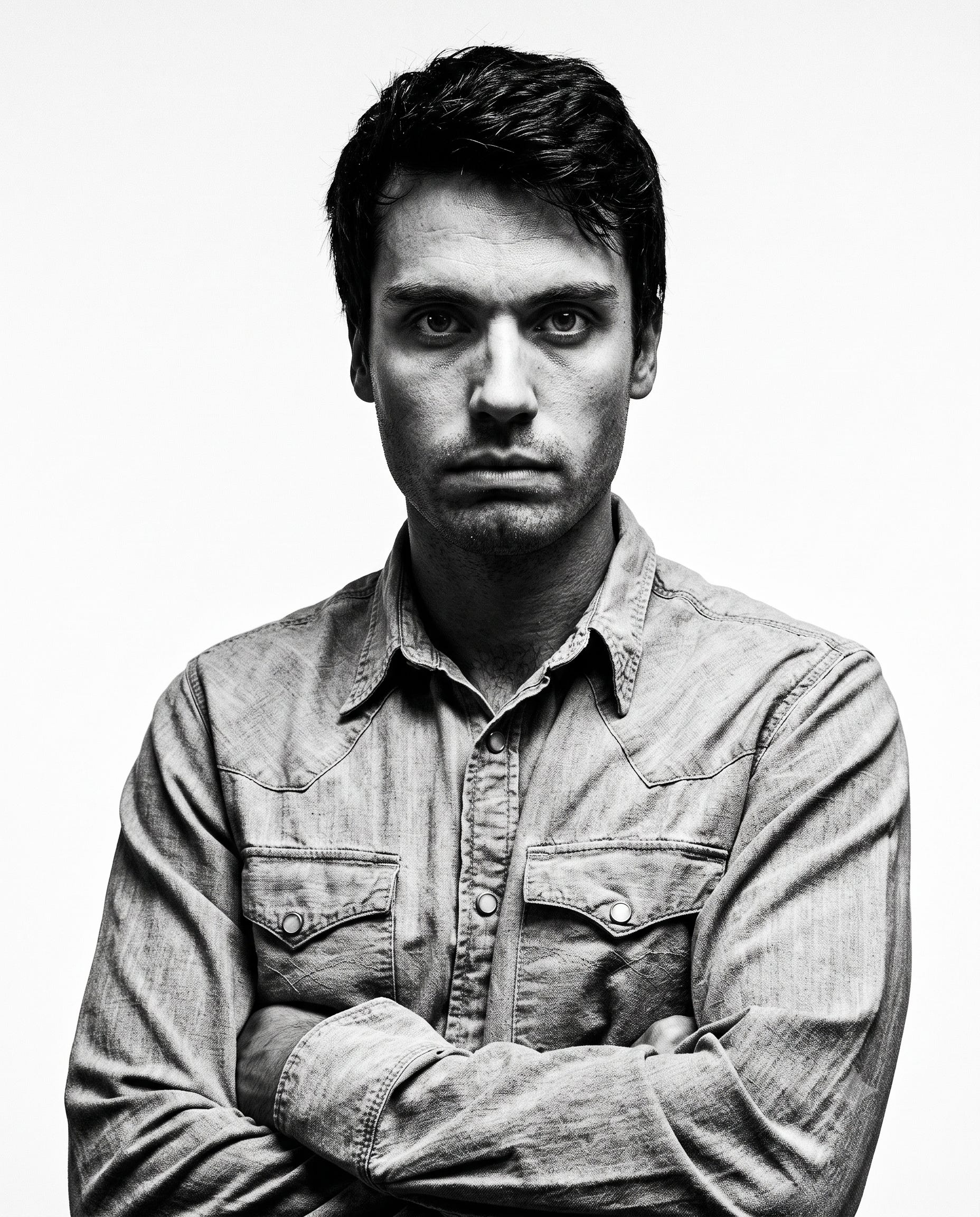
A Deliberately Inefficient Machine
from Originals - Humans Building the Future Hosted by Matt Mireles
The American electric grid is out of inventory. The hyperscalers selling AI tokens will spend $630 billion this year and find that a heavy turbine from General Electric now ships in the 2030s. Dylan Morris, thirty, is betting his company that the way through the five-year queue is a deliberately inferior machine. Where’s Your Turbine? The idea arrived as an insult. In 2025, Morris was walking a nuclear startup’s reactor unveiling with a friend on its mechanical team. Vessel, pipe, coolant loop. He asked how the heat becomes electricity. Where’s your turbine? “He was like, ‘Oh, we haven’t thought about that yet.’ I’m like — what the f**k do you mean you haven’t thought about the turbine? That’s a two-year development, a two-year manufacturing process, and probably two years of qualification.” Your ability to deliver your product is not in your control.It is in your suppliers’ hands. He put the same question to the other half-dozen reactor companies in the El Segundo cluster. Priority three, outsourced, a year behind, or absent. The nuclear renaissance everyone in that neighborhood is pricing has a turbine-shaped hole in the middle of it, and the incumbents, in his estimation, can no longer fill it. “If you boil down what GE does, they assemble the turbine from bought components and write technical manuals,” he says. “They are a technical manual company.” So the quality engineer decided to build a turbine company. Gas now, nuclear next, geothermal after that. Out of Inventory The heavy-duty gas turbine market is a triopoly. GE, Siemens Energy, and Mitsubishi Heavy Industries hold almost 90% of it, and they have spent decades optimizing the Brayton cycle to within a decimal of what physics allows. Morris has raised $2.5 million for Stone Power from Boost VC, Forward Deployed VC, Deepwater Asset Management, and — yes — me. Two years ago he was sleeping on an inflatable mattress on a friend’s garage floor. The company’s entire physical output sits on a wheeled cradle on the Hawthorne floor: one secondhand jet engine, veined with new plumbing — Stone’s own fuel pump, oil pump, safety loops. In late June the team lit it, throttled it, tripped its safeties, and shut it down, on software they wrote. A company learning to run a turbine the way a surgical resident practices on a cadaver. “Dude, we turned on an engine!” is the first thing Morris says to me, before I can ask a question. He texts me the video. That is the whole company. The math is what makes it serious. Compute Compounds; Electrons Don’t Microsoft, Google, Meta, and Amazon are converging on $630 billion in capital spending for 2026, up 60% from last year’s record, building gigawatt campuses for AI training runs. Compute compounds; electrons do not. The median wait to connect a new plant to the grid runs past five years, and the historical completion rate is 13%. A hundred-megawatt data center signing a Virginia lease today sits dark toward the end of the decade unless it makes its own power, and even Texas is measured in years. So they call the incumbents. GE Vernova closed the first quarter of 2026 with 100 gigawatts under backlog and reservation, heavy frames sold out through 2030. Siemens booked a record €146 billion and is quoting 2029 and 2030. Wood Mackenzie has turbine prices hitting $600 a kilowatt by the end of next year, nearly triple 2019. Want a new aeroderivative turbine to power a data center? Three to five years. The incumbents sell waitlists. Jet Engines, on the Ground Aeroderivative. The machine everyone is fighting over is a jet engine. The compact, fast-starting turbines a data center wants are derived, almost without exception, from the engines under the wings of airliners: the core that pushes a 737 down the runway, bolted to a generator instead of a fan. The gas turbine was perfected over seventy years to solve an airplane’s problems — be light, because weight is fuel at altitude; be small, because it lives in a nacelle, the housing under the wing; run murderously hot, because heat is efficiency and efficiency is range. None of those constraints apply to a machine sitting in a field powering servers. It can be heavy, huge, and cooler-running. But the industry only knows how to build the flying kind, so that is what it sells the data centers: a racehorse, by the thousand, to pull a plow. Death by Supply Chain At seventeen, in a corner of a Tennessee factory where nobody was charging rent, Morris and his father Kirk rebuilt a cotton-ball rolling machine from the 1950s — bought, he’s about 90% sure, off eBay — and started making heat-bonded polymer spheres to replace the sand in water filters. The company, FilterBalls, filed a dozen patents with Dylan as co-inventor and threw off a million dollars a year for a decade. Its first pilot customer was Duke Energy, straining faintly radioactive particulate from nuclear-plant cooling water. His first customer in American power was a nuclear utility, and he was in high school. FilterBalls got strangled anyway — not by its product but by its suppliers, nine American fiber processors dying under it in a decade as domestic textiles collapsed. “Your ability to deliver your product is not in your control,” he says. “It’s in your suppliers’ hands.” At Lockheed Martin he was a quality engineer, the unglamorous trade of making the thousandth unit work like the first. He pushed hardware out the door and around anyone in the way. At a performance review his manager sat him down. “Stay in your lane,” she said, kindly. “You’re doing too much. People are getting upset.” Morris quit. He went to Anduril and helped scale the tube-launched Altius-600 from three units a month to fifty, shipping more than a hundred of the armed variant to Ukraine. Then he quit that too, to move to Charlotte and buy a textile mill with his father — the supply-chain holy grail for the family firm that had watched those nine suppliers die. He hired a team, poured in his savings, and came up $400,000 short of what the bank wanted. At ninety days the deal collapsed. He fired the people he’d just hired and went six months without pay. Beaten, Not Defeated Three months before his wedding, Morris landed at LAX with $2,000 and spent it on a Honda Accord with no air conditioning and no radio. A buddy let him sleep in the garage, on an old air mattress. Then he called his old boss and asked for his job back. He doesn’t varnish any of it. The man selling a trillion-dollar outcome keeps an itemized ledger of his own defeats — the three Anduril rejections before the fourth interview stuck, the mill, the short tour running manufacturing at Rainmaker for a thousand drones the company turned out not to need. In an industry that runs on selective memory, the ledger is rarer than the ambition. Your material cost is somebody else’s energy cost, and theirs is somebody else’s below that, all the way down. Read it twice, though, because it keeps two sets of books. Morris tells his story as grit, and the grit is real. It’s also a story about rain. The first real internship came, in his phrase, “from a fluke of meeting somebody.” He reached Lockheed early because the pandemic killed the trip he’d planned first. Anduril turned him down three times before a recruiter who liked him found the fourth job, and a staffing decision, not a plan, put him on Roadrunner, an autonomous drone powered by two jet engines — his introduction to turbomachinery. A friend’s phone call later pulled him off the garage floor and into the company where he caught the itch to found one. He saw the shortage coming, partly. He was also, over and over, a man standing where the rain was about to fall. The God Input Dylan Morris found the secret of the American economy inside a textile mill. Doing diligence on the factory’s books, he saw that 30% of its cost of goods was electricity. Not labor. Not fiber. Power. He tried everything to beat it — modeled rooftop solar, ran the offsets, called a nuclear startup: “Dude, when can I get a reactor? I need a megawatt.” There wasn’t one. There wasn’t anything. Energy is like that: buried in everything else, unevenly. Take fertilizer. Natural gas is 70 to 90% of the cost of making the nitrogen kind — not the fuel that runs the plant, the actual feedstock, the molecule itself. Fertilizer isn’t made with energy; it more or less is energy, pressed into a form roots can eat. When European gas prices spiked in 2022, the plants didn’t cut back. They switched off — 70% of the continent’s capacity, dark, because the product had become worth less than the gas it was made of. Your material cost is somebody else’s energy cost, and theirs is somebody else’s below that, all the way down. Now follow that fertilizer up into a two-dollar loaf of bread. The wheat it grew is about seven cents of the price. The farmer’s whole cut — fertilizer, diesel, seed, land — is 3 or 4%. The rest, the other dollar-ninety, is baking and packaging and trucking and shelf space and the lit, chilled store. Because your material cost is somebody else’s energy cost, and theirs is somebody else’s below that, all the way down — and at the bottom of that stack sits a molecule of natural gas. Energy is 90% of the thing at the base and pennies of the thing on the shelf, hiding at every step inside a line that says “materials” or “freight.” It isn’t 6% of the economy. It’s the foundation of the economy, priced like a rounding error because we only meter it at the end. Cheap Energy Is Cheap Everything When energy stopped getting cheaper in 1979, America didn’t lose its industry at random. It lost it from the base of the gradient up — the smelters, the ammonia plants, the foundries, the things that were mostly congealed electricity. The bakeries stayed. We kept the part of the economy that barely uses energy and exported the part that’s made of it, and called the wreckage a transition to services. Morris’s textile mill, 30% electricity, wasn’t a weird outlier. It was a piece of the half that left. It’s a fringe view. It might also be true — and if it’s true, you’d expect to see it on a map, in countries that bet opposite ways on the same input. Germany decided, over two decades, that the mark of an advanced society was using less energy. It’s a rich country’s instinct, and a moral one: efficiency as virtue, restraint as progress. Then Russian gas vanished in 2022, and the industrial base cracked along its most energy-heavy seam — chemicals first, because chemicals are the most naked energy in solid form, and BASF, the largest chemical company on earth, began pulling production out of the country that invented the industry. German industrial output has now fallen four years running. China decided the opposite, at a scale that’s hard to make an American reader feel. It is building thirty-some nuclear reactors at once, roughly half the world’s nuclear construction, at four to five years apiece — while also building the coal, the gas, the solar, the transmission, all of it, on the theory that a country’s ceiling is set by how much energy it can command. One country treats energy as a sin to be managed. The other treats it as the substance the future is printed on. The thesis under Morris’s spreadsheet — that energy is upstream of everything, that abundant power is a growing everything — isn’t really his. It’s the operating assumption of the fastest-industrializing power in history, and the abandoned assumption of the country that used to hold the title. The Efficiency Trap The incumbents are trapped by their own brilliance. For thirty years GE and Siemens competed to save utilities fractions of a cent on fuel, pushing combined-cycle efficiency past 64% by driving inlet temperatures to a blistering 1,600°C. At that heat a blade can’t be forged. It has to be grown from molten nickel superalloy as a single continuous crystal, then drilled with microscopic cooling holes so it survives gas hotter than its own melting point — a masterpiece of materials science, and a hostage situation. Maybe four or five companies on earth cast single-crystal blades well; two of them, Precision Castparts and Howmet, hold 80% of the capacity, and their books are full. A third of a turbine’s bill of materials is forged, on two-year lead times, by a handful of presses. GE can’t build turbines faster because GE requires perfect blades. The villain of this story is not GE. It’s the forging press with the two-year waiting list. Morris’s heresy is to walk around it. He won’t publish his spec sheet — “I’m not giving you my secret sauce” — but the doctrine is explicit. “GE and Siemens got nerd-sniped by the efficiency math,” he says. They traded near-term margins for long-term fragility, and lost the ability to make new things. A Dumber Turbine, Faster Chasing the last decimal made sense when America imported expensive oil. Gas is cheap now and staying cheap, and a megawatt-hour is worth what it’s never been worth before, because megawatt-hours become AI tokens and tokens become dollars at margins the grid has never seen. 80% of a machine’s cost is locked the moment you pick its architecture. So Stone picks a different one — “the architectures of old, ‘60s, ‘70s, ‘50s even,” with materials a generation behind the aeroderivative frontier. Run it cooler and the single-crystal priesthood becomes optional; the supply chain widens from a few hostage-takers to something a startup can buy from, or build. Trade points of efficiency for years of schedule. The target, borrowed from SpaceX, is the “idiot index” — a turbine costs about sixty times its raw materials, and Stone means to halve that. A dumber turbine, by the thousand, faster than anyone. Acceleration Through Simulation The other half of the heresy is who designs it. For twenty years Silicon Valley has run on the assumption that you can software your way out of anything, and the hyperscalers are now colliding with the parts of the earth that assumption doesn’t cover. You can’t code a forge. You can’t prompt a fifty-ton rotor into existence. And the people who knew how to design these machines are mostly gone — retired, dead, or building rockets. By Morris’s count a few hundred master turbomachinery engineers are left in America, and a clean-sheet turbine has always eaten a few hundred of them for half a decade. You can’t code a forge, but you can simulate a turbine. Stone’s answer is what Morris calls “building the world’s best turbine engineer” — an AI workflow that chains the industry’s existing high-fidelity simulation tools together and runs the thousand tedious button-clicks between a design decision and its aerodynamic verdict, standing in for draftsmen who no longer exist. It became possible, he says, only in the last six or eight months, thanks to AI. The buyers have already voted for the doctrine. Crusoe ordered 29 modular GE turbines — about a gigawatt — for the Stargate site it’s building for Oracle and OpenAI, rather than wait for the grid. xAI ran its Memphis Colossus on some 35 mobile turbines because waiting meant missing a training run. Nobody asked about thermal efficiency. The Stone Power Master Plan 1. Sell a deliberately worse gas turbine, now. Revive a simple 1960s architecture, run it cooler, design out the single-crystal blade and the sold-out forge. Trade efficiency for schedule and sell it to a data center that would rather have a running turbine in 2027 than a perfect one in 2031. 2. Minumum viable vertical integration. Don’t vertically integrate the whole machine. Own the forging and the specialty casting, the two-supplier bottlenecks the whole industry strangles on. Buy the sheet metal like everyone else. 3. Design around the forge until you can become the forge. The near-term moat is dodging the bottleneck and growing the pie of gigawatts. The long-term moat is owning it — building a dozen machines, then fifty, then sixty, each one teaching a manufacturing lesson the incumbents outsourced away. 4. Profit from service contracts. The incumbents make roughly 80% of their money on long-term service agreements, then farm out the actual servicing and keep the paperwork. Stone wants to keep it, sells the machine as a service, and feeds the data back into the design loop. 5. Go nuclear. A turbine is 80 to 90% common across gas, nuclear steam, and geothermal. Use the gas years to build the team, the factory, and the forge, and be standing there — dozens of machines deep in process knowledge — when the nuclear renaissance finds the hole in the middle of itself. Sell every reactor company its hardest part on a silver platter. Nuclear is the prize. Gas is the tuition. Read the two axes together and the plan is a single arrow, from the humble corner to the throne GE currently sits on. Every incumbent walked that arrow once, then pulled the ladder up behind them. Morris is betting he can walk it again before the money runs out, and that the industry has forgotten how. Nuclear Purgatory On September 16, 1954, the chairman of the Atomic Energy Commission, Lewis Strauss, told a room of science writers their children would enjoy electricity “too cheap to meter.” In constant dollars a kilowatt-hour fell from $4.79 in 1902 to $0.32 by 1950, and kept falling. For seventy years electricity did what almost nothing else in economic history has done — it got cheaper every decade — and the country organized itself around the certainty that it always would. Demand doubled every ten years. At the peak the US Atomic Energy Commission projected a thousand nuclear reactors by 2000. In October 1973 the trend broke. The three largest year-over-year electricity price jumps ever recorded came in 1974, 1980, and 1981 — the Arab embargo and the Iranian revolution, arriving at the meter. What followed was a massacre in paperwork: every one of the forty-one reactors ordered in America after 1973 was canceled. The country built about a hundred reactors instead of a thousand and stopped. A generation of utility executives learned the lesson at bond-rating gunpoint — never build ahead of a forecast — which is why, when demand came roaring back fifty years later, nobody had. Low Energy America Everything peaked at once and never recovered. Per-capita energy use topped out in 1979; the average American now runs on less energy than his grandfather did. Manufacturing employment peaked in 1979. This is not a coincidence. Primary aluminum peaked in 1980, and the last new American smelter opened that same year. Aluminum is the cleanest confession in the record — it’s congealed electricity, and when the power stopped getting cheaper it left. Four smelters survive, under 2% of world production. A competitive one needs power around $40 a megawatt-hour; AI companies are paying $115 and up and still can’t get enough. The industry America lost for want of $40 power is watching the new one pay triple, into a shortage. What died in the 1970s wasn’t cheap energy — American power stayed cheap by world standards. What died was the expectation that it would keep getting cheaper, and expectation is what engineers build for. The technical culture flipped from make more to waste less, and the single-crystal turbine blade is a monument to that flinch — a masterpiece built to shave fuel in a world where fuel would be dear forever. Morris says GE got nerd-sniped. Traumatized is closer. The incumbents are still designing for 1979, and so is everyone around them: the utilities that won’t build ahead of demand, the bankers who remember the bond defaults, the regulators working in the shadow of Three Mile Island. Morris was born fifteen years after the wall went up. He may be the first American power engineer who never learned to see it as a wall. The Ghost of Jack Welch Scarcity was the first doctrine. The second one has a name, and it explains why the wall stayed up even after the energy came back. America has lost two-thirds of its foundries since 2000. A large power transformer — the other machine every data center and every plant needs — now takes about 128 weeks to get, and roughly 80% of the big ones are imported; one American company, Cleveland-Cliffs, still makes the grain-oriented electrical steel inside them. The ultra-large rotor forgings at the heart of a heavy turbine come mostly from one firm, Japan Steel Works. The furnaces that melt aerospace superalloy are booked solid, and the next big American one doesn’t fire up until 2027. Run down the bill of materials of the American grid and every line reads the same: one supplier, two suppliers, an ocean away, sold out. Earlier I said the villain was the forging press. Let me amend it. The press is the murder weapon. The doctrine that left a continental economy with a handful of presses has a name and a face, and the face ran the company Morris is trying to out-build. “What I’m most scared of is not being up to the challenge.” Jack Welch took over GE in 1981 and became the most celebrated executive in America by discovering that Wall Street would pay you for subtraction. Close a plant, the stock rose. Shed a division, the stock rose. He cut more than a hundred thousand jobs in his first years — Neutron Jack, the buildings left standing, the people gone — and grew GE Capital until a company famous for building things made a startling share of its money as a bank. Fortune named him Manager of the Century. And none of it was stupid; all of it worked. Every CEO in America studied the playbook because the playbook made shareholders rich. Heavy factories were liabilities. The smart money went asset-light: keep the brand, the IP, the lucrative service contracts; sell the foundry, offshore the forge, fire the mechanics. Each quarter was defensible. Wall Street applauded every one. The sum is a country that can design anything and manufacture almost nothing, on the most efficient and most brittle supply chain ever built. When Morris calls GE “a technical manual company,” he thinks he’s insulting a competitor. He’s describing the finish line of a forty-year doctrine, and the American economy. Welch died in March 2020; the next year his conglomerate announced it would split into three. GE Vernova — the turbine maker with the 100-gigawatt backlog, the one selling waitlists into the 2030s — is a fragment of the ghost’s estate. Token Power Then the AI boom hit, money arrived in quantities nobody had seen, and Silicon Valley discovered what had been optimized away. You can’t train a model if you can’t turn on the lights. The trap is circular, which is what makes it systemic. Reindustrializing — now the stated ambition of both parties — needs cheap, abundant power, because energy is 10 to 40% of the cost of everything. But cheap, abundant power needs exactly the industries that left: the forges, foundries, castings, transformers, heavy steel. Energy needs manufacturing; manufacturing needs energy; the country is locked out of its own house with the key inside. And it’s bigger than the AI story everyone’s telling. By Morris’s read, data centers were only about 30% of the net new power the grid added last year. The rest was factories, oil and gas, the grid itself — a whole economy trying to plug back in. None of this is finally about gas. A turbine is 80 to 90% the same machine whether the steam comes from burning gas, splitting atoms, or the heat of the earth — so the cheap-gas years are tuition: they buy the team, the factory, and the forge. The plan is to be standing there, dozens of machines deep in process knowledge, when the nuclear renaissance goes looking for the part it forgot to design. The reactor company that hadn’t thought about its turbine wasn’t an anomaly. It was the whole market, previewed. Gas is the tuition. Nuclear is the prize. The Race Morris is betting on a timeline, and he has his doubts. “Frankly, what I’m most scared of is not being up to the challenge,” he says. Quality — his home discipline — “is the gating factor in scaling.” The hardware graveyard is full of companies that verticalized too fast and bled out; he names Rivian and Relativity unprompted, which is why he means to own only the true bottlenecks and buy the rest. The critics get their strongest shot, and it has a name. Sean Hughes sells Wärtsilä’s reciprocating engines to data centers, and this spring he made the case on the record: against the simple-cycle turbines a data center would actually run, his engines are 10 to 15% more fuel efficient; they chase AI’s spiky loads, which leap “from 20 to 100 miles an hour in the blink of an eye”; and they leave the factory in about two years, against five to seven for turbines. That’s not a brochure, it’s an order book. Wärtsilä booked 412 megawatts, forty engines, for one Ohio data center this spring, part of more than 1.6 gigawatts across four American projects. ProEnergy is delivering refurbished 48-megawatt jet-engine conversions next year, 650 megawatts of them to Crusoe alone. Boom’s Superpower holds a $1.25 billion launch order for 2027 — which Morris waves off as “a cash grab” that reshuffles the constrained supply chain instead of growing it, a claim that’s at least falsifiable, since Boom’s design lives inside the casting bottleneck and Stone’s whole brief is to live outside it. In San Francisco, a twenty-something Thiel Fellow named John McElhone is building American Turbines to print the hot section outright — 3D-printing the wheels and combustor a data center’s swarm of small machines would need — a bet that tries to delete the casting bottleneck rather than dodge it, and stacks an unproven manufacturing process on an unproven machine to do it. The customer doesn’t care whether the gas burns in a turbine or a piston. And every competitor named here says they’ll ship before Stone has cut first metal. It Might Explode Then the money, which is the shortest entry because there’s so little of it. Stone has raised about $2.5 million. Million, with an M. Arbor Energy, down the street, raised $55 million just for a 25-megawatt pilot; Boom has raised $300 million on a decade of prior capital; Mainspring more than $800 million. GE Vernova booked $18.3 billion in orders last quarter, which means Stone’s entire capitalization flows into GE’s order book about every twenty minutes. Morris doesn't pretend the $2.5 million gets him to a turbine. He says the plan is customer money — joint-development deals he expects to reach hundreds of millions by the middle of next year — but he admits freely that he'll need to raise more equity to get there. First-of-a-kind rotating machinery has a century-long habit of eating budgets a hundred times this size. “Today, we’re executing violently.” Underneath the commercial race is a question nobody on record has answered: can a turbine that gives up the perfect blade hit the reliability a hyperscaler demands — five nines, thirty years, 3,600 rpm? Throw one poorly cast blade at speed and it becomes a multi-ton shrapnel bomb. Stone has found the one door in the industry the incumbents can’t follow it through without abandoning seventy years of their own architecture. It is also attempting the thing that has historically eaten billions and left corpses. His engineers have at least seen the inside of the cathedral: turbomachinery and rocket people out of GE’s orbit, Blue Origin, Pratt & Whitney, from a profession with a few hundred living practitioners. People with nothing to prove chose the seed-stage shop in Hawthorne over the institutions they helped build. That doesn’t prove the machine works. It’s the strongest signal a company this young gets to send. Killed in Action Ask Morris where the drive comes from — the nerve to bet $2.5 million against General Electric — and he doesn’t talk about electrons. He talks about a Sunday when he was eight. Gurnee, Illinois. April 4, 2004. The knock came before dawn: two men and a woman in dress uniform on the doorstep. Upstairs, a light sleeper heard what never happened in that house — his father’s footsteps on the stairs. He was carried down to a kitchen where, impossibly, breakfast was cooking, sat on his father’s knee, and told that his oldest brother — Private First Class Geoffrey Morris, nineteen, “Jeff” to everyone — had been killed by a rocket-propelled grenade in Iraq. The Morris family lost it. The father fell apart, the mother fell apart, the sisters nearly dropped out of school, food went uncooked. Over the next two and a half years, seven more of the town’s young men came home the same way. The house came apart, and an eight-year-old decided the weight was his: he and his father began organizing Gurnee’s Gold Star families — the golf outings, the fundraisers, a memorial fishing tournament that became one of the biggest on the Great Lakes. Originals is proudly sponsored by Cleaner financings and secondaries for private companies.Learn more here. His father tried to go further: a memorial in the center of town with the names of every local man killed back through Korea. He raised the money and gathered the names. Then he ran for office, the politics turned septic, and the permits died in the village’s hands. The statues were never cast. Not in Gurnee. “Everything in this world is somebody’s passion project,” Morris says — every park, every memorial, every thing you see exists only because one person made it happen. He watched his father lose that fight, and drew the lesson that nobody hands you the thing you’re owed. “Every founder’s got trauma,” Morris says. “Mine is that I had to go through that alone. And I refuse to let my team go through hardship without my leadership. I refuse.” What Stone builds, under the turbine, is what an eight-year-old built out of casseroles and golf outings when his family came apart: a team under load, led from the front. The machine is the means. The team is the point. 80% Solution. Executed Violently. The Gurnee memorial was never built. But his father didn’t stop. Kirk Morris spent years hauling its centerpiece — a nine-ton steel column from the 91st floor of the World Trade Center’s North Tower, released by the Port Authority in his dead son’s name — around Lake County, looking for ground that would take it. In 2015, eleven years after the knock, the village of Wauconda gave the beam a home. The Heroes of Freedom Memorial stands there now, on village land next to somebody else’s police station, in somebody else’s town. The father who was denied a memorial built one anyway. It took a decade and different ground. That’s the lesson Morris carried into every factory since: nobody grants you the permit. And if American reindustrialization happens at all, it will probably look like that beam — not the old thing rebuilt where it stood, but a workaround, late, on borrowed ground, dragged into place by someone who wouldn’t take the denial as final. At his last job he opened every standup with a line from his brother’s Marine Corps: “Today, we’re executing violently.” The first turbine is due on a customer’s land next year. He will own the forge. I own equity in Stone Power. Portrait of Dylan Morris is an AI hallucination based on real photos of the man. Infographics were generated by Gemini. Chart was generated by Claude. Read about How I Work. This is a public episode. If you would like to discuss this with other subscribers or get access to bonus episodes, visit originals.is
Embed this episode
No transcript yet.