
EPISODE · Jul 25, 2026 · 48 MIN
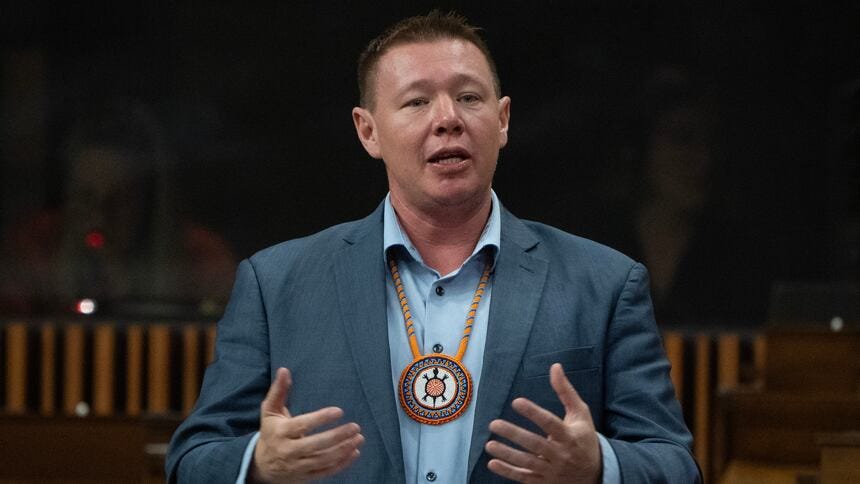
A discussion with our Member of Parliament, Jaime Battiste
from Let's Talk Antigonish Podcast · host Let's Talk Antigonish
This week’s guest is Jaime Battiste, MP for Cape Breton–Canso–Antigonish, who popped by the studio as part of the whirlwind summer tour of his home riding.First, the NameThe episode opens where it probably had to: the name. Jaime is pronounced the Spanish way; perhaps unexpected for someone from Eskasoni. Battiste was named after his father’s closest friend from Harvard Law School; Jaime Cervantes. He doesn’t generally correct people who pronounce it the English way. Where He Came FromHis parents met at Harvard. His mother (Marie Battiste) — a Mi’kmaq scholar pursuing her master’s in education — needed a tutor for an education law course and was referred to his father (James [Sákéj] Youngblood Henderson), who was finishing his law degree. The lessons went well, obviously. Six years later, Battiste was born.His mother became the first ever Mi’kmaq PhD. Her research focused on bilingual and bicultural education — specifically how to teach Indigenous language students in a way that honoured both their language and the broader education system. Battiste describes this as decolonizing education before the term was widely used. The results are striking: since the Mi’kmaq communities took control of their own education system in the 1990s, graduation rates have climbed from around 60% to 95% — among the highest of any Indigenous group in Canada. His parents eventually went to the University of Saskatchewan for thirty years of academic work before returning to Cape Breton in retirement.Battiste followed a similar trajectory. He went straight from law school into academia at Cape Breton University at 24, teaching political science, Mi’kmaq studies and history — sometimes to students older than himself. He was also doing significant youth leadership work; in 2004 he was the Assembly of First Nations National Youth Chair, where he met Paul Martin at the Kelowna Accord — a first ministers meeting on Indigenous issues — and describes Martin as the person who made him a Liberal.He never planned to run for Parliament. He was happy in his work as treaty education lead for Nova Scotia’s Mi’kmaq communities. When his predecessor, Mark Eyking, retired after 19 years, a lot of people encouraged him to run for what would be the first ever seat held by a Mi’kmaq MP. He went in not expecting to win. He was surprised each step of the way when he did. He signed up 800 people for the nomination meeting — roughly 90% of them Mi’kmaq — in a riding where Eskasoni, just under 5,000 people, is the second largest population after Antigonish.He’s also related to a significant portion of Paqtnkek. His great-great-great-grandfather was the one who established Paqtnkek; the current chief is his cousin, and he estimates somewhere between 20 and 30 percent of the community are family.What Does an MP Actually DoBrendan Ahren (guest co-host filling in for Anuj) asks the question most people never get a straight answer to: what does a member of parliament actually do all day?The Ottawa portion of the job runs 26 weeks a year, Monday to Thursday at minimum. As Parliamentary Secretary to the Minister of Crown-Indigenous Relations — essentially a deputy to the minister, stepping in when the minister is unavailable — Battiste is there Monday through Friday. His days run 8am to 8pm: committees, caucus, question period, meetings with stakeholders who come to Ottawa on advocacy days (nurses, firefighters, environmentalists, anyone with something to push for), and evening receptions from those same groups. Back in the riding, the job looks completely different. His riding is over 13,000 square kilometres — twice the size of PEI, which has four MPs to his one. He’s regularly driving two hours to meetings. He wishes he had better cell service — it’s one of his consistent asks in Ottawa — because taking calls on the road is often not an option.This summer he’s tried something new: an 18-foot trailer with a mobile office and a bathroom, which he’s been taking around the riding. He parks it in communities, works on emails and calls from there, and people stop in. It’s a little like campaigning, he admits. He doesn’t entirely mind. He also doesn’t mind when constituents pop in to say hello if the trailer in town. How to Actually Get In TouchThis question came directly from Facebook, where the most common complaint when the podcast announced the interview was: I’ve tried to reach Jaime and haven’t heard back. Battiste’s answer is practical. He receives hundreds to thousands of emails per day — his public email address is exactly that, public, findable by anyone anywhere in the world. Constituent emails get priority, but only if they include a home address and make clear the sender is actually from the riding. Without that, a message from Antigonish sits in the same pile as messages from hundreds of non-constituents from BC, Ontario, or even Europe or Australia. What He’s Been Working on for This AreaA few specific wins and ongoing files come up. The Baddeck skating rink in Victoria County was a significant one — Battiste successfully lobbied to have it named in the federal budget, leading to roughly $12 million in infrastructure funding for what was apparently one of the only counties in Canada without a working rink. That kind of direct budget line item is rare; most advocacy works through broader funds.The largest fund right now is Build Canada — $51 billion over 10 years, running through three streams. The big infrastructure stream covers hospitals, roads, and sewage treatment. A provincial-territorial stream sends roughly $343 million to Nova Scotia for the province to direct toward health infrastructure and related priorities. A local community impact stream matches smaller projects — a Legion heat pump, a playground, beach volleyball courts — dollar for dollar up to around $50,000.The hospital access road for St. Martha’s is something Battiste is actively supporting. He knows firsthand what the traffic situation looks like; he and a colleague were stuck in it last December and eventually turned around and did their meeting by phone. He’s been writing letters alongside every mayor and warden in the tri-counties in support of the Build Canada application.The Maritime Spaceport at Canso, with over $200 million in investment announced by the Prime Minister last week, will ripple into Antigonish: there won’t be enough accommodation in Canso and Guysborough for everyone coming, which means Antigonish benefits from the overflow. He describes this as being right on the cusp of significant growth for the area.On immigration and newcomers, he invokes Peace by Chocolate — Antigonish’s most internationally known example of what a welcoming community can produce — and notes he’s brought the Minister of Immigration to visit Main Street specifically to show her what that looks like in practice. The harder challenge, he acknowledges, is the mismatch between the number of international students arriving and the available housing, and the difficulty many face in finding work in their specialized field — a requirement for permanent residency. That piece, he’s honest, sits more at the local and provincial level than at his.The File He’s Most Proud Of: Physician AssistantsBattiste describes knocking on a door during a campaign and meeting a physician assistant, which led him to a question he hadn’t known to ask: why does the United States have over 200 universities training physician assistants, while Canada has fewer than five? PAs take one-third the time and cost one-third the amount to train as doctors, and they can help staff emergency rooms and carry significant patient loads. He took this idea into caucus, to the Prime Minister, to the president of Dalhousie, and kept pushing. Dalhousie now has a Physician Assistant program — the only one in Atlantic Canada. The Canadian Association of Physician Assistants gave him an advocacy award for it. He considers it one of the more concrete things he’s moved.The Second Generation CutoffThe one federal policy change he’d make if he could pick only one: eliminating the second generation cutoff rule from the Indian Act. Currently, Indigenous people who have children outside of a registered relationship under the Indian Act can, over two generations, have descendants who lose their status entirely. Battiste calls it discrimination baked into legislation and says the decision about who is or isn’t a member of an Indigenous community should rest with those communities themselves, not with the federal government. He’s been pushing for this for four years. The Minister of Indigenous Services Canada has recently committed to introducing legislation to remove it. He expects the bill in the fall.The Leadership Race, and What Comes NextBattiste ran for the Liberal leadership in January. If he’d won, he would have been the first Indigenous Prime Minister of Canada. What would that have changed about Canada as a nation?He takes the question seriously. He talks about his friend Wab Kinew, Premier of Manitoba, whom he’s known for twenty years — they texted before both their political careers began, and still do. He sees in Kinew the same values he grew up with: empathy, an environmental relationship rooted in responsibility, and the ability to stand firm when something is inaccurate. If he’s being honest, he’d bet on Kinew as Canada’s first Indigenous prime minister over himself.He ran, he says, because he felt Atlantic Canada and Indigenous voices were being left out of the conversation during the Liberal leadership race. He needed to hear from one of the frontrunners that they’d taken that seriously. He had about three hours of conversations with Mark Carney before giving his endorsement, came to believe that navigating Trump and the current international economic moment required a very specific resume, and stepped aside. He’s watched Carney’s performance since — the Davos speech, the ongoing trade situation — and thinks he made the right call. Justin’s parting remark: maybe we’ll have you back here on the podcast as The Right Honourable Prime Minister one day. Battiste laughs but doesn’t entirely close the door on the idea.Thanks to Whidden Park Campground, a Community Sponsor of the Let’s Talk Antigonish Podcast.Interested in becoming a sponsor? Email us at [email protected] Get full access to Let's Talk Antigonish at letstalkantigonish.substack.com/subscribe
Embed this episode
Ready to play
A discussion with our Member of Parliament, Jaime Battiste
No transcript for this episode yet
Similar Episodes
No similar episodes found.
Similar Podcasts
No similar podcasts found.