
EPISODE · Sep 7, 2026 · 58 MIN
A Don Hacks the Moon
from Finding Manuland · host Decoding Trolls
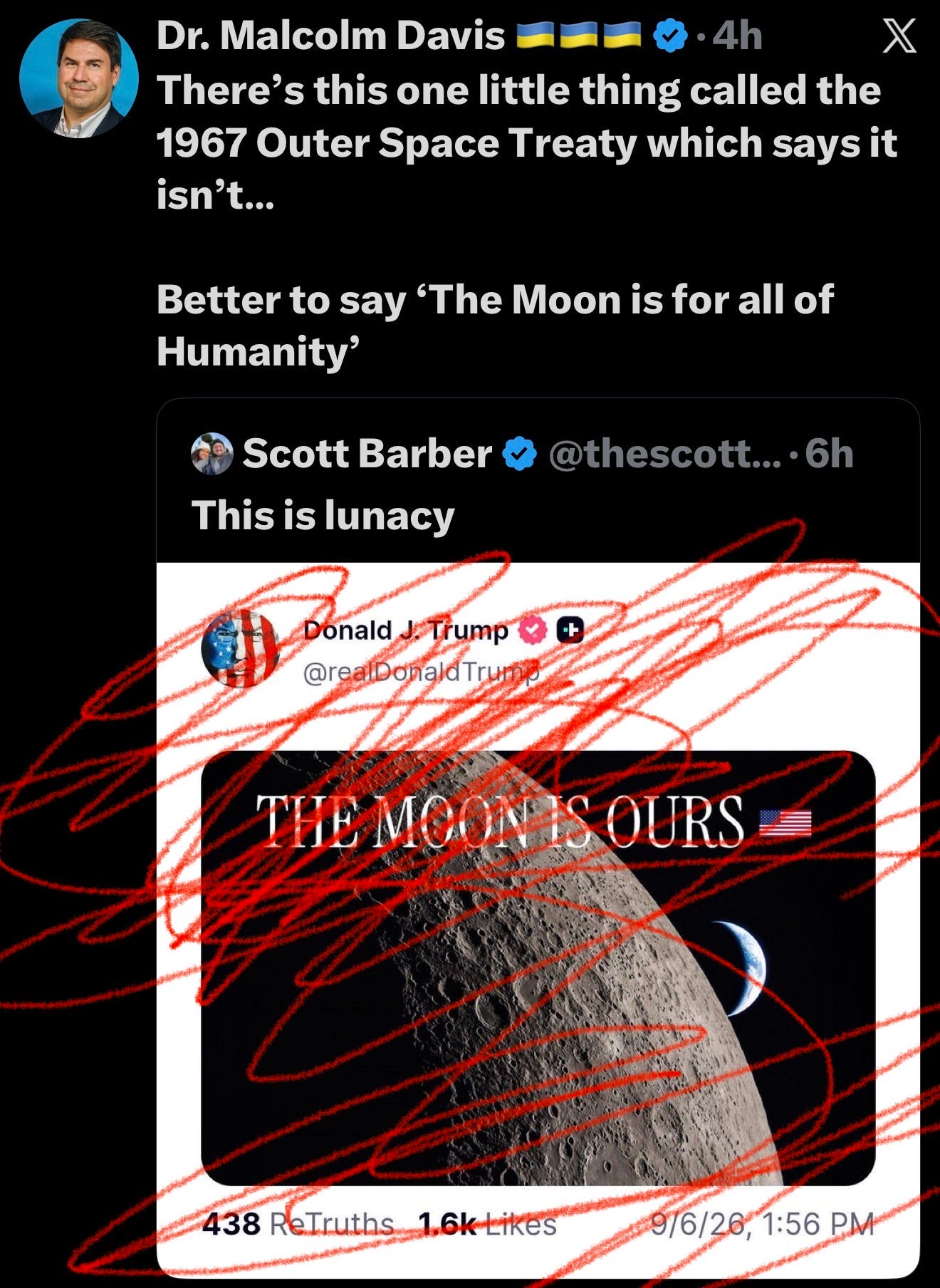
A haven, and two objectivesNormally I find Finding Manuland a haven, a Garden of Eden, a means of escaping the world of geopolitics. Hardwired into Finding Manuland, at its very core, rest two objectives. One: I want to re-centre Ukraine in our species’ story of origins and in the Indo-European origins. I want to make it consistent with the truth, and with what archaeogenetics and other matters tell us today. I also want to remodel the last 6,000 years of history, as we mentally model that history. This is very central to Finding Manuland.I have spoken before about how we can outflank a kind of ideologue. These are the ideologues who provide a philosophical justification for Russia’s activities in Ukraine. Justification is doing a lot of work there. That was in Outflanking Dugin. But I mainly keep that to my Disinfolklore project. That project is umbilically tied to Finding Manuland. Not least because mana as energy, the charge, the affective charge in memes, is very central to the Disinfolklore analytical method. It is also central to the method I try to use myself in making sense of our information space.All that aside, I find a great sense of harmony and peace when I am on the road. When I am visiting archaeological sites. When I am looking at Hittite monuments. Recently I saw the most amazing Urartian monument. I have yet to talk about it and process it properly. And to be in spaces that were very important millennia ago. When I was in Kaneš, I looked at the place where the first writing in any Indo-European language was found. That writing is from 2000 BCE. I cannot communicate quite how that makes me feel. But I do try. That is the purpose of these podcasts.So what?There is also another aspect of Finding Manuland, and indeed the whole Power of Mana project. It goes right to its beginning. I was explaining this pattern that I had noticed to a friend of mine. I did not really understand the M-N- pattern in so many ordinary everyday words. This was around Christmas time in 2022. And they said, yeah, but so what? What use is it? The use I put to it is this idea of creating an entity, a mental entity, called Manuland. Manuland is a geographical space between Ireland and India containing all of those countries. Even those in my Turkic-language-speaking Finding Manuland episodes, as you might have noticed. All of those different countries have fought for all sorts of various different reasons. They have fought about differences over particular religions, which I might archetype as Indo-European religions. If they have a sense of collective identity, then perhaps we might find more reasons to unite and be in harmony. A collective identity which goes beyond the West or Christianity or the winners of World War II or Asia or Europe.But of course I do not do this at the cost of truth, or historical truth. I do this using the truth as we find it. From archaeogenetics and archaeology and history and texts, whether those texts are in cuneiform on stone. Connecting us all genetically, culturally, linguistically through the Manuland project has an idea at its core. We can create a more harmonious community of individuals, defined by something positive. The analogy here is with the positive nationalisms that grew out of Herder’s insight in 1777. That was while the French were occupying part of Germany. The Franks were occupying part of Frankfurt. Ironic, of course. Originally the Frankish aristocracy from Germany had gone to what we call France and occupied it. Although the French kept their Romance language, which grew out of Latin, they took the name Frank.Herder’s callHerder called: where is our Shakespeare? With this call he said, look, let us unite the historic Germanic tribes. Tacitus, the Roman historian, had written about them in 98 CE. To do this we need songs. We need common songs celebrating our common culture across the Germanic tribes that Tacitus had written about. This call launched the folklore and folk-song collecting movement. It eventuated in this great flowering of the 19th century and the 20th century, until today, whereby certain cultures won the lottery. They managed to get protection and status as sovereign states. And of course thousands of amazing cultures lost in this. But let us celebrate the countries that did manage to solidify around a common identity. It is formed of these stories and of these songs and of these cultures. So that is a very serious objective in Finding Manuland. Some might say it is impossible to achieve. But I am trying my best.Yesterday Donald posted a picture of the MoonAll that said, when Donald posted about the Moon yesterday, I considered very carefully. Which of my three projects: decodingtrolls.net, disinfolklore.net or powerofmana.net, and really this particular aspect of it, Finding Manuland? Where should I post about this? Because the Moon, as you listeners will understand, is very central to Finding Manuland. It is a central hypothesis. Yesterday Donald posted a picture of the Moon. As many of you know, the Moon is a central hypothesis. It explains, perhaps, why the M-N- sound is so immanent in our languages.We know, for instance, or I now know, that M-N- is in the founders’ names. It is there in six of eight living Indo-European traditions today. I started going backwards from that empirical observation. Then I noticed it was in almost every sentence we speak, in many different words. Traditional and conventional and brilliant etymology considers those words to emanate from different roots. Any sound-meaning correspondence between these different etymons, as it were, is coincidence. It is just chance. So going backwards, I went on this journey from today back. I ended up on the steppe, in this village, Mykhailivka, in southern Ukraine. It was completely random. This journey had really begun when property developers were trying to destroy a Yamna mound, a burial mound, a kurgan, a mane, outside the city I was then living in and working in as a diplomat. ## The kurgan that started itI was more surprised than anyone to discover the existence of this community of people called the Yamna. Then to discover that they actually come from the area I used to travel around for three years, every day. It’s not a complete coincidence, because their residues, what they left there in Ukraine, are 100,000 to 150,000 burial mounds. It was a burial mound which precipitated this journey. That journey has emanated, or projected, me into this position, where I’m now talking to you through a microphone. So it’s not a complete coincidence. But it’s pretty mad.Uncovering this story is probably the most significant, interesting and organising focus for my life. I tried to communicate that sense of excitement. As I mentioned, it is a bit of a haven for me in a world of disinformation and Disinfolklore. Really sad things, avoidable things, are happening a lot. We press on. Finding Manuland is trying to build a positive identity for all of us who speak Indo-European languages, and indeed Turkic languages. That is in Manuland, the space between Ireland and India, where we traditionally speak Indo-European languages. That’s my response to the state of chaos that we’re in.Arbitrary at sourceThe Yamna were a community of ancient Ukrainians. We can now analyse their ancient DNA. It demonstrates and corroborates and evidences that they are the ancestors of every living Indo-European language. Therefore you can chase a particular sound-meaning bundle, which M-N- is, and the meaning attached to it. I’m not just interested in the sound. I’m interested in the meaning. The meaning of M-N- as a charge, as an affective charge, as energy. It crosses the different etymological boundaries for the different worlds that they correspond to. So I adhere to the premise of de Saussure, the founder of modern linguistics. It is the premise of all modern linguistics, and I refer to it, even obliquely, every day. The foundation of the sign is arbitrary.So the sound we use to describe what we call the moon could be anything. The sign for the moon, which is the M-N- sound immanent in the word we use for moon, could have been N-N-. It could have been A-B-. It could have been F-C-. It could have been anything. But the Yamna took this arbitrary sign, the M-N-, and attached it to the moon. So my hypothesis goes. At that moment it stopped being arbitrary.Then, for one reason or another, this particular sound-meaning bundle of M-N- really took off. So did its meaning of energy and light shining through a different object. That is light shining through meaning, or through the human, to differentiate us from the stone. It colonised every single living Indo-European language. So much so that we are the inheritors, the cultural inheritors, of this tradition. That is so even if you speak an Indo-European language and have no steppe ancestry inside you, no Yamna genes inside you. Which is probably a bit unlikely. Most of us between Ireland and India do have steppe ancestry inside us, from ancient Ukraine, from the Yamna. That in itself is pretty amazing.Europa and Asia meet at the DonThere is the question of how this came about in all of these countries. All of these places in this massive area, which I now moniker Manuland, between Ireland and India. No one before has ever had a signifier for it. They talk about Asia and Europe. I am uniting Europa, the goddess Europa, and Asia, the deity, whose writ ran, again amazingly coincidentally, according to Isidore of Seville. He was kind of the Wikipedia of the ancient age. Isidore of Seville marked the border between Asia’s jurisdiction and Europa’s jurisdiction as the Tanais, the Don River. The Don was and always will be part of ancient Ukraine. It was part of modern Ukraine until the 1920s. Then that whole area was taken away. Maybe one day it will be part of it again.In any event, the point I’m trying to make here is this. The Yamna chose a sound, M-N-, and they attached it to a meaning, the moon, at source. That was in Mykhailivka village and on the steppe around Mykhailivka and Zaporizhzhia. The ancient DNA tells us that this is more likely than not to have happened. They did it so intensively, and it was so important, that that meaning and that source travelled over the next 6,000 years. They travelled into every living Indo-European language. So it’s arbitrary at source, as all modern linguistics establishes. But after it is established as arbitrary at source, there’s something so strongly bonding these signs and meanings, these signs and signifieds. It is strong and powerful enough to attract, like the moon attracting the tides. It continually regenerates itself in the minds of the more than half of humanity today who speak an Indo-European language.Then we teach it to our children. They use this sound-meaning bundle in these different ways over the course of the next 6,000 years. All with this same sense of energy and affective charge inside it, or light shining through something other than itself. That in itself would be my response to my friend who said to me in the Christmas of 2022, “Well, so what?” This is amazing. It’s absolutely amazing that we have these. We have about 1,000 words which are reconstructed back through all the living Indo-European languages, back to so-called roots, which is wonderful. But as far as I know, I’m the first person to notice sound-meaning bundles in Indo-European languages. I call them cryptotypes. I have written about them before. I will continue to write about them and explain what I mean by that.The empirical factSo we start with the empirical fact. Those of you who have been listening to Finding Manuland by now totally understand it. The M-N- is immanent. It is in the word immanent itself. And the attached meaning: it is in the word meaning as well. So it is not just about the sound. It is M-N- and attached meaning: moon, measure, human, name. There is a whole set of meanings attached to this M-N- sound. Conventional linguistics parries them into different etymons, moon, measure, human and name, for instance. It is even in the moniker etymons. This M-N- is in there. You cannot even use the language of linguistics. Noun is nomen, coming from name, the N-M-, the reversal of the M-N- consonantal skeleton. You cannot even talk about these matters without using that vocabulary. M-N- and N-M-, the moon-based semantic metaphorical signalling system, has colonised it.That is a phenomenon I have been looking into since I first saw it. It is pretty amazing. But it is not magical. If we did not know about the Yamna, then it might be magical. If we did not know we all spoke the same language between Ireland and India. From the same language family, from the same common source. I am able to trace it back 6,000 years to the Yamna, with the help of archaeogenetics published in peer-reviewed research. For instance, the Nikitin et al. paper from February 2025 in Nature, which I have spoken about before. It establishes that the Yamna community was centred in Mykhailivka village on the right bank of the Dnipro. That is just south of Zaporizhzhia, just south of Dnipro city, where I lived for three years.The memeSo we go back to yesterday. In the meme posted yesterday, the Earth is in a corner, a blue crescent the size of a coin. It came in a run of three dozen posts in two hours. Donald on a horse beside the first president of the United States. The United States state of New Mexico, re-archetyping as New America. A uniform of the Space Force, which is part of the US military. Some people say it was actually inspired by the Nazis. Then he posted the moon and made a claim for the moon.Everyone commenting on this post is doing so at a superficial signifier level. Some of this set of people go: well, the Outer Space Treaty 1967. As many listeners know, I am a trained international lawyer. I studied international law at Trinity Hall, Cambridge, the pre-eminent law college at the University of Cambridge, founded in 1350. So you might expect me to go for the Space Treaty of 1967. However, I was a diplomat in Russia-occupied Ukraine between 2015 and 2018. (This is mainly dealt with in my disinfolklore.eu project.) That experience means we must look beyond what is immediately given, to look for the mana in the meme. So we are looking beyond names. We are looking into the energy of what is being named.In this podcast I am not sharing Donald’s actual post unadulterated. I do not want to keep this meme in circulation. I am trying, without the risk of promoting the meme, to elucidate, to illuminate, what Donald is doing. I want to explain the level at which he is doing it when he talks about the moon. I do not want to promote him. So I do not use his second name, which is the name he uses to promote himself. He tweets about the moon and claims the moon for the United States. I think very carefully about how I do it, so that we understand more about the stories impacting our daily lives. I do not want to be part of the problem.I have written before about how the energy in memes, the mana in memes, keeps going when you share them. So many people shared various of Donald’s memes yesterday, for instance, the memes I have just described in natural language. They shared them while going, oh, this is terrible, this is shocking, a US president has done this. As they are doing that, they are wrapping it in their negative evaluation of it. Even so, they are contributing to the reasoning and the intentionality of Donald and his team to actually create these memes. They create them because they know lots of us will share them. So I want to be outside of that. That is very much part of my practice, as in my Disinfolklore project. The project is trying to look at ways we can confront the adulteration of our information space with these terrible memes. Including in our minds. They can adulterate them even when we share them unintentionally.This is lunacyThe Space Treaty, of course, does say that no nation may claim the moon. But that is not stopping Donald tweeting about this on the Sunday afternoon. That is when he is trying to distract from this, that or the other. A defence analyst straight away posted (and that is the frame I used for this post): the moon is for all humanity. Then, hilariously or ironically, perhaps knowingly, someone else posted: this is lunacy.Because, of course, there are two words in Indo-European language for the moon. They go right back to the beginnings of Indo-European languages. One has an L in it. It is lun-. That is about the light element of the moon. Indeed, the light element is in element itself, and the M-N- is in element itself. The other is the functional use of the moon. That is what is really relevant to the M-N- project, because méh₁nōt meant measurer. This is how women measure their months, how we measure our months. My cat came in today. They are twelve months old. I said, you are twelve months old today, congratulations, it is your birthday. Then I realised I am basically saying, he is twelve moons old.So we use the word month every day. We look at our calendars, our Microsoft calendars, our Apple calendars on our computer. The moon is right there. It’s month. It’s in month. The M-N- is in month. That’s the functional use of moon as measurer. That is what the Yamna used back on the steppe, 3,600 years before the Common Era. They used it to determine when to plant, when winter was coming, when women’s monthly menstruation was coming. It’s in menstruation as well. So the moon as a measurer is functional, as distinct from lun-. It is very arch and quite funny to me that someone would say “this is lunacy”. Because it quite literally is lunacy, in that sense. We’ll get to that at the end.The post was built to get that reply. That’s why Donald’s team posted it. Every patient correction carries the image, the mana in the image. The name is the image, and then inside it the energy. One share further, and it wraps it in a different opinion. Then it keeps on going. I’ve written about that energy, that mana, keeping the energy of memes going. This is exactly what they’re doing. I’m aware of this. I’m self-aware of this. As I’m commenting on it, I’m attempting to use the power of mana and Finding Manuland. My entire work in linguistics, in fact, to help us understand precisely what’s going on.The groundThe moon in English, that’s what we call the moon. Mond in German. Mās, M-A-S, in Sanskrit. Mēnē in Greek. Mí in Irish. Amis in Armenian. A month in Greek is mēn. So when you say someone is 12 months old, you’re basically saying you’re 12 moons old. As I just mentioned to my cat. That sounds very archaic. But that is how it used to be. It was such a commonly said word. Eventually it managed to colonise all the speech and the descriptions of that Yamna community. Their migrant community seeded all the communities that would become all the Indo-European language-speaking communities we have today.So again, I’m saying this is not magic. This is not lunacy. This is not spiritual awakening. There’s a whole area of moon studies and moonology and what have you. That is not part of what I tried to do with Finding Manuland. Because what I managed to do was trace it back to the steppe, standing on the shoulders of giants, to Mykhailivka village. The ancient DNA published in Nature in February 2025, the Nikitin paper, establishes that the Yamna community lived there on the steppe. They were the ancestors of all living Indo-European languages. Modern linguists have reconstructed the language they spoke. They moniker it Proto-Indo-European. I call it ancient Ukrainian, to afford parity of esteem with Ukraine, the modern nation state. That is, if we are to use the same moniker, Greek, for the modern Greek state. That state emanated out of the same folklore movement that I’ve mentioned before. But it used the history of ancient Greece to justify and explain why their modern state was a proper state. Ancient Greece is a great Indo-European tradition, one of many. We talk about ancient Greeks. So why shouldn’t we also talk about ancient Ukrainians?As far as we know from modern linguistics, when the Yamna looked up at the sky they saw the moon. They didn’t call it X or Y. They called it the moon, méh₁nōt (m, e, h, one, then nōt), the measurer. Linguists use this term for the moon, méh₁nōt. You’ll see this in Mallory and Adams’s Oxford Introduction to Proto-Indo-European. Moon in English, mās in Sanskrit, mēnē in Greek, mí in Old Irish, Mond in German. All of these words descend from one word, one etymon, méh₁nōt. It was spoken in Mykhailivka village on the Ukrainian steppe 6,000 years ago. That is the language that Persian, Hindi, Ukrainian and English all come from. Our ancestors did not name the moon for the light, for Luna. They named the moon for its function. The moon was the measurer, the first instrument anyone had. Month, Monday, measure and menses are the moon’s day job.The sound runs on, whatever a dictionary says. Memory, meaning, man, mind, human, money, monarch, mandate, mantra and mana. And all of those other words. Those who read and listen to my work will know I’ve been talking about them for many years at this point. Including many, by the way. So this is an old word for power, this M-N- sound. The power of the moon, the power of mana, the energy in it. The light in it shining through a stone in the sky. The consonants M-N- run through all of our words for whatever lights a person from the inside, a human. Once you get your ear in, you hear the M-N- everywhere.That’s part of my task, to help you get your eye in so that you hear it. You focus. You pay attention in normal everyday talk to the language and the sounds and the meanings that we use in everyday language. You wonder about where they came from. I found the M-N-, and the sound-meaning bundle, the M-N-, the N-D- and a few others. I’ll continue to talk about them in the Finding Manuland Atlas series. But there are possibly and probably others, which maybe you will be inspired to find.The moon is a stone in the sky. It seems lit from within. Like light shining through the moon, mind shines through a human. That metaphor sits at the foundation of how we name a mind. Everyone who says moon or meaning still uses it, in any Indo-European language.My hypothesisSo, my hypothesis. I state this clearly. My moon-based metaphorical semantic signalling system is merely a hypothesis. We start from the point today and go back through different Indo-European traditions. We see this M-N- sound immanent in so many different words and meanings. Traditional etymology put them into different roots. People say, gosh, that’s the same sound and meaning, if they even notice that at all. Our traditional etymology goes, oh, that’s just a coincidence. That’s just chance.So we start with the empirical fact today of the M-N- sound being ubiquitous across every sentence we speak. We try to look at how that could have happened. The moon-based metaphorical semantic signalling system is just my hypothesis. You might have another. I’d love to hear it. The moon is the metaphor. The light shining through the moon is the foundational metaphor in our Indo-European communities.The measurementThe sound is in fact M-N-. It is associated with measurement. Linguists have a word for a pattern speakers use without knowing it is there: cryptotype. I’ve measured this one using state-of-the-art data analytic techniques. I’ll talk about those in future episodes of the Finding Manuland Atlas. Across thirty-seven living Indo-European languages, words for mind, moon, measure, man and name have M and N keeping company inside them. Name is N-M-, the M-N- reversal. They keep company in any order, 20.8 per cent of the time, against 3.46 per cent for words in general. That’s an odds ratio of 8.0. That means it’s eight times chance.Someone points out that mind, moon, measure, man and name have M and N keeping company inside them. In one or more of their appearances in different Indo-European languages. Linguists claim it is just chance. I spent July using state-of-the-art data analytics techniques and various different instruments like the NorthEuraLex lexicon. So I’ve been able to establish that it’s actually eight times the chance. That means there is an eight times greater chance that M and N keep company in those words than in a word taken at random.It’s the first of 182 sound pairings tested. A word for one of those five things is eight times more likely to carry the M-N- sound. Eight times more likely than a word taken at random. The chance of that happening by accident is a decimal point, sixty-five zeros, and then a five. Basically, you could run that test from the beginning of the Big Bang every second. You still wouldn’t get there by chance.Linguists and etymologists say that the M-N- in mind, man and human, and in measure, and in name, is just chance. It is just chance that these same consonants are in these different monikers. You might even persuade them to say, oh, the Yamna used these different sound-meaning bundles for different things, for different phenomena. And it’s just a coincidence that they used the same one. Perhaps they were very parsimonious. Because these conventional linguists, whose work I rely on a lot, and many others, trace each of these back to individual etymons. And that again, M-N- in etymon.When the linguist says this, we can now say: I’ve done this test. I spent July going through all of these state-of-the-art statistical tests. M and N keep company in words for mind, moon, measure, man and name. The chances of that by accident are a decimal point, sixty-five zeros, then a five. So you could run this test every second since the Big Bang. You’d still not reach the fact of having M and N keeping company in those five words, and what they mean. In different Indo-European languages, thirty-seven living Indo-European languages.Having established that, my hypothesis for what explains it is, okay, they come from méh₁nōt. The Yamna used the moon-based metaphor. They looked at the moon. They saw the light shining through what seemed like a stone in the sky sometimes. They said, okay, well, how do I distinguish a human from a stone? Well, I’ll use this metaphor. We have light shining through us. How do I describe that this signifier means this? Well, I’ll say that the light of this other signifier shines through this. This is its meaning. So that’s my hypothesis.Maybe there are other hypotheses. But it makes sense if you have a theory of cryptotypes. If you don’t have a theory of cryptotypes, you think there cannot be this hidden grammar inside our language. Not until it’s elucidated by researchers like myself and linguists like myself. Put brackets around this idea that these different sounds and meanings happened by chance. Imagine that it didn’t happen by chance. Then, for me, the idea that they emanate from méh₁nōt is plausible. Even if you don’t agree with any of that, hopefully you’ll stick around for the journeys. We’re discovering lots of different interesting stuff. But it’s particularly relevant to today.Six foundersAnyway, six of the eight living Indo-European branches give their founding figure on that sound. Manu in India. Aryaman in Iran, or Aryānām in Iran, depending on who you take. Or Bruce Lincoln thought there was also a Manuš in Iran as a founder. He saw Manuščihr, the son of Manuš, as a founder in Iran. Minos in Greece, and Rhadamanthus, his brother. Menua in Armenia and Urartu. And Mannus among the Germanic people.Some of you might remember listening to my sixth part on Manu, on which came first, Manu or Mannus. Manu in India, or Mannus among the Germanic people. Mannus had three sons, one of whom was called Irmin, again with the M-N-. And Manannán and Érimón in Ireland, the only Celtic-language-speaking nation state that has full status as a state. Maybe that will change in our lifetime. Maybe Wales and Scotland will become independent sovereign entities. But for now, Ireland is the remnant of what, 300 years before the Common Era, was the Celtic-language-speaking empire. It stretched between what we now call Czechia, the Hercynian forest, across to Ireland, down to Spain. They were getting into parts of Italy, and across Anatolia to Ankara. Some of you might remember my posts from Ankara, a city founded by the Phrygians. I visited Midas’s tomb. Midas was a Phrygian, Celtic-language-speaking probably.One name like that would be an accident. But six, at two ends of the family, Ireland and across to India, the whole of Manuland. That means it could not have been borrowed from each other. So it is inheritance. I look at the linguistics. I look at NorthEuraLex, 43,251 word forms across 1,016 concepts. Then I also look at the founder names. These are two separate vectors of evidence that something is going on beyond chance. I am able to measure the chances that Germany and India would end up with Mannus and Manu respectively as their founders. That is one chance in 2,500.Mykhailivka, across the river from EnerhodarThe Yamna, the herders who spoke that common source language, made the word. We know that. That is beyond all reasonable doubt at this point. The word is méh₁nōt. In 2025 Nikitin and his colleagues traced the Yamna, as I mentioned, to Mykhailivka, very close to the Enerhodar nuclear power plant. The Russians are occupying it, across the river from Mykhailivka. As I speak today, it is running out of diesel for the nth time. Anyway, humanity can begin somewhere and end in some place. What an arch coincidence. But we are now enveloping ourselves in an eiderdown of really interesting stuff. So we are going to try and stay away from that geopolitics. We do have to get to Don and that darkness, though. Maybe I can elucidate some of that darkness.Half of humanity today speaks a language that descends from theirs, from the Yamna, spoken in 3600 BCE. The ancient DNA tells us this. The word, the moniker for moon, is the signifier. What it signifies is the actual moon. The word does not belong to any state. It does not belong to America. Donald cannot tweet “the moon is ours”. The moon never has belonged to anyone. It belongs to all of us. And the signified belongs to all of us. We legislate through the language we use.A demon of the moonIn January the Kremlin’s house philosopher Dugin wrote that Cheburashka is a demon. I have spoken about this in my Outflank Dugin, Don’t Rebut series, which I started a few weeks ago on disinfolklore.net. Cheburashka is kind of the Soviet era’s Mickey Mouse, a big-eared puppet three generations of Russian-language-speaking children have loved. The Kremlin’s house philosopher, I maintain, is a security service operative. He is an actor, acting the part of a philosopher. This is to provide a justification for the terrible activities the Soviet Union and today’s Russia are involved in. On the continent of Europe and elsewhere. He provides the philosophical justification.He wrote a piece where he archetyped Cheburashka, who is Russia’s Mickey Mouse, as a demon. And of course there is the M-N- in demon. A demon of the moon. That is what Dugin called Cheburashka. In another universe I would say: can you imagine the US president calling Mickey Mouse a demon of the moon? But we don’t live in that universe any longer, sadly. Part of my job, and part of all of our jobs, is to stay positive. And to find means of understanding what precisely these ne’er-do-wells are doing. Not just to our minds, to our communities, but to our inheritance and to our chance of a peaceful future. That is also part of what I do in Finding Manuland.That Kremlin house philosopher, Dugin, gave the demon a made-up name and made-up pentacles to prove it. He used a made-up, Semitic-language-sounding origin for the term Cheburashka. But I have looked into it very deeply. It is completely fake. He falsified it. He wants to create in the minds of Russians the idea that their dearest big-eared puppet is a demon of the moon. Three generations of Russian-language-speaking children loved that puppet. Then he adds in a pseudo-scientific, fake, Semitic origin for the term Cheburashka.When I talk about the meaning and the purpose of Finding Manuland, I am really serious about outflanking people like Dugin. Many of us don’t pay enough attention to what they are doing. They are using the moon, for instance, in this case, to qualify the idea of demon. A demon of the moon. A demon, M-N-, of the moon. Then he is creating a false Semitic linguistic etymology for the term Cheburashka.You need to be operating on this linguistic level. Or at least to have a module in your brain where you can interrogate what these people are saying. Otherwise we just go: oh, that’s really funny, that’s a bit weird, what’s he going on about? Oh, I’m just getting on with my day. To really understand how the Russians and MAGA and other disinfolklorists are operating, I maintain this. (Disinfolklorists is what I call them in my other projects.) One can invest a lot more understanding into one’s own mind. That comes from looking into the linguistic aspects of the deceptions which they are playing. That is why I focus on this, and on Donald talking about the moon.I don’t just speak about these things because they are interesting to nerds like myself. And they are interesting. Fascinating. I speak of these things incessantly. I think of them all day long. I try to communicate them to you because I am interested in them. I hope I communicate my energy and my enthusiasm to you. But it is not just about that. I want to better understand what is going on in today’s world. I want to help you see how I see what’s going on in the world, what’s affecting today’s world. You go and you discover, for instance, that diesel is costing X amount of money when you try to fill up. Or the food you’re buying for your family, or your children are buying for their families, is going up in price. Then you realise, okay, that’s because Russia invaded Ukraine. Or that’s because Donald is involved in this catastrophic war in Iran. And why did Donald invade Iran? As a distraction. All of this stuff. This is because the Russians got Donald elected. All of these different root causes. If we want to understand how our lives are being impacted by these matters, it’s worth understanding what they’re doing with language. And how they’re affecting our minds.The Russians themselves, their security services, hired an actor, philosopher Dugin. He is hacking the substrate of our very language and our very foundational civilisation. The only way we can outflank this is by going backwards 6,000 years to the beginning of Indo-European civilisation. And saying to them: no, that is wrong. That is a fake Semitic etymology. The reason you are postulating that Cheburashka’s name comes from pentacles is because you’re trying to mystify us with nonsense. Meanwhile you’re justifying your state destroying the very space where our language came from and emanates from. The language you’re trying to brainwash us with came from there too. So stop. I’m outflanking you. I’m not taking any of this nonsense.So this is the purpose of Power of Mana. I’m trying to entrench in our minds a means of outflanking these ne’er-do-wells. Their cynicism, their just sheer awfulness, has an impact on almost every single moment of our lives at the moment. In our family’s lives. On our family budgets. On how our minds compute the data when we turn on the so-called news or we see Disinfolklore. The conversations we have in work. Whether in fact we have work. Whether our jobs continue.Reversion to the MoonDugin could have made a demon of the river, or of the fire, or of the field. But he went for the Moon. The Russian security services create a house philosopher. He’s the actor. He’s not a real philosopher. He’s writing about Cheburashka. Did Kant write about Mickey Mouse? No. So this guy, this clown, Dugin, is an actor for the Russian security services. They chose the Moon. When an operator of the Russian security services needs the authority of old ground, they refer to the oldest ground there is. The foundation. I call this Reversion to the Moon, after the reversion to the mean phenomenon in data analytics.Neural network algorithms power all of the AI that we see around us. They are affecting our daily lives, or making choices for us, finding flights for us. Those who have a vocabulary understanding of neural network algorithms, like I do, will understand this. The artificial neurons driving them are expressed in terms of weights. Those weights themselves are set using the standard deviation from the mean. Reversion to the mean is a phenomenon from the same data analytics. And M-N- is in mean. So the standard deviation is part of how the weights of any particular artificial neuron are set. There are billions of those weights in a particular artificial neural network algorithm we’re using, if we’re in a chatbot or something. And this is not just an arch play on words.When I talk about Reversion to the Moon, I talk about reversion to the M-N- based metaphorical semantic signalling system. It is in almost every sentence we speak. When we go for the founders’ names, whether it’s Manu, Mannus, Manannán, Érimón, Menua, and all of those founders. Then we can empirically see it in almost every sentence we speak. And we can see it in the foundations of our cultures. Every time we say Germany, we are talking about Mannus.So it’s also actually a way of communicating reversion to the mean. That is quite an arch play, because Disinfolklore is about mean stories. It communicates the energy of mean stories, the manner of mean stories, into our minds without us even noticing, using folklore-like archetypes. But the reversion to the mean in data analytics is about measurement. When the Yamna spoke about measurement, they used this term modern linguists call méh₁nōt. It then became attached to the Moon. That is powering our world today. And it powered the world on the steppe. Dugin and the people he works for are trying to justify the annihilation of that steppe. For instance, right across the river at the Enerhodar nuclear power plant. Mean, of course, carries the M-N- sound too. So the foundation of what I mean is what I mean by the substrate. Planting a claim on it is a substrate hack.Dugin claims Cheburashka is a demon of the moon. That is because, for whatever reason, they want to tarnish this Mickey Mouse character as being a rootless cosmopolitan. He is beloved of three generations of Russians. They tarnish him by saying he’s a demon of the moon. A demon of the moon, with a fake etymological substrate claim for it. So they use the Moon. And that hack reveals the power of the cryptotypes we’re talking about.Two operators, one objectIt’s the same trick that Donald used yesterday. So Donald says the Moon is ours. Nobody in Washington needs to have read Dugin. But we know people like Peter Thiel and others have, and their followers, and Vance’s followers have. So we do know there is contact between these two sets of people. Two operators emanating from the same Russian mafia entity, according to one interpretation. But two operators, Dugin and Donald, with no material link between them. This may or may not be true. We don’t know who drafted that text for Donald. Maybe they had read Dugin. Maybe they were hired by Sergio Gor, the Soviet-born head of personnel in the White House. So he is responsible for hiring. As far as I am aware from public reporting, he has not undergone a security check himself. So maybe they are in contact. I don’t know. But let’s assume that they’re not in contact. Just like the Indians, who called their first man Manu. They were not in contact with the Germans, who called their first human Mannus.Everything that the current administration (M-N- in administration) does, the Russian mafia state, let us put that aside for a moment. The moon, because that is where the oldest ground in Indo-European civilisation is. That community of Yamna, sitting around their fire, looking up at the moon. Forging these metaphors and planting them in language, in ordinary speech and in founders. Like Manu, like Mannus, like Manannán, like Érimón, like Menua. When a human who wants to look like a founder goes looking for foundations, the moon is where their minds go.The letterFor months, Donald has been telling people that most people do not know that there is a B in dumb. Anything dumber than that, it is hard to imagine. But remember that I try to be really parsimonious in sharing these memes, whether they are linguistic or visual. Because, of course, the point is that we’re talking about Donald. And gosh, I really look forward to a world where it’s impossible to talk about him in the present tense. Because it’s ruining so many lives and infecting so many of our minds. All I’m trying to do is get into the substrate of what’s going on. These odd things are occurring in our world. Really terrible things are occurring in our world. This is my small contribution, with my various projects.Donald uses this terrible term where he denigrates the Democratic Party. He others them and turns them into the Outer Realm, taking the B out. I’m not actually even going to tell you what it is. All we need to know is that most people do not know that there’s a B in dumb. That is something Donald has been talking about for months. There’s lots of reporting on this. Google it if you would so choose. A man, a human, Donald, fixed on one letter, the B. And yet his own name, Don, has letters in it he’s probably never looked at. But maybe they have. I don’t know that.It’s just, everywhere I go, there’s more meaning in what they do than one can see. That is, using what normal people understand as normal knowledge. I’ve just happened to have spent years looking into all of this. Everywhere I go, I find aspects like this. So it’s entirely plausible someone has explained this to him, what I’m about to explain to you. Who knows? All I can do is draw attention to this.Donald is on the surface a D-N- word. That is the sound of the five great rivers of the Indo-European homeland. The Don. The Donets, where I worked for three years. The Dnipro, where I lived for a further four years. The Dnister, which I crisscrossed many times. And the Danube, which I’ve also crisscrossed many times, along its full length. All the way down to where it meets the sea, the Black Sea in Ukraine. Inside the river names, Don, Donets, Dnipro, Dnister and Danube, sits the older thing.I’ve spoken before about Donn, who is the grandson of the monarch of Scythia, ancient Ukraine. He is the Irish lord of the dead. But here we’re talking about another Don, another Donald. The word, the name, the moniker Donald comes from the Scottish Gaelic Dòmhnall. And of course Donald’s mother was an immigrant from Scotland. Dòmhnall, D-O-M-H-N-A-L-L. Before that, from a Proto-Celtic word, Dumno-ualos. There’s an M-N- in that. Dumno, D-U-M-N-O-U-A-L-O-S. Ruler of the world is what it means. So Donald’s name means ruler of the world. It’s no relation to dumb.That dumno, signifying the world like monde in French, is the element in Dumnorix. The Gaulish chieftain who defied Caesar, the Roman. Many of us will have read Asterix. So he’s in there. That’s what’s going on there. Dumnorix. Again, we’ve got the M-N- sound in there. Wolfgang Meid, the great Austrian Celticist, glosses the name king of the world. Universal sovereign, if you like. It carries an M-N- at its heart, as Latin mundus and French monde do.Donald has spent a summer on the missing B. The M-N- word was immanent in his name the whole time. He has been ruler of the world, at least in his first name, since 1946. And he went to the moon to say this out loud, when he claimed sovereignty over the moon. He’s right about the pronoun. And again, the word noun comes from nomen, with the N-M- reversed in it. So you cannot talk about our language without referencing M-N- or their reversal words. That’s its ubiquity and its curiosity. That is what the Power of Mana is about.OursSo the moon belongs to everyone, in the sense that I’ve been talking about today. Because the Yamna, who forged the first Indo-European language, used the word méh₁nōt to signify the moon. They bequeathed that moniker and its associated meaning to us. It travelled up all the various branches, living and dead, to all of us today. If you’re listening to this podcast or reading it in text form, in an Indo-European language, you are included in that “we”. Even if you’ve migrated from a different linguistic group, or you were born speaking a different language. Today you speak an Indo-European language. You’re part of that Yamna inheritance. We’re all part of this same community.The moon is inside the language of all of us Indo-Europeans. So the Ukrainian, the Iranian, the Irish, the Indian are all part of this. Everyone in Manuland. The moon was measuring our ancestors on the Dnipro River long before there was an England, an America or a France.The month was measured. A puppet was made a demon by the Russian state philosopher. Once you know what the moon is and who named it, there is no claim left to answer.LuninThree months ago, in June, a video appeared on the network. Everyone in Ukrainian and Russian internet space was suddenly sharing it. I wrote about this on the Decoding Trolls Substack, decodingtrolls.net, back in June. The person who created this video was called Lunan. This was a curiosity to me, because I had noticed this pattern. Those I suspect of working for the Russian security services also reach for the light meaning of the moon. Functionally the moon is a measurer. But its quality is light. Out of that particular signifier comes the L in illuminate, for instance, or in light, or in lux. This all emanates from the idea of light being the quality of the moon.I had noticed this pattern before, because I spend my days reading Russian Disinfolklore. Often their Telegram channels, or the characters they invent, have the moon in them. Either as in the case of Cheburashka being a moon demon. Or, as in this case, a lune or a luna or a Lunin in the name. So my ears perk up when I see that. Is this particular meme genuine or not, for instance? Is it inorganic? When I am trying to determine that and I see this term, this moniker, Lunin, my ears perk up. I do a bit of research.Lunin, of course, comes from luna, which means the moon. The Russian security services reach for the moon again and again and again. That is because the moon is where our oldest words for the mind began. The reconstructed name for the moon, méh₁nōt, the measurer, is the root of monarch and mandate, mind, meaning, numen and immanent.Numen, I noticed, is the name of the firm of Donald’s former website designer, Brad Parscale. Parscale appeared in Romania just before the cancelled election. He has now appeared in relation to a big scandal in South America, which is ongoing. I noted the name is Numen, from archaic Roman religion, also with M-N- in it. I did a piece on that about a year ago. But I digress.For 6,000 years the moon has been our master metaphor for the medium that carries meaning. To feel foundational is to sit underneath everything. The apparatus, the Russian state security apparatus, seems to reach for it repeatedly, again and again. Now Donald has reached for it. We have reached for it for the past 6,000 years, as the founder names determine.Sign-offI am not going to draw all of these different strands together. But I hope you have enjoyed this podcast. My name is Decoding Trolls. I blog mainly at disinfolklore.eu, but also here, powerofmana.net. I am engaged in the Finding Manuland Atlas project at the moment. I will post the fourth introductory episode, the framing episode, very soon. Please subscribe to my work if you like. It is free.Those of you who pay for my work, you are absolutely amazing. I do not thank you enough, or really at all. But frankly, I find podcasters who ask for money every single episode, or thank people for support, are not really my thing. I support many podcasters who ask for money. But it is just not my thing. I do not like to interrupt my art, as I see it, with that.So I do not speak of it very much, but it is immanent in everything I do. I do not thank you enough. But you are amazing, and thank you for reading and listening to my work. That is the true exchange of our mana, whether you pay for my work or not. It does not matter. My job is to try and get these ideas out there, to as many people as possible. Into as many minds as possible. And to engage in as many conversations about these issues as possible. I’ll leave it there for today. Get full access to Power of Mana at www.powerofmana.net/subscribe
Embed this episode
Ready to play
A Don Hacks the Moon
No transcript for this episode yet
Similar Episodes
No similar episodes found.
Similar Podcasts
No similar podcasts found.